Understanding the Relationship Between Sunscreen and Skin Microbes
What is the skin surface and how does it support life?
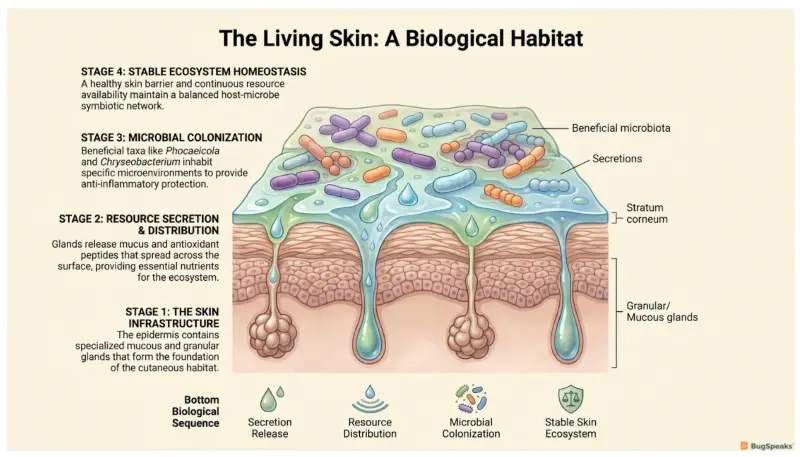
The outer layer of your skin is a living habitat that supports trillions of helpful microscopic organisms. This outermost skin layer is called the stratum corneum, and it acts like a busy forest floor where different tiny tenants make their homesSmith et al. (2023). These microscopic residents, including bacteria, fungi, and viruses, make up what we call the skin microbiomeSmith et al. (2025). Just like wild animals living in a natural forest, these tiny organisms are not dangerous invaders at all; instead, they are friendly, supportive neighbors that work hard to keep our skin healthy, strong, and protected from outside dangers.
To help these microscopic tenants survive, our bodies naturally secrete special habitat resources across the different microclimates of our skin. These helpful resources include sebum, which is a natural skin oil, and sweat, which functions as a diluted mineral solution Smith et al. (2023). Oily areas like your face have lots of oil glands, while dry areas like your forearms have much less, which creates different types of cozy neighborhoodsSmith et al. (2025). Each specific skin neighborhood selects for its own specialized microbial tenants that are perfectly suited to live there, comfortably using those exact natural resources to grow and thrive.
When these tiny residents are happy and balanced, they cooperate with our bodies to build a strong physical and biological barrier against bad germs. This healthy state is called homeostasis, and it means the skin habitat is peaceful and working perfectlySmith et al. (2023). However, if the natural resources change too much or if the habitat gets disrupted, some of these friendly residents can become physiologically stressed, leading to an imbalance called dysbiosisSmith et al. (2025). Keeping our skin habitat happy, stable, and cozy is the absolute ultimate secret to having clear, soft, and highly healthy skin every day.
What is the solar heat storm and how does it affect our skin habitat?
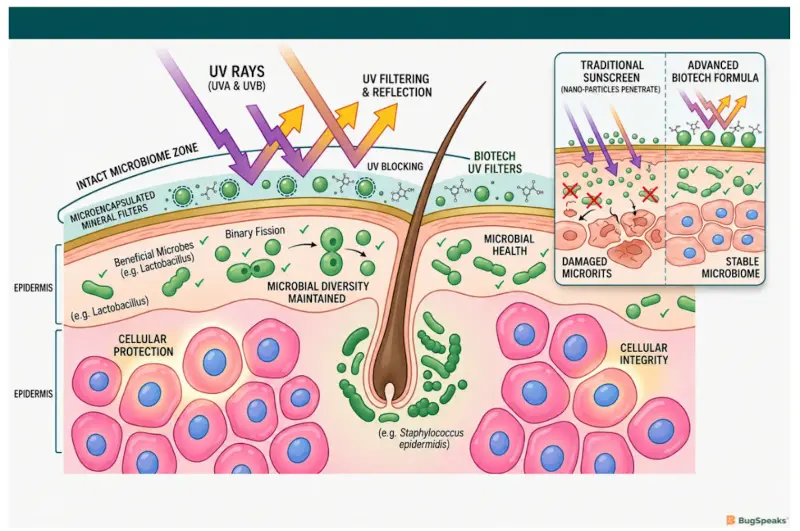
Sunlight acts as an environmental stressor that can damage our skin and disrupt its natural balance. When we go outside, the sun sends down powerful light energy called ultraviolet radiation (UVR)Smith et al. (2023). This radiation is like a harsh weather storm hitting our peaceful skin habitat every single day. The solar storm is made of two main types of light: ultraviolet A (UVA), which has long rays that go deep, and ultraviolet B (UVB), which has short, energetic raysBurns et al. (2019). Both types of light can make our skin habitat very hot, highly uncomfortable, and deeply difficult to manage.
When these solar rays hit the skin, they are absorbed by special light-sensitive parts called chromophoresSmith et al. (2023). This absorption is like a lightning strike that instantly creates dangerous, hyperactive chemical molecules known as reactive oxygen species (ROS)Burns et al. (2019). These hyperactive molecules act like tiny forest fires, causing cellular stress that damages vital things like deoxyribonucleic acid (DNA)Smith et al. (2025). If these fires are not controlled, they can hurt both the skin cells and our friendly microscopic residents, making it extremely hard for the entire delicate habitat to stay healthy, strong, and clean.
Different tiny residents on our skin react in unique ways to this intense solar heat storm. For example, some friendly bacteria can protect themselves by using special sunscreen pigments, while other tenants are very sensitive to the heat and can easily perishSmith et al. (2023). This means a solar storm can unevenly change who lives in our skin habitat, shifting the balance of our microscopic neighborhoodBurns et al. (2019). To prevent this serious imbalance and protect our delicate skin from ultraviolet rays, we need to put up a special temporary protective coating that blocks the harsh weather completely and keeps the tenants safe.
Does applying sunscreen damage our friendly microscopic residents?
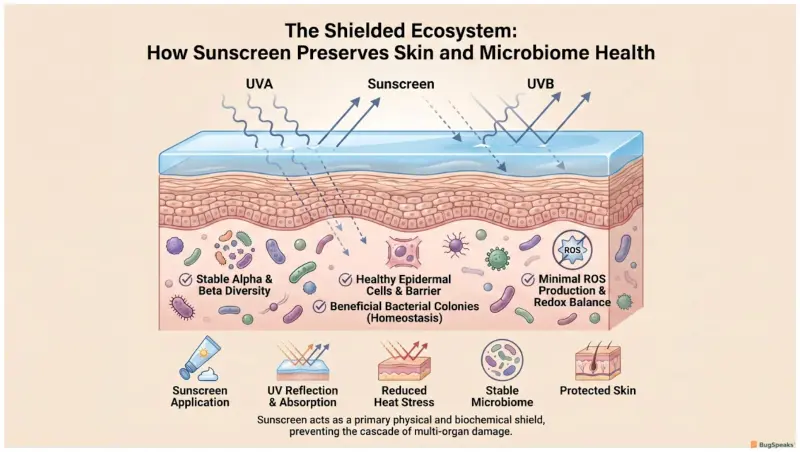
Applying sunscreen acts as a temporary protective coating that keeps both our skin cells and our beneficial microscopic residents safe from dangerous solar radiation. Scientific studies show that when you apply this protective layer, it blocks the ultraviolet rays without wiping out your friendly commensal bacteriaSmith et al. (2025). This coating acts like a big umbrella over the forest floor, cooling down the living habitat and shielding the tenants. It provides a high sun protective factor (SPF) to prevent burns, but it does not act like a germ killer that hurts or destroys the microscopic residents that live underneath it.
Some people worry that putting a thick coating on their skin might disturb the variety of microscopic residents. However, clinical testing has measured the alpha diversity, which is the total number of different types of microscopic residents living in a single areaSmith et al. (2025). The detailed scientific results show that the vital alpha diversity remains highly stable, safe, and healthy after applying this protective coating. This means that the friendly neighborhood stays diverse and robust under the umbrella, keeping all the different types of helpful microscopic tenants alive, happy, and well-balanced throughout the entire day of sun protection.
Scientists also look at beta diversity, which compares the overall microbial community structure between different people or different times. When we apply the protective coating, the beta diversity does not shift or drift, showing that the overall layout of our microscopic city remains completely unchangedSmith et al. (2025). If some active ingredients do touch the microbes, they might only cause a gentle, temporary growth pause called bacteriostasisSmith et al. (2023). This gentle, temporary growth pause is completely safe and healthy, helping our tiny microscopic residents rest very comfortably and safely until the protective coating is naturally washed away by us.
How do different active ingredients act as habitat modifiers?
Different sunscreen active ingredients protect your skin in their own special ways depending on how they are formulated. There are two main groups of filters used to block the sun: mineral filters, called inorganic UV filters, and chemical filters, called organic UV filtersSmith et al. (2023). Mineral filters act like physical shields on top of your skin to reflect and bounce light away, while chemical filters act like sponges that absorb heat. Both groups change the skin surface layer in different ways, but mineral filters are generally known to be very gentle, clean, and highly compatible with our friendly microscopic residents.
The two most popular mineral shields are titanium dioxide and zinc oxideSmith et al. (2023). In careful clinical trials, scientists applied these active minerals directly to friendly bacteria like Staphylococcus epidermidis and Micrococcus luteus to see if they would get hurt or lose their homes. The exciting results showed no loss of cell viability at all, meaning these mineral shields are completely safe and do not kill our helpful microscopic residentsSmith et al. (2025). These mineral shields block the solar heat storm perfectly while leaving the core microscopic neighborhood fully intact, peaceful, and working just as beautifully as before.
However, because liquid sunscreens contain water, they must include preservatives to stop bad mold and bacteria from growing inside the bottle. These preservatives are strong cleaners that can sometimes hurt our friendly microscopic residentsSmith et al. (2025). While the mineral active ingredients themselves are completely safe, the extra ingredients in some commercial formulations can act as harsh habitat modifiersSmith et al. (2023). That is why choosing simple, clean, and preservative-free sun protection products is a truly great way to protect your delicate skin from the sun without disturbing your tiny helpful friends who live there every single day.
How can we protect our skin while keeping our microscopic residents happy?
We can protect our skin and keep our microscopic residents happy by choosing gentle, mineral-based sunscreens that match our skin's natural habitat biology. This approach ensures we maintain homeostasis, the peaceful state of balance in which all our tiny microscopic residents work together perfectly (Smith et al., 2023). By avoiding harsh, irritating chemical habitat modifiers, we also prevent dysbiosis, which is a messy, uncomfortable imbalance that can lead to common skin problems like redness, dryness, or severe irritationSmith et al. (2025). A happy skin habitat means our microscopic tenants can continue doing their important daily work of protecting our bodies.
These friendly microscopic residents work hard behind the scenes to keep our skin healthy, clean, and safe from bad germs. For example, some helpful commensal bacteria on our skin produce natural shields called antimicrobial peptides (AMPs) to fight off harmful invaders (Smith et al., 2023). Others can even release a special protective compound called 6-N-hydroxyaminopurine that helps protect our skin from developing dangerous tumors when we are out in the sunSmith et al. (2023).
By understanding our skin as a living habitat, we can make healthier choices for our daily sun care routines. Instead of using products that act like harsh weather storms or toxic cleaners, we can choose gentle mineral protective coatings. Next-generation sunscreens are being developed specifically to work in harmony with our friendly microscopic residentsSmith et al. (2023). When we take active care of our tiny microscopic tenants, they will take excellent care of us in return, keeping our skin habitat strong and healthy under the bright sun for many years to come.
-Varsha V
Visualize the process- https://youtu.be/zjGb5TPWOKw
Reference
Yuan, Z., Fei, J., Li, S., Wu, Y., & Liu, P. (2025). From Compensation to Collapse: UVB-Driven Disruption of Host-Microbiota Homeostasis Exacerbates Amphibian Ecological Risk. Animals : an open access journal from MDPI, 15(22), 3236. https://doi.org/10.3390/ani15223236
Smith, M. L., Rillaer, T. V., Willmott, T., Lebeer, S., Souza, A., O'Neill, C. A., & McBain, A. J. (2026). The human skin microbiome remains unchanged after 24 h of sunscreen application. Applied and environmental microbiology, 92(1), e0147625. https://doi.org/10.1128/aem.01476-25
Burns, E. M., Ahmed, H., Isedeh, P. N., Kohli, I., Van Der Pol, W., Shaheen, A., Muzaffar, A. F., Al-Sadek, C., Foy, T. M., Abdelgawwad, M. S., Huda, S., Lim, H. W., Hamzavi, I., Bae, S., Morrow, C. D., Elmets, C. A., & Yusuf, N. (2019). Ultraviolet radiation, both UVA and UVB, influences the composition of the skin microbiome. Experimental dermatology, 28(2), 136–141. https://doi.org/10.1111/exd.13854
Smith ML, O’Neill CA, Dickinson MR, Chavan B and McBain AJ (2023) Exploring associations between skin, the dermal microbiome, and ultraviolet radiation: advancing possibilities for next-generation sunscreens. Front. Microbiomes 2:1102315. doi: 10.3389/frmbi.2023.1102315