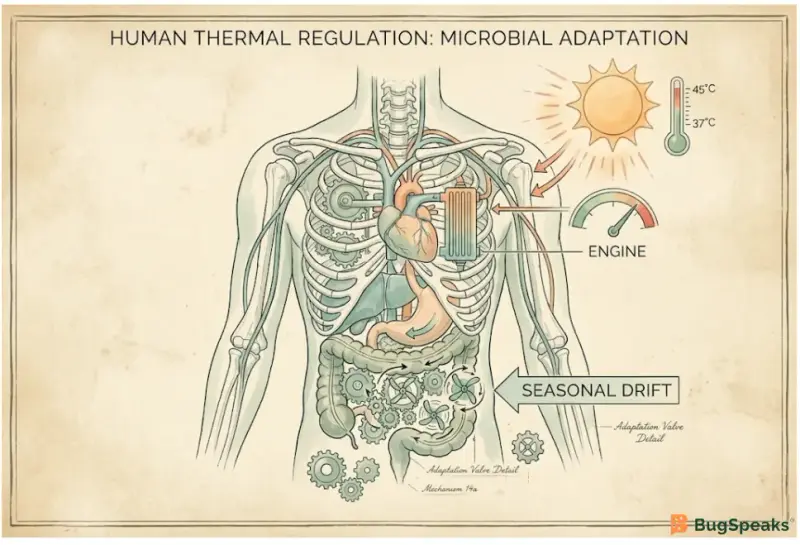
Do seasonal cycles force a total system update?
Yes, your gut’s internal layout and its microscopic workforce undergo a massive, automated update whenever the seasons shift, requiring the Intestines to perform a System-Wide Recalibration to stay efficient. Just as a large city’s power grid must change how it distributes energy during a record-breaking heatwave to avoid a blackout, your body must recalibrate its internal environment based on the external thermal load. This process is not a choice; it is a biological necessity designed to keep your internal "Engine" from overheating as ambient temperatures in the Indian grid climb from 37℃ toward 45℃ Cocomazzi et al. (2025). During the peak of summer, your gut experiences a phenomenon known as Seasonal Drift, where the specific types of bacteria in your system shift their density to help the body manage the extra heat.
In the Indian biological grid, this drift is specifically tuned to your environment. It results in a surge of Actinobacteria and a depletion of Bacteroidetes, causing the Firmicutes-to-Bacteroidetes Ratio to reach a much higher baseline than it does in the winter. Think of this like your computer's cooling fans spinning faster when you run heavy software, the system is working harder to keep things stable and avoid a crash. If these natural updates aren't factored into your health audit, your data integrity is permanently compromised. Because the baseline architecture "drifts" so significantly, a health plan or diet that works in the winter might produce a completely different result in the summer.
To manage this, experts in 2026 use Longitudinal Calibration to compare your current summer performance against your own previous summer data. This ensures the system is audited against its own seasonal benchmarks rather than a static, year-round average that doesn't account for the heat Cocomazzi et al. (2025). By understanding your specific Thermal Grid, you can see that what looks like a "bad" change in your bacteria might actually just be your body successfully updating its software to survive the sun.
How does losing water impact your engine’s efficiency?
Coolant Depletion caused by summer dehydration triggers a collapse in the gut’s lubrication, creating a High-Friction Environment that physically breaks down your internal barriers. The Intestines function like a high-performance engine that requires Essential Coolant (water) to maintain a thick, slippery layer of protective mucus. This mucosal lining acts as a shield, protecting your sensitive Intestinal Epithelial Cells from friction and harmful pathogens Wang et al. (2026). When you run low on this coolant due to the intense summer heat, the lubrication literally "evaporates" or thins out, leaving the engine core exposed and vulnerable to "biological grinding."
Without this liquid buffer, the beneficial bacteria that maintain your system, like Akkermansia, are starved of their operational fuel. These specialized microbes usually eat the sugars in the mucus to stay alive, but when the mucus dries out, they cannot perform their maintenance duties. This unmitigated thermal overload initiates an oxidative stress cascade that targets the Tight Junctions, the microscopic "seals" that keep your gut wall airtight. This structural failure leads to Hyperpermeability, or "Leaky Gut," where the engine’s containment zone is breached. Hostile agents and toxins can then leak into your bloodstream, causing systemic inflammation and a total mechanical breakdown of the barrier wall Wang et al. (2026). Maintaining a steady supply of water is not just about thirst; it is about keeping the "Cooling System" of your Intestines lubricated enough to avoid a total hardware crash.

Can the system use a 'Heat-Sink' to prevent a meltdown?
Yes, the system utilizes a Molecular Heat-Sink manufactured from nutrients in your diet to reinforce the intestinal firewall against extreme summer heat. When the Thermal Grid becomes too intense, specialized microbial units in your Intestines process an amino acid called tryptophan into high-performance chemicals known as Indoles. These Indoles act as "Master Shield Keys" that plug into a master sensor called the Aryl Hydrocarbon Receptor (AhR) on your cells Wang et al. (2026). Think of this like a car’s heat-sink that absorbs excess heat to prevent the engine block from melting or warping.
By activating this receptor, your system triggers the production of Interleukin-22 (IL-22), a signaling protein that acts like an emergency repair crew. Interleukin-22 (IL-22) physically repairs your Tight Junctions and reinforces your mucosal "insulation" faster than the summer heat can degrade it. This Molecular Heat-Sink ensures that even during a thermal surge, your engine core remains protected from the "melting" caused by oxidative stress. Without this Indole-based shielding, your intestinal lining would suffer irreversible structural decay, leading to long-term system instability and a permanent drop in your body's energy levels. The ability of your gut to build these heat-sinks depends entirely on whether you are providing the right raw materials, like fiber and specific amino acids, to your microbial workforce Wang et al. (2026).
Is summer street food a form of high-risk external code?
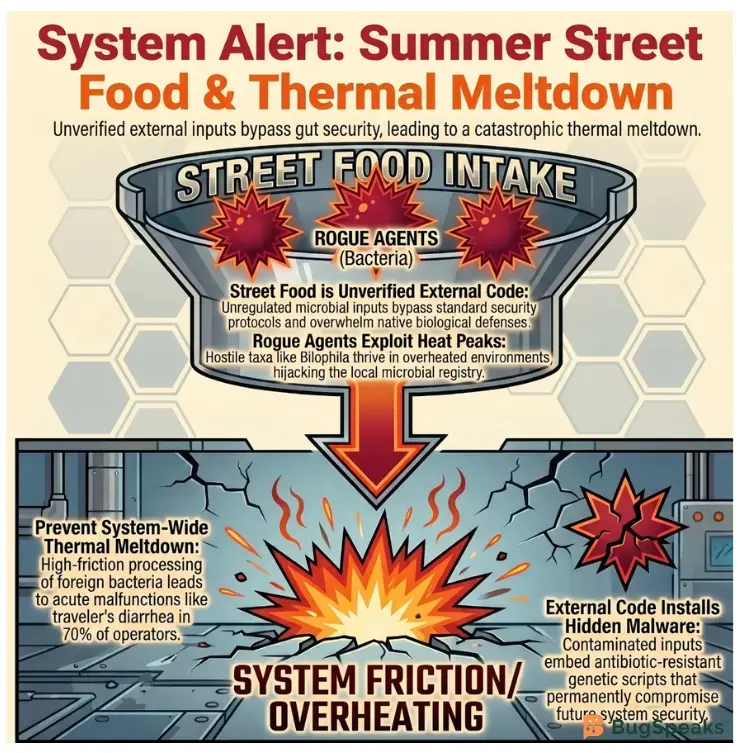
Yes, unregulated microbial inputs like street food function as "High-Risk External Code" that introduces severe Biological Friction and opportunistic germs to your system. During the summer, your internal security is already under immense pressure from the heat, and downloading unverified nutritional data into your processor can cause a massive contamination event. This External Contamination spikes the operational temperature of your Intestines, often resulting in Transient Dysbiosis, such as acute traveler's diarrhea Wang et al. (2026). Because the gut is already hot, these foreign bugs can multiply much faster than they would in the winter, leading to a rapid system crash.
This contamination also jams your Thermal Valve, the biological "Thermostat" that regulates your body's temperature through the Bile Acids pool. Normally, the liver produces these Bile Acids (like engine oil), and specialized microbial workers perform a Deconjugation Protocol to turn them into cooling signals. This transforms them into secondary acids that activate sensors like the TGR5 receptor, telling your body to switch to "Active Cooling." If Rogue Agents from contaminated food take over, the Thermal Valve gets stuck in the "Open" position, causing Bile Acids to become corrosive rather than regulatory. This leads to Bile Acid Malabsorption, where the engine loses its ability to stay cool and suffers from high-friction damage. Furthermore, this high-risk code can install ARGs (Antibiotic Resistance Genes), which act like permanent "malware" that makes your system much harder to fix in the future if you ever get sick Wang et al. (2026).
Does your ethnic hardware determine your heat tolerance?
Yes, your genetic background and ancestral "Programming" establish your gut's Cooling Protocols and determine how well your Intestines tolerate extreme heat. Different human populations possess unique Ethnic Hardware genetic architectures that filter and select specific microbial communities based on geographic history Liang et al. (2026). Think of this as the "Factory Settings" of your body. If your ancestors lived in a tropical climate for thousands of years, your system is likely pre-programmed with high-efficiency cooling fans.
For instance, genetic sensors like TLR4 (Toll-like Receptor 4) and FUT2 (Fucosyltransferase 2) act as the "Security Hardware" that manages how your gut interacts with the environment. In tropical regions like India, these genes have adapted to favor a higher concentration of Bacteroides and Bifidobacterium, which synthesize Short-Chain Fatty Acids (SCFAs) like butyrate Liang et al. (2026). These Short-Chain Fatty Acids (SCFAs) act as high-performance "Molecular Coolants" that lower internal inflammation and strengthen your intestinal walls. This means that your ability to dissipate heat and survive the summer grid is fundamentally determined by the "Build" of your inherited Ethnic Hardware. If you move to a new climate, your hardware might struggle to adjust because it is following a different set of Cooling Protocols than the local environment requires Liang et al. (2026).
Table 1: Regional Heat-Resistance Markers
How can you prevent a total systemic meltdown?
Preventing a meltdown requires proactive maintenance of your Essential Coolant and the use of Biological Patching to stabilize your gut environment under heat stress. When you are operating near your thermal limits 45℃, your gut relies on System Cooling through targeted nutrition like plant-based Polyphenols. These compounds fuel the production of Short-Chain Fatty Acids (SCFAs), which act as the raw materials your workforce needs to rebuild damaged heat shields and keep your intestinal walls strong Liang et al. (2026). Without these inputs, the engine simply runs too hot for too long, leading to a permanent crash.
Environmental monitoring is also critical for preventing a system crash. Vitamin D, synthesized from regulated sunlight exposure, acts as a systemic regulator that keeps your Tight Junctions closed and prevents Hyperpermeability Cocomazzi et al. (2025). If you experience a "Security Breach" from unverified food, using Biological Patching such as multi-strain Bifidobacterium interventions can help override the imbalance and restore Eubiosis. By supplying the Intestines with enough water, fiber, and sunlight, you provide the exact raw materials the system requires to stay cool and maintain 100% uptime throughout the hottest months of the year Wang et al. (2026).
Visualize the process- https://youtu.be/wXcaD8FN0gU
Reference
Cocomazzi, G., Panebianco, C., Vallelunga, A., De Ruvo, D., Del Pup, L., Smeazzetto, S., Antinori, M., Chimienti, V., Maggio, G., Finocchiaro, C., Contu, V., & Pazienza, V. (2025). The Influence of Seasonal Variations in Clinical Trials Based on Gut Microbiota Studies. Microorganisms, 13(10), 2386. https://doi.org/10.3390/microorganisms13102386
https://www.tandfonline.com/doi/full/10.1080/19490976.2025.2476563
Liang, L., Zhang, X., & Nian, X. (2026). The ethnicity and gut microbiota hypothesis: analyzing multifactorial interactions and their health implications. Frontiers in microbiology, 17, 1765775. https://doi.org/10.3389/fmicb.2026.1765775
https://www.frontiersin.org/journals/nutrition/articles/10.3389/fnut.2026.1724829/full