# The Science Behind Sugar and Skin: What You Need to Know
Author: Neha Rao
Author URL: https://www.bugspeaks.com/blog/author/neha-rao
Published: 2026-07-03
Category: skin health
Category URL: https://www.bugspeaks.com/blog/category/skin-health
Meta Title: High Sugar and Skin Effects Explained | BugSpeaks
Meta Description: Discover how high sugar affects skin overnight, causing oiliness, dryness, and inflammation. Learn the science behind sugar and skin health today.
Tags: Skin Health, Sugary treat, Dry Skin, Oily Skin
Tag URLs: Skin Health (https://www.bugspeaks.com/blog/tag/skin-health), Sugary treat (https://www.bugspeaks.com/blog/tag/sugary-treat), Dry Skin (https://www.bugspeaks.com/blog/tag/dry-skin), Oily Skin (https://www.bugspeaks.com/blog/tag/oily-skin)
URL: https://www.bugspeaks.com/blog/sugar-skin-health-dry-oily-skin
## Why does eating sweet treats at night make your body work so hard while you sleep?
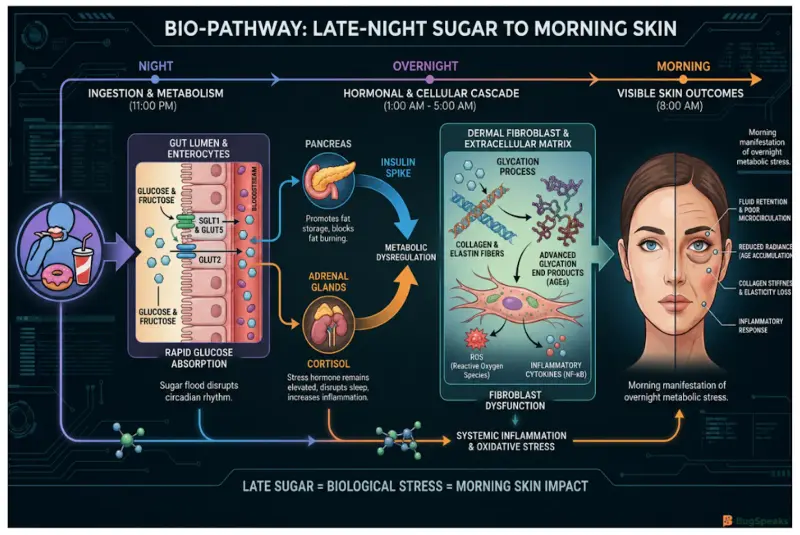
Eating sweet treats at night forces your body to deal with a massive rush of sugar during your critical sleep window. When you eat a high-sugar dessert, it acts as an incoming metabolic load that your digestive system must immediately process [Ochoa (2014)](https://doi.org/10.1007/s00394-014-0776-y). This sudden arrival of sugar causes your blood sugar levels to shoot up quickly, which forces your pancreas to release a large amount of a hormone called insulin to clear it out [Kim (2017)](https://doi.org/10.5021/ad.2017.29.1.20). Because this happens right before bed, your body must spend its entire night shift working overtime to manage this heavy load instead of resting [Tan (2020)](https://doi.org/10.1038/s41586-020-2199-7).
This surge of glucose (the primary sugar molecule in your body) in your bloodstream triggers a secondary hormonal spike overnight. As insulin works to bring your sugar levels down, your liver is stimulated to release another chemical called Insulin-Like Growth Factor-1 (IGF-1) [Kim (2017)](https://doi.org/10.5021/ad.2017.29.1.20). Think of this as your body's overnight processing crew calling for extra heavy machinery to handle the sudden metabolic load. Because the system is flooded with sugar during the [sleep window](https://www.bugspeaks.com/blog/microbiome-cream-skin-health), this processing demand remains extremely high all night long, forcing these powerful growth hormones to stay active when they should be sleeping [Tan (2020)](https://doi.org/10.1038/s41586-020-2199-7). This hormonal activity changes how your body functions.
This heavy overnight work represents the start of the Biological Overnight Processing System in your body. While you sleep quietly, your body is actively processing the consequences of what you ate during the day. In this situation, a high-sugar meal is your incoming metabolic load, and your sleep time serves as the primary processing window. The resulting hormonal spikes represent a massive overnight processing demand, which generates unwanted biological byproducts. Just like a factory that runs all night, the skin acts as the visible output surface, where your morning face becomes the final printed report of this intense overnight activity [Kim (2017)](https://doi.org/10.5021/ad.2017.29.1.20).
**Biological Stage**
**System Component**
**Conceptual Translation**
High-Sugar Dinner
Incoming Metabolic Load
The heavy material shipment that enters the factory floor at sunset.
Overnight Sleep
Processing Window
The night shift where the factory crew must handle the day's shipments.
Insulin & IGF-1 Spikes
Processing Demand
The loud sirens calling for extra machines to work on the sweet load.
Inflammation & Sebum
Accumulated Byproducts
The chemical fumes, toxic sparks, and messy oils are made during processing.
Your Outer Skin
Visible Output Surface
The display board of the factory shows its internal operational state.
Your Morning Face
Final Printed Report
The final paper slip that slides out of the printer at sunrise.
**Glucose**\- The simple sugar found in food that your body uses for energy.
**Insulin**\- A hormone made by your pancreas that acts like a key to help sugar enter your cells.
**Insulin-Like Growth Factor-1 (IGF-1)**\- A powerful hormone triggered by insulin that tells cells to grow and divide quickly.
## How does a sugar-heavy night cause your skin to become so oily?
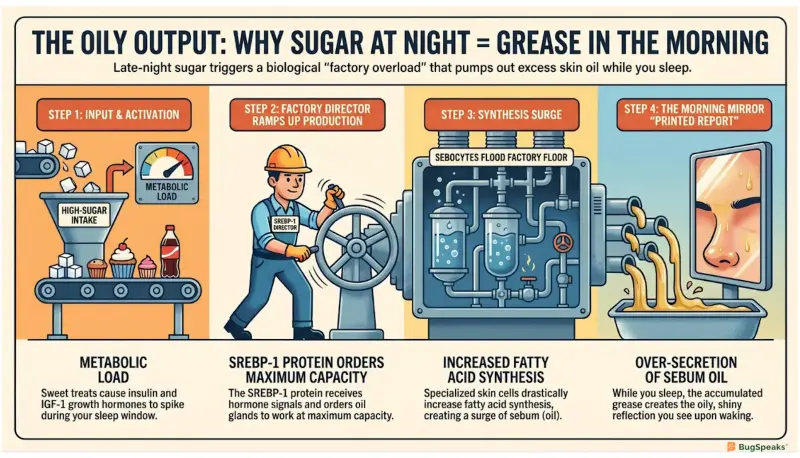
A sugar-heavy night makes your skin oily by triggering a [biological signal](https://www.bugspeaks.com/blog/circadianrhythm-guthealth-gutmicrobiome/) that forces your skin's oil-making factories to produce excessive amounts of grease while you sleep. When you sleep, high levels of Insulin-Like Growth Factor-1 (IGF-1) in your blood travel straight to your skin's sebaceous glands. These glands contain specialized oil cells called sebocytes that are responsible for creating your skin's natural moisture [Kim (2017)](https://doi.org/10.5021/ad.2017.29.1.20). Unfortunately, the overnight growth hormone signal acts like a master switch that turns these glands on full blast, causing them to work at maximum capacity throughout your sleep, which dramatically alters your appearance [Kim (2017)](https://doi.org/10.5021/ad.2017.29.1.20).
This process forces the oil cells to generate a sticky substance called sebum, which is your skin's natural oil. Inside these cells, a special protein helper named Sterol Regulatory Element-Binding Protein-1 (SREBP-1) acts as the factory director, receiving the sugar-fueled hormone messages and immediately ordering the cells to ramp up oil production [Kim (2017)](https://doi.org/10.5021/ad.2017.29.1.20). Think of this as your body's overnight processing crew calling for extra support to handle the sudden metabolic load. Because the system is flooded with sugar during the sleep window, this processing demand remains extremely high all night long, forcing these glands to stay active and make you oily [Kim (2017)](https://doi.org/10.5021/ad.2017.29.1.20).
This sudden surge of sebum is the direct result of what your body processed overnight rather than what you ate in the morning. When you wake up, your skin serves as the visible output surface of this complex system. In this situation, your morning face is the final printed report showing that the oil glands worked at high speed all night long. The accumulated grease on your forehead and nose is actually the physical byproduct of your body trying to process yesterday's late-night high-sugar meal while you were sleeping, leaving a shiny output in your morning mirror [Kim (2017)](https://doi.org/10.5021/ad.2017.29.1.20).
**Sebocytes**\- Specialized cells in your skin's oil glands that manufacture oil to keep your skin moist.
**Sebum**\- The oily, waxy substance produced by sebocytes that coats and protects your skin.
**SREBP-1 (Sterol Regulatory Element-Binding Protein-1)**\- A protein helper that acts as a factory director to control oil making inside sebocytes.
## How does eating too much sugar at night make your skin cells run out of energy?
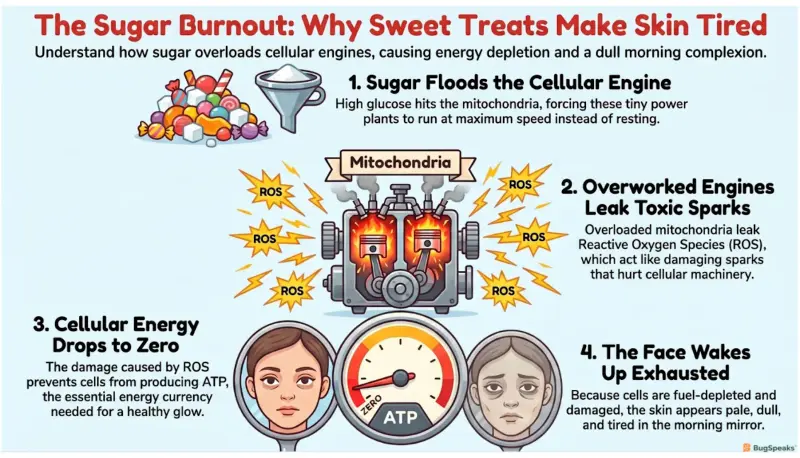
Eating too much sugar at night makes your [skin cells run out of energy](https://www.bugspeaks.com/blog/diet-for-healthy-skin-nourish-your-skin-from-within) by overloading their power plants and causing them to crash while you sleep. Inside your skin cells, tiny power generators called mitochondria are responsible for turning food into cellular power [Natarelli (2024)](https://doi.org/10.3390/ijms25063303). When you flood your body with a high-sugar meal right before bed, these microscopic power plants are hit with a massive incoming metabolic load. Instead of entering a slow resting state during your sleep, they are forced to run at maximum speed to process all the incoming sugar, causing them to overheat and burn out [Natarelli (2024)](https://doi.org/10.3390/ijms25063303).
Normally, healthy generators make a special energy currency called Adenosine Triphosphate (ATP) to keep your skin strong and healthy [Natarelli (2024)](https://doi.org/10.3390/ijms25063303). However, when they are overloaded by sugar all night, they start to leak harmful, unstable oxygen scraps called Reactive Oxygen Species (ROS) [Natarelli (2024)](https://doi.org/10.3390/ijms25063303). Think of these as toxic sparks flying out of an overheated engine that is running too fast. In this biological overnight processing system, the accumulated byproducts of these toxic sparks damage your cells machinery, which completely prevents them from making enough energy and leaves your cells feeling exhausted and depleted [Natarelli (2024)](https://doi.org/10.3390/ijms25063303). This leads to a severe energy deficit.
This loss of power represents the visible report of your Biological Overnight Processing System. When you wake up, your skin serves as the output surface showing the damage of this overnight metabolic load. Because your mitochondria spent their sleeping processing window fighting sugar instead of renewing, your morning face is the final printed report showing that your skin ran out of fuel while you slept. Instead of a bright, healthy look, the lack of energy shows up as a pale, dull, and tired complexion in your morning mirror because your cells are simply too exhausted to glow and work [Natarelli (2024)](https://doi.org/10.3390/ijms25063303).
**System Metric**
**Normal Night Shift (Balanced Load)**
**High-Sugar Night Shift (Overloaded)**
Processing Demand
Low, steady maintenance [Ochoa (2014)](https://doi.org/10.1007/s00394-014-0776-y).
Overtime operation with high hormonal sirens [Kim (2017)](https://doi.org/10.5021/ad.2017.29.1.20).
Byproduct Release
Clean operations, no soot [Natarelli (2024)](https://doi.org/10.3390/ijms25063303).
Excess sebum grease, toxic sparks (ROS), and inflammatory water.
Wall Integrity
Bricks (keratinocytes) tightly glued with ZO-1 [Okano (2016)](https://doi.org/10.1371/journal.pone.0166215).
Uneven bricks with wide gaps and heavy water leaks (TEWL).
Visible Morning Output
Smooth, rested, matte complexion.
Oily, dry, flaky, red, and swollen face.
**Mitochondria**\- Tiny power generators inside your cells that turn food into energy.
**Adenosine Triphosphate (ATP)**\- The energy currency molecule that your cells use to do all their daily work.
**Reactive Oxygen Species (ROS)**\- Unstable oxygen scraps or sparks that can damage your cells if too many build up.
## Why does your skin feel so dry and flaky after eating sugar before bed?
Eating sugar before bed makes your skin feel dry and flaky by breaking your skin's protective moisture shield and letting water escape overnight. Your skin is made of layers of skin cells called keratinocytes that act like bricks in a wall to keep moisture locked inside [Okano (2016)](https://doi.org/10.1371/journal.pone.0166215). However, when blood sugar is high while you sleep, it disrupts how these cells grow and line up properly. This interruption means the bricks in your skin's defensive wall are built poorly and unevenly, which leaves big gaps in your protective barrier throughout the sleep window, letting crucial hydration out [Okano (2016)](https://doi.org/10.1371/journal.pone.0166215).
Normally, your skin cells are held tightly together by a microscopic glue called Tight Junction Protein-1 (ZO-1), which seals the gaps between cells [Okano (2016)](https://doi.org/10.1371/journal.pone.0166215). But when your body is dealing with a high sugar intake, this glue becomes messy, loose, and poorly distributed, which breaks the tight seal. This structural damage leads to a massive rise in Transepidermal Water Loss (TEWL), meaning water leaks out of your skin and evaporates into the air while you sleep. Think of it as a leaky pipeline letting your skin's precious water resources escape overnight, leaving your cells extremely thirsty and dry [Okano (2016)](https://doi.org/10.1371/journal.pone.0166215).
This moisture loss is a direct result of what your body processed overnight rather than what you did that morning. When you wake up, your skin acts as the visible output surface of this overnight system. In this system, your dry, flaky morning face is the final printed report showing that your skin's protective water barrier leaked all night long. The dry patches and peeling skin on your cheeks are the physical byproducts of your body struggling to process yesterday's late-night high-sugar meal while you were sleeping, leaving you with a parched and damaged skin surface to touch [Okano (2016)](https://doi.org/10.1371/journal.pone.0166215).
**Keratinocytes**\- The brick-like skin cells that form your outer protective barrier wall.
**Tight Junction Protein-1 (ZO-1)**\- A molecular glue that tightly seals the spaces between your skin cells to block leaks.
**Transepidermal Water Loss (TEWL)**\- The process of water escaping and evaporating from your skin's surface.
## **W** hy does eating a sugary meal at night make your face look red and swollen the next morning?
Eating a sugary meal at night makes your face look red and swollen by triggering a wave of defense signals that cause your skin to swell while you sleep. When you eat a large amount of sugar, it causes systemic inflammation, which is a full-body irritation that travels through your blood [Ciaffi (2025)](https://doi.org/10.3390/nu17183012). Your body treats the sudden rush of sugar like an invading threat, activating your immune system's alarm bells. This full-body alarm continues to sound all night while you sleep, keeping your body's defense forces highly active during your resting hours instead of allowing your tissues to repair and heal [Awad (2025)](https://doi.org/10.1002/fsn3.70795).
As this full-body alarm continues to ring overnight, your immune cells release specialized warning proteins called cytokines [Awad (2025)](https://doi.org/10.1002/fsn3.70795). One of the most powerful and active alarm proteins is called Interleukin-1β (IL-1β), which acts like a biological siren, telling blood vessels to open up and rush defense fluids to your face [Awad (2025)](https://doi.org/10.1002/fsn3.70795). Think of this as your body's overnight processing crew accidentally flooding the factory floor with emergency response fluids due to the high metabolic load. This constant overnight flooding causes blood vessels to swell up, making your face look red, puffy, and irritated while you sleep [Ciaffi (2025)](https://doi.org/10.3390/nu17183012).
This puffy appearance is a direct result of what your body processed overnight rather than anything you did that morning. When you wake up, your skin acts as the visible output surface, showing the signs of this overnight system. In this system, your red and swollen morning face is the final printed report showing that your body spent the night fighting inflammation. The puffiness under your eyes is the physical byproduct of your body trying to process yesterday's late-night high-sugar meal while you were sleeping, leaving a swollen and puffy output in your morning mirror to inspect closely [Ciaffi (2025)](https://doi.org/10.3390/nu17183012).
**Systemic Inflammation**\- A full-body irritation and redness triggered when your immune system is set to high alarm.
**Cytokines**\- Tiny chemical alarm proteins released by immune cells to coordinate your body's defense response.
**Interleukin-1β (IL-1β)**\- A powerful cytokine alarm protein that acts like a siren to make blood vessels swell.
Visualize the process- [https://youtu.be/n2CRvyL\_V7Q](https://youtu.be/n2CRvyL_V7Q)
### Reference
Awad, C., Rubilar, P., Hirmas-Adauy, M., Iglesias, V., Muñoz, M. P., Retamal, M. A., Carvajal, C., Dadvand, P., & Lassale, C. (2025). Ultra-Processed Foods and Markers of Systemic Inflammation in Children. _Food science & nutrition_, _13_(9), e70795. [https://doi.org/10.1002/fsn3.70795](https://doi.org/10.1002/fsn3.70795)
Ciaffi, J., Mancarella, L., Ripamonti, C., Brusi, V., Pignatti, F., Lisi, L., & Ursini, F. (2025). Ultra-Processed Food Consumption and Systemic Inflammatory Biomarkers: A Scoping Review. _Nutrients_, _17_(18), 3012. [https://doi.org/10.3390/nu17183012](https://doi.org/10.3390/nu17183012)
Kim, H., Moon, S. Y., Sohn, M. Y., & Lee, W. J. (2017). Insulin-Like Growth Factor-1 Increases the Expression of Inflammatory Biomarkers and Sebum Production in Cultured Sebocytes. _Annals of dermatology_, _29_(1), 20–25. [https://doi.org/10.5021/ad.2017.29.1.20](https://doi.org/10.5021/ad.2017.29.1.20)
Okano, J., Kojima, H., Katagi, M., Nakagawa, T., Nakae, Y., Terashima, T., Kurakane, T., Kubota, M., Maegawa, H., & Udagawa, J. (2016). Hyperglycemia Induces Skin Barrier Dysfunctions with Impairment of Epidermal Integrity in Non-Wounded Skin of Type 1 Diabetic Mice. _PloS one_, _11_(11), e0166215. [https://doi.org/10.1371/journal.pone.0166215](https://doi.org/10.1371/journal.pone.0166215)
Ochoa, M., Lallès, J. P., Malbert, C. H., & Val-Laillet, D. (2015). Dietary sugars: their detection by the gut-brain axis and their peripheral and central effects in health and diseases. _European journal of nutrition_, _54_(1), 1–24. [https://doi.org/10.1007/s00394-014-0776-y](https://doi.org/10.1007/s00394-014-0776-y)
Tan, H. E., Sisti, A. C., Jin, H., Vignovich, M., Villavicencio, M., Tsang, K. S., Goffer, Y., & Zuker, C. S. (2020). The gut-brain axis mediates sugar preference. _Nature_, _580_(7804), 511–516. [https://doi.org/10.1038/s41586-020-2199-7](https://doi.org/10.1038/s41586-020-2199-7)
Natarelli, N., Gahoonia, N., Aflatooni, S., Bhatia, S., & Sivamani, R. K. (2024). Dermatologic Manifestations of Mitochondrial Dysfunction: A Review of the Literature. _International journal of molecular sciences_, _25_(6), 3303. [https://doi.org/10.3390/ijms25063303](https://doi.org/10.3390/ijms25063303)
## FAQs
Q: Can washing my face in the morning erase the effects of a high-sugar night?
A: No, washing your face in the morning cannot erase the effects of a high-sugar night because those effects are created deep inside your cells overnight. While washing can clean away the excess sebum grease on the surface, it cannot repair the structural gaps in your cell wall, restore the lost water from Transepidermal Water Loss (TEWL), or reverse the internal systemic inflammation Okano (2016). Your morning face is a reflection of a finished overnight manufacturing process, not a surface-level stain.
Q: Why does sugar affect my face more when I eat it at night compared to the morning?
A: Sugar affects your face more at night because your sleep window is your body's primary repair and restoration shift. During the day, your body is busy with movement and active tasks. When you sleep, your cells normally focus on fixing cellular damage, replenishing energy (ATP), and building a tight skin barrier Natarelli (2024). Flooding the system with sugar before bed forces your body to abandon its normal repair tasks and spend the entire night shift dealing with a massive metabolic load.
Q: Are artificial sweeteners a safer option to avoid morning skin puffiness and oiliness?
A: Yes, artificial sweeteners do not trigger the same overnight skin degradation because they do not activate the gut-brain sugar pathway that leads to high hormonal demands. Studies show that your gut-brain axis detects real sugar molecules using a sensor called SGLT-1, which triggers the hormonal spikes of insulin and IGF-1 Tan (2020). Artificial sweeteners do not activate this pathway, meaning they do not trigger the excessive sebum oil production or mitochondrial stress that leads to morning facial changes Kim (2017).
Q: How long does it take for a high-sugar meal to show up on my face?
A: The physical results of a high-sugar meal show up on your face after about eight to ten hours of overnight sleep. This delay occurs because your body requires several hours of sleeping time to complete the sequence of processing sugar, releasing hormones like IGF-1, producing excess oils, leaking skin water, and generating inflammatory cytokines Kim (2017). The skin you see in the mirror at sunrise is the finished, printed report of this entire overnight sequence.
Q: Does drinking water before bed prevent the dry and puffy morning face?
A: No, drinking water before bed does not prevent the dry and puffy morning face because water intake cannot fix the broken cellular seals in your skin. High sugar levels disrupt your cellular glue, Tight Junction Protein-1 (ZO-1), causing water to leak out of your skin regardless of how much you drink Okano (2016). The puffiness is also caused by inflammatory fluids rushing to damaged areas, so drinking more water may actually contribute more fluid to the swollen tissues rather than hydrating them Ciaffi (2025).
---
This blog is powered by Superblog. Visit https://superblog.ai to know more.
---