How does chronic stress generate a "Thermal Surge" in the intestines?
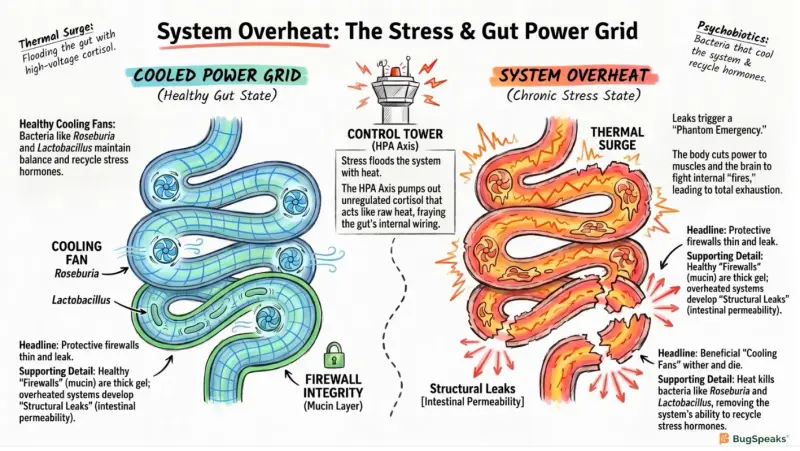
Chronic stress generates a "Thermal Surge" in the intestines by flooding the system with a continuous overflow of stress hormones that act as an uncontrolled thermal load, physically degrading the protective insulation and infrastructure of the digestive power station. In a healthy body, the central control tower—known as the hypothalamic-pituitary-adrenal axis—operates like a precision electrical grid, sending out short, controlled bursts of energy only when an actual emergency occurs. However, when an individual faces persistent psychological pressure or environmental tension, the brain's alarm bell gets stuck in the "on" position, forcing the control tower to pump out a never-ending stream of cortisol and adrenaline. According toLi et al. (2026), this unyielding hormone flow acts like raw, unregulated heat moving through the delicate internal wiring of the intestines. Just as an electrical wire begins to fray when it carries too much voltage for too long, the biological infrastructure of the gut begins to break down under this constant thermal load.
This thermal surge specifically targets the "Firewalls" of the system, the protective slime layer known as mucin that coats the inner walls of the power station. In a properly functioning environment, this mucin layer is a thick, robust gel that prevents dangerous materials from touching the sensitive machinery of the gut wall. The physical integrity of this insulation depends on the body’s ability to build and repair specific proteins. However, the extreme heat of chronic stress directly disrupts the assembly lines responsible for this maintenance. Stress hormones essentially "short-circuit" the biological machinery, leading to a thinning and patchy coating of the colon. As the insulation fails, structural leaks begin to appear in the power station walls, a condition known as Intestinal Permeability. Through these leaks, toxins and waste products escape the station and enter the wider electrical network of the body. Simultaneously, the extreme heat causes the "Microscopic Cooling Fans" , the beneficial, health-promoting bacteria to wither and die off. Without these cooling fans to regulate the internal temperature, the entire power grid falls into a state of permanent emergency, where harmful rogue contractors begin to take over, feeding on the inflammatory heat and causing further damage to the foundation.
Can specific gut bacteria act as "Cooling Technicians" to protect the mind?
Specific gut bacteria act as "Cooling Technicians" by utilizing specialized microscopic tools to physically dismantle excess cortisol and turn it into inactive or even helpful substances before the heat can damage the brain's circuitry. Recent breakthrough discoveries byWang et al. (2026) have revealed that certain individuals possess a built-in "Filtration System" within their intestines that acts as an elite repair crew. These specialized cooling technicians, including a unique strain known as Pseudomonas aeruginosa Tongji, are equipped with a biological tool called a des-like enzyme. Think of this enzyme as a pair of specialized "Microscopic Scissors" that can cut through the molecular structure of stress hormones. When the thermal surge of stress hits the gut, these technicians go to work immediately, capturing the cortisol molecules and "eating" them for fuel.
Instead of allowing the heat of cortisol to build up and travel through the blood to the brain, these technicians recycle the cortisol into helpful compounds known as androgens. This chemical transformation is a critical cooling mechanism that prevents the biological power surge from "frying" the brain’s delicate emotional circuits. By "cleaning" the hormone overflow, these bacteria ensure the body remains calm and stable even during periods of external pressure. Furthermore, this cooling action preserves the body's supply of BDNF, which acts like a "Premium Brain Fertilizer." When the gut is overheated, the supply of this fertilizer usually drops, leading to mental "glitches" like depression. However, with the cooling technicians at work, the brain receives the nutrients it needs to stay resilient. To make this "cooling" technology safer for everyone, scientists have even engineered a friendly probiotic strain to carry this recycling tool, creating a precision cooling unit that can be used to patrol the power grid and neutralize cortisol spikes before they cause a system-wide mental blackout.
How does persistent stress rewrite the adolescent microbial profile?
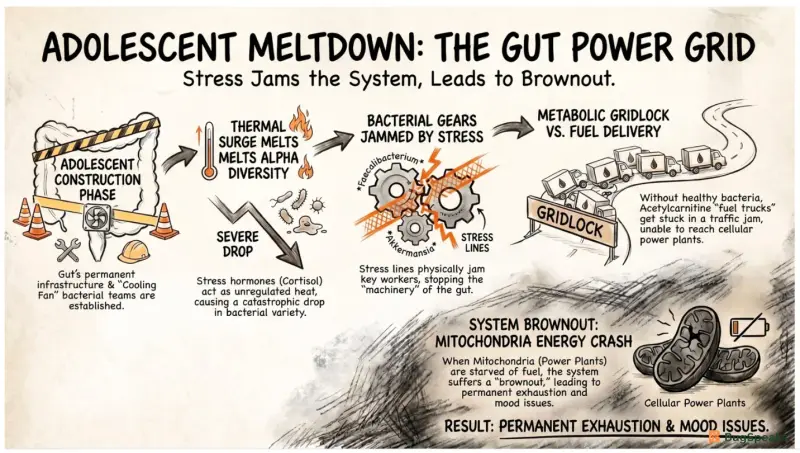
Persistent stress rewrites the adolescent microbial profile by overloading a still-developing power grid and causing a permanent meltdown of the "Cooling Fans" that are essential for long-term emotional and physical stability. Adolescence is a massive "Construction Phase" for the body, where the permanent wiring and infrastructure of the gut's power grid are still being established. Research byYing et al. (2025) shows that a thermal surge of cortisol during this window is particularly destructive because the system hasn't yet built the resilience to handle high voltage. Chronic stress causes a catastrophic drop in Alpha Diversity, meaning the total variety of different cooling fans in the adolescent gut is severely reduced.
When these critical cooling fans—like Faecalibacterium and Akkermansia—melt away under the heat, the adolescent power grid loses its ability to produce a vital energy transporter known as Acetylcarnitine. This molecule acts like a "Fuel Delivery Vehicle" that carries fats into the body's cellular power plants to be burned for clean energy. Without this fuel delivery, the adolescent system enters a state of metabolic gridlock, where the body feels perpetually drained. This lack of clean energy leads to a state of Simmering Inflammation, where the body’s immune system is in a constant state of low-level panic. If the thermal surge is not cooled down during these years, the adolescent grid can become permanently "mis-wired." This means that as the individual enters adulthood, their power station remains prone to "brownouts" or energy crashes, making them much more susceptible to mood disorders and energy issues for years to come.
What is the link between an overheated gut and the progression of disease?
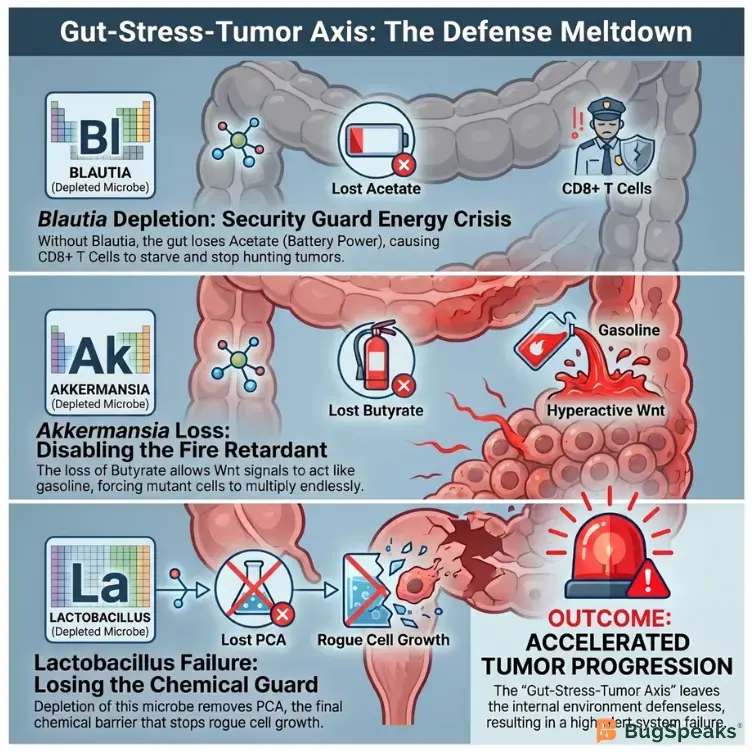
The link between an overheated gut and the progression of disease is that the thermal surge of stress destroys the "Security Guards" of the immune system, allowing "Internal Fires" like tumors to grow unchecked. In a healthy system, the microbial cooling fans produce the "Ammunition" and fuel that the body's security forces need to patrol the network. However, asLi et al. (2026) explain, chronic stress creates a "Gut-Stress-Tumor Axis" where the loss of microbial workers directly accelerates the growth of harmful cells. For example, when the Blautia cooling fans are killed by the heat of cortisol, the power grid stops producing Acetate.
Acetate is the primary battery power for the body's elite security guards, known as CD8+ T Cells. These guards are specifically trained to hunt down and destroy "Rogue Cells" that could turn into tumors. Without this battery power, the guards suffer an energy crisis and can no longer manufacture the weapons needed to protect the body. At the same time, the heat-induced loss of another worker, Akkermansia, results in the disappearance of Butyrate, which acts as a natural "Fire Retardant." Without this fire retardant, a cellular communication line called Wnt/beta-catenin becomes hyperactive, acting like gasoline on a fire. This hyperactive signal tells mutant cells to multiply endlessly, significantly increasing the danger of tumor growth. By destroying the gut's cooling fans, chronic stress effectively turns off the body's natural fire department, leaving the internal environment defenseless against aggressive diseases that thrive in an overheated system.
How does a "System Blackout" impact physical recovery and performance?
A "System Blackout" impacts physical recovery by forcing the body to divert all its available power toward fighting "Phantom Emergencies" rather than repairing its physical muscle hardware. Intense physical training naturally taxes the body, but true recovery requires a sealed and calm "Main Power Station" , the intestine, to distribute clean energy. However,Marwaha et al. (2025) andGlobig et al. (2023) demonstrate that an unyielding thermal surge prevents this recovery cycle from starting. When stress hormones overwhelm the Vagus Nerve, which is the body's main "Cooling Highway," the intestines become leaky and porous.
Through these structural leaks in the power station walls, microscopic toxins and bacterial waste seep into the bloodstream. The immune system sees these toxins and assumes the entire body is under a massive, life-threatening attack , a "Phantom Emergency." In response, the body triggers a System Blackout, cutting off power to the muscles and brain to focus entirely on fighting the perceived infection. Because the body is wasting massive amounts of energy fighting this fake threat, there is no power left to rebuild muscle fibers or replenish energy stores. This keeps the body’s physical hardware in a state of perpetual exhaustion and weakness. Until the power station walls are repaired and the thermal load is dropped, the body remains stuck in a cycle of fatigue, unable to recover baseline strength because the central power grid is too busy managing the "fire" inside the gut.
Can advanced cooling signals and heat shields stop a signal hijack?
Advanced cooling signals stop a signal hijack by redirecting metabolic pathways away from corrosive acids and toward calming neurochemicals while deploying heat shields to clear cellular debris. When the Power Station overheats, a Signal Hijack occurs. Instead of using Tryptophan to manufacture Serotonin (Peace Signals), the thermal load forces the body to create Kynurenine, a metabolic acid that corrodes emotional wiring and triggers mental fog.
To combat this, the system requires Advanced Cooling in the form of a "Postbiotic Heat Shield." Elite workers transform berry polyphenols into Urolithin A, a specialized compound that enters the Cellular Power Plants (Mitochondria) to clear out the "charred" debris left by the surge. This mitochondrial recycling restores high-voltage energy levels while simultaneously triggering the release of GLP-1, which acts as a systemic coolant to lower brain inflammation. Finally, Advanced Cooling requires restoring the Internal Thermostat. The microbial cooling units follow a strict Circadian Shift Schedule, but stress confuses the clock. Restoring this schedule through consistent "Closing Times" and light management allows the technicians to perform deep-tissue repairs while the grid is offline. By blocking the signal hijack and reinforcing these shields, the system regains emotional and metabolic stability.
How can precision maintenance "cool" the overheated power station?
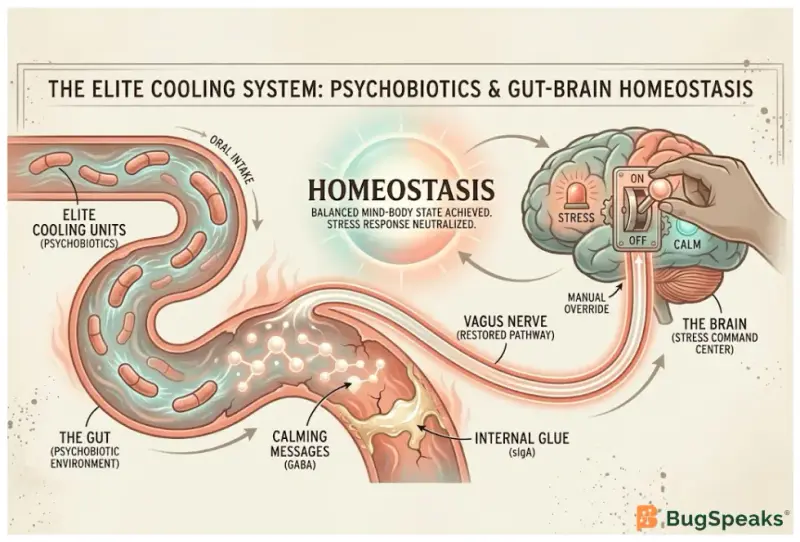
Precision maintenance can "cool" the overheated power station by deploying targeted Psychobiotics that act as "Elite Cooling Units," manually turning off the brain's alarm bell and sealing the leaks in the gut infrastructure. Rebuilding a damaged power grid requires the active introduction of specialized repair crews. According toSisubalan et al. (2026), these psychobiotics are friendly, living bacteria ingested specifically to interface with the nervous system and calm the control tower. When these cooling units, such as Bifidobacterium longum, enter the gut, they begin producing powerful "Calming Messages" known as GABA.
These calming messages are beamed directly up the Vagus Nerve to the brain. Once they reach the command center, they act like a "Manual Override" switch, telling the body to stop producing cortisol and adrenaline. This effectively cuts off the thermal surge at its source and allows the system to begin cooling down. Simultaneously, these cooling units perform physical repairs on the power grid's walls. They stimulate the body to produce "Internal Glue" called sIgA, which patches the structural leaks in the intestines and puts out localized fires. By restoring the firewalls and bringing back diversity to the microbial workforce, these precision maintenance crews pull the body out of an emergency blackout. This restores a state of Homeostasis, where the body can finally stop panicking and return to a state of balanced, calm, and steady energy.
Visualize the process- https://youtu.be/kll6tyGWuao
Reference
Wang, X., Wu, Q., Zeng, H. L., Shen, Y., Zhang, H. H., Gong, J., Zhang, Q., Xie, J. Z., Ye, D. W., Sun, Z. Y., Liu, Z. C., Cheng, L. M., & Li, D. (2026). Gut Bacteria Improve Depressive Symptoms by Degrading Cortisol into Androgen. Advanced science (Weinheim, Baden-Wurttemberg, Germany), 13(11), e08468. https://doi.org/10.1002/advs.202508468
https://www.nature.com/articles/s41598-024-77473-9
https://journals.physiology.org/doi/full/10.1152/japplphysiol.00652.2024
Ying, L., Yuhao, W., Yafang, H., Jiao, L., Lina, D., Qinze, S., Chenghai, Y., Shaoxiong, Z., Yuexi, G., Mingwang, S., Zelin, C., Chuangchuang, W., Zihan, G., Xin, L., Lu, M., & Lei, Z. (2025). Chronic stress is associated with altered gut microbiota profile and relevant metabolites in adolescents. BMC microbiology, 25(1), 423. https://doi.org/10.1186/s12866-025-04094-1
Li, Q., Xia, S., Zhang, X., Liu, Y., Xiao, X., & Yang, J. (2026). Gut Microbiota-Driven Pathways Linking Chronic Stress to Tumor Progression. International journal of biological sciences, 22(1), 258–279. https://doi.org/10.7150/ijbs.119630
https://www.frontiersin.org/journals/microbiology/articles/10.3389/fmicb.2026.1804560/full