# Smartphones and the Invisible Microbial Exchange with Human Skin
Author: BugSpeaks
Author URL: https://www.bugspeaks.com/blog/author/bugspeaks
Published: 2026-02-23
Category: Microbiome and Lifestyle
Category URL: https://www.bugspeaks.com/blog/category/microbiome-and-lifestyle
Meta Title: Smartphone Use Alters the Hand Microbiome and Impacts Systemic Health
Meta Description: Smartphones facilitate the transfer of microbes among devices, our hands, skin, and gut, which can disrupt the balance of our microbiome. This blog explores how phones act as reservoirs for both beneficial and harmful microbes, as well as environmental bacteria, affecting our immune responses, skin health, and gut conditions in everyday users.
Tags: Skin Microbiome, Smartphone, Risk of infections
Tag URLs: Skin Microbiome (https://www.bugspeaks.com/blog/tag/skin-microbiome), Smartphone (https://www.bugspeaks.com/blog/tag/smartphone), Risk of infections (https://www.bugspeaks.com/blog/tag/risk-of-infections)
URL: https://www.bugspeaks.com/blog/smartphones-the-invisible-microbial-exchange-with-human-skin
## Introduction
The human microbiome consists of trillions of microorganisms found in various body areas such as the skin and gut. The skin microbiome plays a vital role in barrier protection, immune modulation, and resistance to pathogens.
Due to the frequent touching of objects, environments, and faces, hands experience significant microbial flux and variability. Smartphones, which are touched hundreds of times each day, have become important vectors in this process, exhibiting a 20-25% bacterial overlap with the hands of their owners according to high-throughput sequencing. This two-way transfer could potentially lead to systemic effects through the skin-gut axis.
Studies indicate that personal smartphones or mobile phones host microbial communities similar to those found on the user's skin. Many of the prevalent bacterial species on a person's smartphone are also typically present on their hands, suggesting ongoing microbial transfer between the skin and frequently handled personal devices. Thus, smartphones could be regarded as extensions of the human microbiome, carrying unique microbial signatures of individuals.
As these devices are touched numerous times throughout the day, they may promote microbial transfer across various body areas through contact with the face and other exposed regions. This continuous exchange might alter temporary microbial exposure patterns and affect the interactions between the skin and other microbial environments in the body.
## Role of Hand Microbiome
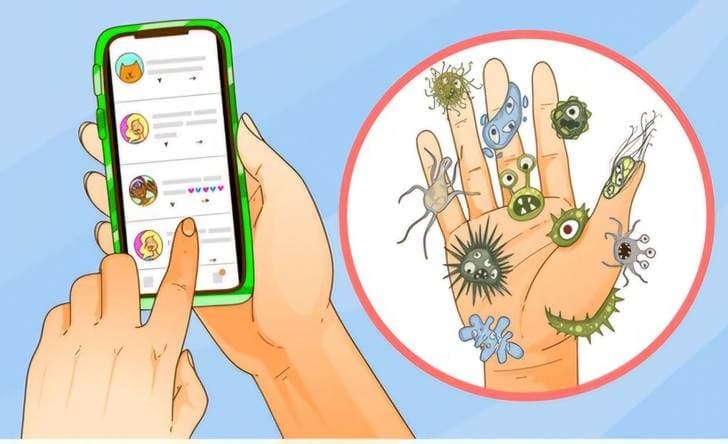
The skin is home to various microbes, and a few of the prominent ones are _Propionibacterium_, _Staphylococcus_ and _Corynebacterium_. These microorganisms produce antimicrobials, compete against pathogens, and help train the immune system, which together aid in preventing infections.
The composition of the hand microbes exhibits variability among individuals due to factors like hygiene, gender, and handedness. The hand microbiome serves as the main source for transferring a variety of skin bacteria, such as _Cutibacterium_ and _Staphylococcus_, onto smartphones with each touch. If hand hygiene is not maintained, then there is a chance of harmful microbes being transferred to the surfaces of the smartphones. Therefore, it is important to maintain good hand hygiene practices to avoid contamination of smartphones.
## Smartphones as Reservoirs
Mobile devices gather a variety of microbes from skin, saliva, feces, and the environment, with heat and humidity promoting the survival of opportunistic bacteria such as _Pseudomonas_ and _Enterococcus_.
Research indicates that each phone has a unique microbial signature, with the bacteria from the owner's hands predominating on phone swabs, in contrast to what is found on public surfaces.
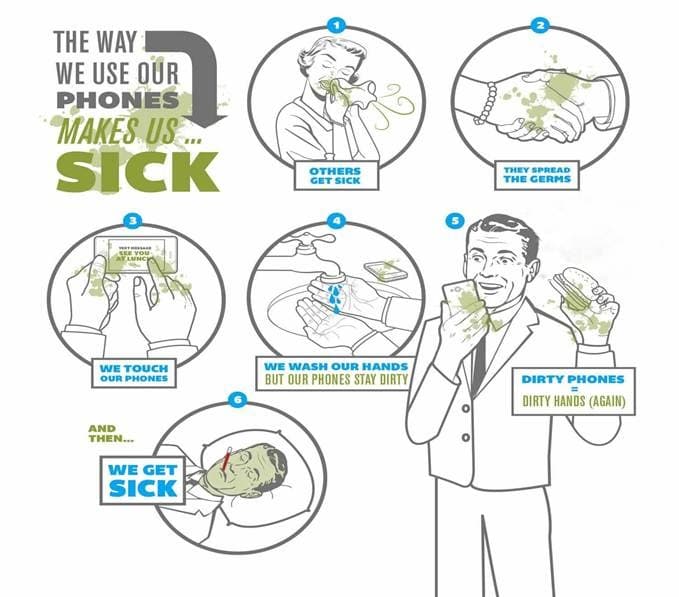
The smartphone generates heat, and the display of the smartphone captures oils and sweat, which together create a favorable environment for the growth of microbes. The enclosed nature of pockets enhances the longevity of these microbes, preventing die-off and forming a unique microbial fingerprint. This initiates a contamination cycle where clean hands are reinoculated by unclean smartphones, allowing pathogens to persist for days.
Disrupting this cycle by cleaning the phone diminishes the hand microbiome's predominant role in the microbial ecology of the device.
## Smartphones as Microbial Transmitters
### Microbial Risks in Healthcare Workers
Smartphones utilized by healthcare workers often harbor enteric bacteria like _Escherichia coli_, _Klebsiella spp_., and _Pseudomonas spp_., which are typically linked to gastrointestinal infections from patient contact, environments, or restrooms, persisting long on device surfaces. Repeatedly handling these contaminated devices can promote the transfer of microbes to the hands, even after following standard hand hygiene protocols. Subsequently, eating with the contaminated hands after using the phones or unconsciously touching the face can lead to the ingestion of these microorganisms into the gastrointestinal system.
Frequent exposure to opportunistic pathogens may lead to temporary changes in gut microbial makeup. Long-term colonization by these microorganisms has been associated with gastrointestinal issues and a heightened risk of infection.
Although smartphones do not directly lead to illness, they serve as carriers in environments with frequent contact, gradually upsetting gut equilibrium; regular cleaning interrupts this cycle of exposure.
### Health Effects of Smartphone Use in the Toilet
Using smartphones while in the toilet can lead to unexpected physiological effects. Studies show that excessive smartphone use while in the toilet may correlate with a higher risk of hemorrhoids, postural strain, irregular bowel movement patterns, and overall physical discomfort.
In a study it was observed that the surface of smartphones used in the washrooms were contaminated with fecal bacteria. This suggests that such practices can lead to higher risk of infections transmitted via the fecal-oral route.
## Hygiene Balance Strategies
- Wash hands with handwash pre-meals and before touching your face.
- Wipe phones weekly with 70% ethanol
- Ban the usage of phone in washrooms/toilets
\- Catherine Praveena J
Also Read: [How to Protect Your Skin and Microbiome from Pollution](https://www.bugspeaks.com/blog/skin-health-skin-microbiome-air-pollution/)
**References**
Belkaid, Y., & Hand, T. W. (2014). Role of the microbiota in immunity and inflammation. Cell, 157(1), 121–141. [https://doi.org/10.1016/j.cell.2014.03.011](https://doi.org/10.1016/j.cell.2014.03.011)
Byrd, A. L., Belkaid, Y., & Segre, J. A. (2018). The human skin microbiome. Nature Reviews Microbiology, 16(3), 143–155. [https://doi.org/10.1038/nrmicro.2017.157](https://doi.org/10.1038/nrmicro.2017.157)
Fierer, N., Hamady, M., Lauber, C. L., & Knight, R. (2008). The influence of sex, handedness, and washing on the diversity of hand surface bacteria. Proceedings of the National Academy of Sciences, 105(46), 17994–17999. [https://doi.org/10.1073/pnas.0807920105](https://doi.org/10.1073/pnas.0807920105)
Grice, E. A., & Segre, J. A. (2011). The skin microbiome. Nature Reviews Microbiology, 9(4), 244–253. [https://doi.org/10.1038/nrmicro2537](https://doi.org/10.1038/nrmicro2537)
Julian, T. R. (2015). Environmental transmission of diarrheal pathogens in low and middle income countries. Environmental Science: Processes & Impacts, 17(8), 1329–1345. [https://doi.org/10.1039/C5EM00222F](https://doi.org/10.1039/C5EM00222F)
Lynch, S. V., & Pedersen, O. (2016). The human intestinal microbiome in health and disease. New England Journal of Medicine, 375(24), 2369–2379. [https://doi.org/10.1056/NEJMra1600266](https://doi.org/10.1056/NEJMra1600266)
Meadow, J. F., Altrichter, A. E., & Green, J. L. (2014). Mobile phones carry the personal microbiome of their owners. PeerJ, 2, e447. [https://doi.org/10.7717/peerj.44](https://doi.org/10.7717/peerj.44)
He J, Shen X, Zhang N, Sun C, Shao Y,2022. Smartphones as an Ecological Niche of Microorganisms: Microbial Activities, Assembly, and Opportunistic Pathogens. Microbiol Spectr10:e01508-22. [https://doi.org/10.1128/spectrum.01508-22](https://doi.org/10.1128/spectrum.01508-22)
Olsen, M., Lohning, A., Campos, M. et al. Mobile phones of paediatric hospital staff are never cleaned and commonly used in toilets with implications for healthcare nosocomial diseases. Sci Rep 11, 12999 (2021). [https://doi.org/10.1038/s41598-021-92360-3](https://doi.org/10.1038/s41598-021-92360-3)
Mohamedin, A., Elsayed, A., & Nashnoush, H. (2019). Bacterial contamination of mobile phones Healthcare versus Non-Healthcare workers at Mansoura City, Egypt. Journal of Plant Protection and Pathology /Journal of Plant Protection and Pathology, 10(2), 101–109. [https://doi.org/10.21608/jppp.2019.40886](https://doi.org/10.21608/jppp.2019.40886)
Ramprasad, C., Wu, C., Chang, J., Rangan, V., Iturrino, J., Ballou, S., Singh, P., Lembo, A.,Nee,
J., & Pasricha, T. (2025). Smartphone use on the toilet and the risk of hemorrhoids. PLoSONE,
20(9), e0329983. [https://doi.org/10.1371/journal.pone.0329983](https://doi.org/10.1371/journal.pone.0329983)
Michael Samantha, Hui Chia, Syakirah Emalin, Meganathan Anushiyavalli, Quan Lim(2020). A Study on Mobile Phone Cleaning Practices and Knowledge of Microbial Contaminants. International Journal of Biomedical and Clinical Sciences Vol. 5, No. 3, 2020, pp. 295-307
## FAQs
Q: Do smartphones really carry the same microbes as our hands?
A: Yes. Research shows significant overlap between hand microbiota and personal smartphone microbial communities.
Q: Can smartphone microbes affect gut health?
A: Indirectly, yes. Hand-to-mouth contact can transfer microbes to the gastrointestinal tract, influencing microbial exposure.
Q: Does cleaning phones destroy beneficial microbes?
A: Periodic disinfection primarily reduces surface pathogens and does not permanently alter the body’s core microbiome.
Q: Can phone use contribute to acne?
A:While not a direct cause, microbial transfer from phones to facial skin may influence local microbial balance in susceptible individuals.
Q: Is microbial exposure always harmful?
A: No. Controlled microbial exposure supports immune development and regulation.
Q: How often should smartphones be cleaned?
A: Research supports regular surface hygiene, especially for high-touch objects, to reduce microbial transmission risk.
Q: Do all smartphones carry harmful bacteria?
A: Not necessarily. Most microbes are harmless commensals, but opportunistic pathogens may also be present.
Q: Can phone use contribute to acne?
A: While not a direct cause, microbial transfer from phones to facial skin may influence local microbial balance in susceptible individuals.
Q: Is microbial exposure always harmful?
A: No. Controlled microbial exposure supports immune development and regulation
Q: How often should smartphones be cleaned?
A: Research supports regular surface hygiene, especially for high-touch objects, to reduce microbial transmission risk.
Q: Do all smartphones carry harmful bacteria?
A: Not necessarily. Most microbes are harmless commensals, but opportunistic pathogens may also be present.
---
This blog is powered by Superblog. Visit https://superblog.ai to know more.
---