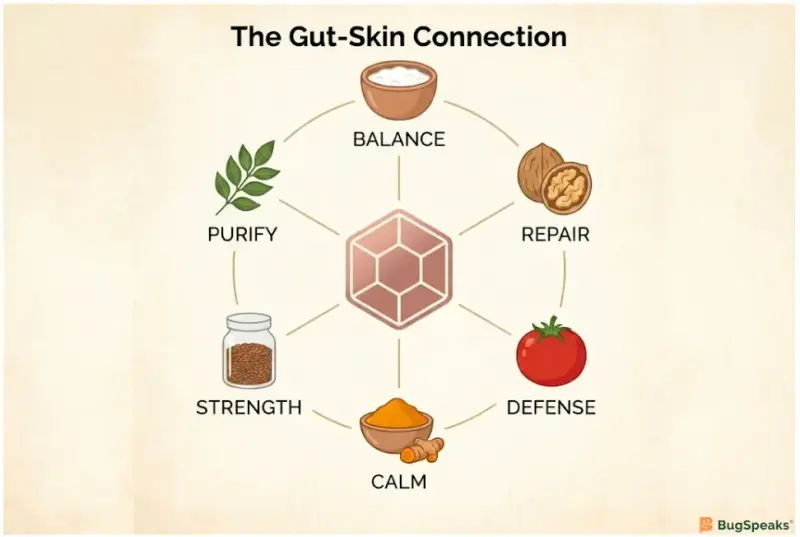
Is the Master Loom spinning tangled threads?
The quality of a tapestry depends entirely on the loom where the threads are spun. In the human body, the intestines operate as the Master Loom, responsible for creating the biological "silk" that forms the skin. When this loom is balanced, it produces smooth, resilient threads that result in a glowing, healthy complexion. However, when the loom experiences a state of Dysbiosis, the threads become tangled and frayed. These imperfections are not hidden away; they travel through the body's internal transport system and appear on the surface as the Living Tapestry of the skin.
This biological connection is known as the Gut-Skin Axis, a sophisticated communication network that allows the intestines to dictate the health of the skin. According toZhao et al. (2025), the intestines function as the primary production floor for the entire body. When the "Microbial Workers" at this loom are out of balance, they produce chemical "static" rather than smooth silk. This static travels along neural and immune pathways, manifesting as visible flaws—such as acne or redness—on the skin. The overall clarity of the skin depends on the Intestinal Metabolome, which is the collection of chemicals produced during digestion. When the loom creates high-quality "Data Packets" or metabolites, the tapestry remains flawless. Conversely, a compromised loom produces toxic "Burrs" like p-Cresol. As noted bySingla et al. (2026), these toxic chemicals can physically weaken the skin by reducing its natural protection. Furthermore, the intestines manage a "Security Gate" known as Intestinal Permeability. If this gate fails, the resulting internal "leakage" floods the system with inflammation, causing the Living Tapestry to lose its luster and strength.
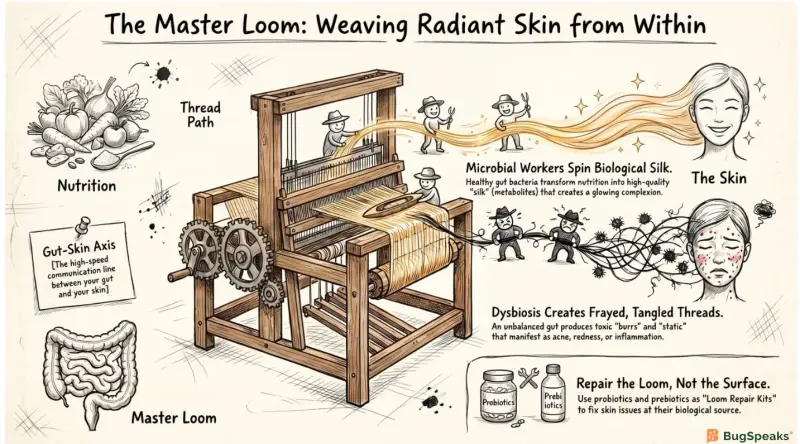
Can a Loom Repair kit fix chronic flaws in the Tapestry?
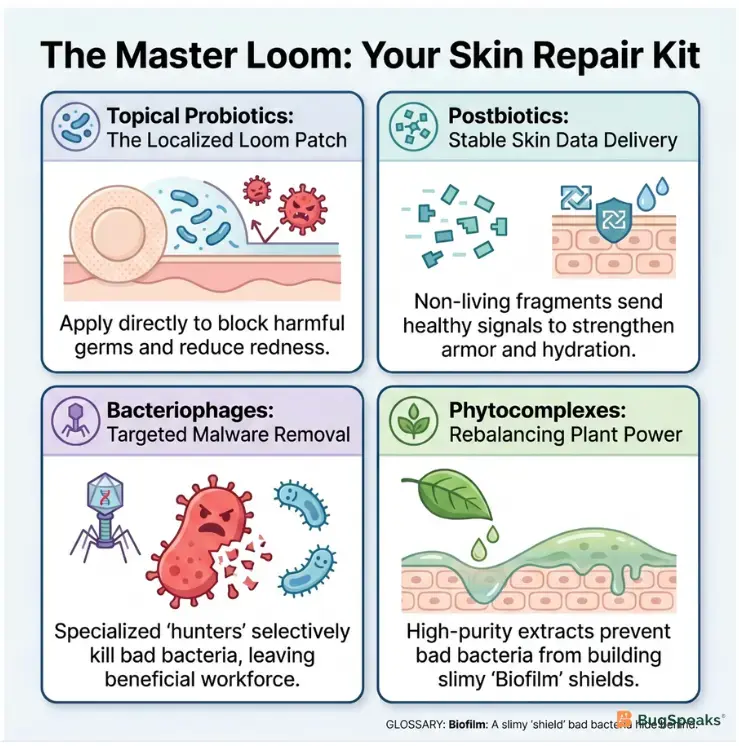
When a tapestry shows signs of wear, the most effective solution is to repair the loom that created it. While many people attempt to fix skin issues with surface-level treatments, science proves that "Software Patches" for the gut are often more effective. Persistent errors like Acne Vulgaris are frequently treated with aggressive "System Resets" like antibiotics, which can unfortunately damage the beneficial workers at the loom. Modern research now prioritizes non-pharmacological interventions to restore balance without causing collateral damage.
An exhaustive review byBurckhardt-Bravo et al. (2026) highlights several advanced repair kits for the Master Loom. One highly effective update involves Topical Probiotics, which are helpful bacteria applied directly to the skin to reduce the growth of "Bad Bugs." Another protocol uses Postbiotics, which act like "Stable Design Patterns" to strengthen the skin barrier. Engineers are even developing Live Biotherapeutic Products—vetted microbial teams designed to stop the skin from producing too much oil. In cases where the bad bacteria are particularly stubborn, specialized "Bacterial Hunters" called Bacteriophages can be used to selectively remove them. Furthermore, the use of Biotechnological Phytocomplexes can prevent harmful bacteria from building "hiding spots" known as Biofilms on the skin. Finally, internal support like oral probiotics combined with Omega-3 Fatty Acids provides the loom with the high-quality lubrication it needs to function smoothly, proving that repairing the source leads to the most resilient results.
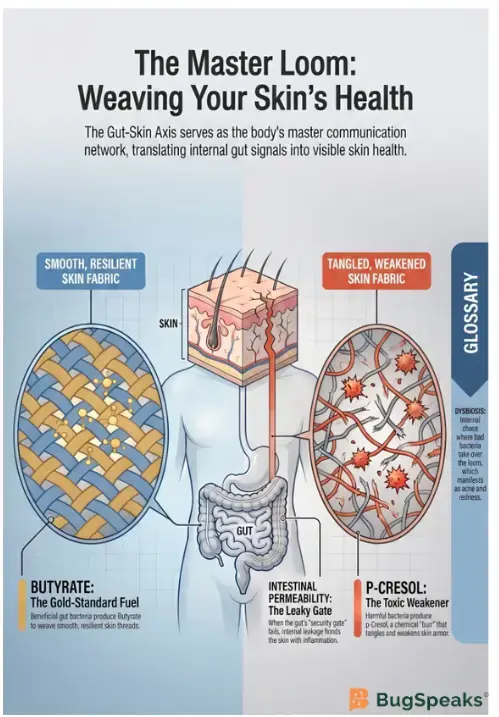
How do the "Chemical Dyes" protect against signal interference?
The color and strength of the Living Tapestry depend on the "Chemical Dyes" created within the Master Loom. These dyes are actually Short-Chain Fatty Acids, which act as essential stabilizers for the entire network. These molecules function like security keys that lock down inflammation and ensure the skin remains calm. A comprehensive review byAshkanani et al. (2025) evaluates how Nutraceuticals deliver these essential dyes to correct skin flaws.
By using targeted probiotics and prebiotics, the quality of the "dyes" originating from the intestines is significantly improved. According toAshkanani et al. (2025), this approach leads to profound improvements in conditions like eczema and chronic rashes. For example, patients suffering from severe skin irritation often see a drop in their SCORAD Index after adding gut-level support. This is because the treatment lowers the circulation of "Alarm Signals" known as Cytokines, which otherwise cause "static" that ruins the clarity of the skin. Providing the Master Loom with high-quality "Fuel" ensures that the internal communication lines remain clear, resulting in a vibrant and healthy appearance.
Is the Intestine the true weaver of the Skin’s Tapestry?
The intestines act as the master weaver by regulating the body's entire immune system and constantly directing the health of the skin. Evidence fromZhao et al. (2025) andSingla et al. (2026) proves that the gut orchestrates every single detail seen on the skin. The intestines do more than just process food; they also create Tryptophan Metabolites, which act as the "stiffening agent" that makes the skin's outer wall strong and resilient.
This mastery extends to complex conditions like Psoriasis. In these cases, a "tangled loom" in the gut causes the immune system to overreact, flooding the skin with inflammation.Singla et al. (2026) further highlight this by showing how severe gut disorders, such as Inflammatory Bowel Disease, often appear as painful bumps on the skin called Erythema Nodosum. Fortunately, research confirms that by fixing the "Master Loom" through gut-level support, these conditions can be reversed, as measured by a lower PASI Score. By managing the microscopic workers inside the gut, the body prevents the spread of toxic "signals," ensuring the Living Tapestry remains beautiful and intact.
Can upgrading the blueprint and weatherproofing protect the tapestry?
The Master Loom does not spin in isolation; it follows a blueprint transmitted via the Vagus Nerve, the internal Master Architect. This high-speed "intercom" connects the gut directly to the skin’s nervous system. When the architect is stressed, the signal becomes frantic, causing the loom to stutter and create "tension knots"—visible on the tapestry as stress-induced hives or sudden inflammatory flares.
Furthermore, a world-class loom doesn't just process threads; it manufactures the silk itself. Elite workers like Lactobacillus reuteri send hormonal messages—specifically triggering Oxytocin—that instruct the skin to spin its own high-tensile Collagen. This ensures the tapestry remains plump and resilient from the inside out, rather than relying on external patches. Finally, the loom provides Internal Weatherproofing. When the workers are fed colorful antioxidants like Lycopene or Astaxanthin, they forge a Photo-protective Shield. These biological dyes circulate to the skin to absorb UV rays, preventing the "sun-fading" of the tapestry and protecting the living silk from the invisible fire of the sun. By upgrading the software and the shielding, the tapestry is not just beautiful—it is biologically fortified.
How do we preserve the Silk of the Tapestry?
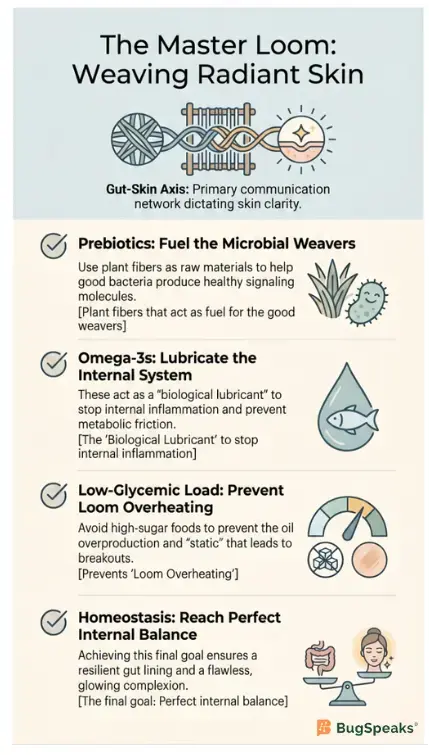
Preserving the "silk" of the skin requires consistent maintenance of the Master Loom. To ensure the intestines continue to weave a flawless tapestry, certain daily habits are essential. According toSingla et al. (2026), avoiding ultra-processed sugars and industrial fats prevents the "overheating" of the loom, which otherwise leads to excessive Sebum production and inflammatory acne. Instead, the loom requires a steady supply of Prebiotics, the essential "Raw Materials" used by the microbial workforce to manufacture healthy signaling molecules.
It is also vital to protect the diversity of these skilled workers. Environmental stressors and the indiscriminate use of antibiotics can "wipe out" the most specialized weavers, causing the entire production line to crash. For the vast majority, the secret to resilience lies in a fiber-rich diet and Omega-3 Fatty Acids, which act as a Biological Lubricant to prevent metabolic friction. However, in rare instances of Total System Failure—where chronic, severe conditions like recalcitrant psoriasis or alopecia areata refuse to respond to standard care—doctors may call for a Factory Overhaul. This advanced procedure, known as Fecal Microbiota Transplantation (FMT), involves installing a pre-verified, healthy microbial workforce into the gut to restore order. While 2026 clinical trials show significant success in using FMT to reverse deep-seated skin pathologies, it remains an Emergency Protocol reserved for the most stubborn "tangles" in the tapestry.
Visualize the process- https://youtu.be/DM8Ehsntse0
Reference
Zhao, Y., Yu, C., Zhang, J., Yao, Q., Zhu, X., & Zhou, X. (2025). The gut‑skin axis: Emerging insights in understanding and treating skin diseases through gut microbiome modulation (Review). International journal of molecular medicine, 56(6), 210. https://doi.org/10.3892/ijmm.2025.5651
Burckhardt-Bravo, V., Funes-Ferrada, R., & Valenzuela, F. (2026). Update on novel acne treatments: a narrative review focused on microbiome modulation and non-pharmacological approaches. Anais brasileiros de dermatologia, 101(1), 501249. https://doi.org/10.1016/j.abd.2025.501249
Ashkanani, A., Ashkanani, G., Yousef, M., Rob, M., Al-Marri, M., Naseem, N., Laws, S., & Chaari, A. (2025). Microbiome and Skin Health: A Systematic Review of Nutraceutical Interventions, Disease Severity, Inflammation, and Gut Microbiota. Microorganisms, 14(1), 63. https://doi.org/10.3390/microorganisms14010063