The Hidden Dangers of Active Ingredients on Your Skin's Microbiome
Why does adding more skincare steps disrupt your skin's natural balance?
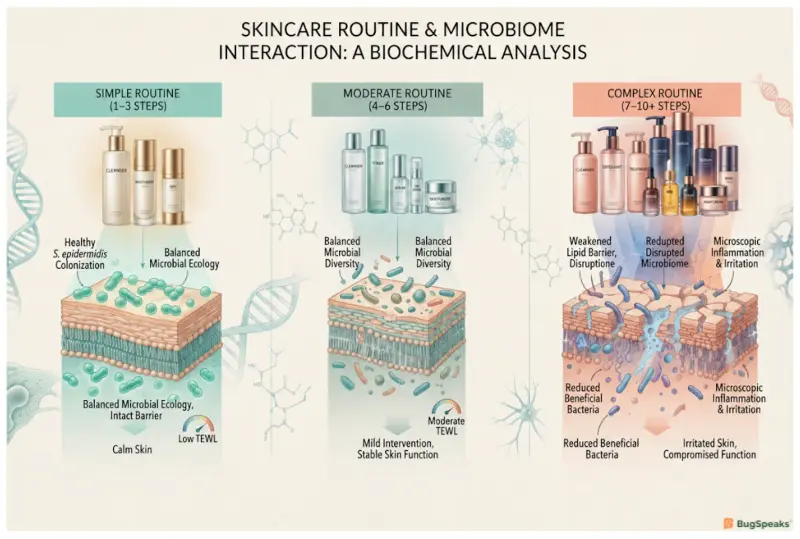
Adding more skincare steps disrupts your skin's natural balance because layering multiple products creates a heavy chemical load that overwhelms your microscopic defense systems. A ten-step routine represents an extreme intervention level that forces your skin's residents to constantly struggle to survive. This heavy intervention load can easily destabilize the delicate ecosystem of your skin's outer surface. Instead of helping, piling on different active ingredients often triggers chronic irritation and stops your native bacteria from doing their daily jobs. One of these key resident bacteria is called Staphylococcus epidermidis, which needs a calm environment to protect youJanssens-Böcker (2025).
A simple skincare routine with fewer steps is often much better because it matches the natural biology of your skin. A low-intervention routine lets your skin's microscopic community find its own healthy balance without constant chemical disruption. This peaceful environment allows your native bacteria to grow and build a strong shield against environmental dangers. When you use too many products, you mix different chemicals together on your face, creating an unpredictable microenvironment that confuses your skin's residents. This mess of ingredients can cause long-term skin problems and lead to a state of microbial dysbiosisBouslimani (2019).
We must realize that routine complexity is not the same as scientific sophistication, and fewer well-chosen steps are often much smarter. Sometimes, your skin's biological systems are far more stable when you do not interfere with them every single day. A moderate routine with a balanced intervention level provides just enough support without overwhelming your skin's natural healing abilities. By choosing a simpler path, you help your physical skin barrier and your microscopic partners work together in perfect harmony. This biological partnership is what keeps your skin looking healthy and prevents the problems of sensitive, irritated skinDubli (2025).
How do overlapping cosmetic preservatives sabotage beneficial skin bacteria?
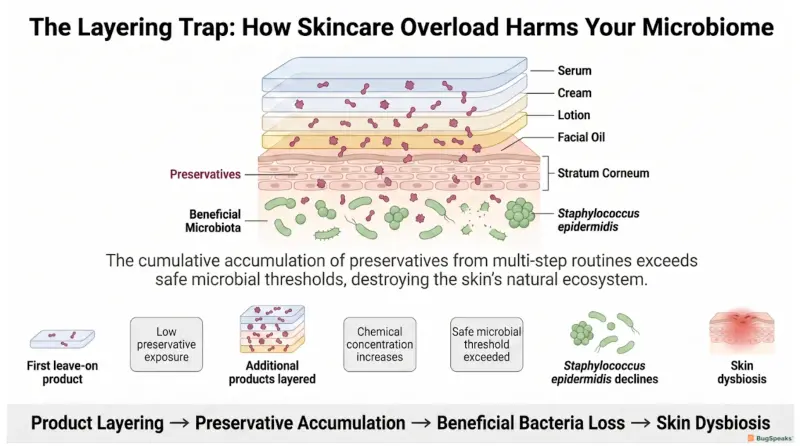
Overlapping cosmetic products sabotage beneficial skin bacteria because leaving multiple layers of cream on your face means you are leaving a high cumulative load of preservatives on your skin. However, when you stack many products on top of each other, these chemicals build up on your face and act like a daily low-dose pesticide. This constant chemical exposure selectively suppresses your friendly bacteria while allowing tougher, harmful pathogens to take over. This is how a complicated routine accidentally wipes out your skin's natural partnersPinto (2021).
A healthy skin ecosystem needs to stay in a natural state of balance where friendly microbes can grow and protect you from infections. This ideal, balanced state of your skin's microscopic community is called eubiosisTaléns-Visconti (2026). When you use a simple routine, you minimize your daily chemical exposure, which helps your friendly bacteria maintain this protective state of balance. A low intervention level respects the natural biological laws of your skin. It gives your resident microbes the stable environment they need to do their important work.
When we overload our face with too many products, we disrupt this delicate balance and cause chronic skin issues. Piling on creams with different ingredients means your friendly microbes must constantly fight off multiple types of preservative chemicals. This heavy load forces your skin's resident system to drop from a healthy state into a state of disease. This biological breakdown shows why complexity is not the same as sophistication when it comes to taking care of your face. By choosing fewer, well-chosen products, you avoid this chemical trap and help your native bacteria thrive in their natural homePinto (2021).
What happens when harsh surfactants and fluctuating pH levels alter the skin's surface?
Harsh surfactants and fluctuating pH levels alter the skin's surface by stripping away protective fats and changing the natural acid level that healthy bacteria need to live. Many cleansers contain aggressive washing detergents, such as sodium lauryl sulfate (SLS), which dissolve the skin's protective lipid barrierVater (2021). When you wash your face with these harsh chemicals, you do not just remove dirt; you also wash away your skin's natural shields. This stripping action leaves your skin surface dry, vulnerable, and completely exposed to the elements, making it very easy for harmful germs to colonize and grow on your face.
This aggressive washing process also depletes vital water-binding molecules, which is known as your natural moisturizing factor (NMF), that normally keep your outer skin cells hydratedVater (2021). When these humectant molecules are stripped away by harsh cleansers, your outer skin cells dry out and shrink. This physical damage creates tiny cracks in your skin's defense wall, making it easy for water to escape and irritants to enter.Using aggressive washes represents a highly destructive intervention level. This harsh approach completely destabilizes the entire environment, making it impossible for your native bacteria to survive and stay healthy.
Additionally, using too many products can disrupt your skin's natural acidic shield, which is known as the acid mantleJanssens-Böcker (2025). Healthy skin is naturally slightly acidic, and this low pH level is the perfect environment for friendly bacteria to grow. When you use alkaline products or too many different creams, you raise this pH, which weakens your skin's defenses. This shift in acidity stops your native bacteria from growing and lets harmful pathogens multiply on your face. By keeping your routine simple and using low-pH products, you help your natural acid shield stay strong and protect your microscopic partners.
How does the Aryl Hydrocarbon Receptor pathway link our microbiome to skin barrier repair?
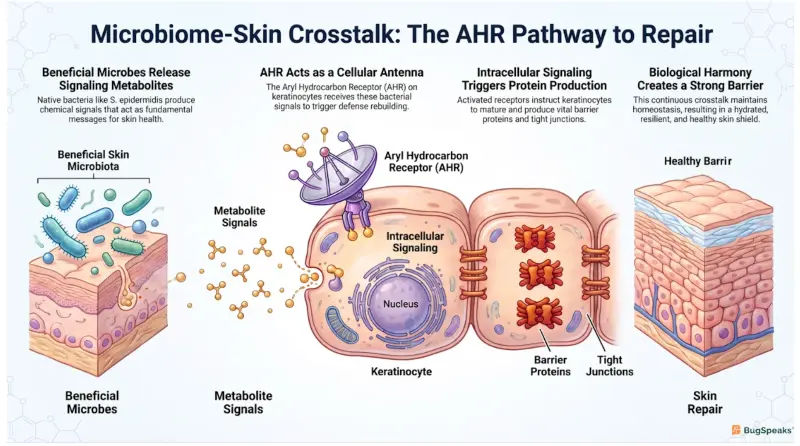
The Aryl Hydrocarbon Receptor pathway links our microbiome to skin barrier repair by acting as a biological communication system where bacterial molecules signal skin cells to build their defenses. Your friendly skin microbes produce special chemical signals that bind directly to a specialized cellular receiver in your outer skin cells called the Aryl Hydrocarbon Receptor (AHR)Uberoi (2021). When this receptor is activated, it tells your body to start rebuilding its physical defenses immediately. This biological crosstalk is a fundamental pathway that links the health of your microscopic partners directly to the physical strength of your skin's outer wall and protects you from harmful infections.
When the receptor is activated, it triggers a chain reaction that instructs your outer skin cells, known as keratinocytes, to mature and form a tight, solid barrierUberoi (2021). These cells act exactly like the physical bricks of your skin's defense wall. To lock together properly, they rely heavily on chemical messages sent from your native bacteria. Without these vital bacterial signals, your skin cells do not mature correctly, leaving your physical wall weak, dry, and leaky. A healthy, low-intervention routine allows this natural cellular communication to take place easily without any chemical interference from the outside world.
This continuous cellular crosstalk is essential for maintaining a state of stable physical health, which is known as skin homeostasisUberoi (2021). When you use too many products, you disrupt this communication system and completely stop your skin cells from receiving these vital signals. This disruption weakens your physical barrier, making your skin dry, sensitive, and prone to chronic irritation. By choosing a simpler skincare routine, you protect these natural communication pathways and help your skin barrier repair itself. This biological harmony clearly shows why keeping your routine simple is always the smartest way to achieve a healthy face.
How can a transition to simpler, microbiome-friendly interventions restore eubiosis?
A transition to simpler, microbiome-friendly interventions can restore eubiosis by reducing your chemical load and giving your native bacteria the room they need to rebuild their communities. Moving from a complex routine to a simple or moderate routine represents a balanced intervention. This shift stops the daily chemical disruptions and allows your skin's resident system to recover naturally in a peaceful environment. By using fewer, well-chosen products, you stop overwhelming your skin and help its natural biological systems find their balance again. This gentle approach lets your microscopic partners grow strong, stay healthy, and protect you.
You can actively support this recovery process by introducing gentle cosmetic ingredients called prebiotics, which act as selective food sources for your skin's protective bacteriaWojciechowska (2025). These specialized nutrients, like colloidal oat, only nourish your helpful bacteria, leaving bad germs with nothing to eat. By giving your helpful bacteria their favorite food, you help them multiply and reclaim their place on your skin surface. This selective support strengthens your natural defenses and helps restore a healthy balance on your face.Using prebiotics is a smart, low-intervention way to assist your skin's natural biology without causing any unnecessary chemical overload at all.
Additionally, you can use specialized bacterial extracts called postbiotics to soothe irritation and accelerate physical barrier repair without the risks of using live microbesTaléns-Visconti (2026). These non-living bacterial components, such as active ferments and lysates, deliver helpful chemical signals directly to your outer skin cells. They help strengthen your physical barrier, reduce redness, and improve hydration without disturbing your skin's natural balance. This balanced, gentle approach clearly shows that fewer, well-chosen interventions produce far more stable biology than a complicated, multi-step skincare routine. By keeping your daily skincare simple, you achieve a very healthy, glowing, and beautiful face naturally over time.
Visualize the process- https://youtu.be/WmfJ5WBbBP8
Reference
Vater, C., Apanovic, A., Riethmüller, C., Litschauer, B., Wolzt, M., Valenta, C., & Klang, V. (2021). Changes in Skin Barrier Function after Repeated Exposition to Phospholipid-Based Surfactants and Sodium Dodecyl Sulfate In Vivo and Corneocyte Surface Analysis by Atomic Force Microscopy. Pharmaceutics, 13(4), 436. https://doi.org/10.3390/pharmaceutics13040436
Uberoi, A., Bartow-McKenney, C., Zheng, Q., Flowers, L., Campbell, A., Knight, S. A. B., Chan, N., Wei, M., Lovins, V., Bugayev, J., Horwinski, J., Bradley, C., Meyer, J., Crumrine, D., Sutter, C. H., Elias, P., Mauldin, E., Sutter, T. R., & Grice, E. A. (2021). Commensal microbiota regulates skin barrier function and repair via signaling through the aryl hydrocarbon receptor. Cell host & microbe, 29(8), 1235–1248.e8. https://doi.org/10.1016/j.chom.2021.05.011
Dubli, K., Balasundaram, P., Chaudhari, R., Vettrivelan, S., Borawake, A., Kapoor, R., Kovalchuk, I., Kapoor, A., Singh, R., & Tripathi, M. B. (2025). Exploring the Impact of Skin Care Routines on the Skin Microbiome and Possible Skin Disease Risk-A Pilot Study. Biomedicines, 13(10), 2371. https://doi.org/10.3390/biomedicines13102371
Taléns-Visconti, R., Diez-Sales, O., & Nácher, A. (2026). Cosmetic Interventions for Skin Microbiome Modulation: Current Strategies and Future Directions. Skin research and technology : official journal of International Society for Bioengineering and the Skin (ISBS) [and] International Society for Digital Imaging of Skin (ISDIS) [and] International Society for Skin Imaging (ISSI), 32(4), e70352. https://doi.org/10.1111/srt.70352
Hwang, B. K., Lee, S., Myoung, J., Hwang, S. J., Lim, J. M., Jeong, E. T., Park, S. G., & Youn, S. H. (2021). Effect of the skincare product on facial skin microbial structure and biophysical parameters: A pilot study. MicrobiologyOpen, 10(5), e1236. https://doi.org/10.1002/mbo3.1236
Janssens-Böcker, C., Doberenz, C., Monteiro, M. et al. Influence of Cosmetic Skincare Products with pH < 5 on the Skin Microbiome: A Randomized Clinical Evaluation. Dermatol Ther (Heidelb)15, 141–159 (2025). https://doi.org/10.1007/s13555-024-01321-x
Pinto, D., Ciardiello, T., Franzoni, M., Pasini, F., Giuliani, G., & Rinaldi, F. (2021). Effect of commonly used cosmetic preservatives on skin resident microflora dynamics. Scientific reports, 11(1), 8695. https://doi.org/10.1038/s41598-021-88072-3
Wojciechowska, K., & Dos Santos Szewczyk, K. (2025). The Skin Microbiome and Bioactive Compounds: Mechanisms of Modulation, Dysbiosis, and Dermatological Implications. Molecules, 30(22), 4363. https://doi.org/10.3390/molecules30224363
Bouslimani, A., da Silva, R., Kosciolek, T., Janssen, S., Callewaert, C., Amir, A., Dorrestein, K., Melnik, A. V., Zaramela, L. S., Kim, J. N., Humphrey, G., Schwartz, T., Sanders, K., Brennan, C., Luzzatto-Knaan, T., Ackermann, G., McDonald, D., Zengler, K., Knight, R., & Dorrestein, P. C. (2019). The impact of skin care products on skin chemistry and microbiome dynamics. BMC biology, 17(1), 47. https://doi.org/10.1186/s12915-019-0660-6
Chia, J., Carma, A., Alwyn, A., Cho, R., Hill, D. S., & Borrello, M. T. (2026). The Skin Microbiome Revolution: The Science and Challenges of Prebiotics, Probiotics, and Postbiotics in Skincare. Cosmetics, 13(1), 43. https://doi.org/10.3390/cosmetics13010043
Graubard, R., Perez-Sanchez, A., & Katta, R. (2021). Stress and Skin: An Overview of Mind Body Therapies as a Treatment Strategy in Dermatology. Dermatology practical & conceptual, 11(4), e2021091. https://doi.org/10.5826/dpc.1104a91
Bobok, N., & Taskesen, T. (2025). Stress-Induced Changes of the Skin: A Narrative Review. Cureus, 17(11), e96285. https://doi.org/10.7759/cureus.96285