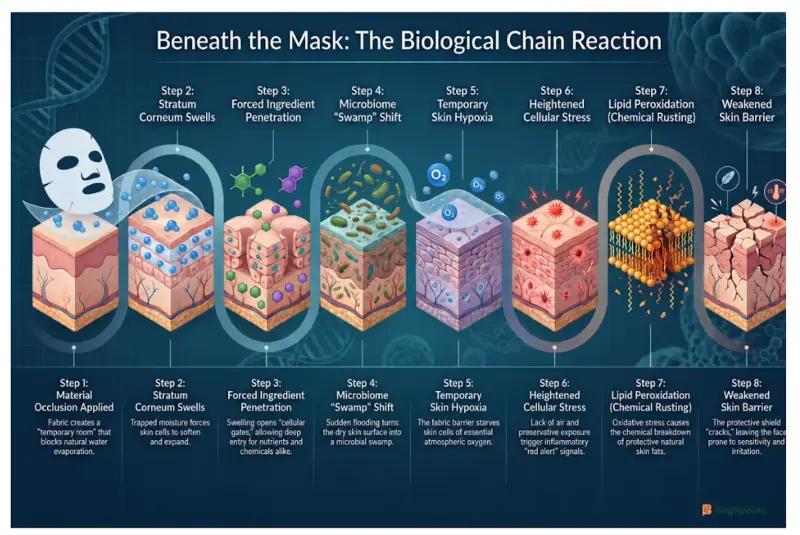
Why does a sheet mask soften your face?
A sheet mask softens your face by trapping water underneath a thick fabric, preventing water from evaporating into the dry air around you. This process is a clear form of cosmetic environment engineering where the mask fabric builds a temporary room over your face. The fabric stops your natural skin sweat from escaping, which makes water gather on the skin surface. This trapped moisture softens and swells the outer layer of your skin cells, which scientists call the stratum corneum. This swelling opens up tiny gates between cells so that the mask liquid can soak inside very quickly. This allows the active ingredients to enter much deeper.
The wet liquid on the sheet contains special ingredients like glycerol and urea to help hydrate your dry face. This liquid is the engineered chemistry that bathes your face to deliver nutrients. Normally, your skin acts as a tight shield to keep outside things from entering. However, the sheet forces your skin gates to stay wide open for fifteen minutes. This temporary moisture hold allows the liquid to flow deep into the skin. While this makes your skin look very plump and smooth, it also forces your natural defense walls to relax and let outside chemicals enter easily. Both helpful nutrients and chemicals enter your face together.
Trapping water on your face can change how your skin behaves for a very long time. Scientific studies show that using these products increases skin hydration and lowers the normal transepidermal water loss, which scientists call TEWLLee et al. (2018). However, this sudden change in moisture also disturbs the home of your friendly skin microbes.Your face is a home for tiny bugs, which are helpful microbes like Staphylococcus epidermidis and Cutibacterium acnes. When you suddenly flood their dry home with liquid, you force them to adapt quickly to a completely new environment that they did not expect at all.
How does trapped water affect your friendly skin bugs?
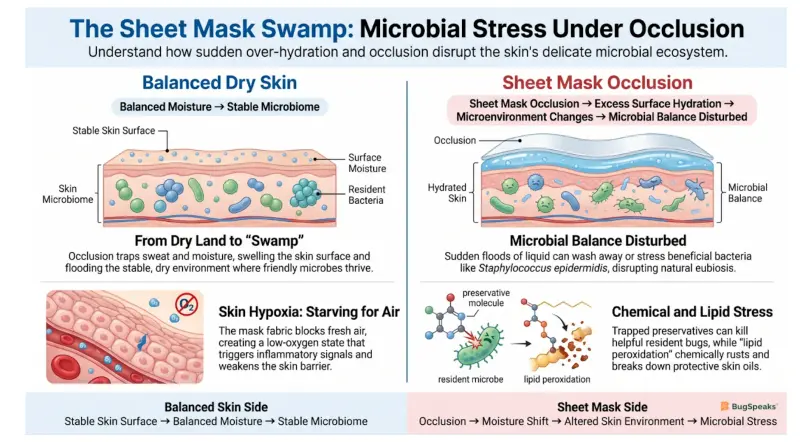
Trapped water under a mask creates an environment of extreme humidity that can wash away or stress your friendly skin microbes. Placing a tight fabric over your face creates a state of occlusion, which means your skin is completely blocked from the outside world. This block stops the natural flow of air and traps warm moisture against your skin. This warmth is very different from the normal dry surface your microbes like. This sudden shift in humidity changes the living conditions on your face, forcing your helpful skin bugs to struggle. This warm space makes it very hard for them to survive.
The tiny microbes on your face are used to living in stable, dry, or oily places. Your cheeks and forehead are usually dry, which allows a specific family of helpful microbes like Cutibacterium and Staphylococcus to live peacefully. When you wear a sheet mask, you suddenly turn this dry land into a giant swamp. This sudden flood of water acts like a big storm that sweeps through their neighborhood. Some microbes will get washed away by the heavy liquid, while other microbes will get trapped under the sheet. This swamp environment forces many of your friendly microbes to shut down and stop working.
Changing the moisture on your face can make your helpful microbes very unstable for many days. Scientists have shown that daily leave-on creams and face products can change the natural balance of your skin microbesCallejon et al. (2023). Some bad bugs like Ralstonia might start to grow too fast by feeding on the mask oils, while friendly resident bugs like Cutibacterium and Staphylococcus begin to disappear, while helpful bugs might get crowded out and disappear. This imbalance can hurt your skin barrier because you need a stable family of microbes to protect your face from outside dirt. Turning your face into a swamp can actually weaken your natural skin defenses and safety.
Why can cosmetic preservatives cause skin problems?
Cosmetic preservatives can cause skin problems by killing both bad and good bacteria on your face. Sheet masks contain a lot of water, which means they can easily grow mold or bad bacteria while sitting on store shelves. To prevent this, makers must add engineered chemistry like preservatives to keep the liquid clean and fresh. However, when you put these preservatives on your face, they do not stop working. They stay active on your skin and can destroy the healthy state of eubiosis, which is the natural and balanced family of helpful microbes that protect your face from outside germs.
Scientists have studied how common cosmetic preservatives affect the helpful bugs on our skin. In laboratory tests, researchers put different preservatives on living skin models to see how the microbes would reactPinto et al. (2021). They found that many common preservatives do a great job of killing bad bugs like Staphylococcus aureus, but they also hurt helpful resident bugs like Staphylococcus epidermidis at the same time. This means the chemical shield meant to keep the mask clean can actually turn into a weapon that harms the friendly microbes that live on your face every single day. This chemical damage can disrupt the healthy microflora dynamics and make your skin highly sensitive over time.
When helpful skin bugs are killed by these harsh chemicals, your skin barrier can get damaged. Helpful bugs like Staphylococcus epidermidis work hard to make natural acids that keep your skin safe from bad infections. If these friendly bacteria are wiped out by mask preservatives, your skin can become dry, red, and very sensitive. This shows that using products with too many strong chemicals can easily disrupt the natural balance of your skin, leaving your face weaker and more prone to itching and irritation. In the end, trying to make your skin look perfect with harsh chemicals can actually make it much more sensitive and weak.
What happens when you block oxygen from your skin?
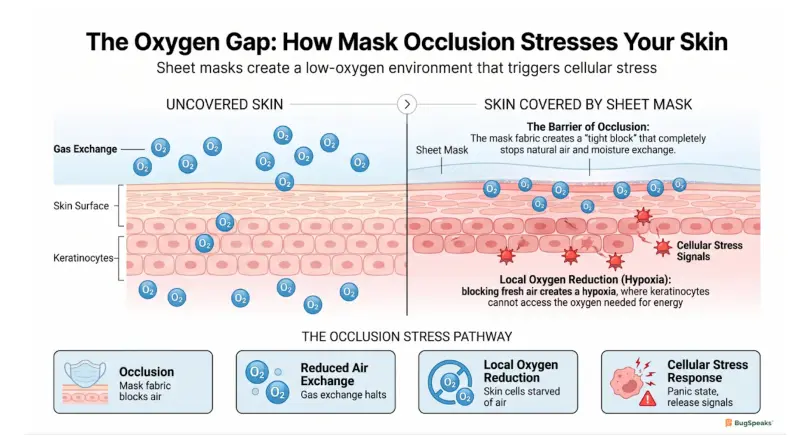
Blocking oxygen from your skin causes a stressful state that weakens your skin cells and helps bad bacteria grow. Your face cells need to breathe oxygen directly from the air around you to stay strong and healthy. When you cover your face with a thick sheet mask, you block this natural airflow completely. This block creates a temporary state of low oxygen on your skin surface, which scientists call hypoxia. This lack of fresh air is highly unusual for your face cells, and it forces them to enter a state of panic and stress. This stressful event makes your skin barrier much weaker.
Under a low-oxygen environment, your skin cells cannot produce enough energy to work properly. Scientists have discovered that this lack of air makes your skin cells much more sensitive to chemical damageLiu et al. (2024). When you combine a low-oxygen environment with preservatives like methylparaben, the bad effects become much stronger. The lack of oxygen stops your cells from cleaning up the chemicals, which allows the preservatives to become much more toxic. This teamwork between low oxygen and chemicals causes your cells to get hurt much faster than normal. This means that covering your face can secretly amplify the toxic effects of the ingredients in your skincare products.
This sudden lack of oxygen also triggers a strong warning signal from your skin cells. When cells are stressed by low oxygen, they release warning chemicals that cause your face to become red, warm, and itchy. This reaction is a sign of inflammation, which is your body's way of saying that your skin barrier is in danger. This shows that what seems like a simple beauty product can actually stress your living face by starving it of the oxygen it needs to stay healthy and strong. Instead of calming your face, the oxygen block can trigger a loud alarm that leads to long-term sensitivity and redness.
How does mask stress damage your skin oils?
Mask stress damages your skin oils by causing a chemical reaction that breaks down protective fats and hurts your skin cells. When your face lacks oxygen and is exposed to harsh preservatives, a damaging process called lipid peroxidation begins. This process is like a chemical rusting that attacks the healthy fats that keep your skin soft. Instead of protecting your face, these damaged fats break down into harmful waste products. This chemical rust weakens your skin cells and makes it very easy for outside dirt to enter. It destroys the protective seal on your face, turning healthy skin oils into dangerous waste that harms your cells.
When your natural skin oils are rusted, they can no longer do their job properly. Healthy skin oils are needed to trap moisture and keep your face from drying out. Scientists have shown that when these oils are damaged by chemical stress, your skin cells lose their strengthLiu et al. (2024). This damage can also stop your skin from repairing itself after a long day. Without healthy oils, your face becomes rough, dry, and loses its natural glow, showing that the mask did not help. This means that the product that promised to hydrate your skin actually causes serious structural damage to your natural oils. This oil damage shows that a simple mask can actually cause a lot of hidden stress to your face. While the mask might make your face look good for a few minutes, it can secretly harm your living cells and friendly bugs. True skin health comes from protecting your natural skin barrier and helping your microbes stay balanced. Instead of forcing sudden changes with sheets and chemicals, we should focus on keeping our skin's natural family of bugs safe and happy every day. Your skin's biological needs, you can achieve a healthy glow without using stressful tools or harsh chemical ingredients.
Visualize the process- https://youtu.be/14tYq2rTcoQ
Reference
Callejon, S., Giraud, F., Larue, F., Buisson, A., Mateos, L., Grare, L., Guyoux, A., Perrier, E., Ardiet, N., & Trompezinski, S. (2023). Impact of Leave-on Skin Care Products on the Preservation of Skin Microbiome: An Exploration of Ecobiological Approach. Clinical, cosmetic and investigational dermatology, 16, 2727–2735.https://doi.org/10.2147/CCID.S409583
Liu, Y., Chen, L., Zhang, S., Wang, X., Song, Y., Sun, H., Cai, Z., & Wang, L. (2024). Do wearing masks and preservatives have a combined effect on skin health?. Eco-Environment & Health, 3(1), 107–115.https://doi.org/10.1016/j.eehl.2024.01.003
Pinto, D., Ciardiello, T., Franzoni, M., Pasini, F., Giuliani, G., & Rinaldi, F. (2021). Effect of commonly used cosmetic preservatives on skin resident microflora dynamics. Scientific reports, 11(1), 8695.https://doi.org/10.1038/s41598-021-88072-3
Lee, K. C., Lee, H., Kim, O. S., Sul, W. J., Lee, H., & Kim, H. J. (2025). Case Study on Shifts in Human Skin Microbiome During Antarctica Expeditions. Microorganisms, 13(11), 2491.https://doi.org/10.3390/microorganisms13112491
Lee, H. J., Jeong, S. E., Lee, S., Kim, S., Han, H., & Jeon, C. O. (2018). Effects of cosmetics on the skin microbiome of facial cheeks with different hydration levels. MicrobiologyOpen, 7(2), e00557.https://doi.org/10.1002/mbo3.557
Mahmud, M. R., Akter, S., Tamanna, S. K., Mazumder, L., Esti, I. Z., Banerjee, S., Akter, S., Hasan, M. R., Acharjee, M., Hossain, M. S., & Pirttilä, A. M. (2022). Impact of gut microbiome on skin health: gut-skin axis observed through the lenses of therapeutics and skin diseases. Gut microbes, 14(1), 2096995.https://doi.org/10.1080/19490976.2022.2096995
Yang, Y., Huang, J., Zeng, A., Long, X., Yu, N., & Wang, X. (2024). The role of the skin microbiome in wound healing. Burns & trauma, 12, tkad059.https://doi.org/10.1093/burnst/tkad059