Exploring the Connection Between Seaweed, Microbes, and Gut Health
Why is our gut microbiome's menu currently so limited?
Our gut microbiome's menu is highly limited because modern processed diets get fully absorbed in our upper digestive tract, leaving almost no food resources for the beneficial microbes waiting down in our large intestine. This drastic dietary shift represents a dramatic change from the long evolutionary path that originally shaped human biology over millions of years. Long ago, early human ancestors diverged from forest-dwelling apes by moving toward a high-quality, nutrient-dense dietTannock (2023). As we began eating cooked, soft starches, our bodies made a huge trade-off: our brain volume expanded, while our digestive tracts shrank to less than sixty percent of expected capacityTannock (2023).
To survive with this much reduced gut volume, humans quickly adapted to extract the most nutrition from every single bite. Learning to master fire allowed us to pre-digest our food externally, maximizing energy extraction in the long small intestine. Cooking dense starches with water triggers a process called gelatinization, unravelling tight carbohydrate helices so that human digestive enzymes like salivary alpha-amylase (AMY1) can rapidly slice them into simple glucose moleculesTannock (2023). Consequently, almost all the starchy foods we eat today are fully digested and absorbed in our upper digestive tract, long before reaching the trillions of waiting colonic bacteriaTannock (2023).
Historically, ancient hunter-gatherers regularly supplied their gut bacteria with a steady stream of resistant starch and complex plant fibers that successfully escaped human digestive enzymesTannock (2023). The gut is like a busy neighborhood restaurant where trillions of microbes act as eager biological tasters. Today, our highly processed diets serve a highly simplified, low-diversity pre-digested menu fully eaten in the upper digestive tract. By the time service reaches the lower colonic restaurant, the tables are completely empty, leaving our resident biological tasters starved and neglected, which narrows our microbiome diversity and harms our overall healthTannock (2023).
What is the new marine cuisine that seaweed brings to the microbial restaurant?
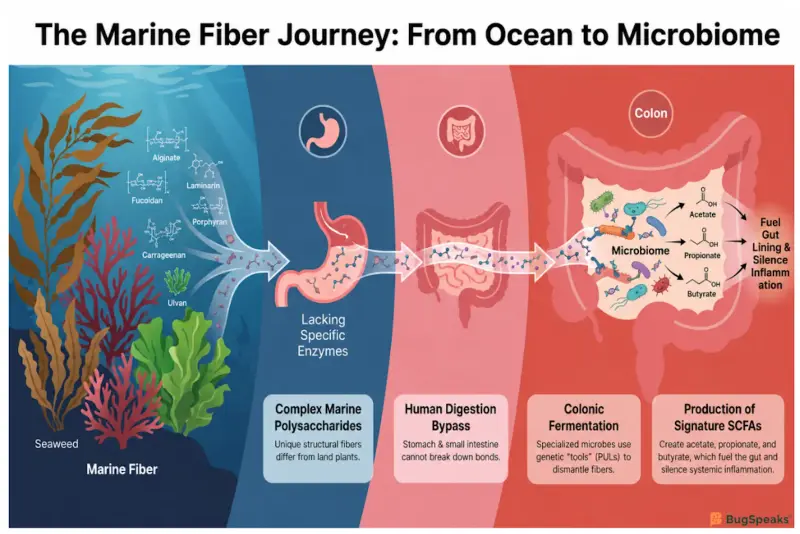
Seaweed brings a brand-new cuisine to our microbial restaurant by supplying unique structural carbohydrates called marine polysaccharides that completely escape human digestion to reach our colonic microbes intact. Because macroalgae grow in highly dynamic, hostile ocean environments characterized by crashing waves, shifting tides, and high salinity, they build incredibly tough, complex cell walls unlike anything found in typical land plantsO'Sullivan et al. (2010). These marine superfoods are divided into three major color-coded families based on their pigments: brown seaweeds (Phaeophyceae), red seaweeds (Rhodophyta), and green seaweeds (Chlorophyta), each offering distinct nutritional rewardsZang et al. (2023).
Each color group provides its own signature delicacies that represent highly complex prebiotics for our beneficial bacteria. Brown seaweeds serve a robust menu featuring alginate, a linear molecule rich in mannuronic and guluronic acid blocks, while red seaweeds offer carrageenan and porphyranO'Sullivan et al. (2010). Green seaweeds complete this underwater banquet with ulvan, which is a highly complex sulfated heteropolysaccharideShannon et al. (2021). Because human digestive enzymes lack the proper molecular keys to unlock these specialized chemical bonds, these unique compounds pass through our stomach completely untouched, delivering a pristine, rich feast directly to our colonic microbesShannon et al. (2021).
These marine polysaccharides act as complex mystery boxes delivered directly to the kitchen of our lower digestive tract. While normal, highly processed land carbohydrates are easily torn apart by our saliva, these seaweeds are incredibly stable and resistant to acid hydrolysisZhao et al. (2026). Consuming these seaweeds expands the menu available to certain microbes, introducing a premium foreign cuisine that keeps our inner restaurant exciting and diverse. By consistently serving this new cuisine, we provide our biological tasters with the tough structural fibers they need to stay strong, healthy, and fully activeZhao et al. (2026).
How do gut microbes break down these complex marine fibers?
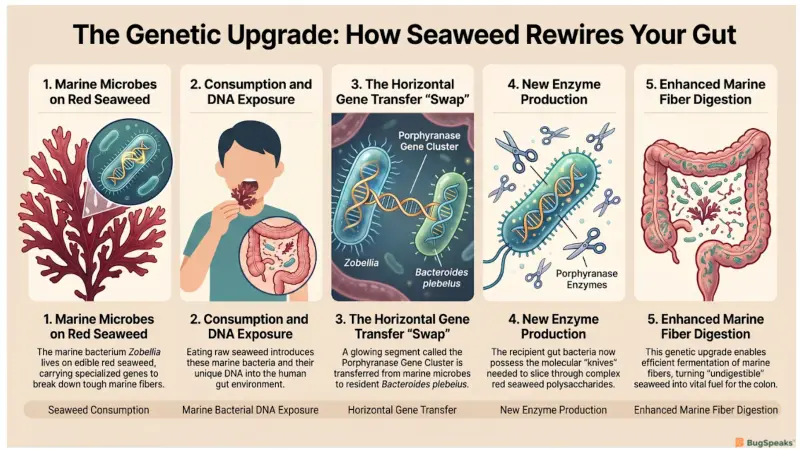
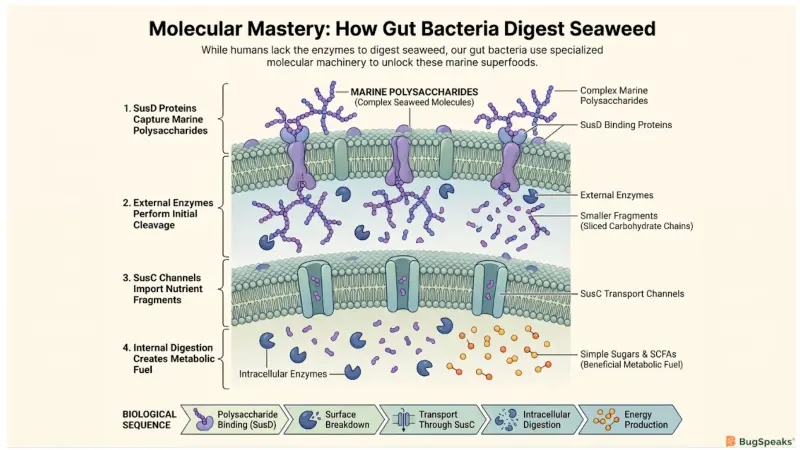
Gut microbes break down complex marine fibers using specialized clusters of genes called polysaccharide utilization loci (PULs) that code for specific carbohydrate-active enzymes (CAZymes). These specialized genetic tools function as highly precise, sharp kitchen utensils inside our dining location's busy metabolic kitchenTannock (2023). While human cells do not possess the molecular knives needed to slice marine macroalgae, our gut microbes have evolved a massive genomic arsenal of gene clusters specifically designed for this premium task. Strains like Bacteroides successfully coordinate the capture, surface cleavage, and direct import of these complex sugars, ensuring nothing is ever wasted in the gutTannock (2023).
Inside this metabolic kitchen, different biological tasters possess highly specialized, expert culinary skills to manage the menu. Some bacteria act as keystone chefs that perform the initial difficult work of slicing the largest fiber structures into smaller, soluble piecesTannock (2023). Through a cooperative sharing process called syntrophy, other members of the intestinal dining club utilize these soluble leftovers to fuel their own growth, integrating the community-wide dining roomTannock (2023). This elegant, cooperative cross-feeding ensures that the whole community stays fed and satisfied, preventing a single type of bacterium from monopolizing the premium food resources in the colonic spaceTannock (2023).
The most striking evolutionary adaptation occurs when microbes swap recipes directly with each other through horizontal gene transfer (HGT). In Japanese populations with a traditional diet rich in red seaweeds, a gut-dwelling resident Bacteroides plebeius acquired specific porphyran-digesting genes directly from environmental marine bacteriaTannock (2023). Through this genetic swap-meet, human gut microbes successfully and rapidly downloaded the unique instructions needed to digest this foreign cuisine. This is like a local neighborhood chef inheriting an ancient, foreign family recipe scroll, enabling them to perfectly prepare and serve a brand-new cuisine that other local bistros cannot cook on their ownTannock (2023).
What are the signature dishes produced during this microbial culinary transformation?
The microbial transformation of seaweed polysaccharides yields essential short-chain fatty acids (SCFAs) that serve as primary metabolic fuel, reinforce our gut barrier, and calm cellular inflammation. This chemical transformation represents our master microbial chefs creating their metabolic dishes. The primary nutritional products, or signature dishes, generated during this physical digestion process are the saturated fatty acids acetate, propionate, and butyrateShannon et al. (2021). Each acid provides a distinct, highly valuable service to our bodies, with butyrate acting as the main energy source for the colonocytes lining our colonic walls to keep them strong and healthyTannock (2023).
Beyond serving as basic fuel, these signature metabolic products act as messengers that signal through specialized cellular receptors. By activating G-protein coupled receptors (GPCRs), these fatty acids initiate cascades that silence inflammation and stabilize our intestinal structureOu et al. (2022). This local messaging upregulates tight junction proteins, which seal the gut lining like a freshly polished floor to block toxic compounds from leaking into our bloodstreamZang et al. (2023). Simultaneously, the fermentation stimulates specialized cells to produce mucin-2 (Muc-2), which forms a thick, slippery protective layer that coats the mucosal surfaces and protects our cellsOu et al. (2022).
These short-chain fatty acids are the ultimate comfort foods for our intestinal dining room, polishing the walls and maintaining local peace. Propionate travels to the liver to undergo gluconeogenesis (the synthesis of glucose), while acetate enters general circulation to support lipid metabolismTannock (2023). Without these essential, high-quality nutritional products, our intestinal tables remain completely unpolished, the walls weaken, and painful cellular stress increases. Consistently supplying seaweed prebiotics ensures that our internal restaurant keeps generating these protective comfort dishes, maintaining robust systemic energy balance and structural integrity throughout the entire bodyZhao et al. (2026).
How does serving this marine menu protect us from metabolic diseases?
Serving this marine menu protects us from metabolic diseases by selectively restructuring our gut microbial community, shifting the balance away from dangerous pathobionts and toward beneficial symbionts. Consistent seaweed consumption prevents our inner restaurant from falling into structural chaos, also known as dysbiosisOu et al. (2022). These specialized marine prebiotics actively reverse the Firmicutes/Bacteroidetes (F/B) ratio associated with obesity, selectively feeding elite culinary critics such as Akkermansia muciniphila to keep us healthyZang et al. (2023). At the same time, this menu starves out toxic, inflammatory troublemakers like Desulfovibrio, keeping our intestinal environment healthy Zang et al. (2023).
This selective dining shift delivers profound, widespread systemic benefits that dramatically improve the host's overall metabolic health. Feeding the beneficial biological tasters lowers metabolic endotoxemia (inflammation from bacterial parts) by stopping the inflammatory lipopolysaccharide (LPS) toxins from leaking across our gut barrier and triggering systemic oxidative stress and cell damageZang et al. (2023). Furthermore, specialized marine polysaccharides like Sargassum fusiforme fucoidan trigger a significant increase in circulating, protective bile acids like tauroursodeoxycholic acid (TUDCA) in the bodyZhao et al. (2026). This metabolic messenger actively silences inflammatory pathways in fat cells and corrects lipid disordersZhao et al. (2026).
Ultimately, expanding our daily dining menu to include seaweed superfoods ensures that our master microbial chefs are always fully supplied with raw materials. By giving our microbes the raw structural ingredients they need to do their biological jobs, we protect our bodies from obesity-related insulin resistance, fatty liver disease, and systemic inflammationZhao et al. (2026). Serving this marine menu transforms our internal dining hall into a highly efficient, resilient hub of health, showing that the most powerful superfoods for our gut microbiome are actually harvested deep within our oceans, waiting for us to try themShannon et al. (2021).
Visualize the process- https://youtu.be/23kL6RlO3kg
Reference
Ou J, Wang Z, Liu X, Song B, Chen J, Li R, Jia X, Huang R, Xiang W, Zhong S. Regulatory effects of marine polysaccharides on gut microbiota dysbiosis: A review. Food Chem X. 2022 Sep 9;15:100444. doi: 10.1016/j.fochx.2022.100444. PMID: 36211733; PMCID: PMC9532782.’
Zhao, X., Huang, S., Wei, Y., Wang, D., Li, C., Pan, C., Wang, Y., Xiang, H., Yu, G., & Zhao, Y. (2026). Marine Bioactive Substances in Precision Nutrient Delivery to the Gut and Advances in Microbiome Regulation: A Narrative Review. Foods, 15(3), 545. https://doi.org/10.3390/foods15030545
Shannon E, Conlon M, Hayes M. Seaweed Components as Potential Modulators of the Gut Microbiota. Mar Drugs. 2021 Jun 23;19(7):358. doi: 10.3390/md19070358. PMID: 34201794; PMCID: PMC8303941.
Zang L, Baharlooeian M, Terasawa M, Shimada Y and Nishimura N (2023) Beneficial effects of seaweed-derived components on metabolic syndrome via gut microbiota modulation. Front. Nutr. 10:1173225. doi: 10.3389/fnut.2023.1173225
O'Sullivan L, Murphy B, McLoughlin P, Duggan P, Lawlor PG, Hughes H, Gardiner GE. Prebiotics from marine macroalgae for human and animal health applications. Mar Drugs. 2010 Jul 1;8(7):2038-64. doi: 10.3390/md8072038. PMID: 20714423; PMCID: PMC2920542.
Tannock GW. Understanding the gut microbiota by considering human evolution: a story of fire, cereals, cooking, molecular ingenuity, and functional cooperation. Microbiol Mol Biol Rev. 2024 Mar 27;88(1):e0012722. doi: 10.1128/mmbr.00127-22. Epub 2023 Dec 21. PMID: 38126754; PMCID: PMC10966955.