Why does looking at a smartphone screen during meals disrupt your body's digestion?
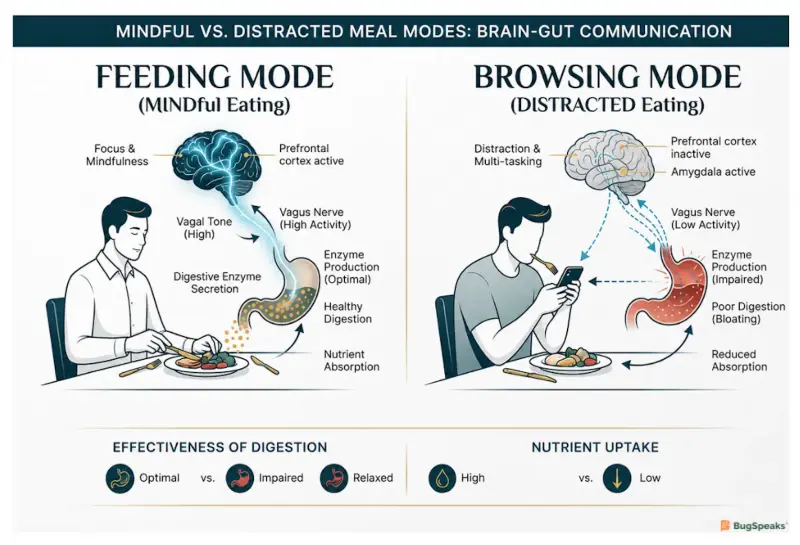
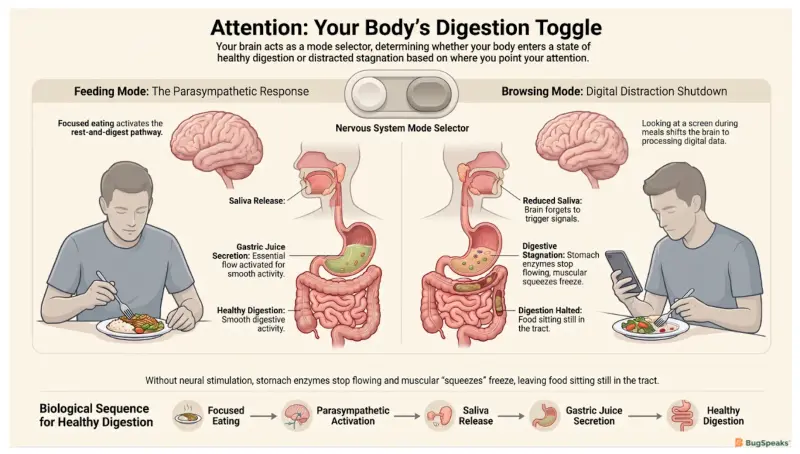
Looking at a smartphone screen during a meal disrupts your digestion because your brain cannot coordinate the neural signals needed to digest food while you are actively processing digital information. When you sit down to eat, your nervous system acts as a mode selector that should switch your body into feeding mode. In this special mode, your brain sends messages to your mouth and stomach to start producing saliva and stomach juices. However, if you look at a screen, your brain switches to browsing mode. This split attention means your brain completely forgets to trigger the essential digestive signals, halting your body's normal digestive responses.
This screen-induced interruption blocks the cephalic phase of digestion, which is the brain-driven stage where just seeing and smelling food prepares your body to digest. Under normal conditions, your brain uses the parasympathetic nervous system, or PSNS, to run this processCherpak (2019). The PSNS is your body's rest-and-digest pathway, and it must dominate for your stomach to work. When you choose to scroll through social media, your brain diverts its energy away from this pathway. Without this neural stimulation, your stomach simply cannot release the enzymes and acids required to break down your meal properlyCherpak (2019).
In daily life, this means your food sits in your stomach without being broken down, which often leads to painful gastrointestinal symptoms like stomach pain, bloating, gas, and severe indigestionCherpak (2019). Your stomach relies on strong muscular squeezes to mix food with enzymes, but these actions require direct instructions from your enteric nervous system, or ENS. The ENS is the special web of nerves in your gut that acts as a second brainCherpak (2019). When screen time stops the rest-and-digest signals, the ENS cannot coordinate these squeezes. As a result, your digestion stops, leaving your food sitting completely still inside your digestive tract.
How does a distracted brain change the way food actually tastes?
A distracted brain changes the way food tastes by reducing your ability to perceive the intensity and pleasantness of different flavors on your tongue. When you play a game or look at pictures while eating, your attention is split between the screen and your meal. This lack of focus means your brain does not fully process the taste signals sent from your mouth. The science shows that people who are highly distracted during a meal experience a major drop in their chemosensory perceptionRuda et al. (2024). Because your brain is busy with the phone, your food will taste very bland.
This drop in flavor is directly linked to how hard your brain has to work while you are distracted by your screen. When your mind is busy solving puzzles or reading posts, your brain has a very high cognitive load. Studies show that a high cognitive load decreases your brain's processing of taste intensity, meaning you cannot perceive how strong a flavor isRuda et al. (2024). Since your mental resources are limited, your brain cannot pay attention to both the game and the flavors. Therefore, the simple act of looking at a phone makes your favorite food taste far less intense.
This loss of flavor enjoyment can actually cause you to make poorer food choices because you are no longer satisfied with your meal. When you do not experience the normal pleasantness of your food, your brain does not feel rewarded by the eating experienceRuda et al. (2024). This can make you crave much stronger and unhealthier flavors, like foods that are extremely sweet or salty. You might end up adding extra salt or sugar to your plate just to make it taste like something good. This shows that a distracted brain directly ruins your natural appreciation for healthy, nutritious foods.

Why does eating while scrolling on your phone change how much you eat?
Eating while scrolling on your phone changes your food intake by weakening your memory of the meal, which can lead you to eat more snacks later. When you watch a screen, your brain fails to create a strong mental record of the food you are consuming. In scientific studies, researchers used a brain test called Rapid Visual Information Processing, or RVIP, to distract eating participantsLiguori et al. (2020). The results showed that these distracted eaters could not remember how much food they had been given. Because their brains did not register the meal properly, their memory of the experience was completely blurred.
This lack of meal memory can lead to poor metabolic health because your body does not know when to stop eating throughout the day. Satiety, which is the feeling of being full and satisfied after eating, is a key behavioral outcome that depends on your brain registering the foodLiguori et al. (2020). When screen time blocks this process, your brain does not receive the normal signals that you have eaten enough. Your hormonal cues can be easily overridden by these digital distractions. This means you are much more likely to keep eating because your brain thinks you are still starving.
In fact, studies show that distracted eating can cause a strange mix of eating too little at first and then overeating laterAslam (2025). When you are highly focused on a screen, you might stop eating your healthy meal early because you are too busy to chew. This prevents you from reaching full satiety, leaving your body physically empty and unsatisfied. A few minutes after you put the phone down, your brain realizes you need more energy, which triggers a massive craving for quick snacks. This leads to unhealthy eating cycles that confuse your metabolism, which can make you gain weight and feel very tired.
How does stress from doomscrolling physically shut down your stomach?
Stress from doomscrolling physically shuts down your stomach by activating emergency hormone pathways that stop your digestive organs from moving. When you scroll through scary online news or very stressful social media posts, your brain senses a threat. This activates your body's stress response, causing your brain to release a chemical called corticotropin-releasing factor, or CRFStengel & Taché (2009). This stress hormone acts as a powerful chemical messenger that tells your body to prepare for a dangerous emergency. Instead of focusing on digesting your lunch, your body prepares to run away or fight, which instantly puts your stomach on hold.
This hormone triggers specific receptors in your gut that act as emergency switches to completely halt your digestive response. The stress hormone binds to specific targets in your digestive tract, causing a massive delay in your gastric emptying, which is the speed at which food leaves your stomachStengel & Taché (2009). This means the muscular contractions of your stomach stop, and food just sits there. While your brain is focused on the screen, your upper digestive tract is frozen. This can make you feel extremely nauseous and full, even if you have barely eaten any healthy food on your plate.
If you do this every day, this constant stress can lead to long-term cortisol dysfunction, which damages your gut lining and causes widespread inflammationSic et al. (2024). Persistently high stress hormones make the walls of your intestines weak and leaky. This allows harmful waste and bacteria to pass into your bloodstream, which can trigger painful conditions like inflammatory bowel disease, which causes major stomach pain. It also disrupts your gut's healthy bacteria, including protective strains like Lactobacillus, Bifidobacterium, Akkermansia muciniphila, Faecalibacterium prausnitzii, Prevotella, and Coprococcus, creating an unbalanced environment that hurts your immune system.
What simple changes can help you reset your body's mode selector for optimal digestion?
Simple lifestyle changes can help you reset your nervous system's mode selector by actively promoting a calm state that allows your body to digest food properly. The absolute most important change you can make today is to remove your smartphone from the table before you sit down to eat. By creating a screen-free space, you allow your brain to switch out of browsing mode and back into feeding modeCherpak (2019). This simple step helps your brain focus entirely on the meal in front of you. This focus is the first step toward restoring your body's natural feeding response and healthy stomach actions.
You can also use simple relaxation practices to activate your vagus nerve, which is the main highway connecting your brain to your gut. Taking three deep, slow, and relaxing breaths before your first bite can instantly shift your body into a calm stateCherpak (2019). This immediately activates your autonomic nervous system, which coordinates all of the automatic functions inside your body, like your heart and stomach. When this system is in a relaxed state, it sends powerful signals to your salivary glands and stomach. This triggers the release of the essential digestive enzymes needed to break down your food into tiny absorbable nutrients.
Finally, practicing mindfulness by fully engaging your senses while you eat will help you feel more satisfied and prevent unhealthy overeating later in the dayCherpak (2019). Simply paying attention to the beautiful colors of your food, smelling the rich aromas, and chewing slowly can completely transform your digestion and boost your energy. Chewing each bite thoroughly physically breaks down your food and gives your brain time to register the meal. This creates a strong memory of the eating experience, helping your body recognize natural satiety cues. By eating mindfully, you protect your gut, help your body stay strong, and enjoy your food much more.
Visualize the process- https://youtu.be/A2pStmIxMI8
Reference
Stengel, A., & Taché, Y. (2009). Neuroendocrine control of the gut during stress: corticotropin-releasing factor signaling pathways in the spotlight. Annual review of physiology, 71, 219–239. https://doi.org/10.1146/annurev.physiol.010908.163221
Zhang R, Zhang M and Wang P (2025) The intricate interplay between dietary habits and cognitive function: insights from the gut-brain axis. Front. Nutr. 12:1539355. doi: 10.3389/fnut.2025.1539355
Hameed, M., Noor, F., Hussain, H., Khan, R. G., Khattak Haroon Ur Rashid, S., Haroon Ur Rashid, S., Atiq, A., Ali, H., Rida, S. E., & Abbasi, M. A. (2024). Gut-Brain Axis: Investigating the Effects of Gut Health on Cognitive Functioning in Adults. Cureus, 16(7), e64286. https://doi.org/10.7759/cureus.64286
Liguori, C. A., Nikolaus, C. J., & Nickols-Richardson, S. M. (2020). Cognitive distraction at mealtime decreases amount consumed in healthy young adults: A randomized crossover exploratory study. The Journal of nutrition, 150(5), 1324-1329.
Ruda, I., Chellapandian, D. C., & Freiherr, J. (2024). The impact of cognitive distraction on gustatory perception in volunteers with obesity. Scientific Reports, 14(1), 14268.
Aslam M. S. (2025). Exploring the impact of mobile device use on mealtime distractions and its consequences for metabolic health: A narrative minireview. World journal of clinical cases, 13(17), 99924. https://doi.org/10.12998/wjcc.v13.i17.99924
Peng, Y., Huang, M., Sun, X., Ling, W., Hao, X., Huang, G., Wu, X., Chen, Z., & Tang, X. (2025). Double-Edged Sword: Urbanization and Response of Amniote Gut Microbiome in the Anthropocene. Microorganisms, 13(8), 1736. https://doi.org/10.3390/microorganisms13081736
Vinogradova, E., Mukhanbetzhanov, N., Nurgaziyev, M., Jarmukhanov, Z., Aipova, R., Sailybayeva, A., Bekbossynova, M., Kozhakhmetov, S., & Kushugulova, A. (2024). Impact of urbanization on gut microbiome mosaics across geographic and dietary contexts. mSystems, 9(10), e0058524. https://doi.org/10.1128/msystems.00585-24
Cherpak C. E. (2019). Mindful Eating: A Review Of How The Stress-Digestion-Mindfulness Triad May Modulate And Improve Gastrointestinal And Digestive Function. Integrative medicine (Encinitas, Calif.), 18(4), 48–53.
Sic, A., Cvetkovic, K., Manchanda, E., & Knezevic, N. N. (2024). Neurobiological Implications of Chronic Stress and Metabolic Dysregulation in Inflammatory Bowel Diseases. Diseases (Basel, Switzerland), 12(9), 220. https://doi.org/10.3390/diseases12090220