What Are Short-Chain Fatty Acids and Where Do They Come From?
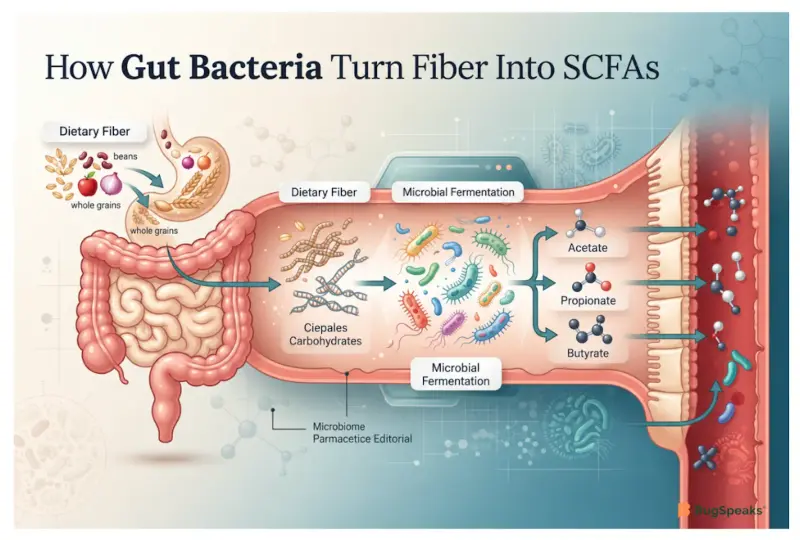
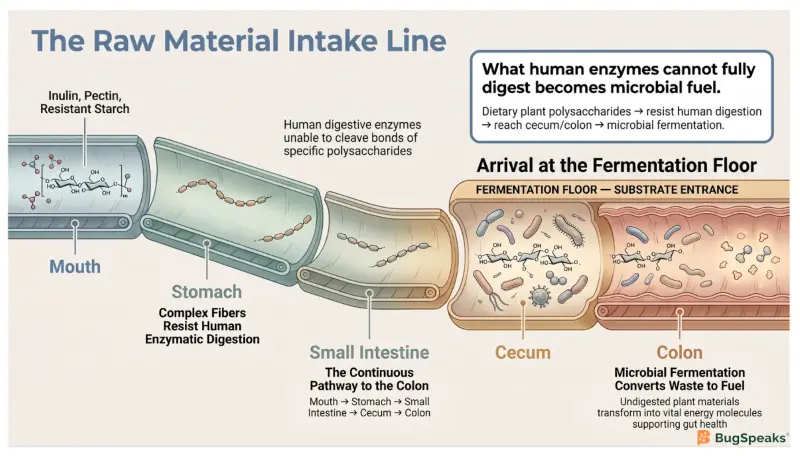
Short-chain fatty acids (SCFAs) are tiny, healthy molecules made by good gut bacteria when they digest the dietary fiber your body cannot break down on its ownRamos Meyers et al. (2022). When you eat fibrous foods like apples, beans, or oats, these materials travel all the way down to your large intestine because your human gut cannot digest themFacchin et al. (2024). Your gut microbes acts as specialized workers in a biological factory, waiting to process these raw materials. They break down the fiber through a chemical digestion process called fermentationXiong et al. (2022). This cooperative teamwork converts otherwise useless plant materials into highly valuable energy molecules that your body can immediately use to support your daily health.
The microscopic factory in your colon produces three main types of energy molecules, which are called acetate, propionate, and butyrateRamos Meyers et al. (2022). These tiny chemical compounds are made of short chains of carbon atoms, which is why scientists group them under this fatty acid categoryFacchin et al. (2024). Together, these three molecules represent more than ninety-five percent of the total energy products generated by your busy microbial workforce. Each of these molecules has a very specific job to do once they are shipped out of the bacterial factory cells. They enter your bloodstream to help power your organs, control your hunger, and regulate your overall metabolic balance.
Your body relies heavily on this external workforce because your human cells simply do not have the right machinery to break down complex plant fibersRamos Meyers et al. (2022). Without these helpful bacteria, the fiber you eat would pass straight through your digestive tract without providing any nutritional benefits to your bodyXiong et al. (2022). By fermenting these tough plant fibers, your microbes unlock hidden energy and produce molecules that strengthen your gut lining and support your immune system. This makes the gut factory a perfect example of a healthy, supportive, and mutual relationship where you feed your microbes and they keep your entire physical body working very well.
How Does the Fiber-to-SCFA Factory Actually Work?
The fiber-to-SCFA factory works by passing tough, undigested food fibers through a cooperative biological assembly line of specialized gut bacteria, including primary fiber degraders like Bifidobacterium and Bacteroides, as well as secondary butyrate-producing converters like Faecalibacterium prausnitzii, Roseburia, Eubacterium hallii, and Anaerostipes caccaeFacchin et al. (2024). First, primary shredders in your gut break down the large, complex fibers into smaller pieces of sugar. Without this initial shredding step, the other bacteria in your colon would not be able to access the energy locked inside the tough plant walls. This initial preparation makes the entire microbiota community much more efficient at processing the foods you eat every day.
Once the primary shredders finish their work, they release simpler sugars and acids that secondary factory workers use as fuelFacchin et al. (2024). The simple sugars and intermediate fuels released by primary degraders include monosaccharides and oligosaccharides like fructose, glucose, xylose, and galactose, alongside organic acid intermediates like lactate and acetate. This process of sharing resources is called cross-feeding, which keeps the entire bacterial community stable and highly productiveRamos Meyers et al. (2022). For example, some bacteria produce lactic acid as waste, but other species consume this waste to manufacture butyrate. This metabolic cooperation ensures that no energy goes to waste inside your colon, creating a highly efficient loop. Because these microbes work together, they can produce a steady stream of beneficial molecules to support your daily wellness, physical strength, and longevity. After the gut microbes finish fermenting the fibers, the newly made short-chain fatty acids must be shipped out to your bodyFacchin et al. (2024). Specialized molecular conveyor belts, which scientists call monocarboxylate transporters (MCTs), carry these molecules across the cells of your intestinal wallRamos Meyers et al. (2022). The primary cellular transporters responsible for moving short-chain fatty acids across different departments of your body are monocarboxylate transporter 1 (MCT1), monocarboxylate transporter 4 (MCT4), and sodium-coupled monocarboxylate transporter 1 (SMCT1). Acetate enters your general blood circulation to reach your brain and muscles, while propionate travels directly to your liver to assist with sugar regulation. This transport system ensures that every single organ receives its proper share of microbial energy.
Why Is Butyrate the Most Important Fuel for Your Gut Wall?
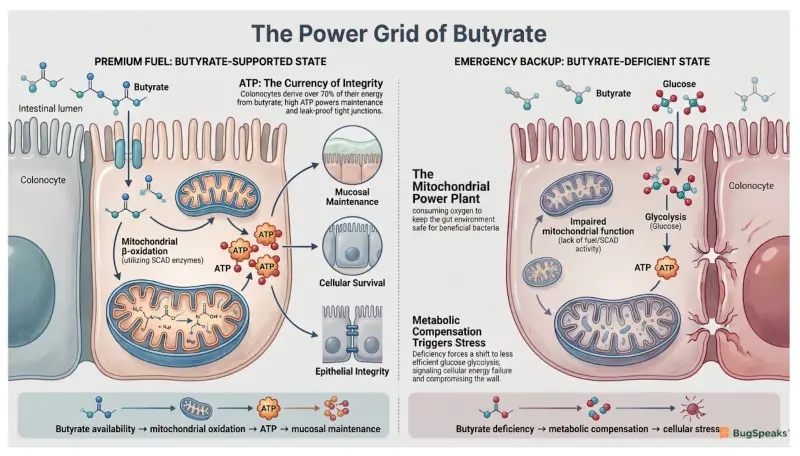
Butyrate is the primary source of energy for your colon cells, acting as the main fuel that keeps your gut wall strong and healthyFacchin et al. (2024). The cells that line your large intestine, called colonocytes, do not get their energy from your bloodstream like other cells in your body doRamos Meyers et al. (2022). Instead, they eat butyrate directly from the inside of your gut, using it to power their daily work. This makes butyrate the absolute favorite meal for these hard-working gut cells, providing them with more than seventy percent of their total energy. Without a steady supply of this microbial fuel, your gut cells would quickly starve and fail.
Inside your gut cells, special cellular power plants called mitochondria burn butyrate to generate energy through a clean chemical process known as beta-oxidationRamos Meyers et al. (2022). This biological burning process requires oxygen, which your gut cells actively pull from the surrounding tissues of your intestinal wall. By burning butyrate and consuming this oxygen, your gut cells perform a crucial second job: they keep the inside of your colon completely free of oxygen. This oxygen-free environment is essential because the most helpful gut bacteria are strict obligate anaerobes like Faecalibacterium prausnitzii, Roseburia intestinalis, Eubacterium rectale, Akkermansia muciniphila, and Anaerostipes caccae, which cannot survive in the presence of oxygen. Therefore, burning butyrate keeps both your gut cells alive and your beneficial bacteria safe. When your gut cells cannot get enough butyrate fuel, they stop burning oxygen, and their entire energy system begins to shut downDallas Donohoe (2024). This failure allows oxygen to leak into the colon, destroying the oxygen-free environment that your good gut microbes need to surviveXie et al. (2026). As oxygen levels rise, the helpful bacteria die off, and harmful bacteria that love oxygen are facultative anaerobic pathobionts from the Enterobacteriaceae family, such as Escherichia coli (E. coli) and Salmonella, can easily take over your gut. This shift can lead to painful swelling, gas, and serious damage to your delicate intestinal lining. Therefore, feeding your gut microbes enough fiber ensures a continuous supply of butyrate, which keeps the oxygen-free environment secure and healthy.
How Do Short-Chain Fatty Acids Protect Your Body from Inflammation?
Short-chain fatty acids protect your body from inflammation by shutting down harmful inflammatory signals and acting as natural gene controllers in your immune cellsWang et al. (2025). Inside your immune cells, certain enzymes called histone deacetylases (HDACs) act like tight packing straps that keep your anti-inflammatory genes turned off and locked awayFacchin et al. (2024). Butyrate acts as a natural inhibitor of these packing enzymes, snipping the straps and opening up your DNA. This allows your cells to read the instructions for calming down swelling and producing peaceful immune cells. By acting as epigenetic regulators, these fatty acids directly control how your body responds to stressful situations.
Another way these amazing molecules defend your body is by building and repairing a strong physical wall in your intestinesPérez-Reytor et al. (2021). This protective wall is made of cells held together by tight junction proteins, which act like strong glue sealing the spaces between cellsTabat et al. (2020). These microscopic seals prevent toxic substances and harmful bacteria from escaping your gut and entering your bloodstream. Short-chain fatty acids trigger your cells to make much more of this protective cellular glue, making the epithelial barrier tight and leak-proof. Keeping this wall secure is absolutely essential for stopping long-term swelling and protecting your entire body from chronic diseases.
Finally, short-chain fatty acids help train your immune system to distinguish between friendly gut microbes and dangerous foreign invadersWang et al. (2025). By interacting with special receptors on your immune cells, these molecules promote the growth of peaceful defender cells called regulatory T cells (Tregs)Facchin et al. (2024). These specialized cells act like friendly security guards that calm down excessive immune reactions before they can cause damage to healthy tissues. They also release calming chemical signals that tell the rest of your physical body that everything is safe and balanced. This constant communication helps prevent your immune system from overreacting and causing unnecessary inflammation throughout your body.
Can Exercise and Diet Help Your Gut Factory Produce More SCFAs?
You can help your gut factory produce more short-chain fatty acids by eating more prebiotic fibers and engaging in regular physical exerciseXie et al. (2026). Prebiotics are specific types of healthy dietary fibers found in foods like garlic, onions, bananas, and whole grains that selectively feed your beneficial gut bacteria, including health-promoting strains like Bifidobacterium, Lactobacillus, Faecalibacterium prausnitzii, Roseburia, and Akkermansia muciniphilaRamos Meyers et al. (2022). These foods act as high-quality raw materials that feed your microbial workforce, allowing them to multiply and produce more health-promoting molecules. When you eat plenty of prebiotics, you give your bacteria the exact fuel they need to keep the biological assembly lines running smoothly. This simple dietary habit keeps your gut factory active, productive, and strong.
In addition to eating fiber, engaging in regular aerobic exercise is another fantastic way to boost your gut's molecular productionXie et al. (2026). Aerobic exercise helps your gut by removing unwanted oxygen, providing fresh food for good microbes, building extra doorways to absorb healthy energy, and keeping food moving at the perfect speed for fiber digestion. When you jog, cycle, or swim, your body increases blood flow to your digestive system and stimulates the movement of your gut walls. This physical activity creates a highly favorable environment that encourages the growth of beneficial, butyrate-producing bacteria. These active gut microbes thrive when you move, leading to much higher levels of protective fatty acids in your colon. Therefore, regular physical exercise acts like a natural motivator that keeps your microbial workforce energized and ready to produce more protective energy.
The ultimate way to maximize your gut's production is by combining both fiber and exercise in a daily synergy formulaXie et al. (2026). When you eat fiber and exercise regularly, you create a powerful cooperative effect that is much stronger than doing either habit alone. The fiber provides the essential raw materials, while your physical movement acts as the power boost that helps the bacteria ferment those materials more efficiently. This combination helps maintain a healthy gut barrier, reduces body-wide inflammation, and improves your mental focus and physical energy. By combining movement and nutrition, you keep your internal factory operating at its very best.
Visualize the process- https://youtu.be/_yRvCYJDz20
Reference
Park, B., Kim, J. Y., Riffey, O. F., Walsh, T. J., Johnson, J., & Donohoe, D. R. (2024). Crosstalk between butyrate oxidation in colonocyte and butyrate-producing bacteria. iScience, 27(9), 110853.https://doi.org/10.1016/j.isci.2024.110853
Singh V, Lee G, Son H, Koh H, Kim ES, Unno T and Shin J-H (2023) Butyrate producers, “The Sentinel of Gut”: Their intestinal significance with and beyond butyrate, and prospective use as microbial therapeutics. Front. Microbiol. 13:1103836. doi: 10.3389/fmicb.2022.1103836
Gasaly, N., Hermoso, M. A., & Gotteland, M. (2021). Butyrate and the Fine-Tuning of Colonic Homeostasis: Implication for Inflammatory Bowel Diseases. International journal of molecular sciences, 22(6), 3061.https://doi.org/10.3390/ijms22063061
Wang, J., Zhao, Q., Zhang, S., Liu, J., Fan, X., Han, B., Hou, Y., & Ai, X. (2026). Microbial short chain fatty acids: Effective histone deacetylase inhibitors in immune regulation (Review). International journal of molecular medicine, 57(1), 16.https://doi.org/10.3892/ijmm.2025.5687
Hull, E. E., Montgomery, M. R., & Leyva, K. J. (2016). HDAC Inhibitors as Epigenetic Regulators of the Immune System: Impacts on Cancer Therapy and Inflammatory Diseases. BioMed research international, 2016, 8797206.https://doi.org/10.1155/2016/8797206
Sadia, K., Castagna, A., Udali, S., Ambrosani, F., Pattini, P., Beri, R., Argentino, G., Masutti, M., Moruzzi, S., & Friso, S. (2025). Epigenetic Regulation Through Histone Deacetylation: Implications and Therapeutic Potential in Hepatocellular Carcinoma. Cells, 14(17), 1337.https://doi.org/10.3390/cells14171337
Gerbeth L and Glauben R (2021) Histone Deacetylases in the Inflamed Intestinal Epithelium—Promises of New Therapeutic Strategies. Front. Med. 8:655956. doi: 10.3389/fmed.2021.655956
Tabat, M. W., Marques, T. M., Markgren, M., Löfvendahl, L., Brummer, R. J., & Wall, R. (2020). Acute Effects of Butyrate on Induced Hyperpermeability and Tight Junction Protein Expression in Human Colonic Tissues. Biomolecules, 10(5), 766.https://doi.org/10.3390/biom10050766
Pérez-Reytor D, Puebla C, Karahanian E and García K (2021) Use of Short-Chain Fatty Acids for the Recovery of the Intestinal Epithelial Barrier Affected by Bacterial Toxins. Front. Physiol. 12:650313. doi: 10.3389/fphys.2021.650313
Tabat, M. W., Marques, T. M., Markgren, M., Löfvendahl, L., Brummer, R. J., & Wall, R. (2020). Acute Effects of Butyrate on Induced Hyperpermeability and Tight Junction Protein Expression in Human Colonic Tissues. Biomolecules, 10(5), 766.https://doi.org/10.3390/biom10050766
Qin, X., Chen, M., He, B., Chen, Y., & Zheng, Y. (2025). Role of short-chain fatty acids in non-alcoholic fatty liver disease and potential therapeutic targets. Frontiers in microbiology, 16, 1539972.https://doi.org/10.3389/fmicb.2025.1539972
Li, S., Liu, M., Cao, S., Liu, B., Li, D., Wang, Z., Sun, H., Cui, Y., & Shi, Y. (2023). The Mechanism of the Gut-Brain Axis in Regulating Food Intake. Nutrients, 15(17), 3728.https://doi.org/10.3390/nu15173728
Xie J, Zhang J, Zhang L and Chen X (2026) Exercise prescription for mood and cognition: targeting the microbiota-gut-brain axis through short-chain fatty acids. Front. Microbiol. 17:1740680. doi: 10.3389/fmicb.2026.1740680
Silva, Y. P., Bernardi, A., & Frozza, R. L. (2020). The Role of Short-Chain Fatty Acids From Gut Microbiota in Gut-Brain Communication. Frontiers in endocrinology, 11, 25.https://doi.org/10.3389/fendo.2020.00025
Culp, E. J., & Goodman, A. L. (2023). Cross-feeding in the gut microbiome: Ecology and mechanisms. Cell host & microbe, 31(4), 485–499.https://doi.org/10.1016/j.chom.2023.03.016
Inokuma, K., Sasaki, D., Shintani, T., Inoue, J., Oyama, K., Noda, Y., Maeda, T., Yamada, R., Matsuki, Y., Kodama, Y., & Kondo, A. (2025). Combination of probiotics enhancing butyrogenesis in colonic microbiota model of patients with ulcerative colitis. Applied microbiology and biotechnology, 109(1), 117.https://doi.org/10.1007/s00253-025-13424-2
Facchin, S., Bertin, L., Bonazzi, E., Lorenzon, G., De Barba, C., Barberio, B., Zingone, F., Maniero, D., Scarpa, M., Ruffolo, C., Angriman, I., & Savarino, E. V. (2024). Short-Chain Fatty Acids and Human Health: From Metabolic Pathways to Current Therapeutic Implications. Life, 14(5), 559.https://doi.org/10.3390/life14050559
Ramos Meyers, G., Samouda, H., & Bohn, T. (2022). Short Chain Fatty Acid Metabolism in Relation to Gut Microbiota and Genetic Variability. Nutrients, 14(24), 5361.https://doi.org/10.3390/nu14245361
Xiong, R. G., Zhou, D. D., Wu, S. X., Huang, S. Y., Saimaiti, A., Yang, Z. J., Shang, A., Zhao, C. N., Gan, R. Y., & Li, H. B. (2022). Health Benefits and Side Effects of Short-Chain Fatty Acids. Foods (Basel, Switzerland), 11(18), 2863.https://doi.org/10.3390/foods11182863
Mansuy-Aubert V and Ravussin Y (2023) Short chain fatty acids: the messengers from down below. Front. Neurosci. 17:1197759. doi: 10.3389/fnins.2023.1197759