How Does Your Stomach Act as the First Physical Checkpoint When You Eat a Meal?
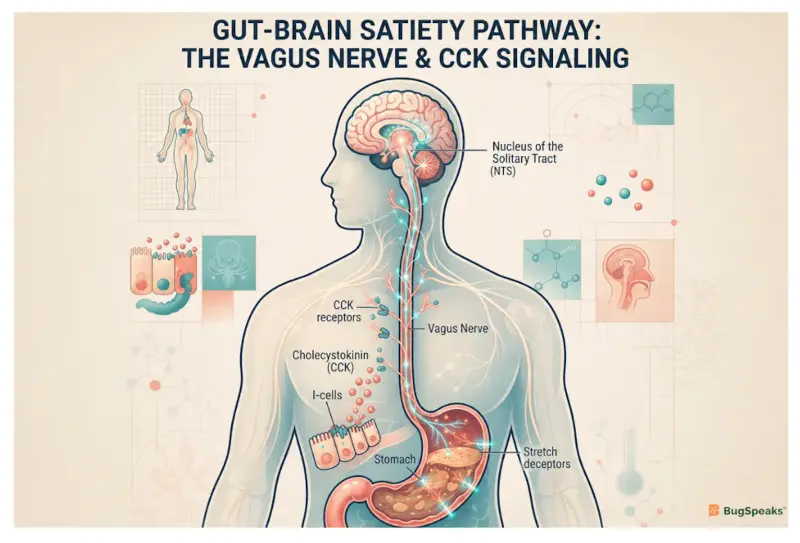
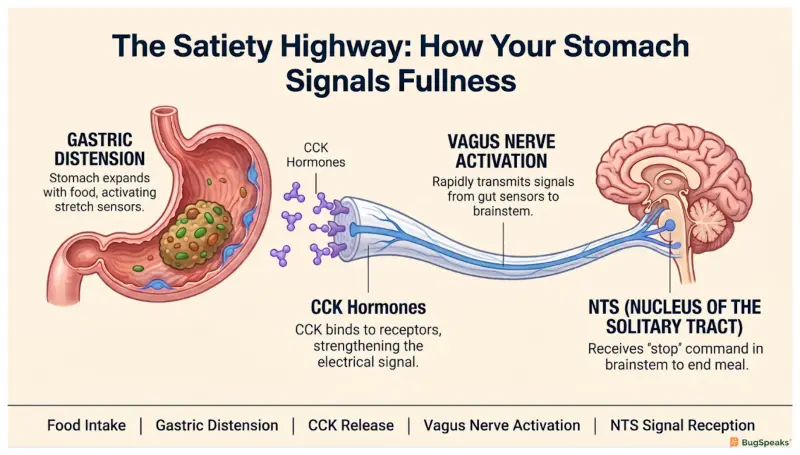
Your stomach acts as the first physical checkpoint by stretching as it fills with food to tell your brain that you are becoming full. When you swallow food, your stomach experiences a process called gastric distension, which simply means it expands like a balloon. Special stretch sensors in the stomach walls measure this expansion and send an immediate message along a highway called the vagus nerveYu et al. (2024). This nerve connects your gut directly to a brain area called the nucleus of the solitary tract (NTS), which is the starting point for deciding if you should stop eating or continue your meal.
At this physical checkpoint, your stomach also releases a helpful hormone called cholecystokinin (CCK) to help slow down your eating. This chemical acts like a helper that tells your stomach to hold onto food longer so your body can digest it properly. The cholecystokinin hormone binds to special cholecystokinin-1 receptors (CCK1R) on the vagus nerve, which strengthens the electrical signals traveling up to your brain. This physical checkpoint is highly effective because it uses both physical stretching and chemical signals to make sure your brain receives the very first message that a delicious meal is currently underwayRomaní-Pérez et al. (2021). This is highly cooperative.
If you eat too quickly, this physical checkpoint might not have enough time to send its signals to your brain. It takes about twenty minutes for these stomach stretch messages and hormones to fully register at the decision node in your head. When you eat slowly, you give your stomach the necessary time to activate these pathways and successfully complete this first step. This prevents you from overeating before the next checkpoints in the system can turn on. Choosing bulky, fiber-rich foods helps stretch your stomach faster, which activates this initial physical checkpoint with fewer total calories consumedMandalari (2020).
Why Are Gut Hormones Considered Crucial Speed Checkpoints in Your Body?
As food leaves your stomach and enters your small intestine, it reaches the hormonal speed checkpoints. These gut hormones act as speed limits that slow down how quickly your stomach empties its food. This hormonal speed checkpoint is crucial because it gives your digestive system enough time to absorb nutrients and send chemical stop signals to your brainRomaní-Pérez et al. (2021). Special cells in your gut walls, called enteroendocrine cells, act as biological sensors that detect when different nutrients like proteins, carbohydrates, and fats arrive, triggering the immediate release of important satiety hormones into your blood. This is a very smart safety measure.
One major speed checkpoint hormone is called glucagon-like peptide-1 (GLP-1), which is released when you eat. This hormone travels through your bloodstream to find its way to a brain region called the arcuate nucleus of the hypothalamusZeng et al. (2023). Once there, it acts as a strong stop signal that makes you feel satisfied. At the same time, glucagon-like peptide-1 tells your pancreas to release insulin, which helps balance your blood sugar levels. This dual action makes it a powerful coordinator of fullness and energy throughout your whole body. It acts as an incredibly fast stop signal that protects your health.
Another important speed checkpoint hormone released from your lower intestine is called peptide YY (PYY). This hormone works closely with the other satiety signals to slow down gut movements and reduce your appetite. By binding to receptors in your brain, peptide YY helps ensure that you remain full for a longer period after you finish eating your mealYu et al. (2024). If your gut does not produce enough of these essential hormones, your hormonal speed checkpoints will fail, and your brain will think you are still starving even when you have eaten plenty of food. This causes severe and highly unwanted overeating.
How Do Gut Bacteria and Their SCFA Metabolites Serve as Supporting Checkpoints?
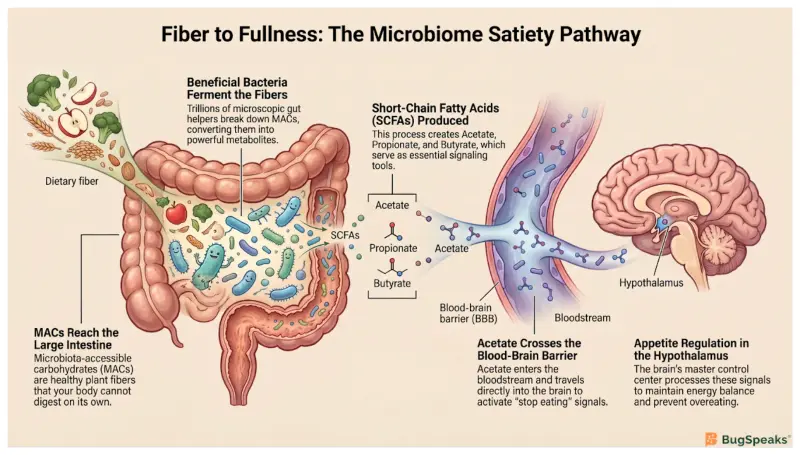
In your large intestine, trillions of gut bacteria act as essential supporting checkpoints in your satiety tree. These microscopic helpers ferment the indigestible parts of your food, specifically microbiota-accessible carbohydrates (MACs), which are healthy fibers your body cannot digest on its ownBerding et al. (2021). By eating a wide variety of plant foods, you feed these beneficial bacteria such as Bifidobacterium, Lactobacillus, Akkermansia, and Faecalibacterium and allow them to thrive. This microbial supporting checkpoint is extremely important because it converts fiber into powerful chemical messengers that talk directly to your gut cells and help them release more satiety hormones to feel full. It is very useful and wonderful.
When gut bacteria ferment these fibers, they produce vital molecules called short-chain fatty acids (SCFAs). These molecules include acetate, propionate, and butyrate, which serve as direct energy sources and signaling toolsLuo et al. (2022). For example, acetate can cross your blood-brain barrier to tell your brain to stop eating, while propionate and butyrate trigger gut cells to release GLP-1 and PYY. This microbial checkpoint provides a steady stream of satiety signals hours after your meal is finished, keeping you from snacking on unhealthy foods between your main meals. It maintains your long-term energy balance, protects metabolic health, and prevents overeating.
Additionally, some next-generation probiotics produce unique proteins that mimic human fullness signals. For example, a beneficial gut bacterium called Hafnia alvei produces a special heat-shock protein called caseinolytic peptidase B (ClpB)Breton et al. (2022). This microbial protein has a structure that looks almost identical to a human satiety hormone, allowing it to directly activate stop signals in your brain. Supplementing your diet with prebiotics and these next-generation probiotics strengthens this supporting checkpoint, making your satiety tree much more efficient at regulating your daily food intake and preventing weight gain over time. This represents a major scientific breakthrough in gut health.
How Does Leptin Act as the Long-Term Checkpoint to Keep Your Satiety Tree Balanced?
Beyond individual mealtimes, your body relies on a long-term checkpoint that acts like an energy sensor. This crucial system is managed by leptin, a hormone produced by your body's adipose tissue, which is simply your fat cellsHu et al. (2025). The more fat cells you have, the more leptin they release into your bloodstream to notify your brain about how much long-term energy your body has stored. This long-term checkpoint tells your brain how much stored energy you have available, helping to keep your overall appetite and metabolic rate stable over weeks and months, rather than just from hour to hour. It keeps your whole body balanced and fully energized.
Under normal conditions, leptin enters your brain and binds to receptors on specific neurons in your hypothalamus. Specifically, it activates anorexigenic proopiomelanocortin (POMC) neurons to trigger satiety and suppresses orexigenic neuropeptide Y (NPY) and agouti-related protein (AgRP) neurons to stop hungerHu et al. (2025). This coordinated action is like a master switch that tells your brain you have plenty of energy stored up, so you do not need to seek out more food. This long-term checkpoint is what keeps your body weight and fat stores in a healthy, stable range over time. It is a perfect, reliable, and highly stable feedback loop.
However, eating too many saturated fats can break this checkpoint, leading to a condition called leptin resistance. This occurs when your brain cells stop responding to leptin signals, making your brain think you are starving. This resistance is driven by low-grade inflammation and toxic lipopolysaccharides (LPS) leaking from an unbalanced gut microbiome where harmful Gram-negative bacteria (like Enterobacteriaceae) have taken over (Pérez-Pérez et al. (2020). Because the brain cannot read the fullness signal, you feel constant, intense hunger. Restoring your gut health with prebiotics and probiotics helps reduce this inflammation, repairing your long-term checkpoint so your brain can finally feel satisfied again.
How Does Your Brain Act as the Final Decision Node for Every Meal?
The brain functions as the final decision node that processes all these satiety signals to determine whether you eat or stop. Located at the top of your satiety system, your brain receives physical stretch messages from your stomach, hormonal signals from your small intestine, and long-term fat notifications from leptinYu et al. (2024). This decision node constantly calculates your body's energy needs to guide your eating behaviors. When your checkpoints work together perfectly, this decision node easily concludes that you are full, and you naturally put down your fork without needing willpower. It makes the final stop choice for eating.
However, modern processed foods are specifically designed to bypass this final decision node by triggering your brain's reward centers. When you eat food, your brain releases a pleasure chemical called dopamine in a region called the dorsal striatumMcDougle et al. (2024). This release of dopamine makes eating feel good, motivating you to repeat the behavior. Normally, satiety hormones like GLP-1 and PYY turn down this reward system once you are full. This ensures that eating is pleasurable when you need energy, but stops being rewarding once your checkpoints are satisfied. It maintains perfect balance and a healthy, natural appetite.
But processed foods contain high amounts of both fat and sugar, which activate separate gut-brain reward circuits at the same time. These separate circuits send independent signals to your brain, resulting in a massive surge of dopamine that overpowers your checkpointsMcDougle et al. (2024). This combination hijacks the final decision node, causing you to overeat even if your stomach is full. Understanding this explains why conscious dieting is so difficult, and why choosing whole, fiber-rich foods is the best way to keep your satiety checkpoints working properly.
Visualize the process- https://youtu.be/An8m4UFHaFY
Reference
Luo, P., Lednovich, K., Xu, K., Nnyamah, C., Layden, B. T., & Xu, P. (2022). Central and peripheral regulations mediated by short-chain fatty acids on energy homeostasis. Translational research : the journal of laboratory and clinical medicine, 248, 128–150. https://doi.org/10.1016/j.trsl.2022.06.003
Breton, J., Galmiche, M., & Déchelotte, P. (2022). Dysbiotic Gut Bacteria in Obesity: An Overview of the Metabolic Mechanisms and Therapeutic Perspectives of Next-Generation Probiotics. Microorganisms, 10(2), 452. https://doi.org/10.3390/microorganisms10020452
Behrouz, V., Jazayeri, S., Aryaeian, N., Zahedi, M. J., & Hosseini, F. (2017). Effects of Probiotic and Prebiotic Supplementation on Leptin, Adiponectin, and Glycemic Parameters in Non-alcoholic Fatty Liver Disease: A Randomized Clinical Trial. Middle East journal of digestive diseases, 9(3), 150–157. https://doi.org/10.15171/mejdd.2017.66
Zeng, Y., Wu, Y., Zhang, Q., & Xiao, X. (2024). Crosstalk between glucagon-like peptide 1 and gut microbiota in metabolic diseases. mBio, 15(1), e0203223. https://doi.org/10.1128/mbio.02032-23
Yu, M., Yu, B., & Chen, D. (2024). The effects of gut microbiota on appetite regulation and the underlying mechanisms. Gut microbes, 16(1), 2414796. https://doi.org/10.1080/19490976.2024.2414796
Mandalari G. (2020). Symposium 'understanding and managing satiety: processes and opportunities'. Journal of nutritional science, 9, e42. https://doi.org/10.1017/jns.2020.32
Barakat, G. M., Ramadan, W., Assi, G., & Khoury, N. B. E. (2024). Satiety: a gut-brain-relationship. The journal of physiological sciences : JPS, 74(1), 11. https://doi.org/10.1186/s12576-024-00904-9
Berding, K., Vlckova, K., Marx, W., Schellekens, H., Stanton, C., Clarke, G., Jacka, F., Dinan, T. G., & Cryan, J. F. (2021). Diet and the Microbiota-Gut-Brain Axis: Sowing the Seeds of Good Mental Health. Advances in nutrition (Bethesda, Md.), 12(4), 1239–1285. https://doi.org/10.1093/advances/nmaa181
McDougle, M., de Araujo, A., Singh, A., Yang, M., Braga, I., Paille, V., ... & de Lartigue, G. (2024). Separate gut-brain circuits for fat and sugar reinforcement combine to promote overeating. Cell metabolism, 36(2), 393-407.
Romaní-Pérez, M., Bullich-Vilarrubias, C., López-Almela, I., Liébana-García, R., Olivares, M., & Sanz, Y. (2021). The Microbiota and the Gut–Brain Axis in Controlling Food Intake and Energy Homeostasis. International Journal of Molecular Sciences, 22(11), 5830. https://doi.org/10.3390/ijms22115830
Amin, T., & Mercer, J. G. (2016). Hunger and Satiety Mechanisms and Their Potential Exploitation in the Regulation of Food Intake. Current obesity reports, 5(1), 106–112. https://doi.org/10.1007/s13679-015-0184-5
Pérez-Pérez, A., Sánchez-Jiménez, F., Vilariño-García, T., & Sánchez-Margalet, V. (2020). Role of Leptin in Inflammation and Vice Versa. International journal of molecular sciences, 21(16), 5887. https://doi.org/10.3390/ijms21165887
Hu, W., Zhu, H., & Gong, F. (2025). Leptin and leptin resistance in obesity: current evidence, mechanisms and future directions. Endocrine connections, 14(9), e250521. https://doi.org/10.1530/EC-25-0521