How RychBiome Super Supplement Can Transform Your Wellness Journey
Why does the body need more than just calories to stay healthy?
To stay healthy, your body needs true nourishment from vitamins and minerals rather than just simple nutrition from raw calories. While calories from carbohydrates and proteins provide the raw energy to keep your body moving, they do not guarantee that your internal systems are working at their best. True nourishment means giving your cells the essential micronutrients they need to carry out thousands of daily chemical reactions. Without these vital helpers, your body cannot properly turn food into energy or repair itself. This nourishment ensures that the Human Control Center, the brain and nervous system, can coordinate your body's survival and keep you feeling strong, active, and full of baseline vitality.
A key partner in this quest for true nourishment is the gut microbiome, which is a busy community of trillions of tiny living microbes inside your gut. These microscopic helpers include hundreds of different kinds of friendly bacteria and yeasts that work together to keep you healthy. The gut microbiome acts like a specialized sorting team, breaking down complex plant fibers that your own gut cannot digest on its own. When these microbes are balanced, they help process your food, produce essential vitamins, and protect your home from harmful germs, serving as the very foundation of your daily health.
When you feed your body a diet rich in vitamins and minerals, you are not just feeding your own cells; you are also supporting your gut microbiome, creating a healthy loop. These tiny micronutrients are necessary for your body to send clear signals from your gut to the Human Control Center. For instance, minerals like magnesium help your muscles relax, while vitamins protect your cells from daily wear and tear. If you lack these essential nutrients, both your cells and your gut microbes suffer, leading to a state of deficiency that makes you feel tired and weak instead of vibrant.
How does the gut microbiome help absorb and utilize nutrients?
The gut microbiome helps your body absorb and use nutrients by breaking down complex foods that your digestive system cannot digest on its own. While your stomach handles the first part of digestion for simple sugars and proteins, complex plant fibers travel all the way to your large intestine. Here, your friendly gut microbes perform fermentation, which is like a tiny recycling process that turns these fibers into special energy molecules called short-chain fatty acids, or SCFAs. These molecules are highly valuable because they serve as the primary fuel for the cells lining your colon, helping keep your gut active.
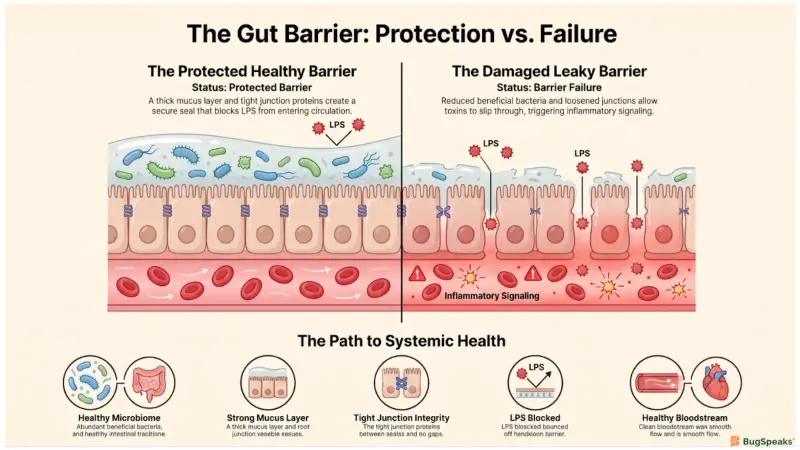
These helpful molecules also play a crucial role in protecting and strengthening your gut barrier, which acts like a secure wall for your gut. A strong gut barrier ensures that only good, healthy nutrients can pass into your blood, while blocking toxic molecules and pathogenic microbes from crossing the intestinal lining. If this wall becomes weak and leaky, toxic pieces of bad bacteria can slip through and enter your bloodstream. This leakage can cause a type of quiet internal inflammation that disrupts how your body stores fat and processes energy, making you feel slow, tired, and completely out of balance.
Finally, your gut microbes work closely with your immune system to keep your body's defenses strong and balanced. About seventy percent of your immune cells live right inside your gut, where they learn to tell the difference between friendly helpers and dangerous invaders. Your microscopic partners train these immune cells to stay calm but alert, preventing unnecessary inflammation that can damage your tissues. By maintaining this balance, your gut microbiome protects your entire body, allowing your internal systems to work smoothly and coordinate your daily health without any unexpected disruptions, keeping you strong and healthy every single day.
What makes RychBiome Super Supplement different from a traditional multivitamin?
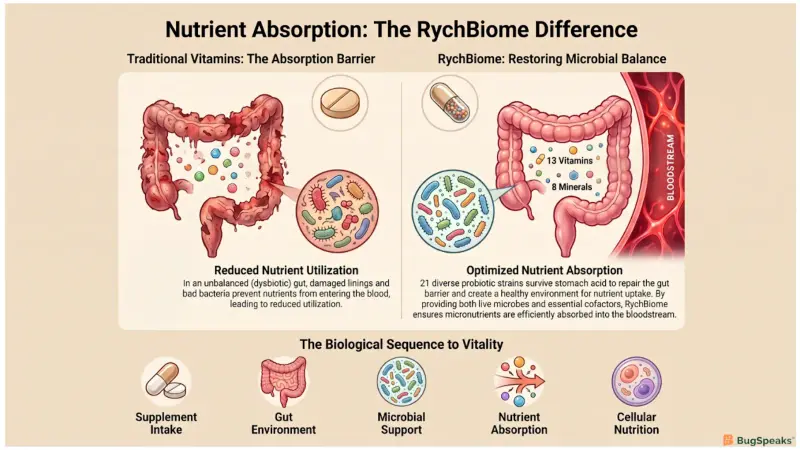
RychBiome Super Supplement is different from a traditional multivitamin because it combines essential nutrients with live beneficial microbes to support your gut and body at the same time. Traditional vitamins and minerals are designed to feed your cells directly, but they often fail if your gut is not healthy. When your gut has an unhealthy imbalance of microbes, a state called dysbiosis, your gut lining weakens, making it very hard to absorb nutrients. In this unbalanced state, many swallowed nutrients cannot enter your blood effectively and are simply lost as waste, without the important health benefits your body needs to thrive and stay active.
On the other hand, standalone probiotics only introduce live beneficial bacteria to your gut, which can also face major limitations without proper support. Friendly gut microbes require their own daily supply of micronutrients to survive, grow, and build their protective networks inside your gut. Giving your body standalone probiotics without essential vitamins and minerals is like sending a team of builders to a construction site without any tools or building materials. Without these vital raw materials, the new microbes struggle to colonize your gut and cannot successfully support your long-term wellness, making it hard for them to establish a healthy home.
This is why a complete formula that delivers both live microbes and essential nutrients together is so much more effective. By providing a diverse probiotic blend alongside a complete daily vitamin and mineral blend, this advanced formula supports your gut and your body simultaneously. This dual-action approach ensures that the friendly microbes have the nutrient helpers they need to thrive and protect your gut. At the same time, it ensures your body can fully absorb and use the nutrients, providing a complete foundation for your energy, digestion, and daily vitality, helping you maintain optimal health and overall wellness throughout your entire life.
What is the complete formulation of RychBiome Super Supplement?
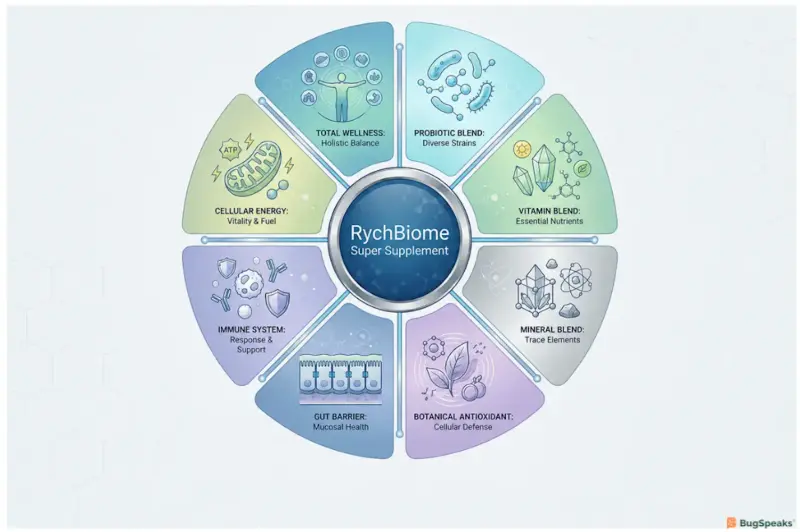
The complete formulation of RychBiome Super Supplement is a carefully selected combination of twenty-one distinct probiotic strains designed to support your gut health and overall daily digestion. This advanced microbial blend works together as a highly coordinated team to balance your intestinal pH, produce valuable short-chain fatty acids, and reinforce your gut barrier against bad bacteria. Every single probiotic strain in this supplement is chosen for its excellent ability to survive the harsh gastric acids in your stomach, ensuring they reach your large intestine alive and ready to help you feel your best every single day of your life, maintaining your baseline physical vitality and daily performance.
To actively nourish both your human cells and your active microscopic helpers, the formulation includes thirteen essential and highly active daily vitamins that act as key cofactors for your metabolism and immunity. This complete daily vitamin spectrum is masterfully engineered to promote healthy cellular energy production, support red blood cell formation, and provide powerful antioxidant protection against oxidative stress in your tissues. Instead of just delivering separate nutrients, this blend functions as a cohesive team that constantly works in perfect biological synergy with your beneficial microbes, ensuring that your body receives the baseline nourishment required to help coordinate your active and healthy lifestyle daily.
Completing this ultimate synbiotics blend are eight essential and highly active minerals for daily well-being and a deeply concentrated and natural plant antioxidant that acts as a protective botanical shield for your cells. These vital elements are absolutely essential for maintaining strong bone structures, supporting relaxed muscles, and helping your body's immune defenses constantly stay highly resilient and alert against harmful environmental stress. Additionally, the natural and organic plant extract works to neutralize free radicals, protecting your tissues from daily wear and tear while enhancing how your gut microbes absorb and utilize these vital compounds for long-term health and consistent daily physical performance.
Complete Probiotic Blend (21 Strains, 7 Billion CFU)
Complete Daily Vitamin Blend (13 Essential Vitamins)
Daily Minerals & Botanical Shield
Why does supporting the gut microbiome and nutrition together create a stronger foundation for long-term wellness?
Supporting your gut microbiome and nutrition together creates a stronger foundation for overall wellness because healthy microbes help you absorb nutrients, while those nutrients help your microbes thrive. This creates a self-sustaining loop where your diet and your microbes work in perfect harmony to protect your body. Taking RychBiome Super Supplement helps feed this cycle by delivering both the friendly microbes and their vital nutrients in one capsule. It also supports the growth of your native microbes, which fertilize your internal garden and keep your digestive system working smoothly and efficiently over your entire life.
When you nurture this internal partnership, your body is much better equipped to maintain stable energy and strong defenses. A balanced gut helps prevent the slow, silent inflammation that can make you feel tired, sluggish, and out of balance. By keeping your gut barrier strong and your microbes happy, you ensure that your body gets the steady flow of nourishment it needs. This consistent support keeps your metabolism active, your immune system balanced, and your mind clear, helping you enjoy a healthy life.
Taking just one capsule of RychBiome Super Supplement daily is an easy and scientifically supported habit to help your body's vital systems thrive. By making this simple choice a part of your daily routine, you are actively caring for your trillions of microscopic helpers and nourishing your cells. It is a wonderful way to protect your health, support your digestion, and build a strong foundation for lifelong well-being. Start your journey toward comprehensive vitality today and discover how easy it is to keep your gut and body happy with the amazing daily support of RychBiome Super Supplement every single day.
Visualize the process-
Reference
Krajmalnik-Brown, R., Ilhan, Z. E., Kang, D. W., & DiBaise, J. K. (2012). Effects of gut microbes on nutrient absorption and energy regulation. Nutrition in clinical practice : official publication of the American Society for Parenteral and Enteral Nutrition, 27(2), 201–214. https://doi.org/10.1177/0884533611436116
Sandhu, A. H., & Radhakrishnan, A. (2025). Gut Biome-Mediated Barriers to Nutrient Absorption: Investigating the Impact of Dysbiosis. Microbiology Research, 16(11), 241. https://doi.org/10.3390/microbiolres16110241
Younes, S. (2025). The role of micronutrients in gut microbiota and metabolic health. Endocrine and Metabolic Science, 100281.
Pham, V. T., Dold, S., Rehman, A., Bird, J. K., & Steinert, R. E. (2021). Vitamins, the gut microbiome and gastrointestinal health in humans. Nutrition Research, 95, 35-53.
Bojang, K. P., & Manchana, V. (2023). Nutrition and Healthy Aging: A Review. Current nutrition reports, 12(3), 369–375. https://doi.org/10.1007/s13668-023-00473-0
Kaufman, M. W., DeParis, S., Oppezzo, M., Mah, C., Roche, M., Frehlich, L., & Fredericson, M. (2024). Nutritional Supplements for Healthy Aging: A Critical Analysis Review. American journal of lifestyle medicine, 19(3), 346–360. https://doi.org/10.1177/15598276241244725
Park, S. H., Jung, C. H., & Ahn, J. (2026). Precision geronutrition: personalized nutritional strategies to extend healthy lifespan. BMB reports, 59(1), 51–59. https://doi.org/10.5483/BMBRep.2025-0216
Koumpouli, D., Koumpouli, V., & Koutelidakis, A. E. (2024). Functional Foods, Gut Microbiome and Association with Obesity and Metabolic Syndrome: A Literature Review. Applied Sciences, 14(13), 5578. https://doi.org/10.3390/app14135578
Essa, M. M., Bishir, M., Bhat, A., Chidambaram, S. B., Al-Balushi, B., Hamdan, H., Govindarajan, N., Freidland, R. P., & Qoronfleh, M. W. (2023). Functional foods and their impact on health. Journal of food science and technology, 60(3), 820–834. https://doi.org/10.1007/s13197-021-05193-3
Garrido-Mesa, J., Gálvez, J., & Garrido-Mesa, N. (2023). Editorial: The gut-immune axis: a complex training ground impacting inflammatory pathologies. Frontiers in immunology, 14, 1274761. https://doi.org/10.3389/fimmu.2023.1274761
Park, J. C., Chang, L., Kwon, H. K., & Im, S. H. (2025). Beyond the gut: decoding the gut–immune–brain axis in health and disease. Cellular & molecular immunology, 22(11), 1287-1312.
Wu, H. J., & Wu, E. (2012). The role of gut microbiota in immune homeostasis and autoimmunity. Gut microbes, 3(1), 4–14. https://doi.org/10.4161/gmic.19320
Loh, J. S., Mak, W. Q., Tan, L. K. S., Ng, C. X., Chan, H. H., Yeow, S. H., ... & Khaw, K. Y. (2024). Microbiota–gut–brain axis and its therapeutic applications in neurodegenerative diseases. Signal transduction and targeted therapy, 9(1), 37.
Slack, J., Noh, H. I., Ledbetter, L., & Albrecht, T. A. (2024). The association between the gut microbiome and fatigue in individuals living with cancer: a systematic review. Supportive care in cancer : official journal of the Multinational Association of Supportive Care in Cancer, 32(4), 267. https://doi.org/10.1007/s00520-024-08468-5
Montenegro, J., Armet, A. M., Willing, B. P., Deehan, E. C., Fassini, P. G., Mota, J. F., Walter, J., & Prado, C. M. (2023). Exploring the Influence of Gut Microbiome on Energy Metabolism in Humans. Advances in nutrition (Bethesda, Md.), 14(4), 840–857. https://doi.org/10.1016/j.advnut.2023.03.015
Rebelos, E., Tentolouris, N., & Jude, E. (2023). The Role of Vitamin D in Health and Disease: A Narrative Review on the Mechanisms Linking Vitamin D with Disease and the Effects of Supplementation. Drugs, 83(8), 665–685. https://doi.org/10.1007/s40265-023-01875-8
Behringer, C. R., Kulkarni, A., & Weinstein, A. (2025). Vitamin B12: A Comprehensive Review of Natural vs Synthetic Forms of Consumption and Supplementation. Cureus, 17(11), e96258. https://doi.org/10.7759/cureus.96258
Fatima, G., Dzupina, A., B Alhmadi, H., Magomedova, A., Siddiqui, Z., Mehdi, A., & Hadi, N. (2024). Magnesium Matters: A Comprehensive Review of Its Vital Role in Health and Diseases. Cureus, 16(10), e71392. https://doi.org/10.7759/cureus.71392
Li, J., Cao, D., Huang, Y., Chen, B., Chen, Z., Wang, R., Dong, Q., Wei, Q., & Liu, L. (2022). Zinc Intakes and Health Outcomes: An Umbrella Review. Frontiers in nutrition, 9, 798078. https://doi.org/10.3389/fnut.2022.798078
Hewlings, S. J., & Kalman, D. S. (2017). Curcumin: A Review of Its Effects on Human Health. Foods (Basel, Switzerland), 6(10), 92. https://doi.org/10.3390/foods6100092
Hatch-McChesney, A., & Lieberman, H. R. (2022). Iodine and Iodine Deficiency: A Comprehensive Review of a Re-Emerging Issue. Nutrients, 14(17), 3474. https://doi.org/10.3390/nu14173474
Kieliszek, M., Bano, I., & Zare, H. (2022). A Comprehensive Review on Selenium and Its Effects on Human Health and Distribution in Middle Eastern Countries. Biological trace element research, 200(3), 971–987. https://doi.org/10.1007/s12011-021-02716-z
Henriksen, C., & Arnesen, E. K. (2023). Copper - a scoping review for Nordic Nutrition Recommendations 2023. Food & nutrition research, 67, 10.29219/fnr.v67.10322. https://doi.org/10.29219/fnr.v67.10322
Henriksen, C., & Bügel, S. (2023). Chromium - a scoping review for Nordic Nutrition Recommendations 2023. Food & nutrition research, 67, 10.29219/fnr.v67.10325. https://doi.org/10.29219/fnr.v67.10325
Gupta, M., Dey, S., Marbaniang, D., Pal, P., Ray, S., & Mazumder, B. (2020). Grape seed extract: having a potential health benefits. Journal of food science and technology, 57(4), 1205–1215. https://doi.org/10.1007/s13197-019-04113-w
Song, A. A., In, L. L. A., Lim, S. H. E., & Rahim, R. A. (2017). A review on Lactococcus lactis: from food to factory. Microbial cell factories, 16(1), 55. https://doi.org/10.1186/s12934-017-0669-x
Batta, V. K., Rao, S. C., & Patole, S. K. (2023). Bifidobacterium infantis as a probiotic in preterm infants: a systematic review and meta-analysis. Pediatric research, 94(6), 1887–1905. https://doi.org/10.1038/s41390-023-02716-w
Abuqwider, J., Altamimi, M., & Mauriello, G. (2022). Limosilactobacillus reuteri in Health and Disease. Microorganisms, 10(3), 522. https://doi.org/10.3390/microorganisms10030522
Aljohani, A., Rashwan, N., Vasani, S., Alkhawashki, A., Wu, T. T., Lu, X., Castillo, D. A., & Xiao, J. (2025). The Health Benefits of Probiotic Lactiplantibacillus plantarum: A Systematic Review and Meta-Analysis. Probiotics and antimicrobial proteins, 17(5), 3358–3377. https://doi.org/10.1007/s12602-024-10287-3
Gao, H., Li, X., Chen, X., Hai, D., Wei, C., Zhang, L., & Li, P. (2022). The Functional Roles of Lactobacillus acidophilus in Different Physiological and Pathological Processes. Journal of microbiology and biotechnology, 32(10), 1226–1233. https://doi.org/10.4014/jmb.2205.05041
Mathipa-Mdakane, M. G., & Thantsha, M. S. (2022). Lacticaseibacillus rhamnosus: A Suitable Candidate for the Construction of Novel Bioengineered Probiotic Strains for Targeted Pathogen Control. Foods (Basel, Switzerland), 11(6), 785. https://doi.org/10.3390/foods11060785
Yang, Y., Song, X., Wang, G., Xia, Y., Xiong, Z., & Ai, L. (2024). Understanding Ligilactobacillus salivarius from Probiotic Properties to Omics Technology: A Review. Foods (Basel, Switzerland), 13(6), 895. https://doi.org/10.3390/foods13060895
Zhang, Z., Zhao, L., Wu, J., Pan, Y., Zhao, G., Li, Z., & Zhang, L. (2023). The Effects of Lactobacillus johnsonii on Diseases and Its Potential Applications. Microorganisms, 11(10), 2580. https://doi.org/10.3390/microorganisms11102580
Mu, Y., & Cong, Y. (2019). Bacillus coagulans and its applications in medicine. Beneficial microbes, 10(6), 679–688. https://doi.org/10.3920/BM2019.0016
de Luna Freire, M. O., Cruz Neto, J. P. R., de Albuquerque Lemos, D. E., de Albuquerque, T. M. R., Garcia, E. F., de Souza, E. L., & de Brito Alves, J. L. (2024). Limosilactobacillus fermentum Strains as Novel Probiotic Candidates to Promote Host Health Benefits and Development of Biotherapeutics: A Comprehensive Review. Probiotics and antimicrobial proteins, 16(4), 1483–1498. https://doi.org/10.1007/s12602-024-10235-1
Griffiths, M. W., & Tellez, A. M. (2013). Lactobacillus helveticus: the proteolytic system. Frontiers in microbiology, 4, 30. https://doi.org/10.3389/fmicb.2013.00030
Ku, S., Park, M. S., Ji, G. E., & You, H. J. (2016). Review on Bifidobacterium bifidum BGN4: Functionality and Nutraceutical Applications as a Probiotic Microorganism. International journal of molecular sciences, 17(9), 1544. https://doi.org/10.3390/ijms17091544
Bozzi Cionci, N., Baffoni, L., Gaggìa, F., & Di Gioia, D. (2018). Therapeutic Microbiology: The Role of Bifidobacterium breve as Food Supplement for the Prevention/Treatment of Paediatric Diseases. Nutrients, 10(11), 1723. https://doi.org/10.3390/nu10111723
Ghailan, A. Z., & Niamah, A. K. (2025). Streptococcus thermophilus: Metabolic Properties, Functional Features, and Useful Applications. Applied Microbiology, 5(4), 101. https://doi.org/10.3390/applmicrobiol5040101
McFarland L. V. (2010). Systematic review and meta-analysis of Saccharomyces boulardii in adult patients. World journal of gastroenterology, 16(18), 2202–2222. https://doi.org/10.3748/wjg.v16.i18.2202
Parapouli, M., Vasileiadis, A., Afendra, A. S., & Hatziloukas, E. (2020). Saccharomyces cerevisiae and its industrial applications. AIMS microbiology, 6(1), 1–31. https://doi.org/10.3934/microbiol.2020001
Chu, A., Samman, S., Galland, B., & Foster, M. (2023). Daily consumption of Lactobacillus gasseri CP2305 improves quality of sleep in adults - A systematic literature review and meta-analysis. Clinical nutrition (Edinburgh, Scotland), 42(8), 1314–1321. https://doi.org/10.1016/j.clnu.2023.06.019
Bengoa, A. A., Dardis, C., Garrote, G. L., & Abraham, A. G. (2021). Health-Promoting Properties of Lacticaseibacillus paracasei: A Focus on Kefir Isolates and Exopolysaccharide-Producing Strains. Foods (Basel, Switzerland), 10(10), 2239. https://doi.org/10.3390/foods10102239
Hill, D., Sugrue, I., Tobin, C., Hill, C., Stanton, C., & Ross, R. P. (2018). The Lactobacillus casei Group: History and Health Related Applications. Frontiers in microbiology, 9, 2107. https://doi.org/10.3389/fmicb.2018.02107
Kariyawasam, K. M. G. M. M., Yang, S. J., Lee, N. K., & Paik, H. D. (2020). Probiotic Properties of Lactobacillus brevis KU200019 and Synergistic Activity with Fructooligosaccharides in Antagonistic Activity against Foodborne Pathogens. Food science of animal resources, 40(2), 297–310. https://doi.org/10.5851/kosfa.2020.e15
Anwar, D. F. F., Salma, Z. N., Oktaviani, S. D., Adiyatma, F. N., Tauhid, F. M., Mustofa, A., Saputra, P. B. T., Karimah, R., & Alkaff, F. F. (2026). Effect of multistrain probiotics on symptom severity in irritable bowel syndrome: a systematic review and meta-analysis of irritable bowel syndrome-symptom severity score outcomes. European journal of gastroenterology & hepatology, 38(4), 397–406. https://doi.org/10.1097/MEG.0000000000003074