Elevate Your Health with RychBiome Natural Gut Well Spice Blend
Why do so many people experience digestive problems such as bloating, indigestion and stomach discomfort?
Many people frequently feel bad in their bellies because modern lifestyle habits can easily disturb our natural digestion process. Common stomach issues like painful bloating, indigestion, trapped gas, and slow digestion are very common today. These problems occur because people eat too many processed foods stripped of their natural goodness. When we eat these highly processed foods, our stomach and intestines struggle to move things along quickly. This slow digestion is the main cause of digestive discomfort and heavy pressure in our gut. To feel good, we must support our daily digestive wellness using natural choices that keep us healthy, active, and happy always.
Imagine your digestive system is like the Ancient Spice Route. This route is a long path where the food you eat travels from your mouth to your stomach. If the boats move too slowly, we call it slow digestion. This delay is like a traffic jam at the harbor. When food sits in one place for too long, it begins to spoil and creates a lot of trapped gas. This trapped air stretches your intestines, causing painful bloating and major digestive discomfort in your belly. This traffic jam happens because our body lacks the natural stimulants needed to keep things moving quickly, comfortably, and smoothly every single day.
Modern research confirms that eating too much processed food is the main cause of these stomach problems. These boxed foods lack the natural fibers that our bodies need to keep things moving. Fiber acts like a broom that sweeps the digestive tract clean and keeps the food boats moving on time. Without fiber, our bodies experience slow digestion, which leads to constant stomach pressure and pain. To protect our long-term gut health, we must choose organic, fiber-rich foods instead of processed snacks. This simple choice helps our bodies digest food easily, prevents painful indigestion, and always keeps our bellies feeling light, comfortable, and healthy.
How is the gut microbiome connected to digestive disorders?
The trillions of tiny microorganisms inside your gut microbiome are directly connected to digestive disorders because any imbalance in their community disrupts your body's natural digestion process. When you have a good microbial balance, there are many more helpful microbes than harmful ones. This high microbial diversity is like having a team of different experts who help with digestion and protect you. Together, these good microbes build a strong gut barrier, which acts like a protective wall. This wall keeps your gut safe from bad germs that try to make you feel sick, weak, and tired during your daily activities.
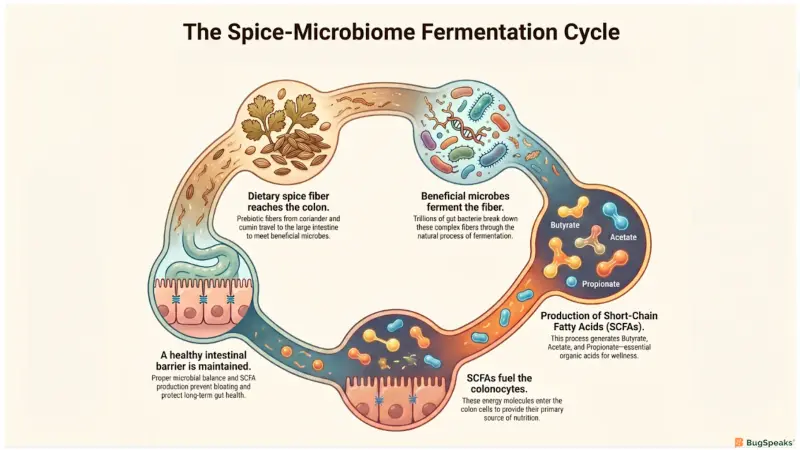
Inside our gut, fermentation is a natural process where beneficial bacteria break down dietary fibers that our human systems cannot digest on our own. When these helpful microbes digest fiber, they produce beneficial substances called short-chain fatty acids called butyrate. This organic acid serves as the primary food for our colon cells, keeping our gut barrier strong and healthy. This fermentation must occur in the large intestine to keep us healthy. If we have low microbial diversity, this helpful process is disrupted, and our gut cannot perform its normal daily tasks, which makes us feel tired and uncomfortable.
An imbalanced microbiome can lead to common digestive problems because harmful bacteria take over your system when your protective gut barrier is compromised. When we lose our microbial balance, harmful bacteria can take over and cause trouble in our gut. Without enough good microbes, food sits in our gut for too long and starts to spoil. This causes uncomfortable gas, painful bloating, and heavy indigestion after we eat our meals. To keep our gut healthy, we must choose a food-first approach to feed our good microbes. This simple habit keeps our gut barrier healthy, protects our long-term gut health, and keeps us comfortable.
How do traditional Indian digestive spices differ from conventional digestive remedies?
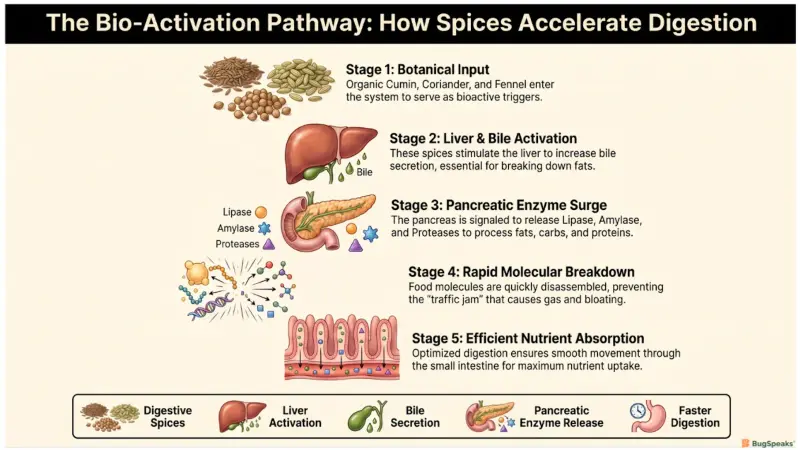
Unlike conventional remedies that just hide symptoms, traditional Indian digestive practices use a food-first approach with everyday digestive spices that actively stimulate your body's natural digestive tract to speed up digestion. In these ancient traditions, people use everyday digestive spices like cumin, coriander, and fennel during food preparation to help their bodies digest food easily. These organic spices act as functional stimulants that help your digestive tract work better. They help the liver make bile, which is necessary for breaking down fats, and they help your pancreas release digestive enzymes. This active support prevents food from sitting too long in your gut.
Conventional remedies like conventional antacids and symptom relief tablets take a completely different path that can often lead to digestive complications because they turn off your natural acid. These quick-fix treatments work by quickly neutralizing the natural stomach acids that are essential for breaking down protein and protecting your gut from harmful germs. While they provide fast and temporary relief from heartburn or indigestion, they do not address the real causes of your stomach issues. Frequent use of these conventional remedies can slow down your digestion over time, disrupting your microbial balance and leading to long-term digestive imbalances in your gut.
Transitioning to microbiome-supportive foods and organic spices represents a sustainable and long-term solution for your gut health and daily comfort because they feed your friendly bacteria. These natural ingredients are rich in both dietary fiber and bioactive plant compounds that help your gut microbiome multiply. Unlike conventional remedies that just cover up symptoms, these microbiome-supportive foods are selectively fermented by the beneficial bacteria in your colon. This fermentation process produces beneficial short-chain fatty acids that keep your gut barrier strong and healthy. By adopting a food-first approach, you can cultivate a healthy gut, improve your digestion, protect your long-term gut health, and feel absolutely great.
What is RychBiome Natural Gut Well and how do its ingredients support the gut microbiome?
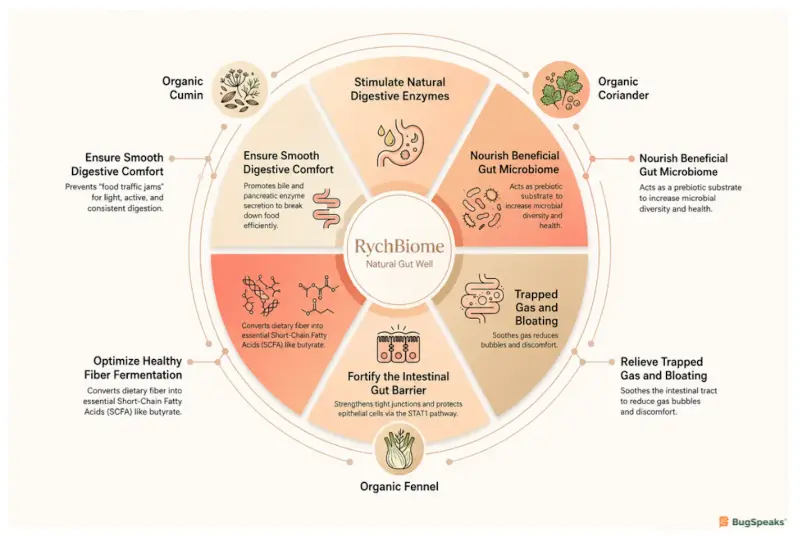
RychBiome Natural Gut Well is an organic digestive spice formula made of cumin, coriander, and fennel that supports your gut microbiome by nourishing beneficial bacteria and maintaining a healthy microbial balance. This plant-based powder blend contains organic cumin, coriander, and fennel, which work together to support your daily digestive wellness. The first key ingredient, organic cumin, is traditionally used to relieve indigestion and stimulate appetite. Modern science shows that cumin is rich in active compounds that promote the secretion of bile acids and pancreatic enzymes, helping your body digest food quickly. Cumin also supports a healthy microbial balance.
Organic coriander seed, a main ingredient in RychBiome Natural Gut Well, supports your gut microbiome by acting as a selective antimicrobial and a prebiotic substrate. Coriander seed has traditionally been used in everyday meals to soothe gas and reduce digestive discomfort. Modern research shows that coriander contains essential oils, like linalool, which can suppress harmful pathogens like E. coli without harming beneficial bacteria. Coriander seed is also rich in dietary fiber and essential minerals. This high-fiber profile allows coriander to act as an effective prebiotic substrate during fermentation, boosting the production of beneficial short-chain fatty acids that keep your gut barrier strong and your digestion moving smoothly.
Organic fennel seed, another key ingredient in RychBiome Natural Gut Well, protects the gut barrier by strengthening tight junctions and downregulating inflammatory STAT1 pathways. Fennel seed has traditionally been consumed as an after-meal digestive aid and breath freshener, known as mukhvas. Modern clinical science shows that fennel seed extract protects the gut barrier by maintaining tight junction integrity. It works by downregulating the STAT1 pathway, which is highly active during gut inflammation. By reducing STAT1 activation, fennel protects your gut from damage. Together, these three organic spices act in synergy as a food-based microbiome-support formulation, offering a powerful, food-first approach to support your daily wellness and physical health.
Why can supporting the gut microbiome through everyday food choices improve digestive health?
Supporting your gut microbiome through everyday food choices improves your digestive health because nourishing these helpful bacteria keeps your gut barrier strong and prevents uncomfortable stomach issues. Traditional dietary wisdom has always recognized that food is our best medicine, a principle now validated by modern science.
RychBiome Natural Gut Well improves your digestive wellness by combining traditional spices with modern science to make daily gut care incredibly simple and tasty. To enjoy this formula, simply mix one scoop with hot water, filter, and drink to easily receive the prebiotic benefits of traditional Indian digestive spices. Since your gut microbiome changes constantly in response to your diet, consistent daily care is necessary to maintain a healthy microbial balance. This simple habit is a powerful way to honor traditional wisdom, achieve lasting gut comfort, and keep your body feeling light, active, healthy, and comfortable every single day of your busy daily life.
In conclusion, taking care of your gut microbiome through a food-first approach is the most effective way to enjoy excellent long-term gut health and complete daily comfort. Supporting your system with RychBiome Natural Gut Well is a scientifically grounded way to nourish your tummy and support your gut barrier. By incorporating this organic spice blend into your daily routine, you can easily overcome common digestive issues like bloating and indigestion. Simply mix one scoop of this high-fiber formula with hot water, filter, and drink daily to actively protect your inner ecosystem and maintain your physical vitality. Choose this natural path to achieve lasting wellness and experience daily comfort.
Visualize the process- https://youtu.be/10YrIWcsWjw
Reference
Balaji, S., Jeyaraman, N., Jeyaraman, M., Ramasubramanian, S., Muthu, S., Santos, G. S., da Fonseca, L. F., & Lana, J. F. (2025). Impact of curcumin on gut microbiome. World journal of experimental medicine, 15(1), 100275. https://doi.org/10.5493/wjem.v15.i1.100275
Scazzocchio, B., Minghetti, L., & D'Archivio, M. (2020). Interaction between Gut Microbiota and Curcumin: A New Key of Understanding for the Health Effects of Curcumin. Nutrients, 12(9), 2499. https://doi.org/10.3390/nu12092499
Hosseinzadeh, H., Alaw Qotbi, A. A., Seidavi, A., Norris, D., & Brown, D. (2014). Effects of different levels of coriander (Coriandrum sativum) seed powder and extract on serum biochemical parameters, microbiota, and immunity in broiler chicks. TheScientificWorldJournal, 2014, 628979. https://doi.org/10.1155/2014/628979
Xia, Y., Kuda, T., Miyashita, A., Yamamoto, M., Koga, K., Nakamura, A., & Takahashi, H. (2023). Effects of cumin, coriander, and sichuan pepper on microbiota and the antioxidant capacities of human faecal cultures. Food and Humanity, 1, 1091-1098.
Das, B., Rabalais, J., Kozan, P., Lu, T., Durali, N., Okamoto, K., McGeough, M. D., Lee, B. J., Barrett, K. E., Marchelletta, R., & Sivagnanam, M. (2022). The effect of a fennel seed extract on the STAT signaling and intestinal barrier function. PloS one, 17(7), e0271045. https://doi.org/10.1371/journal.pone.0271045
Fu, J., Zheng, Y., Gao, Y., & Xu, W. (2022). Dietary Fiber Intake and Gut Microbiota in Human Health. Microorganisms, 10(12), 2507. https://doi.org/10.3390/microorganisms10122507
Plamada, D., & Vodnar, D. C. (2021). Polyphenols-Gut Microbiota Interrelationship: A Transition to a New Generation of Prebiotics. Nutrients, 14(1), 137. https://doi.org/10.3390/nu14010137
Liu, X., Alharbi, A., Gibson, R., & Rodriguez-Mateos, A. (2025). (Poly)phenol-gut microbiota interactions and their impact on human health. Current opinion in clinical nutrition and metabolic care, 28(4), 316–322. https://doi.org/10.1097/MCO.0000000000001132
Vinelli, V., Biscotti, P., Martini, D., Del Bo', C., Marino, M., Meroño, T., Nikoloudaki, O., Calabrese, F. M., Turroni, S., Taverniti, V., Unión Caballero, A., Andrés-Lacueva, C., Porrini, M., Gobbetti, M., De Angelis, M., Brigidi, P., Pinart, M., Nimptsch, K., Guglielmetti, S., & Riso, P. (2022). Effects of Dietary Fibers on Short-Chain Fatty Acids and Gut Microbiota Composition in Healthy Adults: A Systematic Review. Nutrients, 14(13), 2559. https://doi.org/10.3390/nu14132559
Bamigbade, G. B., Subhash, A. J., Kamal-Eldin, A., Nyström, L., & Ayyash, M. (2022). An Updated Review on Prebiotics: Insights on Potentials of Food Seeds Waste as Source of Potential Prebiotics. Molecules (Basel, Switzerland), 27(18), 5947. https://doi.org/10.3390/molecules27185947
Zhang, L., Tuoliken, H., Li, J., & Gao, H. (2024). Diet, gut microbiota, and health: a review. Food science and biotechnology, 34(10), 2087–2099. https://doi.org/10.1007/s10068-024-01759-x
Han, Y., & Xiao, H. (2020). Whole Food-Based Approaches to Modulating Gut Microbiota and Associated Diseases. Annual review of food science and technology, 11, 119–143. https://doi.org/10.1146/annurev-food-111519-014337
Khine, W. W. T., Haldar, S., De Loi, S., & Lee, Y. K. (2021). A single serving of mixed spices alters gut microflora composition: a dose-response randomised trial. Scientific reports, 11(1), 11264. https://doi.org/10.1038/s41598-021-90453-7
Dahl, S. M., Rolfe, V., Walton, G. E., & Gibson, G. R. (2023). Gut microbial modulation by culinary herbs and spices. Food Chemistry, 409, 135286.
Koumpouli, D., Koumpouli, V., & Koutelidakis, A. E. (2024). Functional Foods, Gut Microbiome and Association with Obesity and Metabolic Syndrome: A Literature Review. Applied Sciences, 14(13), 5578. https://doi.org/10.3390/app14135578