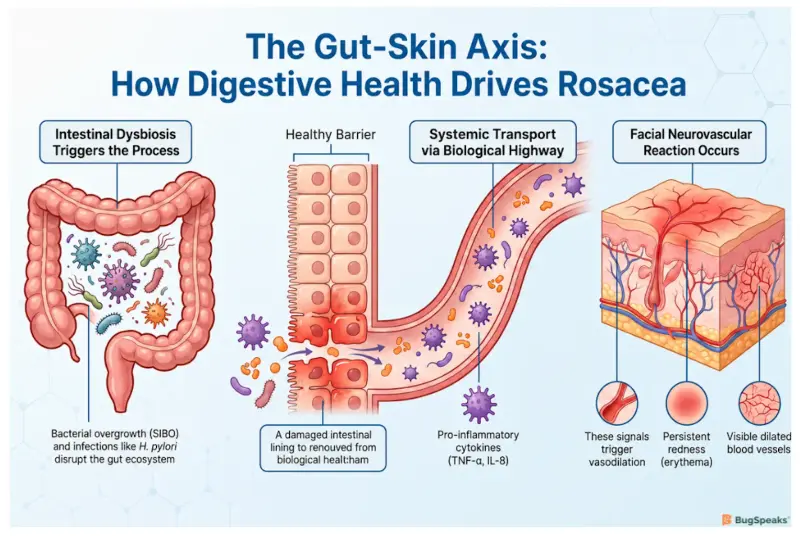
How does a gut imbalance trigger facial redness?
A gut imbalance triggers facial redness because harmful bacteria break through the intestines and send alarm signals that permanently widen the blood vessels in your face. To understand this, imagine your body as an integrated system for regulating inflammation. In this system, your gut is the main regulatory control interface. It acts like a smart biological border, deciding exactly what is allowed to enter your bloodstream. Your microbiome, the trillions of microscopic bugs living inside you, acts as a regulator of stability for this border. When these bugs are healthy and balanced, your border remains strong and tightly sealedManfredini M. et al. (2025).
However, if bad bugs take over, a state called dysbiosis, the border begins to break down. This causes a "leaky gut," medically known as increased gut permeability. When the border leaks, stray bacteria and toxins easily slip through. The moment they cross over, they trigger your immune system, which acts as the body's response management network. The immune system sees these leaked pieces as a major threat and instantly blasts intense activation signals to warn the rest of your bodyLi J. et al. (2024).
These activation signals are powerful chemicals called pro-inflammatory cytokines. They flood your bloodstream and travel all the way up to your face. There, they crash into your response-sensitive infrastructure: your skin blood vessels. If you have rosacea, these blood vessels are highly sensitive. The constant attack of activation signals forces them to stretch out, fill with blood, and show up as bright red lines on your faceManfredini M. et al. (2025).
This chain reaction traps your face in a chronic, overactive regulation state. Sometimes, bugs grow where they shouldn't, like in Small Intestinal Bacterial Overgrowth. This heavily multiplies the alarm signalsLi J. et al. (2024). Other times, a stomach infection from a bug called Helicobacter pylori releases special chemicals that force the blood vessels to open even widerManfredini M. et al. (2025). Ultimately, the redness on your face is just the final siren of an alarm that started deep in your gut.
Table 1: Biological Mapping of the Integrated Inflammation Regulation System
Which specific stability regulators control this inflammatory loop?
Specific good bacteria act as a maintenance crew that builds strong walls to seal the gut and stop the immune system from sending false alarms. Not all bacteria do the same job. Certain families of bacteria exist entirely to repair your gut's regulatory control interface. For example, the Actinobacteria family and a specific bug called Butyrivibrio are highly protective stability regulators. They eat fiber from your food and turn it into Short-Chain Fatty Acids. These acids act like molecular glue to seal up the gut border so nothing harmful leaks outLi J. et al. (2024).
When you have plenty of these good bacteria, they keep your body calm. They tell your body to create Regulatory T-cells, which are special peacekeepers in your response management network. These peacekeepers turn down the loud activation signals. By keeping the alarms quiet, these good bacteria stop your skin's blood vessels from swelling up and turning your face red. This careful maintenance keeps you out of an overactive regulation stateLi J. et al. (2024).
But when dysbiosis happens, these good guys are pushed out by troublemakers. For example, if you have too much of a bad yeast called Candida and not enough of a good yeast called Saccharomyces, your body stays inflamed. People with high levels of good Saccharomyces also have more protective bacteria like Prevotella. These friendly bugs work together to quiet the alarmsJoura M.I. et al. (2025). Without them, your gut border stays leaky, and your face stays red.
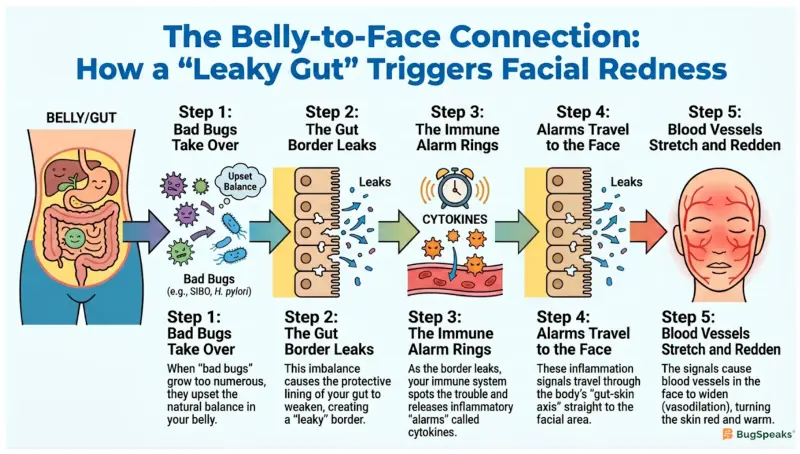
How does the skin's local environment react to systemic inflammation?
The skin reacts to system-wide inflammation by losing its protective bacteria and growing bad bacteria, which triggers extra alarms and causes the face to swell. The integrated inflammation regulation system doesn't just live in your gut; your face has its own local border. In healthy skin, native bugs like Cutibacterium acnes are the local stability regulators. They produce healthy oils that keep your skin safe. But when activation signals from a leaky gut flood your face, this local system completely crashesKalicka M. et al. (2026).
As the skin's blood vessels stretch out and pump extra blood into the face, the skin gets hot and inflamed. This overheated environment kills off the good Cutibacterium acnes. With the good bugs gone, bad bugs like Staphylococcus epidermidis quickly take over. These bad bugs are disruptive stability regulators. They grab onto Toll-Like Receptor 2, which is a tiny panic button built directly into your skin's response management networkKalicka M. et al. (2026).
When this panic button is pressed, your skin cells panic and produce defense proteins called cathelicidins. In people with rosacea, these proteins break into toxic pieces called LL-37. These LL-37 pieces act as massive activation signals. They force the skin to build brand-new, leaky blood vessels, a process called angiogenesis. To make matters worse, tiny facial bugs called Demodex folliculorum mites carry even more bad bacteria deep into your pores. Also, an overgrowth of a fungus called Malassezia can further destroy the skin barrier, locking the face in a permanent overactive regulation stateManfredini M. et al. (2025);Joura M.I. et al. (2025).
Table 2: Key Microbial Stability Regulators and Their System Impact
How do dietary triggers directly overstimulate the response network?

Dietary triggers like spicy foods and alcohol overstimulate the network by hitting temperature sensors and dumping inflammatory chemicals straight into the bloodstream. Everything you eat is data that hits your gut's regulatory control interface. Some foods feed your good bugs, but others act like pure stress. For example, capsaicin, the spice in chili peppers, and physically hot drinks bypass your digestive system. They directly trigger Transient Receptor Potential Vanilloid 1 channels. These channels are tiny temperature sensors wired into your body's response management networkManfredini M. et al. (2025).
When these sensors feel the heat or spice, they instantly fire off neuropeptides. These neuropeptides are powerful activation signals. They race to your face and force your response-sensitive infrastructure, the skin blood vessels, to violently stretch open and release heat. This is exactly why eating a hot curry or drinking a hot tea causes an instant, burning flush on your cheeksManfredini M. et al. (2025).
Alcohol is another major trigger that ruins the system. First, alcohol hurts the delicate lining of your gut, increasing gut permeability. This lets bad bacteria leak into your blood. Second, as your body breaks down alcohol, it releases histamine. Histamine is a loud activation signal that commands your blood vessels to swell up fast. Even eating healthy foods that naturally contain high histamine, like spinach, tomatoes, and aged cheese, can overwhelm your system. If your gut border is already weak, the histamine rushes in and turns your face red, showing exactly how food controls your overactive regulation stateManfredini M. et al. (2025).
Can we reprogram the stability regulators to repair the skin?
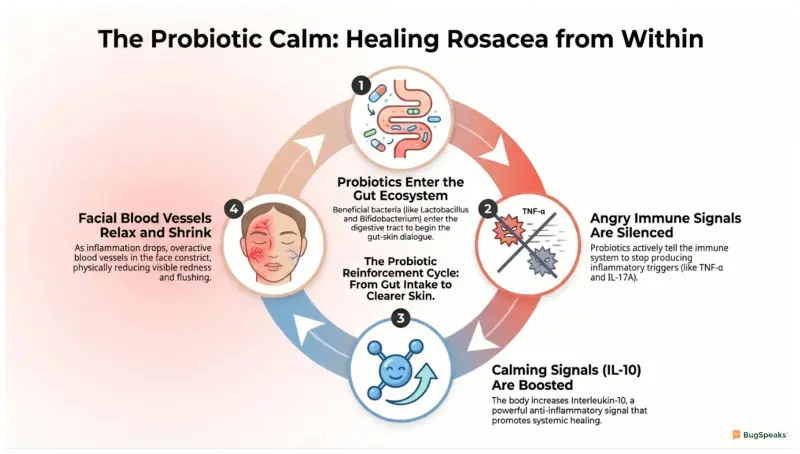
We can reprogram the gut by using probiotics and high-fiber foods to patch the leaks and tell the immune system to stand down. Because rosacea starts with a broken regulatory control interface, fixing your gut bugs is a scientifically proven way to heal your skin. Probiotics are live, good bacteria that act as reinforcements. When you swallow specific probiotics like Lactobacillus or Bifidobacterium, they travel to your gut and start patching the tiny holes in the borderManfredini M. et al. (2025).
These fresh stability regulators send calming messages to your response management network. They tell your immune system to stop making angry activation signals like Tumor Necrosis Factor-alpha. Instead, they tell your body to pump out Interleukin-10, which is a powerful chemical that forces the body to relax. As the angry alarm signals finally quiet down, your exhausted skin's blood vessels can safely shrink back to their normal size. Studies show that taking probiotics regularly leads to massive improvements in redness and fewer painful flare-upsManfredini M. et al. (2025).
To keep these new bugs alive, you have to feed them prebiotics, which are just fiber from plants. Fiber gives the good bugs the fuel they need to keep sealing the gut. Also, adding vitamins like zinc helps act like a shield, protecting the delicate blood vessels in your face from damage. By fixing the gut border, reinforcing your good bugs, and avoiding food triggers, you can turn off the overactive regulation state and bring clear, calm skin back to your faceManfredini M. et al. (2025).
Visualize the process- https://youtu.be/qVcg2zN6Vfo
Reference
Joura, M. I., Nemes-Nikodém, É., Jobbágy, A., Dunai, Z. A., Makra, N., Bánvölgyi, A., Kiss, N., Sárdy, M., Sándor, S. E., Holló, P., & Ostorházi, E. (2025). Integrative Analysis of Fungal and Bacterial Microbiomes Across Skin, Blood, and Stool in Rosacea Patients. International Journal of Molecular Sciences, 26(17), 8127. https://doi.org/10.3390/ijms26178127
Li J, Yang F, Liu Y and Jiang X (2024) Causal relationship between gut microbiota and rosacea: a two-sample Mendelian randomization study. Front. Med. 11:1322685. doi: 10.3389/fmed.2024.1322685
Manfredini, M., Barbieri, M., Milandri, M., & Longo, C. (2025). Probiotics and Diet in Rosacea: Current Evidence and Future Perspectives. Biomolecules, 15(3), 411. https://doi.org/10.3390/biom15030411
Kalicka, M., Biadasiewicz, M., Tekielak, A., Frątczak, A., & Bergler-Czop, B. (2026). The role of the skin microbiome in modulating rosacea. Advances in Dermatology and Allergology/Postępy Dermatologii i Alergologii, 43(1).