# A Comprehensive Guide to Raw vs. Cooked Vegetables: Understanding Digestive Differences
Author: Varsha V
Author URL: https://www.bugspeaks.com/blog/author/varsha-v
Published: 2026-08-17
Category: Nutrition
Category URL: https://www.bugspeaks.com/blog/category/nutrition
Meta Title: Raw vs. Cooked Vegetables for Better Digestion | BugSpeaks
Meta Description: Explore raw vs cooked vegetables, digestion, and gut health. Learn how cooking affects plant cell walls, starch digestibility, gas, and gut microbes. Read now!
Tags: Gut Health, Raw Vegetables, Cooked Vegetables
Tag URLs: Gut Health (https://www.bugspeaks.com/blog/tag/gut-health), Raw Vegetables (https://www.bugspeaks.com/blog/tag/raw-vegetables), Cooked Vegetables (https://www.bugspeaks.com/blog/tag/cooked-vegetables)
URL: https://www.bugspeaks.com/blog/raw-cooked-vegetables-digestive-health
## Why do raw vegetables require more cellular unlocking than cooked ones?
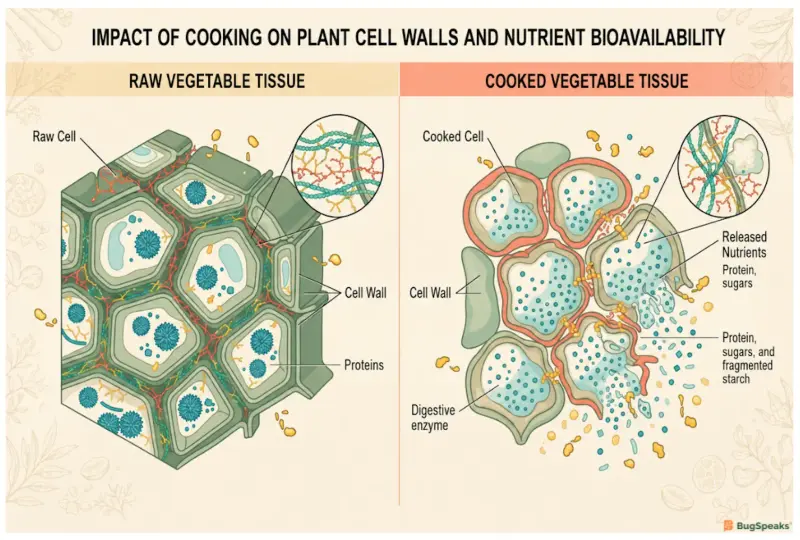
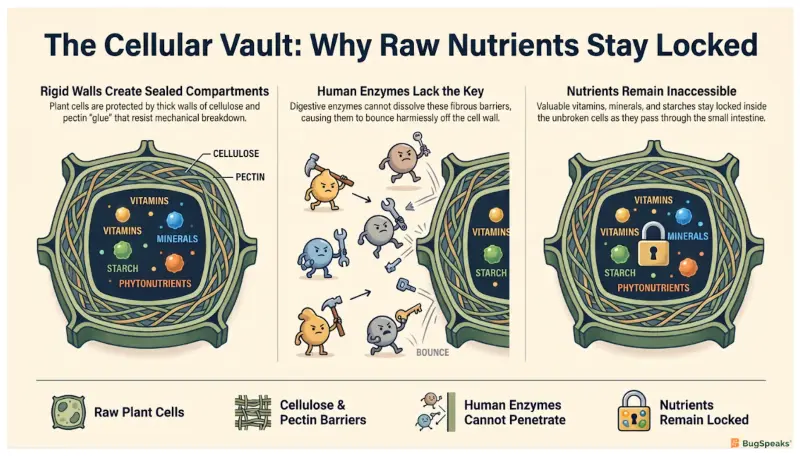
Raw vegetables keep their nutrients locked inside tough, rigid cell walls that our bodies cannot easily break down. When you eat [raw plants](https://www.bugspeaks.com/blog/gutmicrobiome-fooddiversity), your digestive tract encounters billions of tiny locked compartments built from sturdy cell walls. These durable compartments are made of strong materials like cellulose and hemicellulose, which our digestive tract cannot tear open. Without a way to break these barriers, the cell walls remain completely solid as they travel down our system. This means the valuable nutrients hidden inside are kept safely out of reach of our host digestive enzymes [Carmody et al. (2011)](https://doi.org/10.1073/pnas.1112128108). Consequently, digesting raw food requires an intense unlocking effort.
Another tough material holding these cellular compartments closed is pectin, which acts like a strong glue between the cells. Because these walls are held together so tightly, raw plants do not easily fall apart inside our stomachs. This rigid structure prevents our digestive juices from making direct contact with the locked treasures inside the plant cells. Instead, the cells pass through our stomach as whole, sealed packages that protect their contents from being absorbed. Human jaws and teeth can crush some cell compartments, but most cells survive mastication, keeping their nutrients locked away [Carmody et al. (2011)](https://doi.org/10.1073/pnas.1112128108). This prevents easy absorption and makes raw vegetables much tougher to digest properly.
To extract energy from these raw plant cells, our bodies must work much harder compared to eating cooked food. Since our own digestive fluids lack the keys to dissolve cellulose, the cells remain unbroken in the small intestine. This lack of physical access means our body fails to absorb most of the raw starches and sugars. Instead, these locked compartments must travel all the way down to the large intestine to be opened by others. This heavy transit load increases the work our body has to do just to extract basic cellular energy [Carmody et al. (2011)](https://doi.org/10.1073/pnas.1112128108). It demands extra digestive effort and leaves you feeling empty despite eating a large volume.
**Cellulose**- A tough, thread-like fiber that forms the strong outer wall of plant cells, acting like a locked compartment door
**Hemicellulose**\- A firm supporting fiber that helps reinforce plant cell walls, making raw plant tissues highly rigid and difficult to open
**Pectin**\- A sticky sugar compound that glues plant cells together, keeping raw vegetables tough and structurally intact during transit.
## How does heat act as a key to open plant cell compartments?
Heat acts as a key by melting and loosening the tough plant cell walls, which expands and softens the food. When we apply high temperatures during cooking, we are performing a hydrothermal treatment that uses water and warmth. This process begins to dissolve the tough cell glues and relaxes the rigid fibers that surround the plant cells. As the cell compartments absorb water and expand, their walls stretch and begin to leak their inner treasures. This warming step softens the hard vegetables, making them much easier for our teeth and digestive system to open. The cellular structures are gently unlocked.
Inside these opening compartments, the heat also changes the structure of raw starch granules, turning them into soft gels. This amazing transformation is called starch gelatinization, where tightly packed crystalline starches absorb water and swell up. Once gelatinized, these starches lose their crystalline patterns and turn into amorphous, highly accessible structures that are easy to process [Güven and Şensoy (2024)](https://doi.org/10.1002/jsfa.13401). This makes the starches highly vulnerable to our digestive fluids, which can now easily break down the long energy chains. Without this gelatinization process, the starches would remain hard, crystal-like spheres that are almost impossible to extract. They remain totally locked and resistant to our enzymes.
By breaking down the sturdy cell walls and softening starches, heat dramatically increases the overall digestibility of cooked vegetables. Because the cell walls are now standing open, our small intestine can quickly extract and absorb the valuable nutrients inside. This easy access means we absorb a higher proportion of the plant's calories before the food reaches our large intestine [Carmody et al. (2019)](https://doi.org/10.1038/s41564-019-0569-4). This efficient absorption reduces the digestive burden on our lower gut while maximizing our body's net energy gains from eating. Thus, cooking does most of the heavy unlocking work before the food even enters our digestive tract, saving our stomach a lot of energy.
**Plant Cell Compartment**
**Raw Vegetable State (Fully Locked)**
**Cooked Vegetable State (Fully Unlocked)**
**Unlocking Key / Process**
Outer Cell Walls
Rigid cellulose barriers held tightly together by pectin glue.
Solubilized pectin glues and softened, relaxed cellulose fibers.
Hydrothermal treatment relaxes plant matrix structures [Güven and Şensoy (2024)](https://doi.org/10.1002/jsfa.13401).
Starch Core
Semi-crystalline granules tightly packed and resistant to enzymes.
Expanded, soft, amorphous starch gels ready for digestion.
Starch gelatinization melts crystalline starches [Carmody et al. (2019)](https://doi.org/10.1038/s41564-019-0569-4).
Nutrient Treasures
Enclosed inside unbroken physical chambers, fully trapped.
Completely released into solution and accessible for extraction.
Heat breaks compartments to release vitamins [Doniec et al. (2022)](https://doi.org/10.3390/molecules27061861).
Chemical Defenses
Active plant chemical shields that damage gut microbe membranes.
Deactivated and neutralized safe materials that protect gut flora.
Thermal denaturing deactivates active plant toxin shields [Carmody et al. (2019)](https://doi.org/10.1038/s41564-019-0569-4).
**Hydrothermal treatment**\- A cooking method using heat and moisture that softens tough plant cells and loosens their structural barriers
**Starch gelatinization**\- The process where starch granules absorb hot water, swell, and melt from a hard crystal state into digestible gels
**Digestibility**\- A measure of how easily and completely a food's nutrients can be broken down and absorbed by an organism
**Lower gut**\- The final section of our digestive tract, consisting of the large intestine and colon, where billions of helpful microscopic microbes live and process undigested food.
## Why does low starch digestibility lead to gas and microbial shifts?
When starch remains locked up, our digestive enzymes cannot extract it, forcing it down into the large intestine. In the lower gut, the sealed plant compartments are met by a massive community of microscopic microbes. Since our small intestine could not open these cells, these microbes step in as our active fermentation partners. These microbes have special keys to break open the cell walls and devour the starches hidden inside. However, this rapid digestion by microbes creates large amounts of gas as a natural byproduct of their feeding [Carmody et al. (2019)](https://doi.org/10.1038/s41564-019-0569-4). This gas causes intense bloating, painful pressure, and stomach noises that can make you feel very uncomfortable.
An influx of locked starch into the lower gut causes a noticeable drop in the alpha-diversity of the gut. This drop happens because only a few specialized microbe species, like _Ruminococcus bromii_ acting as a keystone, possess the tools to open these hard starch compartments. These dominant starch-eaters multiply rapidly, crowding out other helpful microbes that do not eat raw starches for energy. As these few species take over, the variety of our microbial community becomes off-balance and less diverse [Carmody et al. (2019)](https://doi.org/10.1038/s41564-019-0569-4). A healthy gut thrives on a wide variety of microbes, but raw starch diets can limit this species diversity. This reduces overall microbial richness and hurts the gut community.
This shift in diet specifically boosts the growth of Bacteroidetes, which are expert bacteria at degrading complex plant sugars. While Bacteroidetes increase, the relative proportion of other bacteria like Firmicutes decreases, throwing the ecosystem out of balance [Carmody et al. (2019)](https://doi.org/10.1038/s41564-019-0569-4). This imbalance forces our lower gut to become a busy starch-processing hub, producing large amounts of gas. This explains why raw sweet potatoes can cause intense flatulence while cooked ones leave your digestion feeling calm and comfortable. By cooking the food first, we keep the raw starch from overloading these microbial fermentation partners. This prevents excessive lower gut gas and helps protect your daily peace.
**Gut System Metric**
**Locked Raw Diet Response (Gas Production)**
**Unlocked Cooked Diet Response (Digestive Ease)**
**Ecological Impact on System**
Alpha-diversity
Drops as only a few specialized starch-eating bacteria thrive.
Remains highly balanced with rich, diverse microbe communities.
High diversity ensures a stable and resilient digestion system [Carmody et al. (2019)](https://doi.org/10.1038/s41564-019-0569-4).
Bacterial Phyla
Promotes a spike in Bacteroidetes over Firmicutes.
Maintains a balanced, harmonious phyla ratio of gut flora.
Unlocked foods avoid phyla dominance and severe gas [Carmody et al. (2019)](https://doi.org/10.1038/s41564-019-0569-4).
Microbial Health
High rates of membrane damage from plant defense toxins.
Protected cell membranes with highly active metabolic enzymes.
Intact cells focus on healthy nutrient extraction and butyrate [Carmody et al. (2019)](https://doi.org/10.1038/s41564-019-0569-4).
Digestive Symptoms
Occasional bloating, intense flatulence, and belly cramps are highly common.
Smooth digestion, low gas, and high absorption of plant minerals.
Promotes high daily physical energy and system safety [Ahmed et al. (2025)](https://doi.org/10.1186/s12986-025-01014-y).
**Fermentation**\- The metabolic process where helpful gut microbes consume undigested carbohydrates, releasing gases and organic acids
**Alpha-diversity**\- A measure of the structural richness and evenness of different microbial species residing in the gut
**Bacteroidetes**\- A phylum of gut bacteria equipped with a vast toolkit of enzymes dedicated to degrading tough, complex plant glycans
**Flatulence**\- The accumulation and release of natural gases created as a normal byproduct when lower gut microbes ferment undigested plant starches
## What happens when raw plant defense compounds enter the gut system?
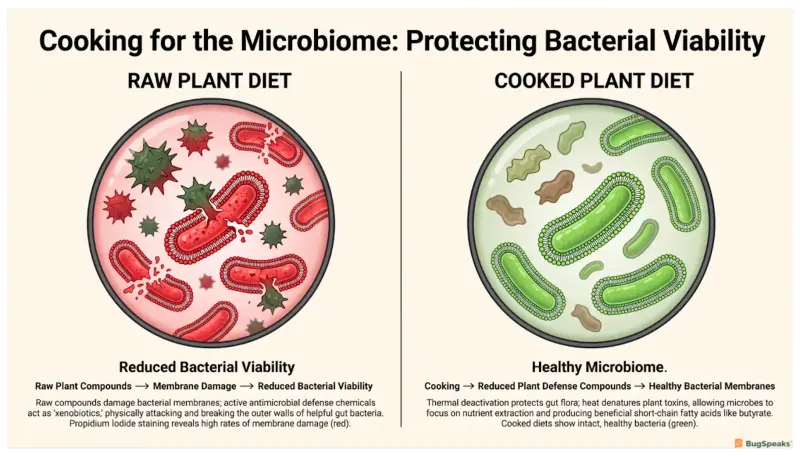
Raw [plants](https://www.bugspeaks.com/blog/fiber-maxxing-bloating-gut-health) contain active defense chemicals that can damage the membranes of our helpful gut bacteria and lower their daily activity. To protect themselves in nature, plants make natural antimicrobial compounds that act like chemical shields against pests and insects. When we eat these plants raw, these active defenses enter our gut and attack our friendly resident bacteria [Carmody et al. (2019)](https://doi.org/10.1038/s41564-019-0569-4). This chemical attack damages the outer walls of our microbes, preventing them from doing their daily jobs. Instead of extracting energy, our bacteria must work hard just to survive these natural plant defense chemicals. This weakens our entire digestive system and makes it hard to absorb energy.
In scientific studies, researchers used a special red stain called propidium iodide to check the health of gut microbes. This stain can only enter a bacterial cell if its outer protective membrane has been torn or damaged [Carmody et al. (2019)](https://doi.org/10.1038/s41564-019-0569-4). When mice were fed raw tubers, their stool samples showed a massive increase in cells stained with this red dye. This proved that the raw plant chemicals were physically breaking the outer membranes of helpful gut bacteria. In contrast, mice fed cooked tubers showed almost no membrane damage, proving cooking deactivates these harsh plant chemicals. Cooking protects microbial structures from getting destroyed by these raw toxins.
These raw plant chemicals act as xenobiotics, which are foreign substances that our gut bacteria must work hard to detoxify [Carmody et al. (2019)](https://doi.org/10.1038/s41564-019-0569-4). Because our microbes are busy defending themselves against these active compounds, their overall cellular activity levels drop significantly. This drop in activity means the bacteria cannot produce the helpful molecules our bodies need for energy and health. By heating our vegetables, we denature and deactivate these chemical shields before they can harm our gut bacteria. Cooking removes the chemical traps, allowing our microbes to focus on unlocking nutrients safely and efficiently. This secures digestive peace and ensures high energetic yields.
**Antimicrobial compounds**\- Chemical defense shields naturally synthesized by plants that inhibit the growth and cellular viability of bacteria
**Propidium iodide**\- A fluorescent red dye that selectively enters damaged cell membranes to identify injured bacterial populations
**Xenobiotics**\- Chemical substances foreign to a biological system that require metabolic processing and detoxification by bacteria
## How does the gut microbiota adapt to cooked vs. raw dietary profiles?
The gut microbiota adapts by changing its bacterial community to favor species that safely process cooked and fermented vegetables to build healthy bodies. Eating cooked plants allows our system to support beneficial bacteria that produce helpful short-chain fatty acids (SCFAs) like butyrate [Lerma-Aguilera et al. (2024)](https://doi.org/10.3389/fmicb.2023.1334623). These fatty acids act like premium fuel for our colon cells, keeping our gut lining strong and healthy. This strong barrier prevents toxins from leaking into our bloodstream, reducing inflammation throughout our entire body. With a steady supply of cooked food, these helpful microbes thrive and build a highly cooperative ecosystem. This ensures highly efficient digestion and gives us much more daily energy.
When we eat fermented vegetables, we also introduce millions of helpful lactic acid bacteria into our gut system. These live bacteria have already done the hard work of opening the plant cell compartments during fermentation [Pihelgas et al. (2025)](https://doi.org/10.3389/fnut.2025.1623710). This pre-unlocking process means the nutrients are fully accessible and ready for our body to absorb without creating gas. These friendly microbes also join our resident community, boosting our overall digestion and crowding out harmful, gas-producing species. This steady influx of active microbes helps rebuild a balanced gut community after antibiotic use or long-term constipation issues. This restores optimal gut balance and brings comfort to our bellies.
This positive shift in our microbial community significantly improves our phase angle, which is a key measure of cell health. A higher phase angle shows that our body's cells have strong, healthy membranes and excellent hydration [Pihelgas et al. (2025)](https://doi.org/10.3389/fnut.2025.1623710). By eating cooked and fermented vegetables, we help our gut microbes support our body's overall cellular strength and metabolism. This adaptation also helps regulate our waist-to-height ratio, which is an important indicator of balanced weight and cardiovascular health. Ultimately, choosing cooked and fermented plant profiles ensures a gas-free gut that powers a healthy and energetic body for a lifetime of activity, and builds a very strong foundation for overall metabolic health.
**Short-chain fatty acids**\- Beneficial organic compounds (SCFAs) like butyrate produced by microbial fermentation that nourish colon cells
**Lactic acid bacteria**\- Healthy live microorganisms (LAB) like Lactobacillus that pre-unlock plant components and stabilize gut ecosystems
**Phase angle**\- A bioelectrical marker reflecting cell membrane integrity, cellular water balance, and overall metabolic strength
**Butyrate**\- A major short-chain fatty acid (SCFA) created during bacterial fermentation that acts as the primary fuel source to keep our colon cells healthy and strong.
Visualize the process- [https://youtu.be/ihPTUYK-yvA](https://youtu.be/ihPTUYK-yvA)
### Reference
Carmody, R. N., Weintraub, G. S., & Wrangham, R. W. (2011). Energetic consequences of thermal and nonthermal food processing. _Proceedings of the National Academy of Sciences of the United States of America_, _108_(48), 19199–19203. [https://doi.org/10.1073/pnas.1112128108](https://doi.org/10.1073/pnas.1112128108)
Zia H, Slatnar A, Košmerl T and Korošec M (2024) A review study on the effects of thermal and non-thermal processing techniques on the sensory properties of fruit juices and beverages. Front. Food. Sci. Technol. 4:1405384. doi: 10.3389/frfst.2024.1405384
Doniec, J., Florkiewicz, A., Duliński, R., & Filipiak-Florkiewicz, A. (2022). Impact of Hydrothermal Treatments on Nutritional Value and Mineral Bioaccessibility of Brussels Sprouts ( _Brassica oleracea_ var. _gemmifera_). _Molecules (Basel, Switzerland)_, _27_(6), 1861. [https://doi.org/10.3390/molecules27061861](https://doi.org/10.3390/molecules27061861)
Carmody, R. N., Bisanz, J. E., Bowen, B. P., Maurice, C. F., Lyalina, S., Louie, K. B., Treen, D., Chadaideh, K. S., Maini Rekdal, V., Bess, E. N., Spanogiannopoulos, P., Ang, Q. Y., Bauer, K. C., Balon, T. W., Pollard, K. S., Northen, T. R., & Turnbaugh, P. J. (2019). Cooking shapes the structure and function of the gut microbiome. _Nature microbiology_, _4_(12), 2052–2063. [https://doi.org/10.1038/s41564-019-0569-4](https://doi.org/10.1038/s41564-019-0569-4)
Pihelgas, S., Ehala-Aleksejev, K., Kutti, M. L., Kuldjärv, R., & Kazantseva, J. (2025). Impact of fresh and fermented vegetable consumption on gut microbiota and body composition: insights from diverse data analysis approaches. _Frontiers in nutrition_, _12_, 1623710\. [https://doi.org/10.3389/fnut.2025.1623710](https://doi.org/10.3389/fnut.2025.1623710)
Lerma-Aguilera AM, Pérez-Burillo S, Navajas-Porras B, León ED, Ruíz-Pérez S, Pastoriza S, Jiménez-Hernández N, Cämmerer B-M, Rufián-Henares JÁ, Gosalbes MJ and Francino MP (2024) Effects of different foods and cooking methods on the gut microbiota: an in vitro approach. Front. Microbiol. 14:1334623. doi: 10.3389/fmicb.2023.1334623
Güven, Ö., & Şensoy, İ. (2024). Effect of fibers on starch structural changes during hydrothermal treatment: multiscale analyses, and evaluation of dilution effects on starch digestibility. _Journal of the science of food and agriculture_, _104_(10), 5724–5734. [https://doi.org/10.1002/jsfa.13401](https://doi.org/10.1002/jsfa.13401)
Ahmed, F., Alhodieb, F. S., Alsanie, S. A., Rasheed, M., & Ndagire, C. T. (2025). Relationship between stress, diet, and gut microbiota: a cross-sectional study. _Nutrition & metabolism_, _22_(1), 122. [https://doi.org/10.1186/s12986-025-01014-y](https://doi.org/10.1186/s12986-025-01014-y)
## FAQs
Q: Why do raw sweet potatoes give me more gas than cooked ones?
A: Raw sweet potatoes contain hard, locked starches that our stomach cannot digest. These starches fall into the lower gut, where microbes consume them rapidly through fermentation, producing large pockets of carbon dioxide and other gases that cause painful bloating and cramps Carmody et al. (2019).
Q: Does mechanical blending or chewing raw veggies unlock them like cooking does?
A: No, mechanical crushing like blending breaks down large chunks of food, but it is too weak to break the microscopic cell walls or gelatinize the tightly packed starch granules inside. Only hydrothermal heat acts as the chemical key to melt the plant cell walls and unlock the starches Carmody et al. (2011).
Q: How do raw plants damage my gut microbes?
A: Plants produce natural chemical shields to protect themselves from bugs in the wild. When we eat these plants raw, these active compounds act as xenobiotics in our gut, tearing microbial membranes and dropping their health, which scientists measure using red dye staining Carmody et al. (2019).
Q: Why are fermented vegetables easier to digest without giving me gas?
A: During fermentation, friendly live bacteria do the heavy opening work first, unlocking the plant's rigid compartments and consuming sugars in a safe environment. By the time you eat them, the nutrients are ready for immediate absorption, saving your gut from intense gas Pihelgas et al. (2025).
Q: Can a cooked diet really change my overall physical well-being?
A: Yes, eating cooked and fermented vegetables reduces lower gut stress and increases the production of short-chain fatty acids. This fuels your colon cells, boosts your body's cellular phase angle, improves waist ratios, and lowers system inflammation Pihelgas et al. (2025).
---
This blog is powered by Superblog. Visit https://superblog.ai to know more.
---