Managing Puffy Eyes: A Guide to the Connection with Stomach Acid
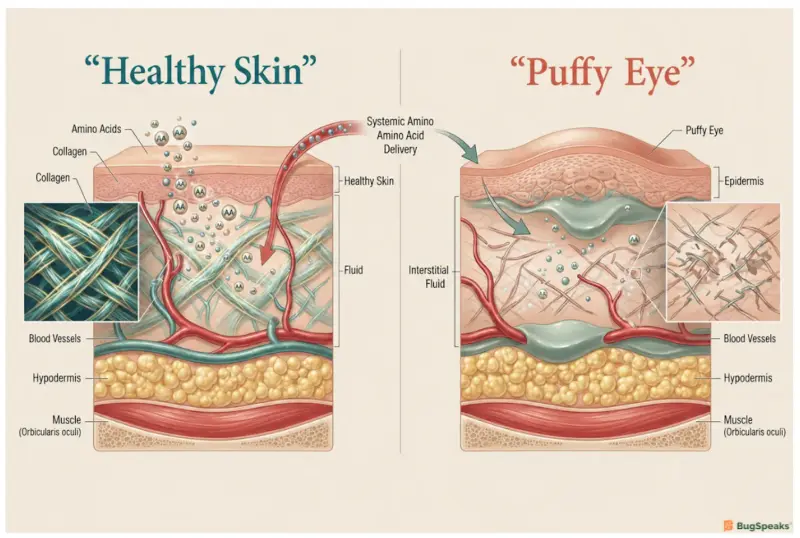
Why do puffy eyes and dark circles start in your stomach?
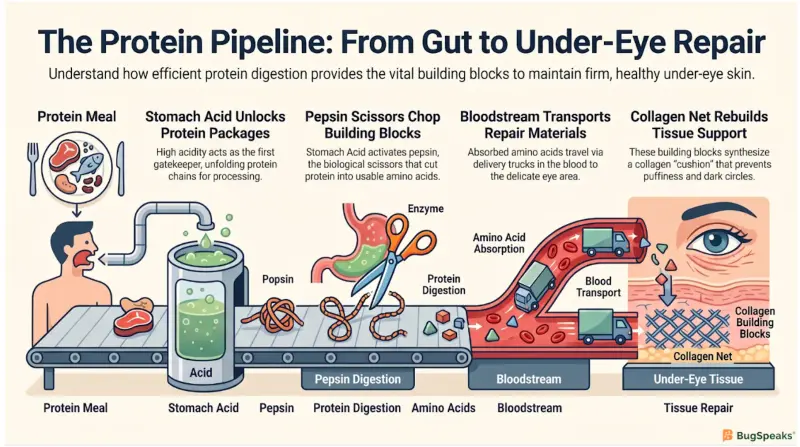
Puffy eyes and dark circles under your skin often start because your stomach does not make enough digestive acid to begin the breakdown of your food. You can imagine your digestive system as a long conveyor belt in a factory where every step must happen in a strict order. The first step on this belt is your stomach, which, acting as a busy sorting gatekeeper, uses acid to open up and prepare incoming protein packages. When your stomach acid levels are low, this vital first step is missed, and the entire conveyor belt stops working correctly, causing visible changes on your face.
Your stomach needs a highly acidic environment to trigger the next stages of your digestive conveyor belt. This special acid acts like a master key that unlocks the first gate on your sorting line, which allows your body to process the foods you eat. When you do not have enough acid, a condition called hypochlorhydria, your food packages pass through without being opened or sorted at all. This major delay means that the rest of your factory conveyor belt cannot do its job properly, leaving your body without the raw materials it needs to repair and maintain its structures.
This system shows that visible changes on your skin start long before nutrients ever reach your blood. The skin around your eyes is very thin, so any problems with your internal delivery belt show up there firstMunteanu et al. (2025). If the first gatekeeper in your stomach fails to open the food packages, your body cannot deliver the vital building blocks to your face. This lack of supplies causes fluid to collect in the under-eye area, which is known as periorbital edema, causing puffy bags and dark circles to form on your face. This explains why the first step in your stomach is so important for your skin.
How does a lack of stomach acid block protein digestion?
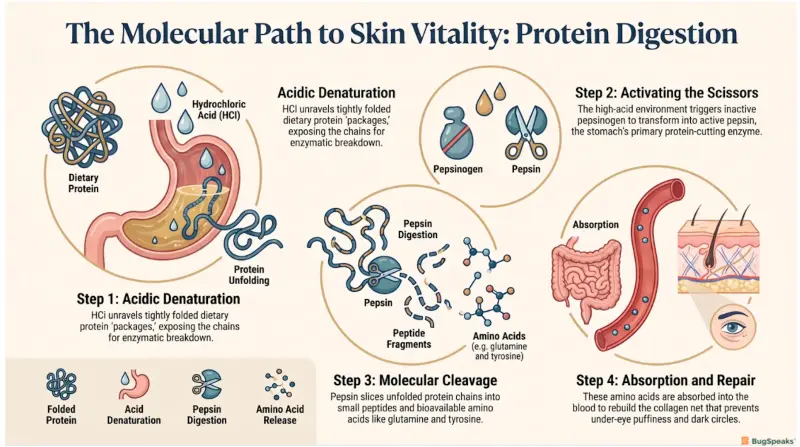
A lack of stomach acid blocks protein digestion because it stops your stomach from activating its main protein-cutting scissors. These biological scissors are necessary to chop large protein chains into smaller, usable pieces that your body can carry in its delivery trucks. When you eat protein, it enters your stomach as a tightly folded package that is very hard for your body to use. Without the help of strong stomach acid, these folded packages cannot be opened, which prevents your digestive scissors from finding and cutting the protein chains into smaller pieces that are needed for your skin to stay healthy and strong.
The primary protein-cutting scissors in your stomach start as an inactive helper molecule called pepsinogen. This helper molecule is completely quiet and cannot cut anything until it is bathed in a very strong bath of stomach acidQiu et al. (2025). Once the acid level is high enough, this helper molecule instantly transforms into the active cutting machine known as pepsin. If your stomach is not acidic enough, the quiet helper molecule stays asleep, meaning your protein packages go completely uncut and your factory conveyor belt cannot move them to the next station to help your body heal and feel strong.
When protein stays uncut, your body cannot absorb any of the important building blocks to send to your face. These uncut packages are too big to pass through the walls of your digestive conveyor belt into your bloodstream. Instead of being used to build strong, healthy tissues around your eyes, the unused proteins simply sit in your digestive tract and are completely wasted. This failure at the second station of your factory belt means that your under-eye skin is left without the daily repair supplies it needs, making it look dark, thin, and puffy over time. This makes your face look tired and worn out.
How does low acid allow bad bacteria to grow in your gut?
Low acid allows bad bacteria to grow in your gut because the acidic protective shield of your stomach is too weak to destroy incoming germs. Usually, your stomach acid acts like a fiery safety moat that burns and neutralizes foreign microbes entering with your food. When your acid levels drop, this protective shield fails, and microbes from your mouth can easily sail right through your stomach completely unharmed. These invaders then travel down into your small intestine, where they settle down and begin to grow very quickly where they do not belong, disrupting the peaceful community of your gut and causing trouble.
When oral invaders take over your small intestine, they create an unhealthy imbalance in your local microbiota. This community of microscopic helpers is supposed to protect your digestive factory and keep your conveyor belt clean. However, when your stomach acid drops, oral bacteria like Rothia mucilaginosa can move in and disturb this balanceFilardo et al. (2022). This colonization of the upper small intestine is called duodenal dysbiosis, and it turns your clean sorting line into a messy, inflamed environment that can no longer process food or absorb nutrients correctly, causing problems for your whole body and helping to make your under-eye skin look dark and puffy.
These bad bacteria also steal your food packages and turn them into putrid protein vapors and waste products. Instead of allowing your body to absorb the clean protein blocks, the invading germs ferment the unused proteins. This fermenting process produces toxic chemicals that irritate your gut lining, making it leaky. Once your gut barrier is damaged, these harmful bacterial toxins can escape into your blood, traveling up to your face and causing swelling and puffiness under your eyes. This shows how poor stomach health directly impacts your face in a visible and tiring way.
How does a lack of digested protein ruin the skin under your eyes?
A lack of digested protein ruins the skin under your eyes because your body cannot rebuild the strong dermal structures that keep your face firm. The skin under your eyes is the thinnest on your entire body, making it extremely sensitive to any drop in daily building supplies. When your stomach cannot break down protein, your blood cannot deliver the necessary building blocks, known as amino acids, to your face. Without these tiny blocks, your body cannot repair the under-eye cushion, leaving the skin thin, fragile, and saggy over time. This makes the blood vessels underneath much more visible to everyone around you.
The primary structural cushion that supports your under-eye skin is a strong protein net called collagen. This biological net acts like a firm mattress that keeps your skin flat and prevents fluid from pooling under your eyesMunteanu et al. (2025). To build this net, your body needs a steady stream of building blocks like glutamine, which supports energy and tissue repair in the skin. When protein digestion is blocked, your body cannot make enough new structural support, which causes your under-eye cushion to deflate and sag, forming puffy shadows on your face. This is why healthy protein digestion is so vital.
Without a strong structural cushion, the tiny blood vessels under your eyes begin to leak fluid into the surrounding tissues. This leaked fluid pools in the deflated spaces under your eyes, creating puffy bags that look swollen and tired. Furthermore, because the overlying skin is so thin you can easily see the dark, pooled blood through it, which creates the appearance of dark circles. This visual change is the direct result of a breakdown in your factory conveyor belt, starting in your stomach first. This shows why a healthy digestive conveyor belt is so essential for your skin to stay healthy.
How can you support your stomach acid and help your skin?
You can support your stomach acid and help your skin by eating a nutrient-rich, clean diet that naturally promotes a healthy environment in your stomach. Eating healthy, whole foods like those in the Mediterranean diet provides your body with the natural tools it needs to keep your digestive factory runningMunteanu et al. (2025). Chewing your food slowly and avoiding highly processed sugars also takes the pressure off your stomach, making it much easier for your body to break down protein packages and deliver clean building blocks to your under-eye skin, helping you look healthy every day.
Some people also find success by directly boosting their stomach acid levels using dietary supplements containing hydrochloric acid before meals. This supplement acts like a temporary helper that restores the acidity of your stomach gatekeeper, allowing your digestive scissors to wake up and work. By helping your stomach break down proteins correctly, you ensure that your conveyor belt can deliver a steady stream of building blocks to your skin, helping to rebuild the under-eye cushion and clear away puffy bags and dark circles. This helper restores the proper flow of your entire factory conveyor line to keep your face looking fresh and clear.
Supporting your stomach acid and balancing your gut bacteria is the ultimate way to heal the gut-skin axis from the inside out. When you fix the first step of your digestive conveyor belt, you stop gut inflammation before it can ever start. This healthy balance keeps your blood clean and your skin tissues well-nourished and strong. By taking care of your stomach, you provide your face with the daily building supplies it needs to stay firm, smooth, and free from puffy bags and dark circles. This simple step keeps your factory working perfectly, allowing your natural beauty to shine bright forever and ever.
Visualize the process- https://youtu.be/Z6ybd9SFKUw
Reference
Cater RE 2nd. The clinical importance of hypochlorhydria (a consequence of chronic Helicobacter infection): its possible etiological role in mineral and amino acid malabsorption, depression, and other syndromes. Med Hypotheses. 1992 Dec;39(4):375-83. doi: 10.1016/0306-9877(92)90065-k. PMID: 1494327.
Munteanu, C., Turti, S., & Marza, S. M. (2025). Unraveling the Gut–Skin Axis: The Role of Microbiota in Skin Health and Disease. Cosmetics, 12(4), 167.https://doi.org/10.3390/cosmetics12040167
Qiu L, Huang Q, Li W, Zhang Q, Zhou J, Chen J, Li Y, Wang R, Wang P, Liu S, Fang B, Wang X. Aging influences protein digestion, absorption and amino acid metabolism. Biogerontology. 2025 Jul 19;26(4):146. doi: 10.1007/s10522-025-10289-w. PMID: 40682691.
Jiminez V, Yusuf N. Bacterial Metabolites and Inflammatory Skin Diseases. Metabolites. 2023 Aug 17;13(8):952. doi: 10.3390/metabo13080952. PMID: 37623895; PMCID: PMC10456496.
Filardo S, Scalese G, Virili C, Pontone S, Di Pietro M, Covelli A, Bedetti G, Marinelli P, Bruno G, Stramazzo I, Centanni M, Sessa R, Severi C. The Potential Role of Hypochlorhydria in the Development of Duodenal Dysbiosis: A Preliminary Report. Front Cell Infect Microbiol. 2022 Apr 19;12:854904. doi: 10.3389/fcimb.2022.854904. PMID: 35521214; PMCID: PMC9062108.