Exploring the Link Between Gut Health and Emotional Well-Being
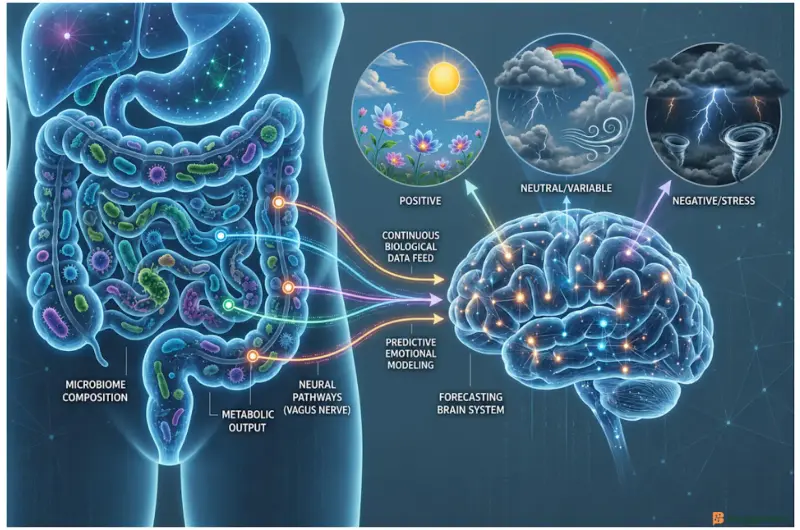
How does your brain forecast your daily mood like a weather app?
Your brain operates a continuous biological prediction center that forecasts daily safety and challenges, using incoming physical data to generate your mood as the ultimate forecast outcomeŚliwka et al. (2025). Instead of simply waiting for events to happen, your brain acts as a weather supercomputer. It constantly reads biological data streams to predict if your immediate world is friendly, stressful, or demanding. The brain processes these updates through its complex structural pathways, which we call the central nervous system (CNS). This interpretation network calculates survival probabilities and builds an emotional forecast to help you navigate your day safely.
This internal forecasting system does not work in isolation, as it requires a reliable pipeline to gather real-time biological updates from the body. To achieve this, the brain utilizes the microbiota-gut-brain axis (MGBA) as its primary communication highwaySá Filho et al. (2026). This bidirectional system connects your digestive tract directly to your skull through millions of special nerves and chemical pathways. When your gut microbes digest food, they send silent biological signals upward to inform the brain of internal conditions. These continuous updates help the forecasting system adjust its predictions so you feel energetic and prepared for the day ahead.
Understanding this prediction process helps explain why a stressful event can instantly make you feel physical discomfort in your stomach. Because the brain constantly sends information down the communication highway, any negative forecast immediately alters how your digestive system functionsHeidarzadeh-Rad et al. (2020). This means that your daily feelings are never random; they are the logical outcomes of your forecasting system analyzing biochemical metrics. By learning to modify these incoming biological signals, we can actually help the interpretation network choose a more stable, peaceful forecast. This strong and reliable biological stability is what scientists refer to as stress resilience.
How do gut microbes send weather signals to the brain?
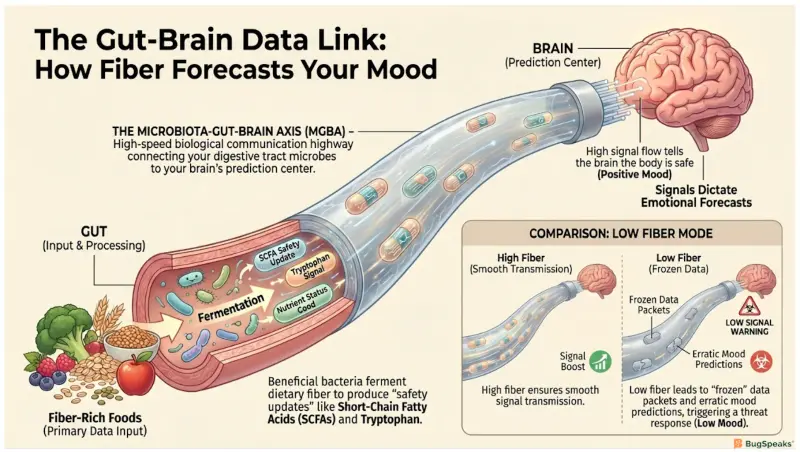
Your gut microbes send continuous biochemical signals to the brain through the fermentation of dietary fibers and the synthesis of special chemical messengersŚliwka et al. (2025). These microscopic bacteria live deep inside your digestive system and work like a tiny, dedicated factory team. They take the healthy food you eat and break it down into helpful chemical updates that serve as local weather reports. These reports are carried by the bloodstream and nerves straight to your brain's prediction center. By monitoring these microscopic messages, the brain understands what is happening in the gut and can adjust your daily energy levels accordingly.
The most important weather updates sent by your gut microbes are special chemical products called short-chain fatty acids (SCFAs)Śliwka et al. (2025). These tiny molecules are created when healthy bacteria ferment fibers from foods like apples, oats, and bananas. Once released, these molecules travel through the body to reinforce your physical barriers and soothe brain inflammation. Microbes also use a vital amino acid called tryptophan to help build mood-regulating chemicals. These active gut-derived data streams act as positive forecast modifiers, telling the nervous system that your body is well nourished, safe, and completely out of danger.
If you do not eat enough fiber, your helpful gut bacteria struggle to produce these crucial chemical safety signals. This lack of communication leads to an unbalanced state called gut dysbiosis, where bad microbes begin to crowd out the good ones. Without regular positive weather reports, your brain's interpretation network receives erratic, confusing biological data. The brain may easily mistake this lack of signals for a hidden environmental threat and generate a persistent low mood. This explains why an unbalanced gut can make you feel worried or sad, as the predictive supercomputer is simply reacting to a severe shortage of safety updates.
Why does your immune system act as a safety sensor?
Your immune system acts as an environmental sensor that monitors the physical integrity of your gut barrier to send safety or threat updates to the brainSá Filho et al. (2026). This defense network is spread throughout your digestive tract, working closely with your microbes to scan for foreign invaders. When your gut barrier is strong, the immune sensor remains calm and sends comforting messages to your central nervous system. These messages act as environmental data, telling your brain that the outer defenses are secure. Consequently, the brain's forecasting supercomputer predicts a safe environment and generates a peaceful, positive daily mood.
However, high psychological stress or a poor diet can quickly damage this protective gut wall, creating tiny, dangerous gaps that cause a leaky gut. When this structural damage happens, tiny bacterial particles can easily slip through these gaps directly into your bloodstream. Your active immune defense network immediately spots these biological intruders and sounds an urgent emergency alarm. To fight the threat, the system releases specific inflammatory proteins called cytokines to alert the entire bodySá Filho et al. (2026). These proteins travel through your blood to the brain, acting as loud threat warnings that completely disrupt your predictive forecasting model.
Once these inflammatory proteins reach your brain, they cause a mild, protective swelling response known to scientists as neuroinflammation. This biological warning signal tells your nervous interpretation network that your body is under active attack, forcing it to generate a highly negative forecast. Your brain deliberately creates a subjective state of low mood and anxiety to make you slow down, isolate, and rest. This adaptive biological reaction shows how physical gut irritation directly shapes your daily mental state. By protecting your gut wall and keeping your immune sensor calm, you can prevent these stress alarms and help your brain predict a stable, safe environment.
What are psychobiotics and how do they modify the forecast?
Psychobiotics are special live or heat-treated microbes that, when consumed in adequate amounts, can alter your brain's mood predictions by modifying incoming biological signalsŚliwka et al. (2025). These unique bacteria do not just support your digestion; they act as active forecast modifiers for your mind. When they reach your digestive tract, they immediately start producing calming chemicals that soothe both your nervous and immune networks. This helpful action corrects erratic biological data streams and rewrites the daily weather updates your brain receives. As a result, the brain's forecasting system predicts safety and shifts your subjective mood toward positivity.
These helpful psychobiotic bacteria work by producing an important, natural calming messenger called gamma-aminobutyric acid (GABA)Śliwka et al. (2025). This chemical messenger acts like a gentle brake pedal for your nervous system, slowing down hyperactive threat signals in the brain. When psychobiotics release this messenger in the gut, special nerves carry the calming safety signal directly to your predictive center. This sudden influx of positive data convinces your interpretation network to turn down its loud alarm systems. By reducing these stressful predictions, these tiny forecast modifiers naturally help you stay calm, happy, and focused, even during a very difficult day.
In addition to their powerful mood benefits, psychobiotics are highly valued because they are extremely safe, natural, and well tolerated. Clinical studies show that these beneficial microbes have a very low risk of causing minor adverse eventsLiu et al. (2026). Unlike traditional psychiatric medications, which can sometimes make people feel excessively drowsy or dizzy, psychobiotics work in perfect harmony with your body's natural systems. They simply reinforce your existing biology, helping to stabilize your internal forecasting model without any harsh side effects. This makes them a promising, gentle tool for anyone looking to naturally support their daily mental wellness.
Can a specific bacterial strain actually stabilize your mood?
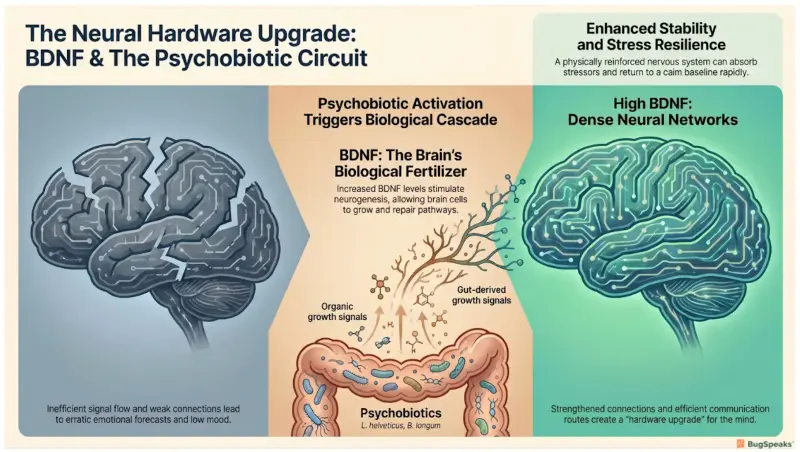
Specific clinical trials prove that certain probiotic strains can significantly reduce feelings of sadness by increasing crucial brain-growth proteinsHeidarzadeh-Rad et al. (2020). Scientists have discovered that these specific strains can easily travel to your digestive tract and send strong growth signals upward. These signals encourage your brain to produce more of a vital protein called brain-derived neurotrophic factor (BDNF). This protein acts like a rich fertilizer for your brain cells, helping them grow, adapt, and build new connections. Higher levels of this growth protein directly improve your neuroplasticity, allowing your forecasting supercomputer to easily recover from daily stress and anxiety.
In a rigorous clinical study, depressed patients took a daily psychobiotic combination containing Lactobacillus helveticus and Bifidobacterium longumHeidarzadeh-Rad et al. (2020). After eight weeks of treatment, the patients taking the active bacteria experienced a highly significant boost in their serum growth protein levels. In stark contrast, those who received an inactive placebo sachet showed no such biochemical improvement. The patients with the highest increase in growth protein also showed the greatest reduction in their overall depression scores. This exciting human trial proves that changing your gut microbes can directly rebuild your brain's physical pathways to support emotional stability and happy thoughts.
This exciting scientific breakthrough demonstrates that we can target specific biological pathways to naturally optimize our daily mental health and physical well-being. By using precision gut microbes to boost brain fertilizer levels, we directly support our nervous system's interpretation network. This biological reinforcement makes our internal state forecasting models highly stable, strong, and resilient against unexpected life challenges. Instead of feeling helpless when stress hits, we can actively cultivate a thriving gut microbiome to protect our minds and bodies. Understanding this powerful gut-brain connection fully empowers us to take control of our emotional weather forecasts, one helpful bacterium at a time.
-Varsha V
Visualize the process- https://youtu.be/mJ0WQNzXptU
Reference
Sá Filho, A., Oluwagbamigbe Fajemiroye, J., & Machado, S. (2026). Psychobiotics in Mental Health - Between Hope, Evidence, and the Need for Precision. Alpha psychiatry, 27(2), 45973. https://doi.org/10.31083/AP45973
Heidarzadeh-Rad, N., Gökmen-Özel, H., Kazemi, A., Almasi, N., & Djafarian, K. (2020). Effects of a Psychobiotic Supplement on Serum Brain-derived Neurotrophic Factor Levels in Depressive Patients: A Post Hoc Analysis of a Randomized Clinical Trial. Journal of neurogastroenterology and motility, 26(4), 486–495. https://doi.org/10.5056/jnm20079
Śliwka, A., Polak-Berecka, M., Zdybel, K., Zelek-Molik, A., & Waśko, A. (2025). Psychobiotics in Depression: Sources, Metabolites, and Treatment-A Systematic Review. Nutrients, 17(13), 2139. https://doi.org/10.3390/nu17132139
Haiyan, L., Dan, W., Xiaochao, W., Xiuxiu, C., Ye, L., Zhiguo, C., & Ting, L. (2026). Efficacy of probiotic intervention in unmedicated depression: a systematic review and meta-analysis. Frontiers in psychiatry, 16, 1608238. https://doi.org/10.3389/fpsyt.2025.1608238