Exploring the Biological Impact of Probiotics on Microbial Health
Why do antibiotics require probiotic recovery support?
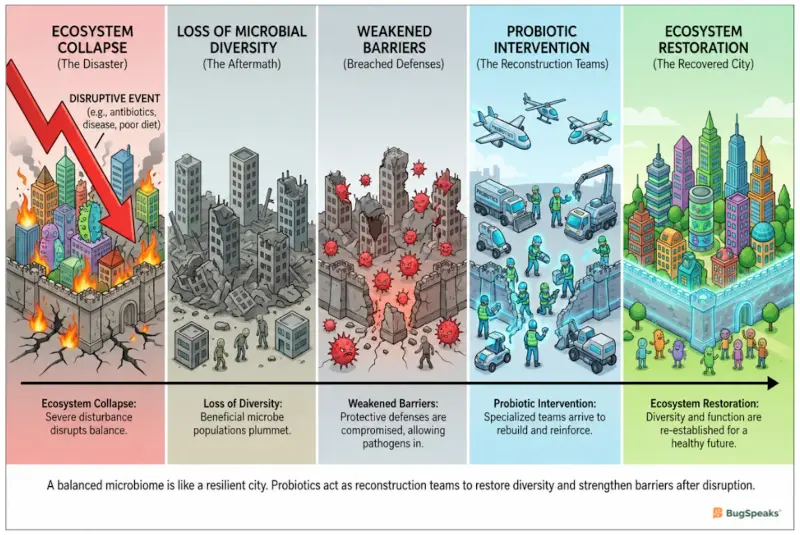
Antibiotics require probiotic recovery support because they trigger a major disruption event that decimates your living biological community, leaving the physical space highly vulnerable. When taking these medications, they non-selectively destroy both harmful invaders and your essential foundational workers. This massive structural collapse frequently leads to a condition known as Antibiotic-Associated Diarrhea (AAD). With the natural defensive barrier broken, opportunistic pathogens, such as Clostridioides difficile, aggressively colonize the newly vacated space. The sudden loss of colonization resistance means your ecosystem can no longer defend its territory chemically or physically. Because this major disruption event is immensely destructive, your body loses its natural ability to suppress these bacterial invadersKopacz & Phadtare (2022).
The intensity of this damage depends heavily on the specific medication used during the major disruption event. Broad-spectrum antibiotics cause a significantly higher rate of community collapse because they indiscriminately wipe out diverse populations of beneficial anaerobic bacteria. This clearing phase also triggers profound metabolic disturbances inside the living biological community. Normally, your resident microbes ferment complex carbohydrates into Short-Chain Fatty Acids (SCFAs), which provide vital cellular energy to keep your intestinal lining strong. When these microscopic workers are eliminated, unabsorbed carbohydrates remain abandoned in the gut. These leftover carbohydrates forcefully pull excess water into the intestines through osmosis, creating a highly unstable, hyperactive physical environment that directly causes severe digestive distressKopacz & Phadtare (2022).
Introducing Probiotics serves as a crucial recovery-support input designed to actively rebuild this damaged infrastructure and restore metabolic harmony. These beneficial microbes function through several distinct biological mechanisms to reinforce the weakened living biological community. First, they physically enhance the gut barrier by increasing the synthesis of tight junction proteins, literally sealing the microscopic leaks inside your intestinal walls. Second, these inputs deploy active defenses by producing Bacteriocins and organic acids that directly inhibit foreign invaders from growing. Additionally, targeted recovery-support inputs upregulate specialized water channels in the colon, drastically improving water absorption to quickly stabilize the physical environment and stop diarrhea from continuingKopacz & Phadtare (2022).
How does international travel disturb your intestinal community?
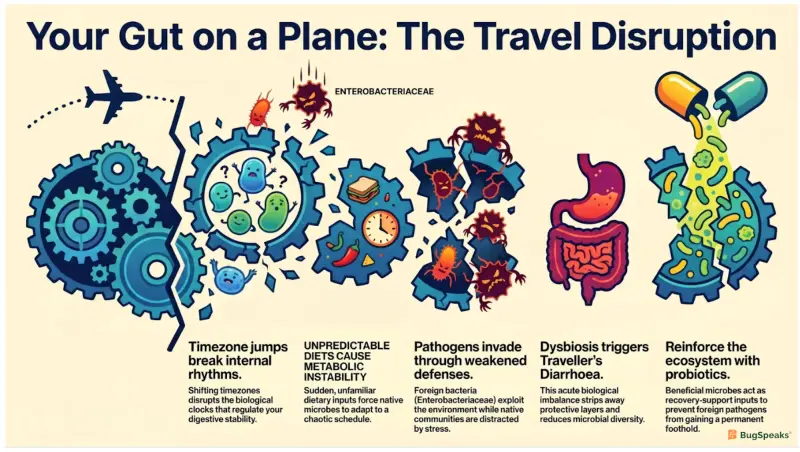
International travel disturbs your intestinal community by introducing a chaotic environmental disturbance characterized by sudden dietary shifts, altered biological clocks, and foreign pathogens. Your living biological community is remarkably sensitive to routine and highly dependent on stable conditions. When long-haul flights abruptly shift your timezone, the fundamental biological rhythms regulating digestion are completely thrown out of synchronization. This initial environmental disturbance physically weakens the structural integrity of the ecosystem. The native microbes become highly vulnerable to the chaotic schedule, physical exhaustion, and wildly unpredictable dietary inputs that accompany international journeys. This forced adaptation creates immediate instability, dramatically lowering the natural diversity of your resident microbesDuPont (2025).
As travellers venture into high-risk global regions, their living biological community is frequently bombarded by highly aggressive foreign bacteria, specifically hostile members of the Enterobacteriaceae family. This direct exposure acts as a rapid environmental shock, leading to an acute state of Dysbiosis, where the normally protective community is entirely overwhelmed by aggressive colonizers. This severe disruption often manifests as Traveller’s Diarrhoea, a major clinical event that strips away protective mucosal layers and significantly reduces native diversity. The severely weakened ecosystem then becomes a prime target for silent colonization by Multiple Drug-Resistant (MDR) organisms, which embed themselves permanently within the community, resisting standard medical treatments long after you return homeDuPont (2025).
To properly defend against this overwhelming environmental disturbance, travellers must actively manage their ecosystem stability before, during, and after their journey. Studies show that returning travellers frequently carry newly acquired antimicrobial-resistant genes hidden within their intestinal ecosystems. Providing the gut with targeted Probiotics serves as a vital recovery-support input to actively suppress these dangerous biological blueprints. By supplying a steady, reinforcing stream of beneficial microbes, the ecosystem can maintain its natural competitive exclusion mechanisms. These specialized recovery-support inputs prevent foreign pathogens from establishing a permanent biological foothold, effectively stopping the long-term communal spread of antimicrobial-resistant bacteria and maintaining a fortified living biological communityDuPont (2025).
What happens to your microbiome during an acute gastrointestinal illness?
During an acute gastrointestinal illness, your microbiome endures a severe ecosystem stress period where pathogenic invaders breach the protective intestinal layers, triggering intense inflammation and drastically altering the community's structural makeup. This highly destructive infectious event disrupts the standard operational functions of the gut, forcefully shifting the living biological community entirely away from its normal equilibrium. For example, during bouts of Acute Gastroenteritis, this intense ecosystem stress period regularly triggers the sudden emergence of an aggressive Escherichia-Shigella-dominated Enterotype. This hostile biological blueprint aggressively displaces foundational, health-promoting bacteria, hijacking the entire local environment to support pathogenic survivalCastaño-Rodríguez et al. (2018).
This extreme biological shift represents a dangerous reorganization of the gut's underlying infrastructure. The newly dominant Escherichia-Shigella Enterotype is highly pro-inflammatory, actively instructing the local bacteria to build destructive toxins rather than protective compounds. Advanced genetic tools reveal that this hostile takeover drastically alters the community's overall metabolic output. During this ecosystem stress period, the biological environment channels all its energy into constructing structural toxins designed specifically to damage your intestinal lining further. Visual markers of this extreme ecosystem stress period are clearly evident in the physical waste produced; changes in stool color correlate directly with massive expansions of these opportunistic invadersCastaño-Rodríguez et al. (2018).
Introducing high-quality recovery-support inputs is absolutely critical following this intense ecosystem stress period because the native community is often too severely decimated to rebuild independently. Even after the initial invading pathobiont is completely cleared by the body's immune system, the resulting structural damage leaves the environment incredibly susceptible to long-term chronic dysfunction. Probiotics act as necessary ecological reinforcements, rapidly colonizing the empty structural niches left behind by the infection. By deploying these targeted recovery-support inputs, the host can finally suppress the pro-inflammatory bacterial factions, physically re-establish the protective mucus barriers, and successfully coax the living biological community back toward stable healthCastaño-Rodríguez et al. (2018).
How does chronic psychological stress pressure your gut barrier?
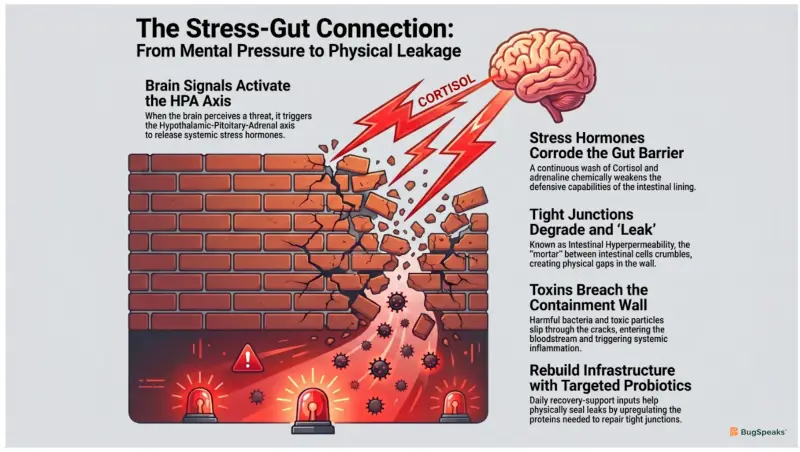
Chronic psychological stress pressures your gut barrier by acting as an ongoing pressure factor that continuously triggers the release of systemic stress hormones, which mechanically weaken intestinal walls and provoke severe bacterial imbalances. When the brain perceives a mental threat, it activates the Hypothalamic-Pituitary-Adrenal (HPA) Axis, violently flooding the body with Cortisol and adrenaline. While this chemical response is effective for short-term physical survival, chronic activation places immense, unrelenting pressure on the living biological community. The constant wash of stress hormones chemically alters the delicate gut environment, directly reducing the defensive capabilities of the intestinal lining and shifting the entire local ecosystem into a highly aggressive, hyper-reactive stateIlchmann-Diounou & Menard (2020).
Under this intense ongoing pressure factor, the physical infrastructure of the gut begins to fail, resulting in Intestinal Hyperpermeability, frequently referred to as a "leaky gut." The crucial tight junction proteins that normally lock the intestinal cells tightly together begin to degrade rapidly. This dangerous structural failure allows harmful bacteria, toxins, and undigested food particles to physically breach the containment wall and leak into the bloodstream. As the tight junctions collapse, the resulting biological leakage triggers peripheral immune cells to overreact, causing a massive spike in pro-inflammatory signals. This systemic alarm essentially forces the entire living biological community into a state of chronic defensive panic, draining critical energy away from routine ecosystem maintenanceIlchmann-Diounou & Menard (2020).
Because this severe biological pressure is entirely continuous, the living biological community cannot naturally enter a proper, uninterrupted repair cycle on its own. To actively counteract this ongoing pressure factor, the systematic introduction of recovery-support inputs becomes a vital daily maintenance strategy. Probiotics intervene by chemically reinforcing the damaged tight junctions, actively upregulating the specific proteins required to physically seal the intestinal leaks. Furthermore, these beneficial inputs actively lower localized inflammation by promoting the immediate expansion of regulatory immune cells and cooling the inflamed environment. By physically bolstering the structural barrier and chemically neutralizing the constant damage, these recovery-support inputs help the fragile ecosystem successfully resist the destructive effects of constant psychological stressIlchmann-Diounou & Menard (2020).
When exactly should you introduce probiotic recovery-support inputs?
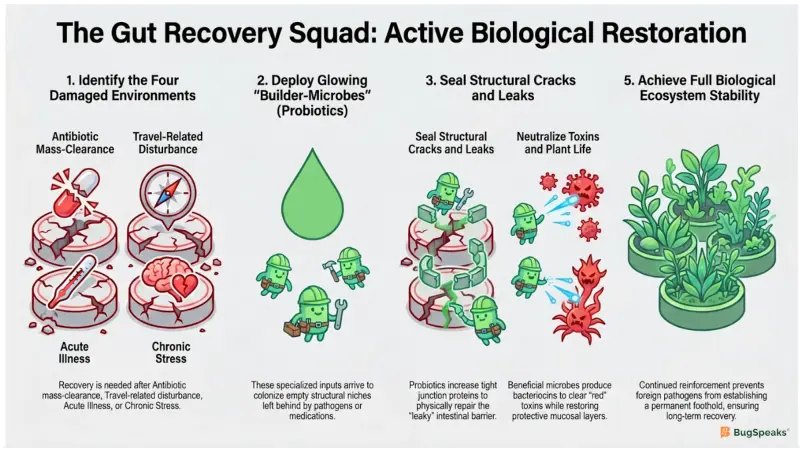
You should introduce probiotic recovery-support inputs simultaneously alongside and immediately following major disruption events to effectively rebuild and restabilize the living biological community. Understanding the exact timing and specific genetic nature of these recovery-support inputs is absolutely critical for repairing severe structural damage. The core biological concept of Strain Specificity dictates that while generalized bacterial strains are excellent for minor daily maintenance, high-impact disruption events require highly specialized, rigorously tested strains to execute rapid biological repair. Therefore, the strategic deployment of these inputs must align directly with the specific type of biological trauma the gut has recently experienced to achieve maximum effectiveness and prevent dangerous opportunistic pathogens from multiplying (Kopacz & Phadtare (2022).
For example, during a major disruption event like aggressive antibiotic usage, robust Randomized Controlled Trials (RCT) definitively prove that targeted recovery-support inputs significantly reduce severe complications. Global authorities emphasize that while basic fermented foods may lack the sheer structural power to halt severe diarrhea, specifically verified strains provide documented, reliable reconstruction of the damaged living biological community. High-impact strains, heavily recommended by major healthcare organizations, rapidly reconstruct the fragile ecosystem architecture before pathogens can take hold. These precise recovery-support inputs must be consistently administered starting on the very first day of the disruption and continued for several weeks after the primary stressor has been entirely removed, ensuring a highly stable, long-term biological recoveryKopacz & Phadtare (2022).
It remains essential to recognize the fundamental biological difference between routine daily maintenance and active, high-intensity recovery operations. During standard, low-stress periods, a diverse array of basic fermented foods provides sufficient baseline support for a healthy living biological community. However, during an intense ecosystem stress period or an unpredictable environmental disturbance, the structural damage is entirely too severe for casual dietary maintenance alone. The hostile environment strictly requires concentrated, high-dose biological reinforcements capable of surviving the highly inflamed landscape to successfully outcompete aggressive pathogens. By correctly timing the introduction of these powerful recovery-support inputs, individuals can drastically shorten their biological recovery timelines and aggressively protect their long-term systemic healthKopacz & Phadtare (2022).
Visualize the process- https://youtu.be/uwwakKZVZgE
Reference
Kopacz, K., & Phadtare, S. (2022). Probiotics for the Prevention of Antibiotic-Associated Diarrhea. Healthcare, 10(8), 1450. https://doi.org/10.3390/healthcare10081450
Szurek, E. A., Ngo, V. L., Abo, H., Cebula, A., Chassaing, B., Howard, R. A., … Kuczma, M. P. (2026). Soil-derived microbiota induces T regulatory cells and protect against mouse colitis, metabolic disease, and sepsis. Gut Microbes, 18(1). https://doi.org/10.1080/19490976.2026.2675089
Herbert L DuPont, Microbiome alterations during and after international travel, Journal of Travel Medicine, Volume 32, Issue 8, December 2025, taaf114, https://doi.org/10.1093/jtm/taaf114
Castaño-Rodríguez N, Underwood AP, Merif J, Riordan SM, Rawlinson WD, Mitchell HM, Kaakoush NO.2018.Gut Microbiome Analysis Identifies Potential Etiological Factors in Acute Gastroenteritis. Infect Immun86:10.1128/iai.00060-18.https://doi.org/10.1128/iai.00060-18
Ilchmann-Diounou H and Menard S (2020) Psychological Stress, Intestinal Barrier Dysfunctions, and Autoimmune Disorders: An Overview. Front. Immunol. 11:1823. doi: 10.3389/fimmu.2020.01823