# Probiotics and Gut Health: Understanding Survival and Delivery
Author: Neha Rao
Author URL: https://www.bugspeaks.com/blog/author/neha-rao
Published: 2026-09-15
Category: Diet and Supplements
Category URL: https://www.bugspeaks.com/blog/category/diet-and-supplements
Meta Title: How to Take Probiotics for Better Gut Health | BugSpeaks
Meta Description: Learn how to take probiotics for better gut health. Discover probiotic survival, delivery, capsules, microencapsulation, and food matrices.
Tags: Probiotic Survival, Gut Health
Tag URLs: Probiotic Survival (https://www.bugspeaks.com/blog/tag/probiotic-survival), Gut Health (https://www.bugspeaks.com/blog/tag/gut-health)
URL: https://www.bugspeaks.com/blog/probiotic-survival-delivery-gut-health
## What is the probiotic survival challenge course?
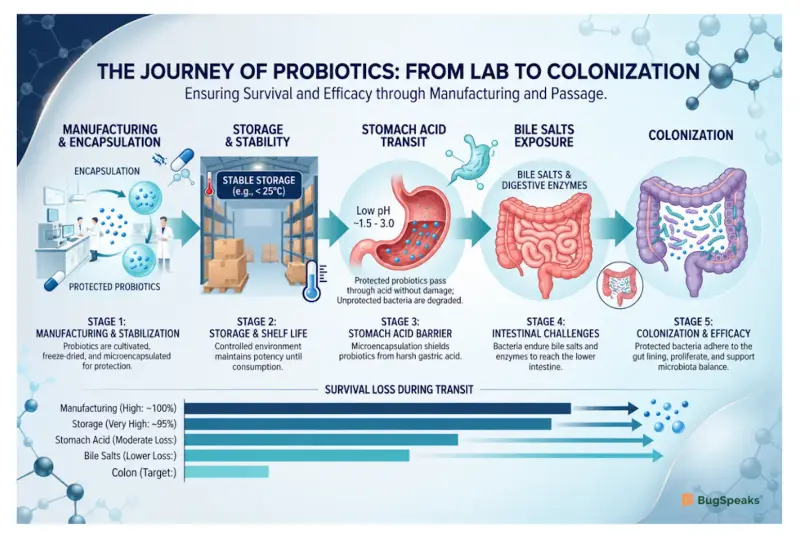
A probiotic survival challenge course is a series of harsh environments that friendly bacteria must pass through to help your body [Wendel (2022)](https://doi.org/10.3389/fmicb.2021.818468). These small [living](https://www.bugspeaks.com/blog/modern-traditional-living-gut-health) microbes are called probiotics, and they need to stay alive until they reach your large intestine [Wendel (2022)](https://doi.org/10.3389/fmicb.2021.818468). Along this journey, they face many difficult tasks, starting from the factory where they are made to storage on a kitchen shelf. Once you swallow them, they must travel through a pool of strong stomach acid and then a bath of soapy bile salts. Only the strongest and most protected microbes will survive this entire path to do their helpful work.
Many probiotic products boast about having very [high](https://www.bugspeaks.com/blog/high-heels-digestive-flow-gut-health) counts of colony-forming units (CFU) on their labels, but this is not what matters most [Wendel (2022)](https://doi.org/10.3389/fmicb.2021.818468). It does not help to start with billions of friendly bacteria if they all get destroyed during the first few steps of the survival challenge course [Fenster et al. (2019)](https://doi.org/10.3390/microorganisms7030083). The true value of any probiotic is its delivery efficacy, which means how many active cells actually finish the course alive. If a probiotic cannot survive the journey, it will not be able to join your [gut](https://www.bugspeaks.com/blog/berberine-gut-health-microbiome) community, protect your digestive system, and improve your overall health.
For these friendly bacteria, maintaining viability means keeping their cellular machinery running and staying alive during their long trip [Wendel (2022)](https://doi.org/10.3389/fmicb.2021.818468). Some naturally tough bacteria have special tools, like enzymes that break down dangerous bile, to help them survive the obstacles [Wendel (2022)](https://doi.org/10.3389/fmicb.2021.818468). Other sensitive bacteria are delicate and need human help to get through the body safely. Scientists design special capsules, dry powders, and healthy food coatings to act as protective gear for these bacteria. By learning how different products perform on our course, you can choose the best way to help these tiny travelers reach their destination safely.
**Challenge Stage**
**Biological Obstacle or Stressor**
**Course Status / Survival Test**
**Technical and Dietary Solutions for Efficacy**
Manufacturing
Desiccation and shear forces during drying
Starting Condition: Establishes initial population strength
Incorporation of cryoprotectants like trehalose to stabilize cell walls [Fenster et al. (2019)](https://doi.org/10.3390/microorganisms7030083)
Storage & Transit
Heat, oxidation, and humidity exposure
First Survival Test: Tests long-term viability before use
Foil packaging, low water activity excipients, and desiccant packs [Fenster et al. (2019)](https://doi.org/10.3390/microorganisms7030083)
Stomach Acid
Gastric juice with low pH (around 2.5)
Major Challenge: Acid causes cell walls to burst and lyse
Use of acid-resistant hypromellose capsules or co-ingested milk-based porridge [Wang et al. (2022)](https://doi.org/10.3390/foods11162472)
Bile Salts
Small intestine detergent secretions
Second Challenge: Detergents dissolve delicate cell walls
Microencapsulation in alginate-xanthan matrices or selecting tough strains [Zhu et al. (2026)](https://doi.org/10.1111/1751-7915.70305)
Large Intestine
Food competition and mucosal adhesion
Course Destination: Survival, completion, and colonization
Co-delivered prebiotics (like inulin) to stimulate selective growth in the gut [Roy and Dhaneshwar (2023)](https://doi.org/10.3748/wjg.v29.i14.2078)
**Survival Challenge Course**\- The series of environmental and physiological barriers a probiotic must successfully navigate from manufacturing to the colon.
**Colony-Forming Units** **(CFU)**\- A microbiological unit used to estimate the number of active, viable, replicating microbial cells in a probiotic sample.
**Viability**\- The physiological capability of a probiotic bacterium to remain alive, maintain active metabolism, and reproduce.
**Cryoprotectants**\- Protective substances (such as carbohydrates or peptides) added to bacterial concentrates before freezing to increase solution viscosity, prevent ice crystal growth, and protect cell membranes from freezing injury.
**Trehalose**\- A disaccharide sugar used as a thermal and freeze-drying protective agent due to its high glass transition temperature and hydratability, which shields bacterial cells against ice crystal damage and membrane degradation.
**Hypromellose capsules**\- Acid-resistant hard-shell capsules made of hydroxypropyl methylcellulose that remain insoluble in low gastric pH to shield delicate probiotic powders from stomach acid before releasing them in the intestine.
**Microencapsulation**\- Wrapping single-cell structures or groups of bacteria inside tiny, microscopic protective coatings or gel matrices to enhance gastrointestinal survival and enable targeted intestinal release.
**Alginate-xanthan matrices**\- Composite biopolymer hydrogel networks combining calcium alginate and xanthan gum to minimize gel pore size, repel digestive enzymes, and achieve up to 95% encapsulation efficiency.
## How do liquid and powder forms perform at the starting line?
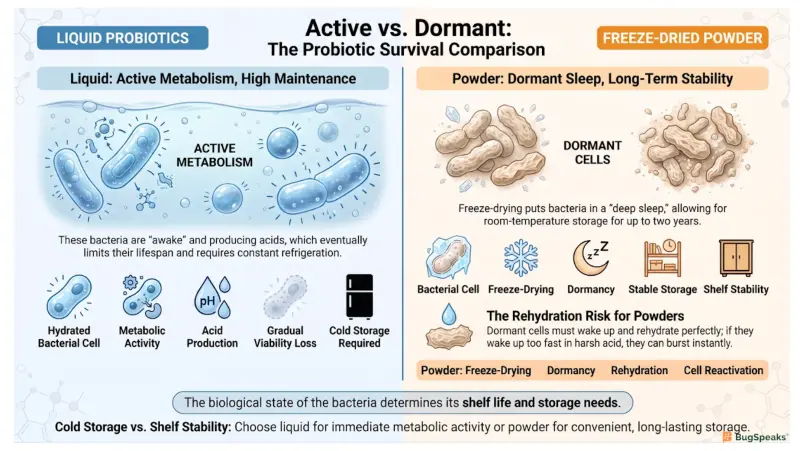
Liquid and powder probiotics are different starting forms that face their first survival tests before you even swallow them [Fenster et al. (2019)](https://doi.org/10.3390/microorganisms7030083). Liquid forms, like fermented milk drinks and yogurts, keep the bacteria awake in an active state where they can grow and produce healthy acids [Ranadheera et al. (2017)](https://www.mdpi.com/2311-5637/3/4/67). However, because they are awake, they keep eating and making their environment more acidic, which eventually hurts them. This means liquid forms have a short shelf life and must be kept in the refrigerator. Otherwise, the bacteria will run out of food and die before you can drink them.
In contrast, powder forms use a special method called freeze-drying to remove water and put the bacteria into a deep sleep [Fenster et al. (2019)](https://doi.org/10.3390/microorganisms7030083). However, the freeze-drying process is very stressful. If the water is frozen too fast, sharp ice crystals can tear the bacteria's delicate walls. Manufacturers must add protective sugars including trehalose, sucrose, maltodextrin, and lactose to prevent this from happening.
When you finally drink a probiotic powder, the dry bacteria must wake up and rehydrate inside your digestive system [Wendel (2022)](https://doi.org/10.3389/fmicb.2021.818468). If they wake up too quickly in a harsh environment, their cell membranes can burst, which destroys them instantly [Wendel (2022)](https://doi.org/10.3389/fmicb.2021.818468). This makes the rehydration step a critical moment at the starting line of our course. Powders are great for storage, but they leave the bacteria completely naked once they dissolve. Without a physical shield, these newly awakened bacteria must face the burning acid of your stomach without any help, which often leads to major losses of friendly cells.
**Active state**\- The awake and metabolically active physiological condition of a bacterium where it consumes nutrients and grows.
**Freeze-drying-** A low-temperature dehydration process that freezes the sample and then sublimates the ice to turn bacteria into a stable powder.
**Sucrose**\- A common disaccharide sugar utilized as a lyoprotectant during freeze-drying and spray-drying to stabilize microbial membrane structures and prevent dehydration stress.
**Maltodextrin**\- A water-soluble polysaccharide carrier used as a protective bulking agent during spray-drying and encapsulation to enhance bacterial survival during storage and gastrointestinal transit.
**Lactose**\- A disaccharide sugar that acts as a protective carrier during drying processes, stabilizing bacterial subcellular structures when combined with divalent cations like calcium.
## How do standard capsules and tablets handle the stomach acid obstacle?
Standard capsules and tablets act as physical shields to help friendly bacteria such as _Lactobacillus_ ( _L. acidophilus_, _L. plantarum_, and _L. rhamnosus_) and _Bifidobacterium_ ( _B. animalis_ and _B. longum_) survive the burning acid of your stomach [Wang et al. (2022)](https://doi.org/10.3390/foods11162472). The stomach is a hostile place filled with gastric juice, which has a very low pH around pH 2.0 to 2.5 and contains digestive enzymes designed to break down food [Wendel (2022)](https://doi.org/10.3389/fmicb.2021.818468). Unprotected bacteria are quickly destroyed in this acid bath, often within minutes [Oberoi et al. (2021)](https://doi.org/10.3390/foods10091999). Capsules made from special acid-resistant materials do not dissolve in the stomach [Wang et al. (2022)](https://doi.org/10.3390/foods11162472). They keep the bacteria dry and safe until they reach the intestine, where the acid disappears and the capsule safely opens [Zhu et al. (2026)](https://doi.org/10.1111/1751-7915.70305).
Probiotic tablets are made differently, as they are created by mixing dry bacteria such as strains of _Lactobacillus_ and _Bifidobacterium_, that have been dehydrated into a resting, non-metabolic state with powder and pressing them tightly [Wang et al. (2022)](https://doi.org/10.3390/foods11162472). This hard compression force creates a massive amount of mechanical shear that physically crushes and kills many of the bacteria [Fenster et al. (2019)](https://www.ncbi.nlm.nih.gov/pmc/articles/PMC6463069). Even though tablets are easy to swallow, the physical compaction during manufacturing permanently damages the cell structures of the lucky survivors. Furthermore, standard tablets do not always dissolve at the right time in the gut. They might release the bacteria too early in the stomach, or too late in the large intestine where they are needed.
Because of these differences, standard gelatin capsules and compressed tablets perform very differently on the survival course [Wang et al. (2022)](https://doi.org/10.3390/foods11162472). Gelatin capsules dissolve too quickly in the stomach, exposing the bacteria to acid, while compressed tablets physically injure the cells before they are even packaged [Fenster et al. (2019)](https://www.ncbi.nlm.nih.gov/pmc/articles/PMC6463069). This is why scientists prefer using specialized acid-resistant polymer capsules for probiotics [Wang et al. (2022)](https://doi.org/10.3390/foods11162472). These advanced capsule shells act like armored cars, carrying the bacteria through the burning stomach acid obstacle without letting a single drop of acid touch them, which ensures the maximum delivery success of these living cells.
**Dosage Form**
**Starting Condition Quality**
**Stomach Acid Survival**
**Key Pros**
**Key Cons**
Free Liquids
Active, vegetative state
Very poor; directly exposed to acid
Active and ready to work
Short shelf life; needs refrigerator [Wang et al. (2022)](https://doi.org/10.3390/foods11162472)
Dry Powders
Sleeping, dry state
Poor; rehydrates in stomach acid
Shelf stable at room temperature
Completely unprotected upon dissolving [Wendel (2022)](https://doi.org/10.3389/fmicb.2021.818468)
Tablets
Compacted and injured
Moderate; physical shield is dense
Easy to produce; low cost
Compression kills many cells during pressing [Fenster et al. (2019)](https://www.ncbi.nlm.nih.gov/pmc/articles/PMC6463069)
Capsules
Dry and protected
High (with acid-resistant shell)
Target-released in neutral gut
More complex and costly to manufacture [Wang et al. (2022)](https://doi.org/10.3390/foods11162472)
Microencapsulation
Micro-shielded beads
Excellent; matrix repels stomach acid
Up to 38% higher gut survival rates
Requires advanced production methods [Oberoi et al. (2021)](https://doi.org/10.3390/foods10091999)
**Gastric juice**\- The watery, highly acidic secretion of the stomach containing hydrochloric acid and active digestive enzymes like pepsin.
**Mechanical shear**\- The physical forces, friction, and pressure applied to bacterial cells during industrial processing or tablet compaction.
**Gelatin capsules**\- Traditional solid dosage containers made of soluble animal collagen protein that protect dry cores but dissolve rapidly upon contact with liquid in the stomach.
## How does microencapsulation protect probiotics from bile salts?
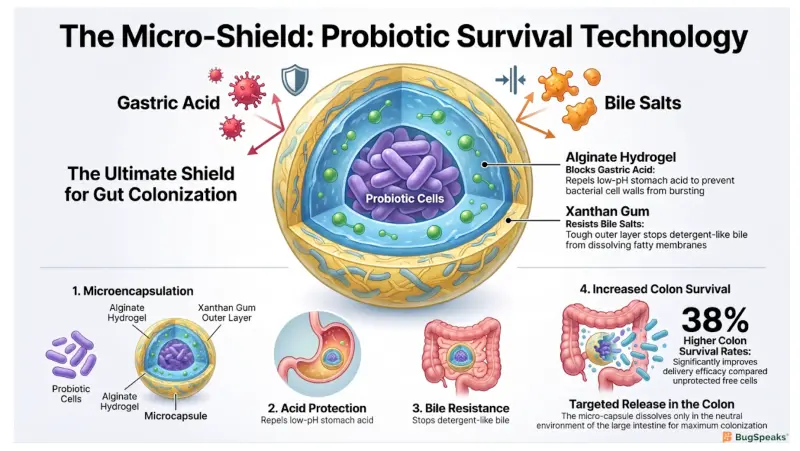
Microencapsulation is an advanced protective technology that packs tiny bacteria inside defensive micro-capsules [Oberoi et al. (2021)](https://doi.org/10.3390/foods10091999). Instead of using one large capsule shell, this method wraps single cells or small groups of bacteria in their own microscopic coats [Zhu et al. (2026)](https://doi.org/10.1111/1751-7915.70305). These tiny coats are often made from natural seaweed extracts, like alginate, mixed with starch or proteins [Philip and Philip (2010)](https://doi.org/10.5001/omj.2010.24). By using these natural polymers, scientists can create a soft gel matrix around each bacterium [Oberoi et al. (2021)](https://doi.org/10.3390/foods10091999). This gel keeps the stomach acid out but allows the bacteria to breathe and receive nutrients during their journey.
Once the bacteria survive the stomach, they must face their next major obstacle in the small intestine: bile salts [Wendel (2022)](https://doi.org/10.3389/fmicb.2021.818468). These soapy fluids act like detergents, which are great for digesting fats but can dissolve the delicate fatty walls of unprotected bacteria [Wendel (2022)](https://doi.org/10.3389/fmicb.2021.818468). Micro-capsules coated with xanthan gum create an extra tough layer that stops these detergents from reaching the bacteria [Oberoi et al. (2021)](https://doi.org/10.3390/foods10091999). Studies show that this double-layer gel shield improves probiotic survival in the gut by up to thirty-eight percent compared to free, unprotected cells, which is a major victory in our course [Oberoi et al. (2021)](https://doi.org/10.3390/foods10091999).
This micro-shielding technology ensures that a massive number of live bacteria safely reach their target destination [Oberoi et al. (2021)](https://doi.org/10.3390/foods10091999). The tiny gel beads hold the bacteria tightly during the early parts of the digestive system, but they are designed to dissolve once they feel the neutral environment of the colon [Zhu et al. (2026)](https://doi.org/10.1111/1751-7915.70305). When the beads open, the healthy bacteria are released in a perfectly active state, ready to colonize, build a strong community, and defend your gut from harmful microbes [Oberoi et al. (2021)](https://doi.org/10.3390/foods10091999). This targeted release makes micro-encapsulated probiotics a highly reliable choice for daily use.
**Microencapsulation**\- Wrapping single-cell structures or groups of bacteria inside tiny, microscopic protective coatings or gel matrices.
**Bile salts**\- Detergent-like liquids secreted into the small intestine that digest lipids but dissolve unprotected bacterial cell walls.
**Alginate**\- A natural biopolymer extracted from brown algae that forms biocompatible, acid-stable hydrogels when cross-linked with calcium ions to immobilize live microorganisms.
**Xanthan gum**\- A microbial polysaccharide that provides acid resistance and viscosity without degrading under intestinal enzymes, strengthening outer microcapsule layers against bile salts.
**Micro-shielding technology**\- The application of double-layered or composite micro-capsules to physically isolate living bacteria from environmental hazards, low gastric pH, and detergent-like bile fluids.
## **How** do food matrices help probiotics complete the course?
A food matrix is the physical structure and nutrient mixture in food that surrounds and protects probiotics during digestion [Treven et al. (2024)](https://doi.org/10.3390/foods13193135). Eating probiotics with food, like a bowl of milk-based porridge, provides a natural shield that slows down the stomach's acid secretions [Treven et al. (2024)](https://doi.org/10.3390/foods13193135). The proteins and fats in food act as physical barriers that absorb the acid, giving the bacteria a safe place to hide [Treven et al. (2024)](https://doi.org/10.3390/foods13193135). In fact, studies show that co-digesting probiotics with porridge helps them survive much better than taking them with acidic fruit juice or water on an empty stomach [Treven et al. (2024)](https://doi.org/10.3390/foods13193135).
Additionally, some foods are enriched to become synbiotics, which combine friendly bacteria with their favorite dietary fibers, known as prebiotics [Roy and Dhaneshwar (2023)](https://doi.org/10.3748/wjg.v29.i14.2078). Prebiotics, like inulin, are non-digestible ingredients that go straight to the colon to feed the probiotics [Roy and Dhaneshwar (2023)](https://doi.org/10.3748/wjg.v29.i14.2078). In a synbiotic mixture, the prebiotics physically coat the bacteria, offering extra protection from stomach acids and enzymes [Roy and Dhaneshwar (2023)](https://doi.org/10.3748/wjg.v29.i14.2078). Once they arrive in the colon, the bacteria immediately ferment these fibers to produce healthy organic acids that protect the gut [Roy and Dhaneshwar (2023)](https://doi.org/10.3748/wjg.v29.i14.2078). This synergistic food partnership ensures they have plenty of fuel.
Different kinds of foods can support probiotic survival in distinct ways, depending on their physical properties [Treven et al. (2024)](https://doi.org/10.3390/foods13193135). Fermented dairy foods, like curd and yogurt, are highly effective carriers because they contain natural fats, primarily palmitic acid, oleic acid, stearic acid, myristic acid, and conjugated linoleic acids that coat the bacterial cells [Reddy et al. (2021)](https://doi.org/10.5005/jp-journals-10005-1883). Similarly, traditional fermented plant-based foods, like shalgam or kimchi, provide excellent, protective microclimates that support the bacteria (Rasika et al., 2021). By taking your probiotics with a meal, you provide them with a supportive environment that acts like a team of helpers, helping them complete their survival course and keep your gut healthy and happy.
**Food matrix**\- The physical structure and nutrient composition of food (like dairy or oatmeal) that surrounds and carries probiotics.
**Synbiotics**\- A synergistic combination of friendly probiotic bacteria and their favorite food, non-digestible prebiotic fibers, in one sachet or meal.
**Inulin**\- A non-digestible prebiotic carbohydrate fiber that physically coats bacterial cells during digestion and selectively feeds beneficial microbes in the large intestine.
**Shalgam**\- A traditional fermented plant-based vegetable beverage that provides an acidic, nutrient-rich micro-climate for delivering viable lactic acid bacteria.
**Palmitic acid**\- A saturated 16-carbon fatty acid found in dairy fat matrices that contributes to the physical lipid coating around probiotic cells during digestion.
**Oleic acid**\- A monounsaturated 18-carbon omega-9 fatty acid present in milk fat and vegetable oils that aids in forming lipid barriers around bacterial cell membranes.
**Stearic acid**\- A saturated 18-carbon long-chain fatty acid used in solid lipid microparticles to encapsulate probiotic strains and provide a biocompatible moisture and acid barrier.
**Myristic acid**\- A saturated 14-carbon fatty acid abundant in fermented dairy milk fats that contributes to the protective lipid structure surrounding ingested microbes.
**Conjugated linoleic acids**\- Bioactive polyunsaturated fatty acid isomers produced during milk fermentation by lactic acid bacteria that provide antioxidant properties and support gut health.
Visualize the process- [https://youtu.be/iwE7F-OJri4](https://youtu.be/iwE7F-OJri4)
### Reference
Zhu, Y., Lv, L., Du, B., & Zhao, M. (2026). Next-Generation Microencapsulation Technologies for Probiotic Protection and Precision Delivery. _Microbial biotechnology_, _19_(2), e70305. [https://doi.org/10.1111/1751-7915.70305](https://doi.org/10.1111/1751-7915.70305)
Malmo, C., Giordano, I., & Mauriello, G. (2021). Effect of Microencapsulation on Survival at Simulated Gastrointestinal Conditions and Heat Treatment of a Non Probiotic Strain, _Lactiplantibacillus plantarum_ 48M, and the Probiotic Strain _Limosilactobacillus reuteri_ DSM 17938. _Foods (Basel, Switzerland)_, _10_(2), 217. [https://doi.org/10.3390/foods10020217](https://doi.org/10.3390/foods10020217)
Oberoi, K., Tolun, A., Altintas, Z., & Sharma, S. (2021). Effect of Alginate-Microencapsulated Hydrogels on the Survival of Lactobacillus rhamnosus under Simulated Gastrointestinal Conditions. Foods, 10(9), 1999. [https://doi.org/10.3390/foods10091999](https://doi.org/10.3390/foods10091999)
Treven, P., Paveljšek, D., Bogovič Matijašić, B., & Mohar Lorbeg, P. (2024). The Effect of Food Matrix Taken with Probiotics on the Survival of Commercial Probiotics in Simulation of Gastrointestinal Digestion. _Foods (Basel, Switzerland)_, _13_(19), 3135. [https://doi.org/10.3390/foods13193135](https://doi.org/10.3390/foods13193135)
Rasika, D. M. D., Vidanarachchi, J. K., Luiz, S. F., Azeredo, D. R. P., Cruz, A. G., & Ranadheera, C. S. (2021). Probiotic Delivery through Non-Dairy Plant-Based Food Matrices. Agriculture, 11(7), 599. [https://doi.org/10.3390/agriculture11070599](https://doi.org/10.3390/agriculture11070599)
Grujović, M. Ž., Semedo-Lemsaddek, T., & Marković, K. G. (2025). Application of Probiotics in Foods: A Comprehensive Review of Benefits, Challenges, and Future Perspectives. _Foods (Basel, Switzerland)_, _14_(17), 3088. [https://doi.org/10.3390/foods14173088](https://doi.org/10.3390/foods14173088)
Fenster, K., Freeburg, B., Hollard, C., Wong, C., Rønhave Laursen, R., & Ouwehand, A. C. (2019). The Production and Delivery of Probiotics: A Review of a Practical Approach. _Microorganisms_, _7_(3), 83. [https://doi.org/10.3390/microorganisms7030083](https://doi.org/10.3390/microorganisms7030083)
Philip, A. K., & Philip, B. (2010). Colon targeted drug delivery systems: a review on primary and novel approaches. _Oman medical journal_, _25_(2), 79–87. [https://doi.org/10.5001/omj.2010.24](https://doi.org/10.5001/omj.2010.24)
Roy, S., & Dhaneshwar, S. (2023). Role of prebiotics, probiotics, and synbiotics in management of inflammatory bowel disease: Current perspectives. _World journal of gastroenterology_, _29_(14), 2078–2100. [https://doi.org/10.3748/wjg.v29.i14.2078](https://doi.org/10.3748/wjg.v29.i14.2078)
Reddy, S., Madhu, V., Punithavathy, R., Satyam, M., Chowdary, U. K., & Mythraiye, R. (2021). Comparative Evaluation of Efficacy of Kefir Milk Probiotic Curd and Probiotic Drink on _Streptococcus mutans_ in 8-12-year-old Children: An _In Vivo_ Study. _International journal of clinical pediatric dentistry_, _14_(1), 120–127. [https://doi.org/10.5005/jp-journals-10005-1883](https://doi.org/10.5005/jp-journals-10005-1883)
Wang, G., Chen, Y., Xia, Y., Song, X., & Ai, L. (2022). Characteristics of Probiotic Preparations and Their Applications. _Foods (Basel, Switzerland)_, _11_(16), 2472. [https://doi.org/10.3390/foods11162472](https://doi.org/10.3390/foods11162472)
La Torre, C., Caputo, P., Cione, E., & Fazio, A. (2024). Comparing Nutritional Values and Bioactivity of Kefir from Different Types of Animal Milk. Molecules, 29(11), 2710. [https://doi.org/10.3390/molecules29112710](https://doi.org/10.3390/molecules29112710)
Ranadheera, C. S., Vidanarachchi, J. K., Rocha, R. S., Cruz, A. G., & Ajlouni, S. (2017). Probiotic Delivery through Fermentation: Dairy vs. Non-Dairy Beverages. Fermentation, 3(4), 67. [https://doi.org/10.3390/fermentation3040067](https://doi.org/10.3390/fermentation3040067)
Wendel U. (2022). Assessing Viability and Stress Tolerance of Probiotics-A Review. _Frontiers in microbiology_, _12_, 818468\. [https://doi.org/10.3389/fmicb.2021.818468](https://doi.org/10.3389/fmicb.2021.818468)
## FAQs
Q: Does a higher CFU count on a label mean a probiotic is better?
A: No, because a high starting count of colony-forming units does not guarantee that the bacteria will reach your gut alive Wendel (2022). If the bacteria are unprotected, most of them will be destroyed by stomach acid or bile salts before reaching their colonic destination Oberoi et al. (2021). A lower count in a highly protected, acid-resistant capsule or micro-capsule is much more effective than billions of unprotected cells.
Q: Should I take probiotics on an empty stomach or with food?
A: Taking your probiotics with a meal, particularly one containing some healthy fats and proteins (like yogurt or porridge prepared with milk), is highly beneficial Treven et al. (2024). The food acts as a buffer that absorbs stomach acid, creating a safer passage for the bacteria and helping more cells survive their journey compared to drinking them with water on an empty stomach Treven et al. (2024).
Q: Why is microencapsulation better than standard capsules or tablets?
A: Standard capsules dissolve too quickly, and tablets physically crush bacteria during manufacturing Fenster et al. (2019). Microencapsulation wraps the bacteria inside tiny, individual gel beads that act as small personal shields Oberoi et al. (2021). These beads repel both stomach acid and detergent-like bile salts, improving gut survival rates by up to thirty-eight percent Oberoi et al. (2021).
Q: Can I get probiotics from eating regular food?
A: Yes, you can get natural probiotics from traditional fermented foods. Fermented dairy options like curd, kefir, and yogurt contain natural milk fats that shield and protect the bacteria Reddy et al. (2021). Additionally, plant-based fermented options like shalgam, kimchi, and fermented cabbage offer highly supportive micro-climates that keep bacteria alive Rasika et al. (2021).
Q: What is a synbiotic and why is it helpful?
A: A synbiotic is a mixture of friendly bacteria and their favorite food, prebiotics, in one single product Roy and Dhaneshwar (2023). Prebiotic fibers like inulin physically coat the bacteria, shielding them from digestion stresses Roy and Dhaneshwar (2023). Once the team reaches the colon, the bacteria immediately ferment this fiber to make healthy organic acids, ensuring they survive and thrive Roy and Dhaneshwar (2023).
---
This blog is powered by Superblog. Visit https://superblog.ai to know more.
---