# Posture and Gut Health: Exploring the Digestive Motility Connection
Author: Neha Rao
Author URL: https://www.bugspeaks.com/blog/author/neha-rao
Published: 2026-08-30
Category: Microbiome and Lifestyle
Category URL: https://www.bugspeaks.com/blog/category/microbiome-and-lifestyle
Meta Title: Posture and Gut Health: Digestive Motility | BugSpeaks
Meta Description: Explore how poor posture affects gut health, digestive motility, and peristalsis. Learn ergonomic habits to support digestion and reduce discomfort today.
Tags: Gut Health, Digestive Health, Posture
Tag URLs: Gut Health (https://www.bugspeaks.com/blog/tag/gut-health), Digestive Health (https://www.bugspeaks.com/blog/tag/digestive-health), Posture (https://www.bugspeaks.com/blog/tag/posture)
URL: https://www.bugspeaks.com/blog/posture-gut-health-digestive-health
## How does slouching physically alter your abdominal workspace?
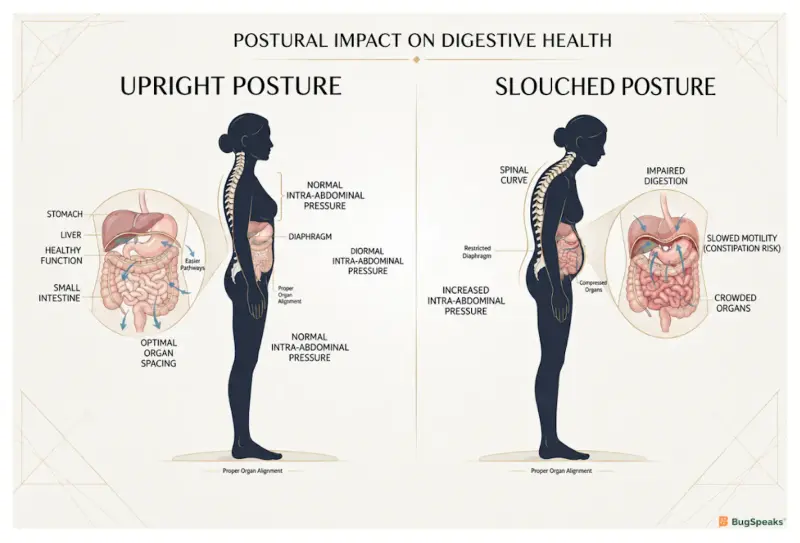
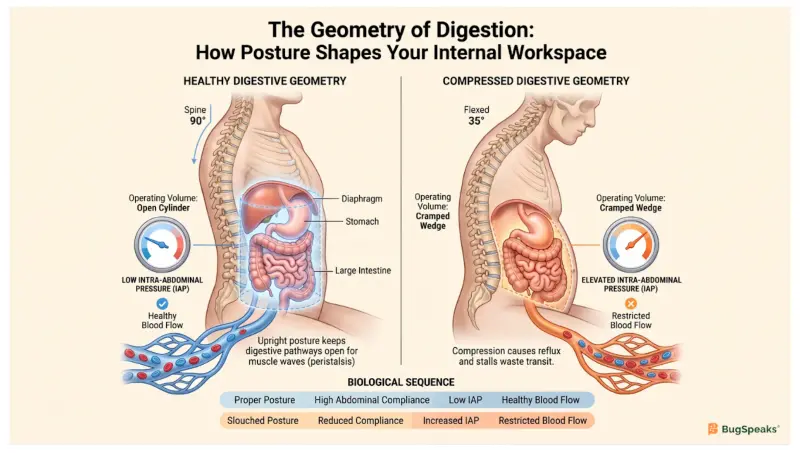
Slouching at your remote desk physically collapses the operating volume of your abdominal cavity, compressing the organs inside and raising the internal pressure. Your abdominal cavity behaves like an operating volume, which is the total physical space available for your organs. When you sit in an upright, erect posture, this operating volume is maximized, and your abdominal compliance remains high. However, when you slouch or bend forward, you force your body geometry into a state of prolonged trunk flexion. This skeletal collapse reduces the vertical height of your [gut](https://www.bugspeaks.com/blog/seaweed-gut-health-gut-microbes) cavity and squashes its flexible boundaries, making digestion much harder.
This mechanical compression limits your abdominal compliance, meaning your stomach wall cannot stretch properly to accommodate food. Just as an elastic abdominal binder squeezes your stomach and artificially increases your intra-abdominal pressure, slouching at your desk acts like a tight physical clamp. This elevated intra-abdominal pressure squashes your organs, making it very hard for them to function normally. For remote workers spending six to eight hours a day in poor home setups, this pressure is a constant stress on their [digestive health](https://www.bugspeaks.com/blog/screen-time-digestive-health). It limits the vital space our organs need to work.
We can understand this easily through a simple body-angle comparison of our seating setups. Sitting at a ninety-degree upright angle keeps our operating volume shaped like a spacious, open cylinder. Slouching down to a thirty-five-degree trunk angle squashes this cylinder into a tiny, cramped wedge. This posture collapse physically squeezes our digestive organs together, leaving them very little room to work. Spending hours in this slouched body geometry leads to unhealthy sedentary behavior, where a lack of movement and constant organ crowding slows down our entire digestive system, causing pain and severe discomfort. Correcting your posture opens up your internal space and immediately improves your organ workspace.
**Anatomical Structure**
**Geometric Representation**
**Impact of Slouching / Flexion**
**Physiological Consequence**
Abdominal Cavity
Operating Volume [Papavramidis (2011)](https://www.ncbi.nlm.nih.gov/pmc/articles/PMC3132369/)
Vertical collapse of physical boundary; reduced compliance
Elevated baseline intra-abdominal pressure [Ghomash Baf Zadeh (2025)](https://doi.org/10.1002/hsr2.70976)
Posture / Spine
Body Geometry [Voglar (2016)](https://www.ncbi.nlm.nih.gov/pmc/articles/PMC5096890/)
35-degree slouched trunk angle vs. 90-degree erect angle
Tissue deformation, back muscle fatigue, spinal instability
Stomach
Geometric Position [Ghomash Baf Zadeh (2025)](https://doi.org/10.1002/hsr2.70976)
Vertical compression and upward displacement
Lower esophageal sphincter failure; acid reflux/GERD [Barnouti (2016)](https://www.ncbi.nlm.nih.gov/pmc/articles/PMC5018651/)
Intestines
Geometric Arrangement [Colonic Motility (2010)](https://www.ncbi.nlm.nih.gov/books/NBK53471/)
Narrowing and squeezing of transport pathways
Sluggish flow, blocked contractions, constipation [Rahgoshay (2025)](https://www.ncbi.nlm.nih.gov/pmc/articles/PMC12219158/)
Peristalsis
Geometry-Dependent Movement [Colonic Motility (2010)](https://www.ncbi.nlm.nih.gov/books/NBK53471/)
Disruption of wave propagation along path
Impaired transit, irregular mixing, and straining effort
**Operating volume**\- The total physical space inside your belly where digestion happens. When you slouch, this space shrinks.
**Body geometry**\- The physical shape and angles of your body, which are determined by how you sit or stand.
**Abdominal compliance**\- How easily your belly walls can stretch to accommodate your organs and food. When compliance is low, pressure inside goes up.
**Intra-abdominal pressure**\- The steady physical pressure inside your belly cavity. Slouching acts like a tight belt, raising this pressure.
**Sedentary behavior**\- Sitting or lying down for long periods without moving. This is a common habit among office workers and is linked to poor health.
**Trunk flexion**\- The physical act of bending your torso forward at your waist or hips, which squashes your belly space and strains your back tissues if held too long.
**Lower esophageal sphincter failure**\- The temporary weakening or opening of the muscular ring-valve at the top of your stomach, which lets stomach acid splash upward into your food pipe when your belly is squeezed
## What happens to the geometric path of food when the stomach and intestines are compressed?
Squeezing your gut cavity alters the stomach's geometric position and the intestines' geometric arrangement, which stops food from moving smoothly. Your stomach and intestines have a precise geometric position and geometric arrangement that keeps them open and clear. Normally, your gut uses coordinated muscle waves called peristalsis to push food forward through this open path. However, when you slouch, you bend this open path and create tight physical bottlenecks. These structural bends make it extremely difficult for your gut muscles to squeeze food along, causing the digestive flow to stall and become blocked. This physical blockage causes food to pile up inside.
Inside your gut, two main types of contractions are responsible for this geometry-dependent movement of food. First, rhythmic phasic contractions mix and turn your food over so your body can absorb nutrients. Second, giant migrating contractions act like strong, sweeping brooms that push waste down the long colonic path. When slouching squishes your intestines, it blocks these sweeping giant migrating contractions. This physical block slows down your transit time, meaning waste sits in your body much longer than it should, which directly leads to constipation. This slow movement makes you feel heavy and sluggish.
This structural squishing of the stomach also forces its contents upward, causing painful gastroesophageal reflux disease. When you slouch, the high pressure inside your gut pushes stomach acid through the lower esophageal sphincter, which is the physical valve at the top of your stomach. This pressure failure can cause acid reflux, even in healthy people without any history of stomach problems. If you cannot empty your bowels because of this cramped path, you might try a forced straining effort called the Valsalva maneuver. However, straining increases your internal pressure further, causing pain and medical injury. Keeping an upright posture protects your stomach from this backward acid flow.
**Seated Posture**
**Body Geometry Angle**
**Operating Volume Status**
**Peristaltic Efficiency**
**Health Outcomes & Risk Factors**
Erect Seated [Bueno Silva (2024)](https://www.ncbi.nlm.nih.gov/pmc/articles/PMC11276999/)
~90 degrees
Optimal and uncompressed; normal compliance
High; unhindered giant migrating contractions
Minimal digestive strain; correct spinal loading
Supported Slouch [Voglar (2016)](https://www.ncbi.nlm.nih.gov/pmc/articles/PMC5096890/)
~70 degrees
Moderately compressed; reduced compliance
Moderate; sluggish rhythmic phasic contractions
Minor digestive discomfort; manageable muscle fatigue
Unsupported Slouch [Voglar (2016)](https://www.ncbi.nlm.nih.gov/pmc/articles/PMC5096890/)
~35 degrees
Severely compressed; high pressure
Low; blocked contractions and transit delay
Constipation, reflux, abdomino-phrenic dyssynergia
**Geometric position**\- The natural location where your stomach sits in your body. When this shifts, it can cause acid reflux.
**Geometric arrangement**\- The organized, open path that your intestines form. When this arrangement is bent, food gets stuck.
**Geometry-dependent movement**\- The passage of food that relies on keeping your digestive tubes straight and free of tight squeezes.
**Peristalsis**\- The automatic, wave-like squeezing movements made by your gut muscles to push food along.
**Rhythmic phasic contractions**\- Short, localized squeezing movements in your gut that mix and turn over food so nutrients can be absorbed.
**Giant migrating contractions**\- Strong, long-distance squeezing waves in your intestines that act like sweeping brooms to push waste toward the exit.
**Gastroesophageal reflux disease**\- A condition where stomach acid escapes upward into your food pipe, causing a burning sensation.
**Valsalva maneuver**\- The physical act of straining or pushing hard with your breath held to force a bowel movement, which can cause injury.
## How does posture-driven compression trigger the trap of altered geometry and bloating?
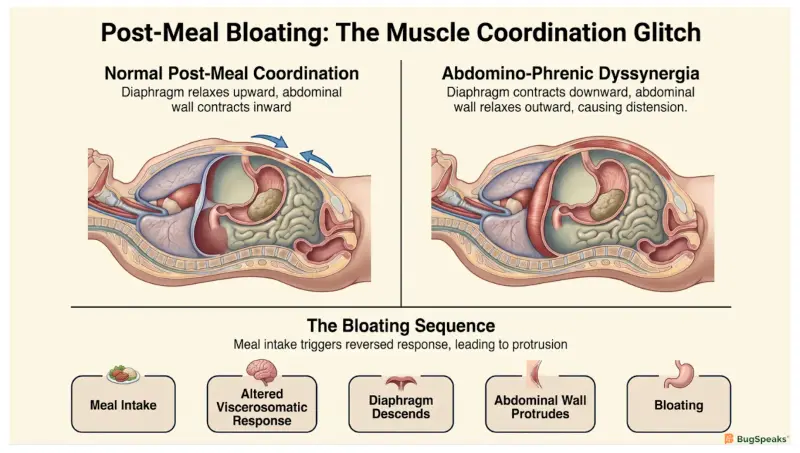
Squeezing your abdominal cavity causes your breathing muscles and your gut wall to fight each other, triggering an altered geometry outcome known as bloating. Bloating is defined as an altered geometry outcome where your belly physically swells and expands. This swelling is not just caused by excess gas, but by a major coordination mistake between your core muscles. This coordination failure is called abdomino-phrenic dyssynergia. When this mistake happens, your breathing muscle and your gut wall stop working together as a team, making your gut stick out.
In a healthy body, your muscles use an automatic reflex called the viscerosomatic response to manage space. When you eat, your diaphragm relaxes and moves upward, while your gut wall contracts to support your stomach and help food move. This healthy reflex keeps your stomach flat and comfortable. However, in people with abdomino-phrenic dyssynergia, this automatic viscerosomatic response is completely reversed. Instead of relaxing, your diaphragm contracts and pushes downward into your belly. At the same time, your gut wall muscles relax and bulge outward, creating a swollen, bloated look. This reversed internal movement makes your stomach feel extremely tight and full.
This painful altered geometry outcome is made much worse by a slouched seating posture. When you slouch, you physically force your diaphragm downward and prevent your gut wall from contracting properly to support your organs. This physical block confuses your brain's reflex loops, making it impossible for your core muscles to coordinate their movements. As a result, even tiny amounts of normal gas get trapped and push your gut wall outward. This muscular fighting causes intense physical pain, bloating, and constant stomach discomfort, making your workday feel miserable. Sitting up straight helps your brain reset these muscle signals, flattening your belly and relieving the painful pressure.
**Altered geometry outcome**\- A visible change in the shape of your body, like a swollen or bloated belly, resulting from shifted pressures and poorly coordinated muscles.
**Abdomino-phrenic dyssynergia**\- A coordination mistake where your breathing muscle pushes down, and your belly muscles relax and push out, making you look bloated.
**Diaphragm**\- A dome-shaped muscle below your lungs that moves down when you breathe in and up when you breathe out.
**Viscerosomatic response**\- The automatic reflex where your brain adjusts your breathing and abdominal muscles in response to changes inside your digestive tract.
## How does prolonged trunk flexion exhaust the muscular supports of our digestive volume?
Holding a bent posture for hours tires out your core muscles and stretches your spine, weakening the supportive muscular box of your belly. Your core acts like a protective muscular box made of your gut, back, diaphragm, and pelvic floor. This muscular box is responsible for keeping your body geometry stable and your operating volume open. When you spend hours bent over your computer, you experience a physical stretching of your ligaments called viscoelastic creep [Matej Voglar (2016)](https://www.ncbi.nlm.nih.gov/pmc/articles/PMC5096890/). This stretching makes your spine loose and weak, completely removing your natural, healthy body support.
To protect your loose spine, your body automatically increases your trunk muscles' reflex gains and raises your trunk stiffness. This nervous system response forces your back muscles to contract extra hard, which makes them very tired and sore. As your back muscles get exhausted, they can no longer support your muscular box or keep your digestive space open. This muscular fatigue collapses your posture even further, increasing the downward squishing force on your stomach. This progressive collapse shows how back muscle fatigue directly worsens your internal pressure and digestive cramping. Taking regular breaks helps your tired muscles recover their strength.
This muscle exhaustion also spreads down to the pelvic floor, causing a coordination problem called pelvic floor dyssynergia. When your muscular box fails, your pelvic floor muscles become tense and cannot relax properly when you try to use the restroom. This pelvic floor dyssynergia blocks the exit of your digestive tract, forcing you to strain to pass waste. This physical block makes it extremely difficult to empty your bowels, leading to chronic constipation. Using an ergonomic chair with passive upper body support can prevent this and protect your digestion, which helps your tired pelvic muscles relax naturally and prevents constipation.
**Muscular box**\- The core muscle system (belly, back, diaphragm, and pelvic floor) that acts like a supportive box around your digestive space.
**Viscoelastic creep**\- The slow stretching and sagging of your ligaments and spine tissues when you hold a bent posture for a long time.
**Trunk muscles reflex gains**\- The autonomic nervous system reflexes that increase muscle activity to keep your spine stable when your ligaments get loose.
**Trunk stiffness**\- The structural rigidity of your torso, which increases to protect a fatigued or stretched back.
**Pelvic floor dyssynergia**\- A coordination problem where the muscles at the bottom of your pelvis fail to relax, making it hard to go to the toilet.
## How does a slouched geometry interrupt the nervous pathways that govern digestion?
Slouching at your desk physically pinches your main gut nerves, blocking the vital signals of your gut microbiota-brain axis. Your nerves act like a high-speed communication network that coordinates your digestion. The most important part of this network is the vagus nerve, which connects your brain directly to your gut [Yimin Han (2022)](https://www.ncbi.nlm.nih.gov/pmc/articles/PMC9656367/). This long nerve is eighty percent sensory fibers, allowing it to send constant updates about your gut health to your brain. This quick signaling pathway forms your gut microbiota-brain axis, which keeps your entire digestion running in perfect harmony every day.
When your posture collapses, the high internal pressure physically pinches the vagus nerve, which severely lowers your vagal tone. You can measure this nervous activity by looking at your heart rate variability, which shows how your heart reacts to stress. When your vagal tone is low, your body loses its ability to control gut inflammation [Yimin Han (2022)](https://www.ncbi.nlm.nih.gov/pmc/articles/PMC9656367/). This lack of control breaks down your gut's defensive barrier, allowing toxic cell-wall pieces called lipopolysaccharide (LPS) from Gram-negative bacteria and actual live microbes like _Edwardsiella tarda_ to leak through the microscopic gaps [Han (2022)](https://www.ncbi.nlm.nih.gov/pmc/articles/PMC9656367/). This constant irritation alters your gut [microbiome](https://www.bugspeaks.com/blog/sheet-mask-skin-microbiome-health) by shifting its delicate balance, leading to a rise in inflammatory bacterial groups like Proteobacteria and a sharp decline in your gut's natural, protective phyla like Firmicutes and Bacteroidetes [Han (2022)](https://www.ncbi.nlm.nih.gov/pmc/articles/PMC9656367/). This swelling blocks your body's natural defense systems, slows down your digestion, and makes you feel bloated and sick.
Normally, specialized sensor cells called enteroendocrine cells detect food and microbes in your gut and talk to your nerves. When these enteroendocrine cells are stimulated, they release chemical signals including gut hormones like cholecystokinin (CCK), glucagon-like peptide-1 (GLP-1), and peptide YY (PYY), as well as neurotransmitters like serotonin and glutamate that travel up your vagus nerve to inform your brain. When slouching pinches this nerve path, this vital two-way communication is broken, leaving your brain completely blind to your daily digestion. Practicing simple deep breathing can stimulate your vagus nerve and activate the cholinergic anti-inflammatory pathway. This healthy nervous system activation releases acetylcholine to calm gut inflammation, protect your digestive health, and make you feel healthy.
**Vagus nerve**\- The longest nerve that connects your brain directly to your gut, acting as a high-speed communication cable for your digestion.
**Vagal tone**\- A measure of how active and healthy your vagus nerve is. A high tone means your body is relaxed and digesting well.
**Heart rate variability**\- The small changes in time between each of your heartbeats, which tell us how well your nervous system is handling stress and posture.
**Gut microbiota-brain axis**\- The busy two-way communication highway between the trillions of microbes in your gut and your brain.
**Enteroendocrine cells**\- Specialized sensor cells in your gut lining that detect food and microbes, releasing hormones to talk to your nerves.
**Cholinergic anti-inflammatory pathway**\- An automatic nervous system defense pathway that uses your vagus nerve to reduce swelling and irritation in your gut.
**Gut inflammation**\- The swelling, redness, and soreness of your intestinal lining that can damage your gut’s protective wall and make digestion painful and slow.
**Lipopolysaccharide (LPS)**\- A toxic cell-wall component found on certain gut bacteria that can leak through a damaged gut barrier, triggering body-wide swelling and irritation.
**Cholecystokinin (CCK)**\- A digestive hormone released by your small intestine after you eat, which helps control digestion and sends "I'm full" signals to your brain.
**Glucagon-like peptide-1 (GLP-1)**\- A key hormone released by your intestines after a meal that helps manage your blood sugar and tells your brain that you are full and satisfied.
**Peptide YY (PYY)**\- A helpful hormone released by your lower intestines after eating that naturally slows down your digestive tract so your body has time to absorb nutrients.
**Serotonin**\- A chemical messenger that regulates your gut movements and acts as a major signal to carry health and mood updates from your gut straight to your brain.
**Glutamate**\- A rapid-acting chemical messenger that your gut's sensor cells use to quickly pass precise digestive signals and sensory updates directly to your vagus nerve.
**Acetylcholine**\- A vital chemical messenger released by your nerves that commands your gut muscles to squeeze for healthy digestion and works to shut down swelling and irritation.
Visualize the process- [https://youtu.be/SKOv\_QweTHc](https://youtu.be/SKOv_QweTHc)
### Reference
Barnouti, H. N., & Zhang, L. Y. (2016). The effect of different types of abdominal binders on intra-abdominal pressure. _Saudi medical journal_, _37_(7), 815–816. [https://doi.org/10.15537/smj.2016.7.15217](https://doi.org/10.15537/smj.2016.7.15217)
Bonaz, B., Sinniger, V., & Pellissier, S. (2019). Vagus Nerve Stimulation at the Interface of Brain-Gut Interactions. _Cold Spring Harbor perspectives in medicine_, _9_(8), a034199. [https://doi.org/10.1101/cshperspect.a034199](https://doi.org/10.1101/cshperspect.a034199)
Han, Y., Wang, B., Gao, H., He, C., Hua, R., Liang, C., Zhang, S., Wang, Y., Xin, S., & Xu, J. (2022). Vagus Nerve and Underlying Impact on the Gut Microbiota-Brain Axis in Behavior and Neurodegenerative Diseases. _Journal of inflammation research_, _15_, 6213–6230. [https://doi.org/10.2147/JIR.S384949](https://doi.org/10.2147/JIR.S384949)
Papavramidis, T. S., Marinis, A. D., Pliakos, I., Kesisoglou, I., & Papavramidou, N. (2011). Abdominal compartment syndrome - Intra-abdominal hypertension: Defining, diagnosing, and managing. _Journal of emergencies, trauma, and shock_, _4_(2), 279–291. [https://doi.org/10.4103/0974-2700.82224](https://doi.org/10.4103/0974-2700.82224)
Rahgoshay, N., Rahdar, M., Nikoo, L., & Daneshmandi, H. (2025). Sitting vs. squatting: a scoping review of toilet postures and associated health outcomes. _BMC public health_, _25_(1), 2192. [https://doi.org/10.1186/s12889-025-23379-8](https://doi.org/10.1186/s12889-025-23379-8)
Zadeh, R. G. B., Roghani, T., Gladin, A., Katzman, W. B., Bokaee, F., & Adibi, P. (2025). Spinal‐Related Musculoskeletal Determinants of Functional Abdominal Bloating and Distension: A Narrative Review. _Health Science Reports_, _8_(7), e70976.
Voglar, M., Wamerdam, J., Kingma, I., Sarabon, N., & van Dieën, J. H. (2016). Prolonged Intermittent Trunk Flexion Increases Trunk Muscles Reflex Gains and Trunk Stiffness. _PloS one_, _11_(10), e0162703. [https://doi.org/10.1371/journal.pone.0162703](https://doi.org/10.1371/journal.pone.0162703)
Silva, L. B., Beserra Melo, C. J., Lisboa de Souza, A. G., & de Oliveira, L. G. (2024). Ergonomics, Health, and Perceptions about Remote Domestic Workposts: Study in Areas of City of João Pessoa, Paraíba, Brazil. _International journal of environmental research and public health_, _21_(7), 941. [https://doi.org/10.3390/ijerph21070941](https://doi.org/10.3390/ijerph21070941)
## FAQs
Q: How does slouching at a computer cause acid reflux?
A: Slouching compresses your operating volume, which physically forces your stomach upward out of its correct geometric position. This compression increases your intra-abdominal pressure, pushing your stomach's contents against the lower esophageal sphincter—the muscular valve that acts as a physical boundary between your food pipe and stomach Barnouti (2016). Under this persistent pressure, the sphincter fails to hold the boundary closed, allowing stomach acid to leak upward into your food pipe. This process can trigger symptoms of acid reflux and gastroesophageal reflux disease, even in individuals who eat a healthy diet.
Q: What is the difference between bloating and actual gas build-up in the gut?
A: Actual gas is a build-up of physical air pockets caused by bacterial fermentation, whereas bloating is an altered geometry outcome caused by a coordination mistake between your muscles. In a healthy body, your diaphragm moves up and your belly wall contracts to make room for your gut contents. However, in people with abdomino-phrenic dyssynergia, the brain sends incorrect signals: the diaphragm contracts and pushes down, while the abdominal wall muscles relax and bulge outward Ghomash Baf Zadeh (2025). This coordination failure makes your belly look swollen and distended, even if the actual volume of gas inside your gut is completely normal.
Q: Why does my lower back hurt at the same time that my stomach feels bloated?
A: This dual discomfort occurs because your core operates as a single, integrated muscular box. When you spend hours slouched over a desk in prolonged trunk flexion, your spine experiences viscoelastic creep, which sags your passive ligaments and reduces your natural back support Voglar (2016). Your back muscles must work extra hard to stabilize your spine, leading to muscle fatigue and lower back pain. This physical exhaustion disrupts the coordination of your entire core, breaking the automatic reflex loop that controls your diaphragm and abdominal muscles, which simultaneously triggers the altered geometry outcome of bloating.
Q: Can using a footstool or footrest help improve my digestive geometry while sitting?
A: Yes, using a footstool can help optimize your body geometry by altering the angle between your thighs and your spine. While sitting on a standard chair positions your hips at a ninety-degree angle, placing your feet on a footstool mimics a natural squatting posture Rahgoshay (2025). This postural shift increases your hip flexion and straightens the anorectal angle, which is the physical bend in your lower digestive path Sakakibara (2010). Straightening this pathway allows for a more efficient, resistance-free bowel evacuation, reducing the need for forced straining and the Valsalva maneuver.
Q: How does the vagus nerve connect my posture to my gut microbiota?
A: The vagus nerve serves as a bidirectional communication cable in the gut microbiota-brain axis, and its function is highly sensitive to the physical pressures inside your body Han (2022). When slouching compresses your digestive space and raises your intra-abdominal pressure, it physically restricts the blood flow and nerve signaling of your vagus nerve. This compression lowers your vagal tone and weakens the cholinergic anti-inflammatory pathway Bonaz (2019). A weak pathway leads to low-grade gut inflammation, which damages your intestinal barrier and alters your gut microbiome. At BugSpeaks, we study how these physical and microbial pathways interact to shape your health. Through our personalized gut microbiome testing, we map your unique microbial population and provide tailored dietary recommendations to help you support your gut barrier, restore your vagal tone, and optimize your digestive geometry.
---
This blog is powered by Superblog. Visit https://superblog.ai to know more.
---