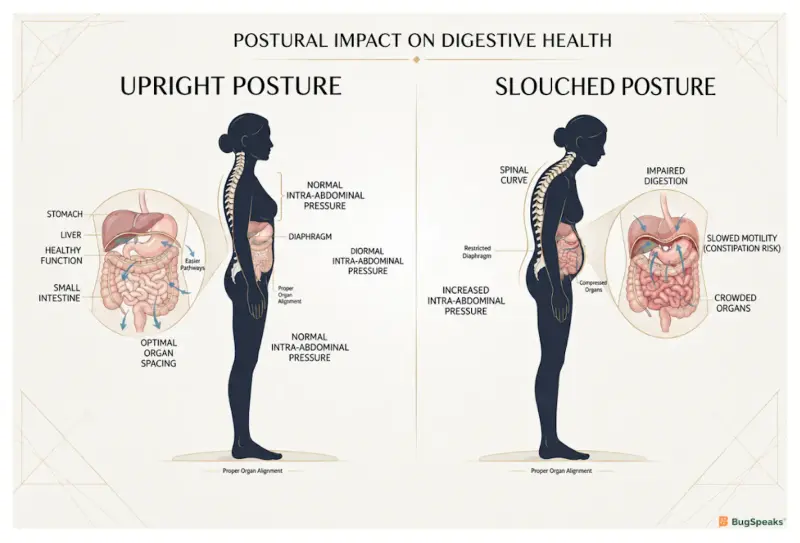
How does slouching physically alter your abdominal workspace?
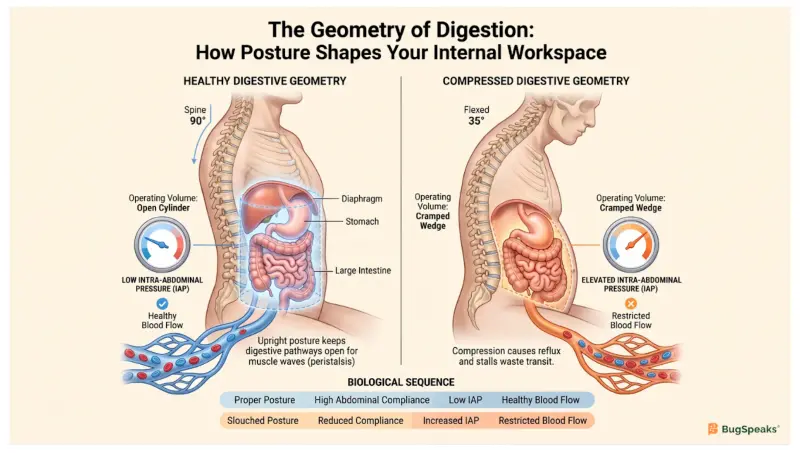
Slouching at your remote desk physically collapses the operating volume of your abdominal cavity, compressing the organs inside and raising the internal pressure. Your abdominal cavity behaves like an operating volume, which is the total physical space available for your organs. When you sit in an upright, erect posture, this operating volume is maximized, and your abdominal compliance remains high. However, when you slouch or bend forward, you force your body geometry into a state of prolonged trunk flexion. This skeletal collapse reduces the vertical height of your gut cavity and squashes its flexible boundaries, making digestion much harder.
This mechanical compression limits your abdominal compliance, meaning your stomach wall cannot stretch properly to accommodate food. Just as an elastic abdominal binder squeezes your stomach and artificially increases your intra-abdominal pressure, slouching at your desk acts like a tight physical clamp. This elevated intra-abdominal pressure squashes your organs, making it very hard for them to function normally. For remote workers spending six to eight hours a day in poor home setups, this pressure is a constant stress on their digestive health. It limits the vital space our organs need to work.
We can understand this easily through a simple body-angle comparison of our seating setups. Sitting at a ninety-degree upright angle keeps our operating volume shaped like a spacious, open cylinder. Slouching down to a thirty-five-degree trunk angle squashes this cylinder into a tiny, cramped wedge. This posture collapse physically squeezes our digestive organs together, leaving them very little room to work. Spending hours in this slouched body geometry leads to unhealthy sedentary behavior, where a lack of movement and constant organ crowding slows down our entire digestive system, causing pain and severe discomfort. Correcting your posture opens up your internal space and immediately improves your organ workspace.
What happens to the geometric path of food when the stomach and intestines are compressed?
Squeezing your gut cavity alters the stomach's geometric position and the intestines' geometric arrangement, which stops food from moving smoothly. Your stomach and intestines have a precise geometric position and geometric arrangement that keeps them open and clear. Normally, your gut uses coordinated muscle waves called peristalsis to push food forward through this open path. However, when you slouch, you bend this open path and create tight physical bottlenecks. These structural bends make it extremely difficult for your gut muscles to squeeze food along, causing the digestive flow to stall and become blocked. This physical blockage causes food to pile up inside.
Inside your gut, two main types of contractions are responsible for this geometry-dependent movement of food. First, rhythmic phasic contractions mix and turn your food over so your body can absorb nutrients. Second, giant migrating contractions act like strong, sweeping brooms that push waste down the long colonic path. When slouching squishes your intestines, it blocks these sweeping giant migrating contractions. This physical block slows down your transit time, meaning waste sits in your body much longer than it should, which directly leads to constipation. This slow movement makes you feel heavy and sluggish.
This structural squishing of the stomach also forces its contents upward, causing painful gastroesophageal reflux disease. When you slouch, the high pressure inside your gut pushes stomach acid through the lower esophageal sphincter, which is the physical valve at the top of your stomach. This pressure failure can cause acid reflux, even in healthy people without any history of stomach problems. If you cannot empty your bowels because of this cramped path, you might try a forced straining effort called the Valsalva maneuver. However, straining increases your internal pressure further, causing pain and medical injury. Keeping an upright posture protects your stomach from this backward acid flow.
How does posture-driven compression trigger the trap of altered geometry and bloating?
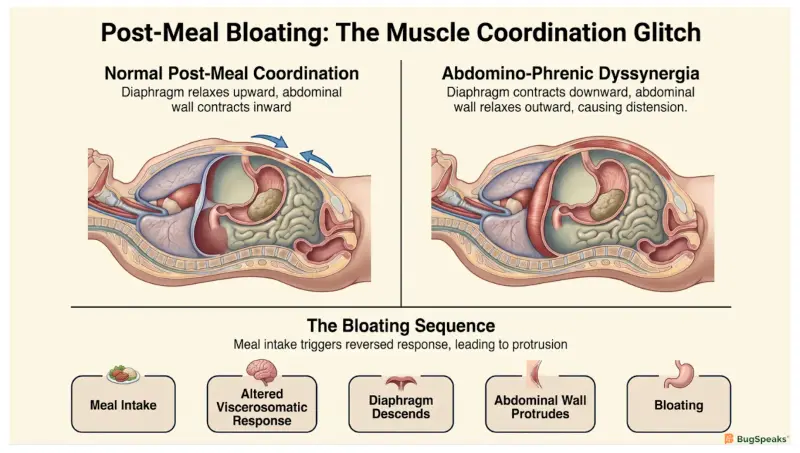
Squeezing your abdominal cavity causes your breathing muscles and your gut wall to fight each other, triggering an altered geometry outcome known as bloating. Bloating is defined as an altered geometry outcome where your belly physically swells and expands. This swelling is not just caused by excess gas, but by a major coordination mistake between your core muscles. This coordination failure is called abdomino-phrenic dyssynergia. When this mistake happens, your breathing muscle and your gut wall stop working together as a team, making your gut stick out.
In a healthy body, your muscles use an automatic reflex called the viscerosomatic response to manage space. When you eat, your diaphragm relaxes and moves upward, while your gut wall contracts to support your stomach and help food move. This healthy reflex keeps your stomach flat and comfortable. However, in people with abdomino-phrenic dyssynergia, this automatic viscerosomatic response is completely reversed. Instead of relaxing, your diaphragm contracts and pushes downward into your belly. At the same time, your gut wall muscles relax and bulge outward, creating a swollen, bloated look. This reversed internal movement makes your stomach feel extremely tight and full.
This painful altered geometry outcome is made much worse by a slouched seating posture. When you slouch, you physically force your diaphragm downward and prevent your gut wall from contracting properly to support your organs. This physical block confuses your brain's reflex loops, making it impossible for your core muscles to coordinate their movements. As a result, even tiny amounts of normal gas get trapped and push your gut wall outward. This muscular fighting causes intense physical pain, bloating, and constant stomach discomfort, making your workday feel miserable. Sitting up straight helps your brain reset these muscle signals, flattening your belly and relieving the painful pressure.
How does prolonged trunk flexion exhaust the muscular supports of our digestive volume?
Holding a bent posture for hours tires out your core muscles and stretches your spine, weakening the supportive muscular box of your belly. Your core acts like a protective muscular box made of your gut, back, diaphragm, and pelvic floor. This muscular box is responsible for keeping your body geometry stable and your operating volume open. When you spend hours bent over your computer, you experience a physical stretching of your ligaments called viscoelastic creep Matej Voglar (2016). This stretching makes your spine loose and weak, completely removing your natural, healthy body support.
To protect your loose spine, your body automatically increases your trunk muscles' reflex gains and raises your trunk stiffness. This nervous system response forces your back muscles to contract extra hard, which makes them very tired and sore. As your back muscles get exhausted, they can no longer support your muscular box or keep your digestive space open. This muscular fatigue collapses your posture even further, increasing the downward squishing force on your stomach. This progressive collapse shows how back muscle fatigue directly worsens your internal pressure and digestive cramping. Taking regular breaks helps your tired muscles recover their strength.
This muscle exhaustion also spreads down to the pelvic floor, causing a coordination problem called pelvic floor dyssynergia. When your muscular box fails, your pelvic floor muscles become tense and cannot relax properly when you try to use the restroom. This pelvic floor dyssynergia blocks the exit of your digestive tract, forcing you to strain to pass waste. This physical block makes it extremely difficult to empty your bowels, leading to chronic constipation. Using an ergonomic chair with passive upper body support can prevent this and protect your digestion, which helps your tired pelvic muscles relax naturally and prevents constipation.
How does a slouched geometry interrupt the nervous pathways that govern digestion?
Slouching at your desk physically pinches your main gut nerves, blocking the vital signals of your gut microbiota-brain axis. Your nerves act like a high-speed communication network that coordinates your digestion. The most important part of this network is the vagus nerve, which connects your brain directly to your gut Yimin Han (2022). This long nerve is eighty percent sensory fibers, allowing it to send constant updates about your gut health to your brain. This quick signaling pathway forms your gut microbiota-brain axis, which keeps your entire digestion running in perfect harmony every day.
When your posture collapses, the high internal pressure physically pinches the vagus nerve, which severely lowers your vagal tone. You can measure this nervous activity by looking at your heart rate variability, which shows how your heart reacts to stress. When your vagal tone is low, your body loses its ability to control gut inflammationYimin Han (2022). This lack of control breaks down your gut's defensive barrier, allowing toxic cell-wall pieces called lipopolysaccharide (LPS) from Gram-negative bacteria and actual live microbes like Edwardsiella tarda to leak through the microscopic gapsHan (2022). This constant irritation alters your gut microbiome by shifting its delicate balance, leading to a rise in inflammatory bacterial groups like Proteobacteria and a sharp decline in your gut's natural, protective phyla like Firmicutes and BacteroidetesHan (2022). This swelling blocks your body's natural defense systems, slows down your digestion, and makes you feel bloated and sick.
Normally, specialized sensor cells called enteroendocrine cells detect food and microbes in your gut and talk to your nerves. When these enteroendocrine cells are stimulated, they release chemical signals including gut hormones like cholecystokinin (CCK), glucagon-like peptide-1 (GLP-1), and peptide YY (PYY), as well as neurotransmitters like serotonin and glutamate that travel up your vagus nerve to inform your brain. When slouching pinches this nerve path, this vital two-way communication is broken, leaving your brain completely blind to your daily digestion. Practicing simple deep breathing can stimulate your vagus nerve and activate the cholinergic anti-inflammatory pathway. This healthy nervous system activation releases acetylcholine to calm gut inflammation, protect your digestive health, and make you feel healthy.
Visualize the process-https://youtu.be/SKOv_QweTHc
Reference
Barnouti, H. N., & Zhang, L. Y. (2016). The effect of different types of abdominal binders on intra-abdominal pressure. Saudi medical journal, 37(7), 815–816. https://doi.org/10.15537/smj.2016.7.15217
Bonaz, B., Sinniger, V., & Pellissier, S. (2019). Vagus Nerve Stimulation at the Interface of Brain-Gut Interactions. Cold Spring Harbor perspectives in medicine, 9(8), a034199. https://doi.org/10.1101/cshperspect.a034199
Han, Y., Wang, B., Gao, H., He, C., Hua, R., Liang, C., Zhang, S., Wang, Y., Xin, S., & Xu, J. (2022). Vagus Nerve and Underlying Impact on the Gut Microbiota-Brain Axis in Behavior and Neurodegenerative Diseases. Journal of inflammation research, 15, 6213–6230. https://doi.org/10.2147/JIR.S384949
Papavramidis, T. S., Marinis, A. D., Pliakos, I., Kesisoglou, I., & Papavramidou, N. (2011). Abdominal compartment syndrome - Intra-abdominal hypertension: Defining, diagnosing, and managing. Journal of emergencies, trauma, and shock, 4(2), 279–291. https://doi.org/10.4103/0974-2700.82224
Rahgoshay, N., Rahdar, M., Nikoo, L., & Daneshmandi, H. (2025). Sitting vs. squatting: a scoping review of toilet postures and associated health outcomes. BMC public health, 25(1), 2192. https://doi.org/10.1186/s12889-025-23379-8
Zadeh, R. G. B., Roghani, T., Gladin, A., Katzman, W. B., Bokaee, F., & Adibi, P. (2025). Spinal‐Related Musculoskeletal Determinants of Functional Abdominal Bloating and Distension: A Narrative Review. Health Science Reports, 8(7), e70976.
Voglar, M., Wamerdam, J., Kingma, I., Sarabon, N., & van Dieën, J. H. (2016). Prolonged Intermittent Trunk Flexion Increases Trunk Muscles Reflex Gains and Trunk Stiffness. PloS one, 11(10), e0162703. https://doi.org/10.1371/journal.pone.0162703
Silva, L. B., Beserra Melo, C. J., Lisboa de Souza, A. G., & de Oliveira, L. G. (2024). Ergonomics, Health, and Perceptions about Remote Domestic Workposts: Study in Areas of City of João Pessoa, Paraíba, Brazil. International journal of environmental research and public health, 21(7), 941. https://doi.org/10.3390/ijerph21070941