What exactly are postbiotics, and how do they function in the body?
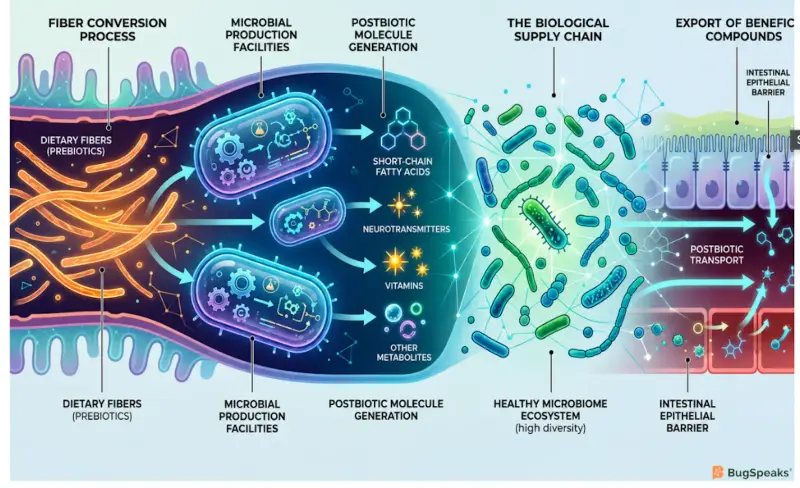
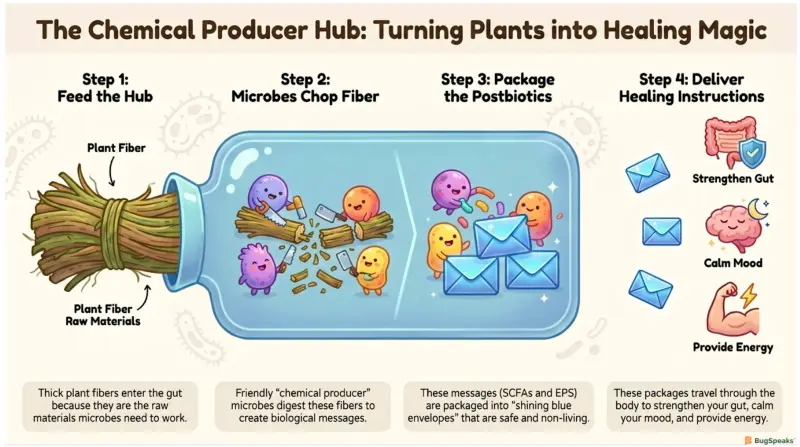
Postbiotics are the helpful, non-living parts and chemicals produced by gut bugs that directly communicate with our bodies to keep us healthy. In our Biological Chemical Exchange Network, the gut is a busy hub. Here, friendly microbes act as chemical producers. They do not have to stay alive to help us. Instead, they build biological messages, which are solid, non-living molecules. These messages are much safer than live bacteria because they cannot cause infections, even when the body is weak Joung et al. (2026). They easily survive harsh stomach acids to do their important jobs.
These chemical producers produce a wide variety of bioactive compounds when they digest plant fibers that we cannot break down ourselves. The most famous messages are Short-Chain Fatty Acids (SCFAs), like butyrate and acetate. These specific molecules carry energy and calming instructions right through the networkLi et al. (2026). The chemical producers also create exopolysaccharides (EPS). These are large sugar structures that build protective shields and send balancing signals to the immune systemAsefa et al. (2025). By constantly making these molecules, the producers ensure our bodies have the right instructions to stay healthy.
Even the broken pieces of dead chemical producers work as brilliant biological messages. When bacteria naturally die, pieces of their outer shells enter the hub. The body does not see these pieces as dangerous threats. Instead, it reads them like instruction manuals to fine-tune its own defensesMaftei et al. (2026). Since these pieces are not alive, they act as very reliable tools. This network needs a steady flow of these messages every single day. By eating fiber, we supply the raw materials so producers can keep flooding the network with healing instructions.
How do postbiotics cross the gut to influence systemic health?
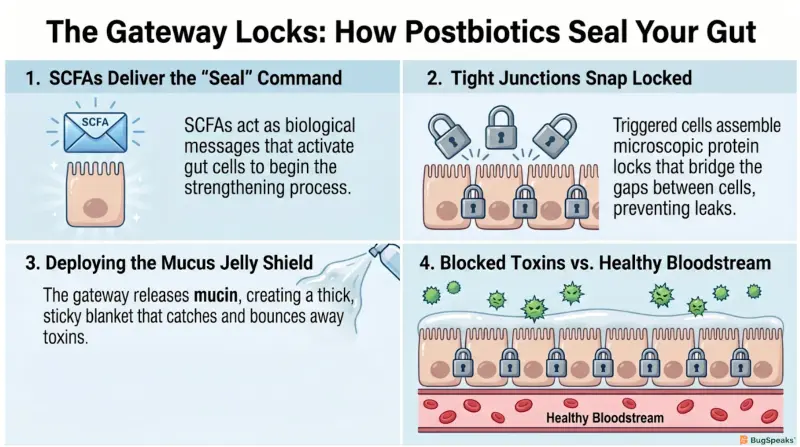
Postbiotics cross the gut by traveling through a strictly guarded communication gateway to enter the blood and reach distant organs. The gut lining acts as this critical communication gateway in the Biological Chemical Exchange Network. It is made of a single, microscopic layer of cells that decides what gets into the body. When working perfectly, this gateway absorbs helpful biological messages and completely blocks harmful toxins, bad bacteria, and waste from leaking into the bloodstreamLi et al. (2026). It acts like a highly intelligent filter that only permits safe signals to pass through.
The gateway's strength is maintained by microscopic locks called tight junctions. These proteins snap together to seal the spaces between the gateway cells. Biological messages, especially butyrate, directly command these cells to build more tight junctions, making the wall much strongerOglio et al. (2026). These messages also tell the gateway to produce mucin, a thick, sticky protein that forms a protective mucus layer. This mucus layer acts as a heavy blanket over the gateway, catching dangerous particles and stopping them from damaging the delicate cells underneath.
If the gateway breaks down due to stress or a bad diet, the tight locks snap open. This mechanical failure causes a "leaky gut," allowing dangerous bacterial waste to bypass the gateway. Once these toxins slip into the distribution network, they cause metabolic endotoxemia, a state of constant, low-level inflammation that damages the whole bodyBoroumand et al. (2026). The biological messages from chemical producers actively prevent this disaster. They provide fuel to keep the gateway completely sealed, ensuring only safe, healing instructions travel through the distribution network to reach distant organs.
How do postbiotics communicate with the immune system to stop inflammation?
Postbiotics bind directly to special antennas on immune cells to shut off inflammatory alarms and start producing calming molecules. In the Biological Chemical Exchange Network, human immune cells work as dedicated receiving systems. They constantly scan the gut and bloodstream for incoming biological messages. When these receiving systems catch friendly postbiotic signals from the chemical producers, they carefully lower their defensive shields. This exact communication stops the immune system from launching destructive attacks against the body's own tissues. It prevents the system from becoming too aggressive, which is the main cause of autoimmune diseasesBoroumand et al. (2026).
Biological messages cool down the body by turning off inside alarm switches. A major alarm switch is the nuclear factor kappa B (NF-κB) pathway. When flipped, it shouts at the cell to start heavy inflammation. Postbiotics deliver a powerful stop signal to the receiving systems, blocking NF-κB from sounding the alarmAsefa et al. (2025). Additionally, these messages command the body to build Regulatory T cells (Tregs). Tregs act as biological peacekeepers. They patrol the network and teach the receiving systems to completely ignore harmless food proteins, effectively silencing allergic reactions before they startBoroumand et al. (2026).
The chemical producers also use postbiotics to release powerful defender molecules directly at the communication gateway. When biological messages connect with the receiving systems near the gut, they order the rapid creation of natural defense proteins like human beta-defensin-2 (HBD-2) and cathelicidin LL-37. These specialized molecules act like local security guards. They patrol the gateway to neutralize any invading bad bacteria while also helping damaged cells heal and return to a calm stateOglio et al. (2026). This ensures the biological network remains peaceful, stable, and completely protected from internal fires.
How do microbial chemicals regulate metabolic health and energy?
Postbiotics act as clean energy fuel for the gut and travel to metabolic organs to fix how the body processes sugar and fat. After passing the communication gateway, biological messages enter the bloodstream distribution network. They travel quickly to major downstream response centers like the liver, muscles, and body fat. These vital response centers rely entirely on instructions from the chemical producers to know exactly when to burn, store, or use incoming energy. When there is a steady flow of postbiotic messages, the body's entire metabolic engine runs smoothly and efficientlyLi et al. (2026).
One of the most important jobs of circulating SCFAs is preventing insulin resistance. In a healthy network, postbiotic messages plug into the downstream response centers and tell them to listen to insulin and absorb sugar from the blood. If the chemical producers do not get enough fiber, they stop sending these messages. The response centers then go deaf to insulin, causing sugar to pile up in the distribution network. This massive system failure directly leads to Type 2 Diabetes (T2D) and severe damage to the blood vessels over timeLi et al. (2026).
Biological messages also deliver vital instructions to the liver about how to handle fat. Specific postbiotic signals control how the liver response center burns fat for energy instead of just storing it inside cells. Without these clear instructions, the liver quickly fills up with excess fat. This triggers metabolic syndrome, a dangerous chain reaction of high blood pressure and heart strainLi et al. (2026). By providing the distribution network with concentrated biological messages, we can directly restart these failing response centers, forcing the body to burn fat normally and safely restore its energy balanceAsefa et al. (2025).
How does the gut use postbiotics to send signals to the brain?
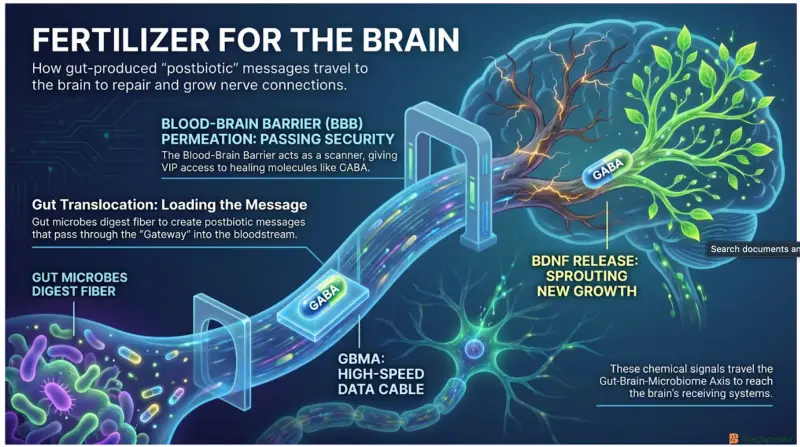
Postbiotics travel through the blood to calm the brain, reduce stress swelling, and help grow fresh nerve connections. The brain is the most complex downstream response center in the entire Biological Chemical Exchange Network. It uses the gut-brain-microbiome axis (GBMA) as a high-speed data cable to receive constant updates from the gut. Through this cable, chemical producers send specific biological messages straight into the nervous system. These tiny instructions have the incredible power to directly alter our mood, sharpen our memory, and help us bounce back from emotional stressJoung et al. (2026).
To reach the brain, biological messages must pass a strict security filter called the blood-brain barrier (BBB). The BBB acts just like the gut's gateway, blocking dangerous toxins from touching delicate brain cells. Thankfully, special postbiotics like gamma-aminobutyric acid (GABA) are given a VIP pass through the BBB. Once inside, they plug into the brain's receiving systems to calm down sparking, panicked nerves. They act like a cooling system, quickly putting out the dangerous neuroinflammatory fires that are sparked by long-term stress and anxietyJoung et al. (2026).
These advanced biological messages also tell the brain to make brain-derived neurotrophic factor (BDNF). BDNF works exactly like a miracle fertilizer for the brain. It forces neurons to grow new branches, heal damage, and build fresh connections. When a person is chronically stressed, their BDNF levels crash, causing memory loss and depression. By pumping specific postbiotic instructions through the network, the chemical producers force the brain response center to create more BDNF. This repairs the broken nerve connections and brings back mental clarity, proving that a calm brain begins with a healthy gutJoung et al. (2026).
Visualize the process- https://youtu.be/jLorytePxNo
Reference
Maftei, N. M., Ambrose, L., Dogaru, E., Răileanu, R., Mierlan, O. L., Amariței, O., Ramos-Villarroel, A., Răuță Verga, G. I., Gurău, T. V., & Gurău, G. (2026). From Probiotics to Postbiotics-An Update on Their Biotherapeutic Potential and the Emerging Strategies in Human Health. International journal of molecular sciences, 27(5), 2218. https://doi.org/10.3390/ijms27052218
Asefa, Z., Belay, A., Welelaw, E., & Haile, M. (2025). Postbiotics and their biotherapeutic potential for chronic disease and their feature perspective: a review. Frontiers in microbiomes, 4, 1489339. https://doi.org/10.3389/frmbi.2025.1489339
Oglio, F., Coppola, S., Cadavere, A., Di Santillo, R., Mauriello, V., Michelini, M., Iorio, R. F., Caldaria, E., & Carucci, L. (2026). Novel Food Supplement Containing a Combination of Postbiotics and Plant-Derived Compounds Regulates Epithelial Barrier Integrity and Immune Response in Human Enterocytes. Foods (Basel, Switzerland), 15(5), 922. https://doi.org/10.3390/foods15050922
Joung, J. Y., Choi, H. S., & Oh, N. S. (2026). Emerging Roles of Postbiotics in Gut–Brain–Microbiome Axis Modulation and Neurobiological Pathways of Chronic Stress–Related Brain Dysfunction. Journal of Microbiology and Biotechnology, 36, e2603010.
Li, Z., Samui, S., Liu, J., Yang, Y., Liu, X., Chen, Q., Li, J., Gopinath, D., Luo, P., & Shan, D. (2026). Gut microbiome and metabolic health: mechanisms and precision interventions. Gut microbes, 18(1), 2644677. https://doi.org/10.1080/19490976.2026.2644677
Boroumand, B., Jaberi, A., Zamani, G., Zandi, E., Zare, F., Vahedinezhad, M., Abdollahi, E., KarkonShayan, S., GhazanfarAhari, S., & Sattar, M. (2026). Therapeutic Remodeling of the Gut Microbiome as a Strategy to Restore Immune Tolerance in Autoimmunity. MicrobiologyOpen, 15(2), e70294. https://doi.org/10.1002/mbo3.70294