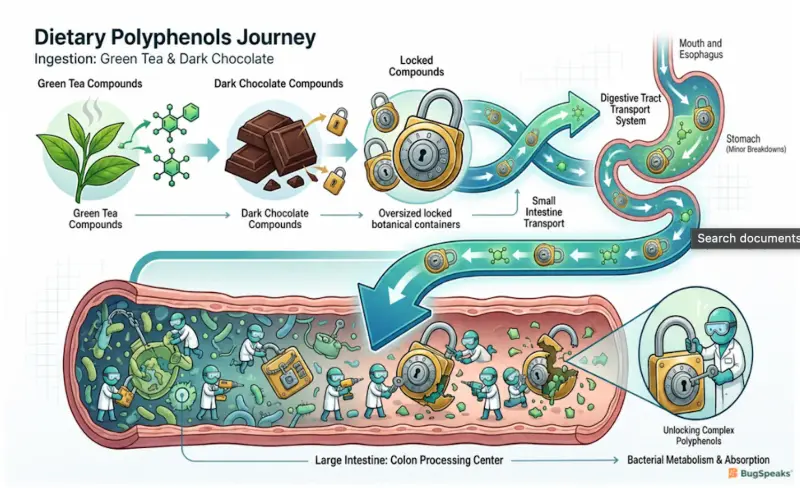
What exactly are dietary polyphenols, and why can't human bodies process them alone?
Dietary polyphenols are highly complex, bulky plant-based chemicals found abundantly in foods like dark chocolate and green tea that possess chemical structures too large and intricate for the human digestive system to absorb independentlyRudrapal et al. (2026). Because human intestinal cells lack the specific enzymes required to break down these large molecules, the vast majority of these compounds cannot pass directly through the intestinal walls into the bodyAlharbi (2026). Instead, they require a dedicated system of microscopic organisms to dismantle them into smaller, functional pieces before they can be utilizedRudrapal et al. (2026).
To understand this process, imagine your digestive system as a massive Botanical Compound Processing Facility. In this environment, the dietary polyphenols act as incoming specialty raw materialsAlharbi (2026). When you consume a cup of green tea or a piece of dark chocolate, these large, unprocessed shipments travel down the esophagus and through the stomach. However, the upper levels of the digestive facility are equipped only for basic extraction. They lack the highly specialized molecular tools required to unpack these dense, tightly bound botanical cratesRudrapal et al. (2026).
Because the human body cannot break down these incoming specialty raw materials on its own, the polyphenols bypass the small intestine almost entirely untouched (Alharbi, 2026). They are transported directly to the large intestine, or colon, which serves as the primary biochemical processing floor of the facilityRudrapal et al. (2026). It is only upon reaching this deep-level processing floor that the raw materials encounter the machinery capable of unlocking their hidden nutritional valueAlharbi (2026).
Waiting on this processing floor are trillions of gut microbiota, which function as highly specialized biochemical processing unitsRudrapal et al. (2026). These microbial units produce a vast array of unique enzymes that the human body cannot manufacture itselfAlharbi (2026). The microbes immediately get to work dismantling the bulky polyphenols, breaking their complex chemical bonds, and converting them into lightweight, functional molecules known as metabolitesRudrapal et al. (2026). These metabolites represent the final, refined biological products that the human body actually usesAlharbi (2026).
This entire operation is essential to solving the problem of bioavailability, a term that measures how much of a consumed substance successfully enters the body's circulation (Rudrapal et al., 2026). In their raw, unprocessed form, polyphenols have incredibly low bioavailabilityAlharbi (2026). If the biochemical processing units did not step in to refine these materials, the health benefits locked inside your green tea and dark chocolate would simply pass through the facility and be discarded as wasteRudrapal et al. (2026).
How do gut microbes transform green tea and dark chocolate into beneficial compounds?
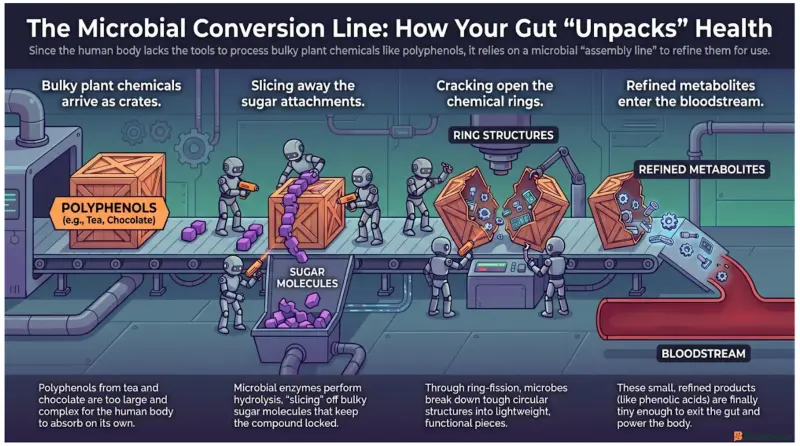
Gut microbes utilize specific microbial fermentation pathways to chemically break apart the large polyphenols found in green tea and dark chocolate, stripping away complex sugar attachments and splitting large chemical rings to create smaller, highly absorbable moleculesAlharbi (2026). This structural reduction is the critical step that transforms a plant chemical floating in the digestive tract into a functional health tool circulating inside the human bodyRudrapal et al. (2026).
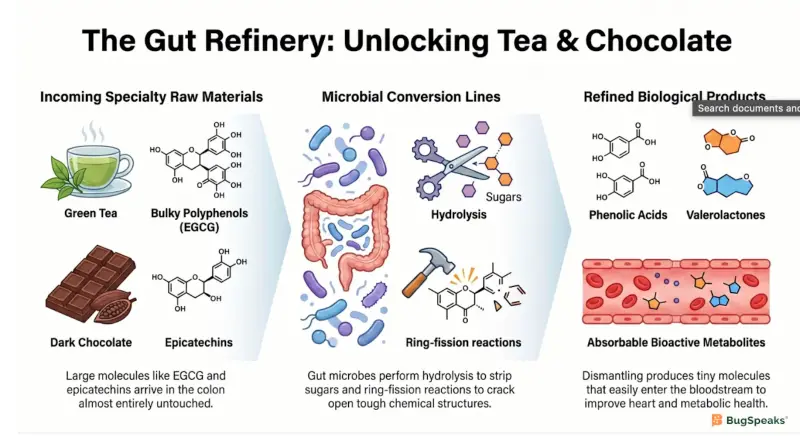
Within the Botanical Compound Processing Facility, this transformation takes place along highly coordinated microbial conversion linesAlharbi (2026). When you consume green tea, the facility receives large shipments of a specific raw material called epigallocatechin-3-gallate (EGCG)Iino et al. (2026). When you eat dark chocolate, the body receives similar shipments of complex flavonoids called epicatechinsRudrapal et al. (2026). These incoming specialty raw materials are loaded onto the microbial conversion lines, where the biochemical processing units deploy enzymes to systematically deconstruct themAlharbi (2026).
The first major step on these conversion lines is a process called hydrolysis, where microbial enzymes slice away the bulky sugar molecules that are naturally attached to the raw plant compoundsAlharbi (2026). Once the sugars are removed, the processing units initiate ring-fission reactions, which literally crack open the tough, circular chemical structures of the polyphenolsRudrapal et al. (2026). This systematic dismantling reduces the heavy, complex EGCG and epicatechins into much smaller, lightweight componentsIto et al. (2023).
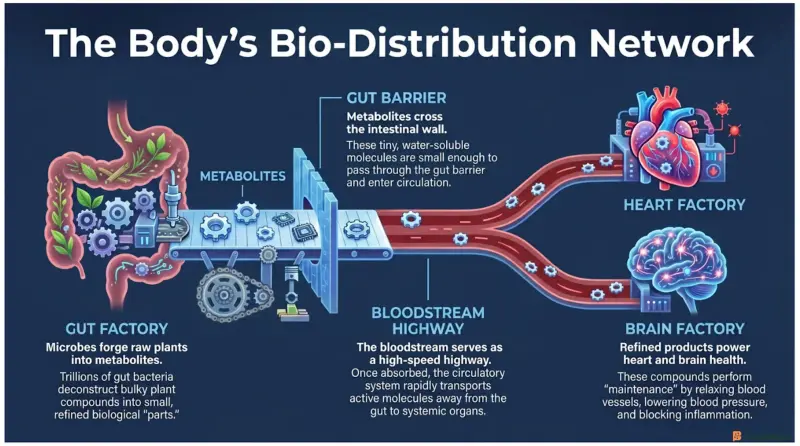
The output of these conversion lines is a steady stream of highly refined biological products, primarily in the form of phenolic acids and valerolactonesRudrapal et al. (2026). Because these newly minted refined biological products are structurally tiny and highly water-soluble, they can easily pass through the facility's security wallsAlharbi (2026). They exit the processing floor and are seamlessly absorbed directly into the body's vast circulatory systemRudrapal et al. (2026).
Once the refined biological products clear the intestinal wall, they enter the bloodstream, which acts as the facility's global distribution networkAlharbi (2026). The bloodstream rapidly transports these tiny, active molecules away from the gut and delivers them to the liver, heart, brain, and musclesRudrapal et al. (2026). This complex sequence of intake, microbial conversion, and rapid transport is the exact reason why digesting botanical compounds leads to measurable physiological changes throughout the entire human bodyIto et al. (2023).
In what ways do polyphenol metabolites improve cardiovascular and metabolic health?
Once absorbed, the small metabolites produced from green tea and dark chocolate travel through the bloodstream to directly lower blood pressure, reduce cellular inflammation, and dramatically improve how the body responds to insulinRudrapal et al. (2026). By interacting with the cells lining the blood vessels and regulating metabolic hormones, these microbial byproducts protect the host against chronic diseases like atherosclerosis and type 2 diabetesAlharbi (2026).
In our Botanical Compound Processing Facility analogy, these refined biological products are loaded into the bloodstream distribution network and transported to downstream applications across the bodyAlharbi (2026). When they arrive at the cardiovascular system, these refined products perform critical maintenance on the inner walls of blood vesselsRudrapal et al. (2026). They signal the blood vessels to relax and widen, which effectively lowers high blood pressure and reduces the physical wear and tear on the heartAlharbi (2026).
Simultaneously, the facility's biochemical processing units are breaking down plant fibers to produce Short-Chain Fatty Acids (SCFAs), such as butyrateIino et al. (2026). These SCFAs work in perfect synergy with the refined polyphenol products to stabilize the body's metabolic gridAlharbi (2026). Scientific studies demonstrate that combining green tea catechins with fiber can significantly lower a person's Homeostatic Model Assessment of Insulin Resistance (HOMA-IR)Iino et al. (2026). When this score drops, it means the body is becoming highly efficient at using insulin to pull sugar out of the blood, protecting the host from developing diabetesIto et al. (2023).
Beyond improving blood flow and managing sugar, these downstream applications perform a vital security function by blocking the activation of a dangerous inflammatory pathway known as Nuclear Factor Kappa-Light-Chain-Enhancer of Activated B Cells (NF-κB)Rudrapal et al. (2026). When cells are stressed, this pathway triggers aggressive, damaging inflammationAlharbi (2026). The refined biological products from green tea and chocolate chemically jam this alarm system, forcing the cells to remain calm and preventing the chronic, low-grade inflammation that destroys healthy tissue over timeRudrapal et al. (2026).
Ultimately, the successful operation of the Botanical Compound Processing Facility ensures that the host body remains structurally soundAlharbi (2026). By constantly exporting these refined biological products into the distribution network, the gut microbes essentially manufacture a daily supply of cardiovascular medication and metabolic regulators, derived entirely from your dietRudrapal et al. (2026).
How does the gut microbiome benefit from processing these botanical compounds?
Processing dietary polyphenols creates a reciprocal, mutually beneficial "duplibiotic" relationship where the polyphenols serve as a food source that selectively nourishes beneficial bacteria while simultaneously acting as an antimicrobial agent that suppresses the growth of harmful pathogensRudrapal et al. (2026). By digesting green tea and dark chocolate, the microbiome improves its own structural health and diversity, preventing hostile organisms from taking over the intestinal tractAlharbi (2026).
In the context of the Botanical Compound Processing Facility, this means the incoming specialty raw materials do not just pass through the factory; they actively upgrade the facility itselfAlharbi (2026). When high-quality polyphenols arrive on the processing floor, they provide exclusive fuel for the most valuable and efficient biochemical processing unitsRudrapal et al. (2026). As these specific microbial units dismantle the polyphenols, they extract energy that allows their populations to multiply and thrive, expanding the facility’s overall operational capacityAlharbi (2026).
This targeted nourishment causes specific groups of health-promoting bacteria, such as Bifidobacterium and Coprococcus, to rapidly increase their numbers on the processing floorIino et al. (2026). Coprococcus, in particular, is a master processing unit responsible for churning out massive amounts of butyrateIino et al. (2026). Clinical data show that when green tea and fibers are introduced, the expansion of these specialized units is directly linked to improved insulin sensitivity and overall metabolic stability across the host's bodyIto et al. (2023).
While the good bacteria are flourishing, the conversion lines produce specific refined biological products that act as internal security agentsRudrapal et al. (2026). These metabolites exert strong antimicrobial pressure on dangerous, hostile microbial units like pathogenic strains of Clostridium or E. coli, preventing them from damaging the processing equipment or stealing resourcesAlharbi (2026). By neutralizing these threats, the facility prevents biological sabotage and maintains a secure, highly efficient working environmentRudrapal et al. (2026).
This constant balancing act, feeding the beneficial processing units while starving and suppressing the harmful ones, is essential for preventing dysbiosisRudrapal et al. (2026). Dysbiosis occurs when the processing facility descends into chaos, allowing toxic byproducts to leak into the bloodstreamAlharbi (2026). By routinely importing botanical raw materials, you are directly investing in the stability, security, and long-term ecological health of your entire intestinal processing plantRudrapal et al. (2026).
What factors determine how efficiently your gut processes dietary polyphenols?
The efficiency of polyphenol breakdown varies dramatically from person to person, heavily dictated by an individual's unique gut microbial composition, the specific physical structure of the food being eaten, and the dosage of the plant compounds consumedAlharbi (2026). Even if two people drink the same cup of green tea, the biological benefits they extract from it can be completely different depending on the internal conditions of their digestive tractsRudrapal et al. (2026).
In our Botanical Compound Processing Facility, this variation occurs because no two facilities are built exactly alike. Each person possesses a unique configuration of biochemical processing units, known scientifically as metabotypesRudrapal et al. (2026). These metabotypes dictate exactly which conversion lines are operational. If a person's facility is missing a specific species of bacteria, the corresponding conversion line simply does not exist, and certain incoming specialty raw materials cannot be fully refinedAlharbi (2026).
For example, certain individuals possess the specific microbial units required to process soy and legume polyphenols into a highly potent anti-inflammatory compound called equolRudrapal et al. (2026). Individuals lacking these specific bacterial populations will pass the raw materials through their facility without ever producing this valuable refined biological productAlharbi (2026). Furthermore, the facility's efficiency is impacted by the food matrix, the physical structure of the foodRudrapal et al. (2026). Polyphenols locked inside dense plant fibers are harder for the processing units to reach, requiring longer periods on the conversion lines before they can be completely dismantledAlharbi (2026).
Finally, the total volume of raw materials arriving at the facility must be carefully managedRudrapal et al. (2026). Dietary polyphenols exhibit hormetic effects, meaning they are highly beneficial in moderate doses because they stimulate a healthy, adaptive stress response across the conversion linesRudrapal et al. (2026). However, if an individual consumes massive doses such as from concentrated supplement pills, the enormous influx of raw materials can overload the biochemical processing units, causing oxidative damage and halting productionRudrapal et al. (2026).
To keep the Botanical Compound Processing Facility running smoothly, it requires a steady, moderate, and highly diverse supply of raw materials from whole foodsAlharbi (2026). Supplying the gut with a wide variety of plant foods ensures that all the different microbial processing units stay active, allowing the facility to produce a vast, protective array of refined metabolites day after dayRudrapal et al. (2026).
-Varsha V
Visualize the process- https://youtu.be/cXoT9XwIx-o
Reference
Rudrapal M, de Oliveira AM and Singh RP (2026) Dietary polyphenols maintain human health through modulation of gut microbiota. Front. Pharmacol. 16:1710088. doi: 10.3389/fphar.2025.1710088
Iino, C., Mikami, K., Furusawa, K., Sato, S., Yoshida, K., Yamaguchi, T., Bushita, H., Kinoshita, K., Matsui, Y., Imoto, S., Iwane, T., Tamada, Y., Murashita, K., Nakaji, S., Mikami, T., & Sakuraba, H. (2026). Green Tea Catechin Plus Inulin Improves Insulin Resistance Without Reducing Visceral Fat and Shows Exploratory Gut Microbiota Signals in Adults with Visceral Obesity: A Double-Blind Randomized Controlled Trial. Nutrients, 18(5), 851. https://doi.org/10.3390/nu18050851
Ito, A., Matsui, Y., Takeshita, M., Katashima, M., Goto, C., & Kuriki, K. (2023). Gut microbiota-mediated associations of green tea and catechin intakes with glucose metabolism in individuals without type 2 diabetes mellitus: a four-season observational study with mediation analysis. Archives of microbiology, 205(5), 191. https://doi.org/10.1007/s00203-023-03522-y
Alharbi NA (2026) Polyphenol metabolites in fermented foods: biotransformation, bioavailability, and functional roles. Front. Nutr. 13:1767453. doi: 10.3389/fnut.2026.1767453