Why is every person's gut microbiome unique?
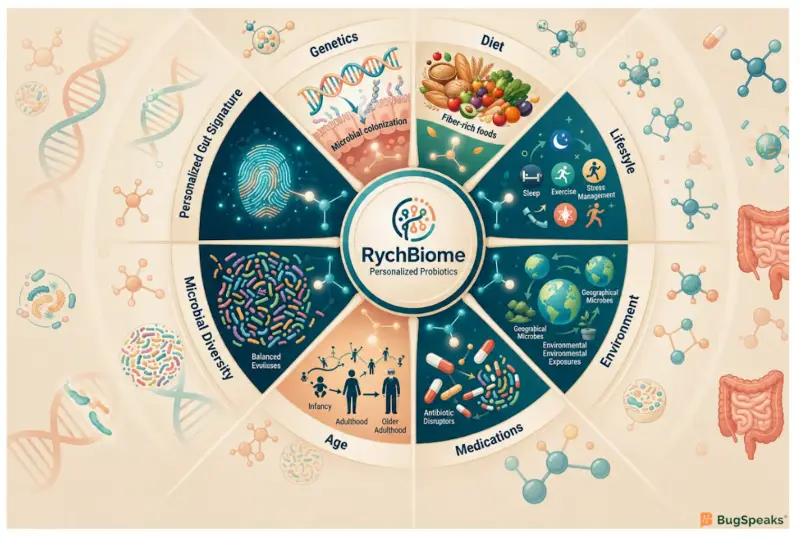
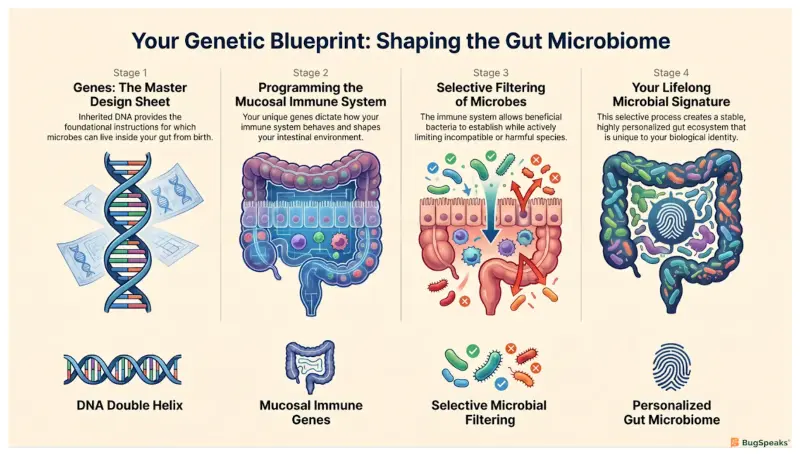
Inside our bellies lives a huge community of trillions of tiny, helpful living things called the gut microbiome. This invisible world is completely unique to you, much like a custom-tailored suit built to fit only one person's body shape. Your parents pass down genes to you, and these genes act like a master design sheet that decides which microbes can live inside your gut from the day you are born. Your personal genes decide how your immune system behaves, making your initial baseline gut microbiota totally unique to you throughout your entire life, starting right from childhood.
Besides our genes, what we eat and how we live play huge roles in shaping our gut microbes. When you eat healthy, fiber-rich foods, your good microbes ferment these fibers to produce useful metabolites. These compounds act like daily power-ups that keep your gut lining strong. However, if you eat too much junk food, your good microbes will starve, leading to an unhealthy state of imbalance called dysbiosis. Your daily actions, like getting enough sleep, playing outside, and managing stress, constantly change your gut's overall health and microbial diversity over time.
Our age, geographical environment, and exposure to medications introduce further complex layers of variation that guarantee no two gut microbiomes can ever be identical. As we grow from a baby to an adult and eventually grow old, our gut microbes naturally change in their microbial composition and numbers. Also, living in different countries exposes us to completely different environmental microbes and sanitation standards, which directly shape our resident communities. Strong medications, like antibiotics, can act as disruptive forces that quickly wipe out beneficial populations, compromise our colonization resistance, and create long-lasting dysbiosis. The combination of our genetics, diet, age, and environmental exposures ultimately results in a level of microbial individuality that makes our inner ecosystem.
Why do the same probiotics not work equally well for everyone?
Many people take off-the-shelf bacterial pills hoping they will instantly make them healthy, but these standard pills often have very different results for different people. Scientists have found that when people take the same bacteria, some people are responders who get healthy benefits, while others are non-responders who feel no change at all. This happens because your unique, native microbes might not be friendly with the new bacteria. If the incoming bacteria do not match your baseline community, they cannot survive. It is like buying a general suit off the rack; without being a custom-fit tailored suit, the generic probiotic will simply not align with the unique, complex contours of your individual digestive tract, rendering it ineffective.
For any new bacteria to help you, they must stay in your gut and start growing, which is called colonization or engraftment. Most pills you buy use non native bacteria that come from outside the human gut, like from yogurt or dirt. Your gut treats these non native microbes like uninvited strangers and quickly kicks them out, meaning they only provide a tiny, temporary benefit. Furthermore, your native microbes protect their home by fighting off these newcomers. This natural shield is called colonization resistance, which acts like a crowded room where new guests are actively blocked from entering, preventing them from establishing a permanent home in your digestive system.
Successfully making a home in your gut depends on whether the new bacteria can find free food and supportive, helpful microbes. If your baseline gut microbiota contains high levels of highly competitive resident bacteria, they can cause competitive exclusion that prevents probiotics from achieving successful colonisation. Furthermore, if a person's gut is in a state of dysbiosis or has low microbial diversity, it may lack the helper microbes needed to support the incoming strains. This explains why a generic, one-size-fits-all probiotic often fails to work for everyone. Without matching the microbial individuality of the host, the incoming bacteria cannot find a suitable home, highlighting the need for a personalized approach that acts like a custom-made tailored suit for your inner ecosystem.
What are personalized probiotics and how are they different from traditional probiotics?
Customized bacteria made specifically for your body are called personalized probiotics, and they are very different from the standard, off-the-shelf pills. Standard, conventional probiotics are made for everyone in general, meaning they contain the same bacterial strains for every customer. While these general pills can sometimes be useful, they completely ignore your individual body's needs. In contrast, customized formulas are specially designed to match your personal inner microbes. This custom fit is much like getting a hand-crafted tailored suit that is measured to match your body's exact lines, ensuring the microbes can easily survive.
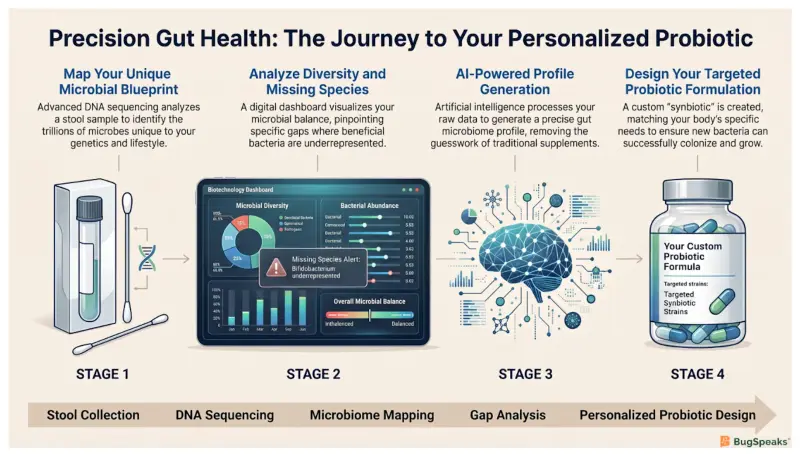
The key to creating these personalized probiotics lies in advanced microbiome testing, which maps out your gut's unique landscape. By examining a small stool sample in a high-tech lab, microbiome testing shows scientists the exact amount of each microbe living inside your body. This detailed test can identify if you are missing any helpful bacteria, or if there is an overgrowth of bad bacteria causing pain. This advanced testing reveals the exact needs of your body, so we do not have to guess which supplements will work for you. It is just like scanning your body to make a perfect suit.
Based on the insights gained from testing, scientists can create targeted formulations of probiotics that are specifically designed to address your unique needs. These targeted formulations replenish missing or underrepresented bacterial strains, support your existing beneficial microbes, and avoid strains that may be incompatible with your system. In many cases, these formulas are combined with specific prebiotics that act as healthy fertilizers to feed and support the new bacteria. This custom method represents the modern future of gut health, providing precise, reliable support to help you feel your best every day by addressing your specific biological requirements.
How does RychBiome Personalized Probiotics create a personalized approach to gut health?
To begin your custom health journey, RychBiome Personalized Probiotics starts by giving you a thorough microbiome assessment of your gut's helper bugs. This deep study uses next-generation sequencing to check the diversity of your gut's resident bacteria. By analyzing this raw data, the microbiome assessment identifies which helpful species are too low and which harmful ones are causing trouble. This acts like a master tailor taking your measurements to build a custom-tailored suit. Instead of taking generic pills, you get a custom blueprint showing exactly what your body needs to stay healthy and balanced, preventing any bad germs from taking over.
Once the testing phase is complete, a high-tech computer system chooses the best mix of probiotics for your daily routine. By selecting exact bacterial strains that match your unique gut, the formula can successfully settle down in your digestive tract and start growing. This customized selection ensures that your new probiotic helper bugs will work in perfect harmony with your resident microbes, rather than fighting with them for food or space. This targeted selection ensures that the probiotics you consume are specifically formulated to replenish what's missing in your gut, while avoiding strains that may compete with your existing beneficial bacteria, promoting overall wellness.
RychBiome Personalized Probiotics is a high-quality, shelf-stable synbiotic. These dried and stabilized microbes remain dormant inside their capsules until they safely pass through your stomach and reach your intestines. This custom synbiotic formula provides the essential resources needed to support the growth and activity of these beneficial strains, helping them produce health-promoting short-chain fatty acids (SCFAs). This targeted approach allows your custom formula to align closely with your individual gut environment, supporting daily digestion, nutrient utilization, and gut-immune interactions as part of a simple, daily routine.
Why is personalized microbiome care shaping the future of gut health?
Customized gut care is shaping the future of medicine because we now realize that generic, one-size-fits-all treatments simply do not work well over the long term. Just as you cannot swap your custom-tailored suit with someone else's without losing that perfect fit, you cannot use someone else's probiotic plan and expect the same health benefits. Personalized care your biological individuality, replacing outdated guesswork with advanced, data-driven science. By tailoring your supplements and lifestyle habits to match your resident microbes, you can build a strong, resilient gut, prevent painful imbalances, protect your immune system, and support your long-term health.
This personalized approach is a major part of precision nutrition, which uses your unique body data to design customized food and supplement recommendations. By looking at your genes, lifestyle, and microbes, precision nutrition helps us understand how your body reacts to different ingredients, helping you make smarter, healthier choices.
In summary, your gut is a highly complex, custom world that needs personalized care to stay strong. RychBiome Personalized Probiotics offers an advanced, science-backed approach to help you care for your body by using a custom blend that fits your gut perfectly. By taking a proactive, active role in supporting your gut bugs, you can build a balanced, resilient gut environment that supports your daily well-being and overall biological vitality. To discover your gut's unique needs and receive your custom formula, consider taking a personal microbiome assessment to start your journey toward optimal health with RychBiome Personalized Probiotics.
Reference
Livingstone, K. M., Ramos-Lopez, O., Perusse, L., Kato, H., Ordovas, J. M., & Martínez, J. A. (2022). Reprint of: Precision nutrition: A review of current approaches and future endeavors. Trends in Food Science & Technology, 130, 51-62.
Wang F, Zheng J, Cheng J, Zou H, Li M, Deng B, Luo R, Wang F, Huang D, Li G, Zhang R, Ding X, Li Y, Du J, Yang Y, Kan J. Personalized nutrition: A review of genotype-based nutritional supplementation. Front Nutr. 2022 Sep 9;9:992986. doi: 10.3389/fnut.2022.992986. PMID: 36159456; PMCID: PMC9500586.
Mills S, Stanton C, Lane JA, Smith GJ, Ross RP. Precision Nutrition and the Microbiome, Part I: Current State of the Science. Nutrients. 2019 Apr 24;11(4):923. doi: 10.3390/nu11040923. PMID: 31022973; PMCID: PMC6520976.
Vandeputte D. Personalized Nutrition Through The Gut Microbiota: Current Insights And Future Perspectives. Nutr Rev. 2020 Dec 1;78(12 Suppl 2):66-74. doi: 10.1093/nutrit/nuaa098. PMID: 33259623.
Montazeri-Najafabady N. From One-Size-Fits-All to Precision Medicine: The Promise of Personalized Probiotics. Probiotics Antimicrob Proteins. 2026 Apr;18(3):3893-3926. doi: 10.1007/s12602-025-10815-9. Epub 2025 Oct 29. PMID: 41160388.
Min U, Jin YJ, Jang YJ, Lim J, Kim BY. Personalized probiotic strategy considering bowel habits: impacts on gut microbiota composition and alleviation of gastrointestinal symptoms via Consti-Biome and Sensi-Biome. Front Nutr. 2024 Feb 16;11:1302093. doi: 10.3389/fnut.2024.1302093. PMID: 38435094; PMCID: PMC10904615.
Manan, M. A. (2025). The role of probiotics in personalized therapeutics: Advances in gut microbe-driven interventions The Microbe, 8: 100497.
Chi J, Patterson JS, Li L, Lalime N, Hawley D, Kim KJ, Liu L, Cui JY, Sears DD, Jasbi P, Gu H. Precision Probiotics Regulate Blood Glucose, Cholesterol, Body Fat Percentage, and Weight Under Eight-Week High-Fat Diet. Metabolites. 2025 Sep 25;15(10):642. doi: 10.3390/metabo15100642. PMID: 41149620; PMCID: PMC12566540.
Reid G, Gaudier E, Guarner F, Huffnagle GB, Macklaim JM, Munoz AM, Martini M, Ringel-Kulka T, Sartor B, Unal R, Verbeke K, Walter J; International Scientific Association for Probiotics and Prebiotics. Responders and non-responders to probiotic interventions: how can we improve the odds? Gut Microbes. 2010 May-Jun;1(3):200-4. doi: 10.4161/gmic.1.3.12013. PMID: 21637034; PMCID: PMC3023600.
Habteweld HA, Tsige AW, Ayenew KD, Habtewold AA, Abebe TA, Yismaw MB, Taye HB. Microbiome-Targeted Probiotic Strategies for the Prevention and Treatment of Osteomyelitis: A Novel Biological Approach. Probiotics Antimicrob Proteins. 2026 Apr;18(3):3750-3766. doi: 10.1007/s12602-025-10780-3. Epub 2025 Oct 15. PMID: 41091405.
Lynch LE, Lahowetz R, Maresso C, Terwilliger A, Pizzini J, Melendez Hebib V, Britton RA, Maresso AW, Preidis GA. Present and future of microbiome-targeting therapeutics. J Clin Invest. 2025 Jun 2;135(11):e184323. doi: 10.1172/JCI184323. PMID: 40454480; PMCID: PMC12126222.
Alavi S, Mitchell JD, Cho JY, Liu R, Macbeth JC, Hsiao A. Interpersonal Gut Microbiome Variation Drives Susceptibility and Resistance to Cholera Infection. Cell. 2020 Jun 25;181(7):1533-1546.e13. doi: 10.1016/j.cell.2020.05.036. Epub 2020 Jun 16. PMID: 32631492; PMCID: PMC7394201.
Benson AK, Kelly SA, Legge R, Ma F, Low SJ, Kim J, Zhang M, Oh PL, Nehrenberg D, Hua K, Kachman SD, Moriyama EN, Walter J, Peterson DA, Pomp D. Individuality in gut microbiota composition is a complex polygenic trait shaped by multiple environmental and host genetic factors. Proc Natl Acad Sci U S A. 2010 Nov 2;107(44):18933-8. doi: 10.1073/pnas.1007028107. Epub 2010 Oct 11. PMID: 20937875; PMCID: PMC2973891.
Porcari S, Mullish BH, Asnicar F, Ng SC, Zhao L, Hansen R, O'Toole PW, Raes J, Hold G, Putignani L, Hvas CL, Zeller G, Koren O, Tun H, Valles-Colomer M, Collado MC, Fischer M, Allegretti J, Iqbal T, Chassaing B, Keller J, Baunwall SM, Abreu M, Barbara G, Zhang F, Ponziani FR, Costello SP, Paramsothy S, Kao D, Kelly C, Kupcinskas J, Youngster I, Franceschi F, Khanna S, Vehreschild M, Link A, De Maio F, Pasolli E, Miguez AB, Brigidi P, Posteraro B, Scaldaferri F, Stojanovic MR, Megraud F, Malfertheiner P, Masucci L, Arumugam M, Kaakoush N, Segal E, Bajaj J, Leong R, Cryan J, Weersma RK, Knight R, Guarner F, Shanahan F, Cani PD, Elinav E, Sanguinetti M, de Vos WM, El-Omar E, Dorè J, Marchesi J, Tilg H, Sokol H, Segata N, Cammarota G, Gasbarrini A, Ianiro G. International consensus statement on microbiome testing in clinical practice. Lancet Gastroenterol Hepatol. 2025 Feb;10(2):154-167. doi: 10.1016/S2468-1253(24)00311-X. Epub 2024 Dec 5. PMID: 39647502; PMCID: PMC12343204.
Tegegne HA, Savidge TC. Gut microbiome metagenomics in clinical practice: bridging the gap between research and precision medicine. Gut Microbes. 2025 Dec 31;17(1):2569739. doi: 10.1080/19490976.2025.2569739. Epub 2025 Oct 25. PMID: 41137523; PMCID: PMC12562794.
Han S, Lu Y, Xie J, Fei Y, Zheng G, Wang Z, Liu J, Lv L, Ling Z, Berglund B, Yao M, Li L. Probiotic Gastrointestinal Transit and Colonization After Oral Administration: A Long Journey. Front Cell Infect Microbiol. 2021 Mar 10;11:609722. doi: 10.3389/fcimb.2021.609722. PMID: 33791234; PMCID: PMC8006270.
Walter J, Maldonado-Gómez MX, Martínez I. To engraft or not to engraft: an ecological framework for gut microbiome modulation with live microbes. Curr Opin Biotechnol. 2018 Feb;49:129-139. doi: 10.1016/j.copbio.2017.08.008. Epub 2017 Sep 13. PMID: 28866242; PMCID: PMC5808858.
Senan S, Prajapati JB, Joshi CG, Sreeja V, Gohel MK, Trivedi S, Patel RM, Pandya H, Singh US, Phatak A and Patel HA (2015) Geriatric Respondents and Non-Respondents to Probiotic Intervention Can be Differentiated by Inherent Gut Microbiome Composition. Front. Microbiol. 6:944. doi: 10.3389/fmicb.2015.00944