The Science Behind Fasting: Linking Ancient Practices to Modern Microbiome Health
Why did human biology evolve to require alternating cycles of eating and not eating?
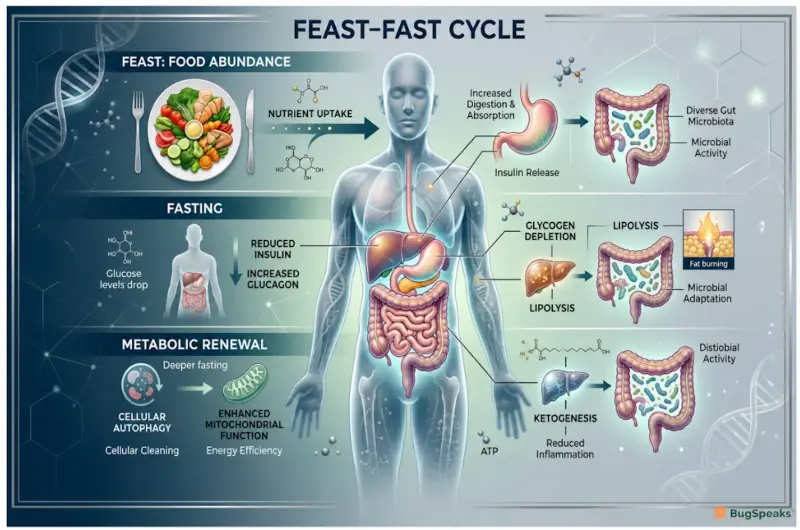
Human biology evolved to function optimally through alternating cycles of nutrient abundance and nutrient scarcity because our ancestors experienced regular shifts in food availability. In our evolutionary past, food was often hard to find, forcing our bodies to store energy during times of plenty and switch to preservation during lackTrabelsi et al. (2022). This oscillation created an adaptive system where eating served growth, while fasting triggered cellular self-cleaningZhao et al. (2025). Modern societies, however, have abandoned this flow, leading to continuous eating that never lets our internal clean-up crew work.
To help restore this natural balance, ancient Indian traditions developed periodic fasts called Vrats, which consciously reintroduce these healthy cycles of eating and resting. A well-known pattern is a bi-weekly cycle of short-term fasting, which is observed twice every single month on the eleventh day of the lunar cycleTrabelsi et al. (2022).During these times, we transition from a phase of nutrient abundance to a temporary phase of nutrient scarcity, meaning we stop eating external meals and let our cells clean up. This deliberate pause allows our active cells to recycle old parts and become stronger, matching how our ancestors survived.
Our digestive system contains a busy, adapting community of billions of tiny microbes that must change their roles when food stops arrivingPramono et al. (2024). When we eat constantly without pausing, fast-growing microbial species can overgrow, while the quieter microbes that protect us are pushed aside. Integrating short-term fasting intervals helps prune this garden, keeping the population diversePramono et al. (2024). Re-establishing these healthy rhythms helps modern humans keep their bodies flexible, protecting us from metabolic issuesTrabelsi et al. (2022).
How does a periodic fasting day trigger a metabolic transition in the body?
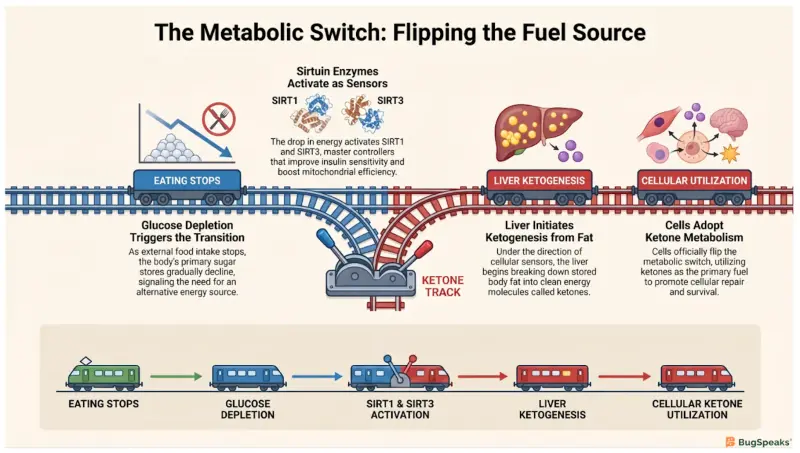
A periodic fasting day triggers a metabolic transition by shifting cellular energy production from glucose to fats and ketones. When our cells are challenged by fasting-induced energy lack, usually starting twelve to thirty-six hours after our last meal, our metabolism changes its fuelZhao et al. (2025). Instead of relying on external sugars, the liver begins breaking down stored fat into clean molecules called ketonesZhao et al. (2025). This shift represents our natural alternating physiology, where our cells switch between two distinct fuel systems depending on whether food is available.
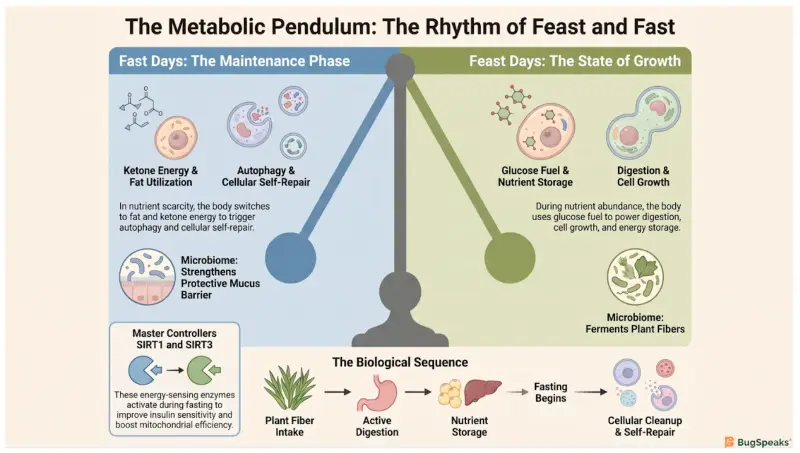
This metabolic switch is carefully directed by cellular energy sensors, particularly Sirtuin 1, or SIRT1, which acts as a master controller during fasting. When food is paused, the drop in cell energy activates SIRT1, which immediately improves insulin sensitivity, burns stored fats, and protects cellsPramono et al. (2024). At the same time, another helpful enzyme called Sirtuin 3, or SIRT3, is turned on inside mitochondria, the powerhouses, to boost energy efficiencyPramono et al. (2024). Together, these sirtuins ensure that our cells remain active, clean, and completely protected against cellular stress.
To get the best results from this metabolic reset, traditional Indian diets focus on eating high-fiber foods on non-fasting daysGhosh et al. (2023). Consuming wholesome traditional grains such as finger millet, amaranth, and sorghum delivers rich fibers, minerals, and natural antioxidants to our digestive system microbesGhosh et al. (2023). This beautiful combination of a periodic metabolic reset through fasts and subsequent refeeding with complex traditional foods keeps our energy systems flexible, preventing the sluggishness caused by heavily processed modern dietsTrabelsi et al. (2022).
How does the gut microbiome restructure itself during periods of fasting and refeeding?
The gut microbiome restructures itself during fasting and refeeding by favoring specialized bacteria that eat host mucus during pauses, followed by fiber-loving species when eating resumes. Abstaining from food during a fast completely cuts off incoming carbohydrates, forcing our gut microbes to find alternative fuelPramono et al. (2024). During this quiet phase, a helpful bacterium named Akkermansia muciniphila thrives by consuming the natural mucus of our gut wallPramono et +al. (2024). This activity triggers our gut lining to produce fresh, thick mucus, which dramatically strengthens our intestinal barrier.
By reinforcing this protective wall, Akkermansia muciniphila prevents harmful toxins from leaking into our bloodstream and causing inflammationPramono et al. (2024). Once we end our fast and begin eating healthy fibers, our beneficial fiber-loving microbes multiply rapidly to digest themPramono et al. (2024). Important species like Faecalibacterium prausnitzii ferment these complex carbohydrates to create Short-Chain Fatty Acids, or SCFAs, which feed our gut cells and keep our digestive system strong. This cycle of fasting and feeding ensures that both group types remain perfectly balanced.
Our bodies have a built-in ability to protect this mucosal microbial community even under severe nutritional stress. Studies in young infants show that the host is the dominant factor in maintaining microbiome stability during enteral deprivationBar-Yoseph et al. (2024). Even when different parts of the digestive tract are temporarily separated from food, the host's profile helps keep microbial communities stable and similarBar-Yoseph et al. (2024). This shows that our bodies naturally collaborate with our resident microbes to keep the entire system safe and functioning.
How does fasting align our internal clocks and protect us from metabolic diseases?
Fasting acts as a clock-setter that aligns our body's internal timing with the microbes living inside our digestive system. Just like we sleep and wake, our gut bacteria have daily rhythms that dictate when they work and restPramono et al. (2024). Eating late or constantly snacking disrupts these rhythms, confusing our cells and causing metabolic problems. Restricting our eating times through a daily pattern restores these necessary cyclical fluctuationsPramono et al. (2024). This restoration of circadian biology is essential because it synchronizes our outer actions with inner bacterial schedules.
When we restore this natural coordinating rhythm, our body can process sugars and fats much more efficiently than before. This healthy alignment helps protect us against metabolic syndrome, a group of health issues that includes high blood pressure, high blood sugar, and excess belly fatPramono et al. (2024). During fasting, our metabolic clocks trigger fat burning and insulin repair pathways at the correct timesZhao et al. (2025). Synchronizing our habits with our cells' natural timing ensures that our metabolic engine does not become overworked or prone to chronic diseases.
Traditional Indian lifestyles naturally promoted this alignment by organizing meal times around the sun's cycles and incorporating regular fasting days. These cultural practices helped ancestors maintain a healthy weight and avoid modern diseases by keeping their body clocks in perfect syncTrabelsi et al. (2022). By returning to these structured habits, we can help our gut bacteria maintain their healthy daily activities and protect our long-term wellness. Keeping our inner biological clocks aligned with our daily environment is one of the simplest ways to support our metabolism in modern times.
How does a periodic gut reset communicate with the brain to improve mental clarity?
Fasting helps our gut send positive chemical signals to the brain that lower everyday stress and boost cognitive memory. The microbes in our digestive tract are not isolated; they are constantly talking to our entire nervous systemZhao et al. (2025). When we fast, our gut bacteria produce highly beneficial molecules that travel up to the brain to support cellular survival and growth. This two-way communication channel is known as the gut-brain axis, and it plays a massive role in regulating both our daily mental health and our physical brain functions.
During a fast, our gut microbes produce a helpful short-chain fatty acid called butyrate, which enters our blood and travels to our nervous systemZhao et al. (2025). Once inside, butyrate triggers the production of brain-derived neurotrophic factor (BDNF), a special protein that helps grow and protect our brain cellsZhao et al. (2025). This process acts like a fertilizer for our brain, enhancing learning, memory, and general thinking skills. Fasting also reduces overall inflammation in the gut, which keeps our brain cells calm, happy, and fully protected from age-related decline.
These neurological benefits explain why people often feel a sense of mental clarity and calm focus during a fast. Clinical studies show that periodic fasting can significantly improve mood, lower anxiety levels, and protect against cognitive declineZhao et al. (2025). By giving our digestive tract a break, we reduce the inflammatory signals that usually make our minds feel foggy and tired. Using periodic, short-term fasting intervals is not just an everyday routine;it is a scientifically proven way to refresh our minds, sharpen our thinking, and keep our brain healthy and active.
Visualize the process- https://youtu.be/kWBZdUIJA6o
Reference
Pramono A, Ardiaria M, Limijadi EKS, Noer ER, Lestari ES, Siswanto FM. Intermittent fasting modulates human gut microbiota diversity in a phenotype-dependent manner: a systematic review. Biosci Microbiota Food Health. 2024;43(3):170-182. doi: 10.12938/bmfh.2023-111. Epub 2024 Apr 29. PMID: 38966051; PMCID: PMC11220331.
Trabelsi K, Ammar A, Boujelbane MA, Puce L, Garbarino S, Scoditti E, Boukhris O, Khanfir S, Clark CCT, Glenn JM, Alhaj OA, Jahrami H, Chtourou H and Bragazzi NL (2022) Religious fasting and its impacts on individual, public, and planetary health: Fasting as a “religious health asset” for a healthier, more equitable, and sustainable society. Front. Nutr. 9:1036496. doi: 10.3389/fnut.2022.1036496
Keles NA, Dogan S, Dogan A, Sudagidan M, Balci TN, Cetiner O, Kavruk M, Ozalp VC, Tuna BG. Long-term intermittent caloric restriction remodels the gut microbiota in mice genetically prone to breast cancer. Nutrition. 2024 Oct;126:112525. doi: 10.1016/j.nut.2024.112525. Epub 2024 Jun 25. PMID: 39168040.
Bar-Yoseph, H., Krekhno, Z., Cirstea, M., Holani, R., Moon, K. M., Foster, L. J., ... & Finlay, B. B. (2024). The effect of nutrient deprivation on early life small intestinal mucosal microbiome and host proteome. The Journal of Nutrition, 154(2), 412-423.
Zhao Z, Geng W, Gao Y, Liu Y, Nie S, Yin Q. Effects of intermittent fasting on brain health via the gut-brain axis. Front Nutr. 2025 Nov 21;12:1696733. doi: 10.3389/fnut.2025.1696733. PMID: 41356819; PMCID: PMC12679884.
Ghosh S, Meyer-Rochow VB, Jung C. Embracing Tradition: The Vital Role of Traditional Foods in Achieving Nutrition Security. Foods. 2023 Nov 22;12(23):4220. doi: 10.3390/foods12234220. PMID: 38231593; PMCID: PMC10706084.