Is the Central Control Room sending cross-wired signals?
The human body functions like a massive, interconnected city, and at the heart of this city lies the Central Control Room. For women, the Master Switchboard that manages hormonal communication is located within the intestines. This switchboard is responsible for processing thousands of electrical signals every second, ensuring that hormones move from one "neighborhood" to another without interference. However, living with Polycystic Ovary Syndrome often introduces metabolic noise into these circuits. This noise is not just a minor distraction; it is a fundamental disruption caused by a state of imbalance where the "communication lines" become tangled and cross-wired.
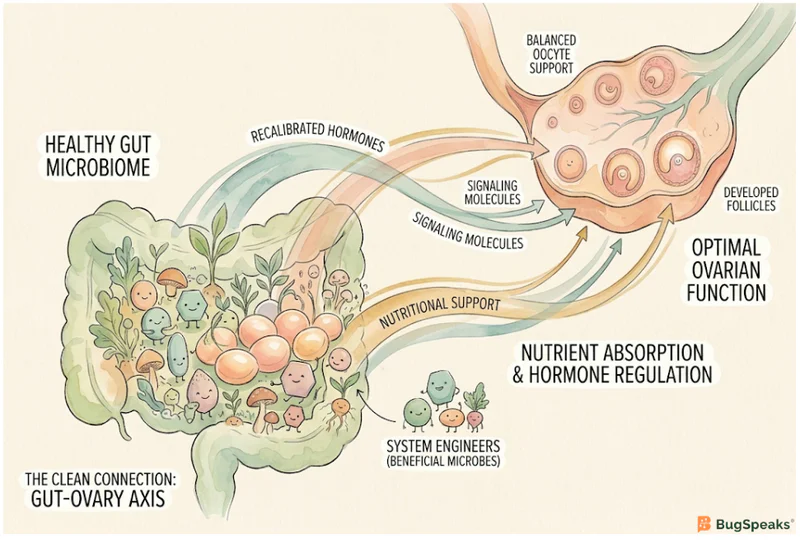
When the switchboard is overwhelmed by this noise, the body begins to send incorrect instructions to the ovaries and the metabolic system. These cross-wired signals often manifest as a struggle with glucose processing or the overproduction of specific male-type hormones. To fix these crossed wires, the body relies on a specialized team of System Engineers. These engineers are actually the trillions of beneficial microbes that live within the intestines, working tirelessly to clean the lines, repair the insulation on the wires, and ensure the signals stay crisp and clear.
A landmark review conducted by Yin et al. (2026) provided irrefutable evidence that optimizing these System Engineers can recalibrate the entire Master Switchboard. By analyzing the data from twenty-six different clinical studies, the researchers found that restoring microbial balance directly reduces the "static" that causes PCOS symptoms. The study showed that when these biological engineers are supported with the right inputs, patients see a significant drop in their total testosterone levels and a noticeable improvement in how their bodies manage weight and energy.
Can System Engineers improve reproductive outcomes?
Operating the Master Switchboard requires extreme precision, especially when a person is undergoing fertility treatments. The System Engineers in the intestines are not just responsible for basic digestion; they are actually the foundation for reproductive readiness. When these microbial workers are strong and diverse, they ensure that the signals for ovulation and implantation are delivered to the reproductive organs on time and without errors.
A clinical trial by Behroozilak et al. (2026) put this theory to the test by working with women who were candidates for a fertility procedure known as IUI. The researchers wanted to see if "upgrading" the workforce in the intestines would lead to physical improvements in the reproductive system. For eight weeks, participants received targeted support to strengthen their internal System Engineers. The results were a breakthrough for reproductive science: by focusing on the gut, the researchers observed a physical change in the "architecture" of the uterus.
The study found a significant improvement in the thickness and quality of the uterine lining, which is the most critical requirement for a successful pregnancy. This suggests that the System Engineers are responsible for delivering the specific "building materials" the body needs to prepare for conception. When the intestinal environment was healthy, the chances of both early pregnancy confirmation and successful long-term pregnancy increased. This confirms that the intestines are the actual command center that dictates whether the reproductive system is "open for business."
How does metabolism interfere with the switchboard?
To understand how PCOS symptoms worsen, one must look at how the metabolic system can accidentally "hijack" the Master Switchboard. Metabolism is the process the body uses to turn food into energy, but when it fails, it creates rogue electrical signals that override normal reproductive commands. The most common form of this interference is a condition called Insulin Resistance. Think of this like a power surge in a building's electrical system; it creates too much "voltage" in the form of insulin, which forces the ovaries to overproduce male-type hormones.
Liu et al. (2026) investigated how this metabolic noise specifically damages the quality of an Oocyte. The researchers found that when the intestines are overwhelmed by harmful bacteria, they trigger a state of internal "heat" or inflammation that travels directly to the ovaries. This heat actually changes the chemical makeup of the Follicular Fluid that surrounds and protects the developing egg. Through a specialized study of tiny molecules called Metabolomics, the scientists identified "broken" molecules that act as markers for high stress in the cells.
Furthermore, when the Central Control Room in the gut is compromised, it allows microscopic toxins called Lipopolysaccharides to leak into the bloodstream. These toxins act like small pieces of grit that get stuck in the delicate machinery of the switchboard, causing a state called Endotoxemia. This toxic leakage prevents the System Engineers from producing Short-Chain Fatty Acids, which are the protective "coolants" the body uses to keep the switchboard from overheating. Without these fatty acids, the metabolic interference grows stronger, forcing the reproductive signals to perpetually misfire.

Can external tools help recalibrate the signals?
Operating a Master Switchboard as complex as the one in the intestines often requires external tools to help clear the static. These tools act like specialized hardware upgrades that repair the transmission lines and provide the precise nutrients needed to stabilize the signals. Liu et al. (2026) found that combining physical therapies like Acupuncture with advanced fertility treatments like IVF can significantly regulate how the body processes sugar and fats. This dual approach helps quiet the "alarms" sent by harmful bacteria, allowing the beneficial System Engineers to reclaim their territory.
Beyond physical therapy, the body needs specific "parts" to keep the switchboard running smoothly. Research highlighted in Frontiers (2026) discusses how certain nutrients act as sophisticated sensors for the intestines. For example, Vitamin D is not just for bones; it is a critical tool that helps the body's insulin sensors work correctly. Similarly, a sugar-like compound called Myo-inositol acts as a fine-tuning knob for the gut, preventing the ovaries from being "tricked" into making too many male hormones.
Finally, integrating healthy fats like Omega-3 Fatty Acids provides architectural support to the degraded transmission lines. These fats work by activating specific biological receptors that suppress the release of Inflammatory Cytokines. Think of these cytokines as loud emergency sirens that tell the immune system to attack everything in sight. By silencing these sirens with Omega-3s, the Master Switchboard can finally return to its normal, calm operation, ensuring that hormonal signals are delivered with perfect clarity.
Upgrading the Hardware
To truly silence the hormonal static, the gut relies on an elite repair crew—Akkermansia muciniphila. In early 2026, researchers discovered that this specific group of System Engineers builds a dedicated Arginine Power Line directly from the intestines to the ovaries. By boosting Arginine Biosynthesis, these microbes help normalize testosterone levels and physically repair damaged ovarian circuits at a genetic level, ensuring the reproductive system remains "on-line" for regular cycles.
Furthermore, a high-performing switchboard requires more than just power; it needs the right biological lubricant to prevent metabolic friction. System Engineers manage a Bile Acid Reservoir (specifically involving UDCA) that regulates the body’s glucose via TGR5 Signaling. When this lubrication system fails due to a lack of beneficial microbes, the switchboard "grinds" and overheats, triggering the high-voltage insulin spikes characteristic of PCOS.
Conversely, disorganized gut environments produce a toxic byproduct called TMAO, which acts like a constant, high-pitched "Feedback Screech" on the internal intercom. This metabolic noise is a primary predictor of insulin resistance, effectively "deafening" the ovaries so they can no longer hear the brain’s instructions for regular ovulation. To further "clean the lines" of the switchboard, 2026 research also suggests that Time-Restricted Feeding can act as a "System Reboot," giving the System Engineers a dedicated window to repair the "wiring" without the interference of new food signals. By prioritizing these advanced microbial repairs and silencing the TMAO screech, the system isn't just managing symptoms—it is fundamentally recalibrating the Master Switchboard for long-term hormonal clarity and metabolic peace.
How do we maintain a clean connection?
Maintaining a clean connection across the Master Switchboard is a daily commitment to gut health. The clinical evidence from 2026 makes it clear that the intestines require steady "preventative maintenance" to avoid the cross-wired signals of PCOS. This maintenance begins by providing the System Engineers with their primary fuel: complex dietary fibers. When these engineers are well-fed, they produce a protective layer that shields the transmission lines from damage.
Equally important is the removal of "metabolic noise." This means eliminating the interference caused by highly processed sugars and poor-quality fats. These substances act like grit in the gears, breaking down the delicate barriers of the gut and allowing toxins to seep into the bloodstream. When the intestines are populated with a diverse and highly capable team of System Engineers, the entire communication network can synchronize. True hormonal balance is only possible when the internal ecosystem is resilient enough to prevent toxic leaks and suppress the dangerous cellular inflammation that disrupts the Master Switchboard.
Visualize the process- https://youtu.be/hCpnJQCyqJk