# The Pathobyte Series: Streptococcus agalactiae-From Maternal Carriage to Invasive Disease
Author: BugSpeaks
Author URL: https://www.bugspeaks.com/blog/author/bugspeaks
Published: 2026-06-17
Category: MicroByte Series
Category URL: https://www.bugspeaks.com/blog/category/microbyte-series
Meta Title: Group B Streptococcus: Symptoms, Diagnosis & Prevention | BugSpeaks
Meta Description: Learn how Group B Streptococcus (Streptococcus agalactiae) causes GBS infection and neonatal infection. Explore symptoms, diagnosis, prevention and care to protect against bacterial pathogens.
Tags: Pathogens, Gut Microbiome, Gut Health, Streptococcus agalactiae
Tag URLs: Pathogens (https://www.bugspeaks.com/blog/tag/pathogens), Gut Microbiome (https://www.bugspeaks.com/blog/tag/gut-microbiome), Gut Health (https://www.bugspeaks.com/blog/tag/gut-health), Streptococcus agalactiae (https://www.bugspeaks.com/blog/tag/streptococcus-agalactiae)
URL: https://www.bugspeaks.com/blog/pathobyte-series-streptococcus-agalactiae
First classified in the 1930s, Streptococcus agalactiae is a versatile Gram-positive bacterium capable of causing a wide array of human illnesses. Driven by an advanced arsenal of virulence factors and a protective polysaccharide capsule, it effortlessly evades host immunity, spreading primarily from colonized mothers to infants during childbirth. Infections range from localized urinary tract infections to life-threatening systemic conditions, including neonatal sepsis and meningitis. Accurate diagnosis leverages classic laboratory cultures and modern tools like PCR assays. While treatment typically requires targeted antibiotic therapy with penicillin or ampicillin, robust prevention relies heavily on maternal screening and intrapartum antibiotic prophylaxis.
## What Is Group B Streptococcus (Streptococcus agalactiae)?
Group B Streptococcus (GBS) is a Gram-positive bacterium that commonly colonizes the human gastrointestinal and genitourinary tracts and can cause serious infections in newborns, pregnant women, older adults, and people with certain underlying medical conditions.
Although many individuals carry _Streptococcus agalactiae_ without symptoms, the bacterium can become invasive under specific circumstances and cause diseases ranging from urinary tract infections to bloodstream infections, meningitis, and pneumonia. [Group B Streptococcus](https://www.bugspeaks.com/blog/shigelladysenteriae-pathogen-gutmicrobiome/) remains one of the most important causes of neonatal bacterial disease worldwide and continues to be an important public health concern despite major advances in prevention strategies.
Understanding its biology, transmission routes, disease mechanisms, and prevention measures helps improve awareness of this medically significant pathogen.
## **What Are the Key Characteristics of Group B Streptococcus?**
### **Microbe Profile**
**Feature**
**Description**
Scientific Name
_Streptococcus agalactiae_
Common Name
Group B Streptococcus (GBS)
Gram Status
Gram-positive
Shape
Spherical (cocci), commonly arranged in chains
Spore Formation
Non-spore-forming
Motile
Non-motile
Oxygen Requirements
Facultative anaerobe
Optimum Temperature
Approximately 35–37°C
Optimum pH
Approximately 7.0–7.4
Primary Habitat
Human gastrointestinal and genitourinary tracts
**Facultative Anaerobe:** A microorganism capable of growing in both oxygen-rich and oxygen-poor environments.
## **How Was Group B Streptococcus Discovered and Named?**
Group B Streptococcus received its name through a bacterial classification system developed in the early twentieth century.
[_Streptococcus agalactiae_](https://www.bugspeaks.com/blog/microbyte-series-streptococcus-pneumoniae/) was initially recognized as a cause of bovine mastitis, an infection of the mammary glands in cattle. During the 1930s, microbiologist Rebecca Lancefield developed a method for classifying streptococci according to carbohydrate antigens found in their cell walls. Based on this classification system, _S. agalactiae_ was assigned to Lancefield Group B, leading to the commonly used name Group B Streptococcus.
Interest in the organism increased significantly during the 1960s and 1970s when researchers identified it as a leading cause of neonatal sepsis and meningitis. Since then, scientific research has expanded knowledge of its epidemiology, virulence factors, host interactions, and prevention strategies.
**Lancefield Grouping:** A classification system used to categorize streptococcal bacteria based on specific carbohydrate antigens present in their cell walls.
## **What Diseases Does Group B Streptococcus Cause?**
Group B Streptococcus can cause invasive infections in newborns, pregnant women, older adults, and immunocompromised individuals.
The severity and type of disease vary according to age, immune status, and underlying health conditions.
### **Major Diseases Associated with Group B Streptococcus**
**Population Group**
**Common Diseases**
Newborns
Sepsis, meningitis, pneumonia
Pregnant Women
Urinary tract infections, chorioamnionitis, postpartum infections
Older Adults
Bloodstream infections, pneumonia
Individuals with Chronic Diseases
Skin infections, soft tissue infections, bone infections
### **Symptoms in Newborns**
Newborns with invasive GBS disease may develop:
- Difficulty feeding
- Breathing problems
- Fever
- Low body temperature
- Irritability
- Reduced responsiveness
- Seizures in severe cases
### **Symptoms in Adults**
Symptoms depend on the site of infection and may include:
- Fever
- Chills
- Fatigue
- Shortness of breath
- Painful urination
- Redness and swelling of affected tissues
- Joint pain
### **Early-Onset vs Late-Onset Disease**
**Type**
**Typical Onset**
Early-Onset Disease
First 6 days of life
Late-Onset Disease
7–89 days of life
**Sepsis:** A potentially life-threatening condition that occurs when the body's response to infection leads to widespread inflammation and organ dysfunction.
## **How Does Group B Streptococcus Cause Disease?**
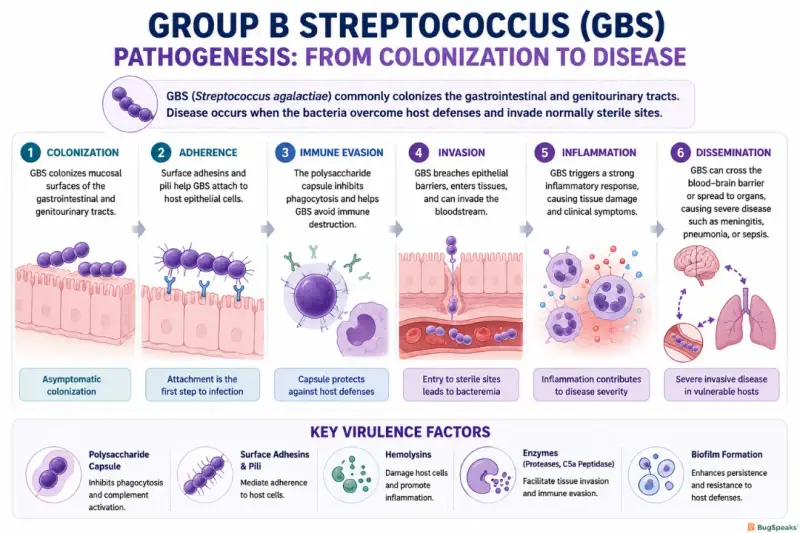
Group B Streptococcus causes disease through colonization, immune evasion, tissue invasion, and induction of inflammatory responses.
Many individuals carry the bacterium without developing symptoms. Disease occurs when the organism gains access to normally sterile sites such as the bloodstream, lungs, or central nervous system.
### **Key Steps in Pathogenesis**
#### **1\. Colonization**
GBS establishes itself on [mucosal surfaces](https://www.bugspeaks.com/blog/microbytes-series-6-neisseria-meningitidis/), particularly within the gastrointestinal and genitourinary tracts.
#### **2\. Adherence to Host Cells**
Specialized surface proteins allow the bacterium to attach to epithelial tissues.
#### **3\. Immune Evasion**
A polysaccharide capsule protects the organism from immune recognition and destruction.
#### **4\. Tissue Invasion**
The bacterium can cross epithelial barriers and enter deeper tissues or the bloodstream.
#### **5\. Inflammation**
Activation of the host immune response contributes to tissue injury and disease symptoms.
#### **6\. Central Nervous System Invasion**
Certain strains possess mechanisms that enable them to cross the blood-brain barrier and cause meningitis.
### **Important Virulence Factors**
- Polysaccharide capsule
- Surface adhesion proteins
- Pili
- Hemolysins
- Enzymes involved in tissue invasion
**Virulence Factor-** A microbial structure or molecule that enhances the ability of a pathogen to colonize, invade, survive, or cause disease within a host.
## **How Is Group B Streptococcus Transmitted?**
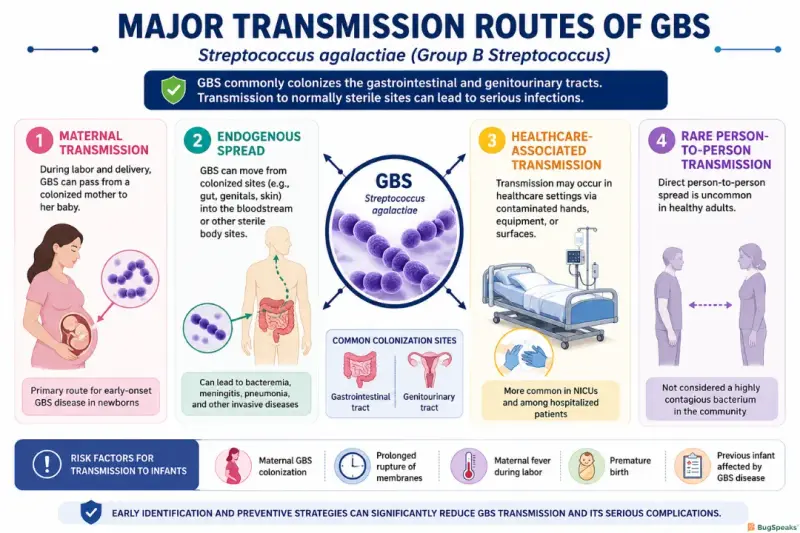
Group B Streptococcus is most commonly transmitted from colonized mothers to newborns during labor and delivery.
The bacterium frequently exists as part of the normal microbial community in healthy adults and is not generally considered highly contagious.
### **Major Transmission Routes**
**Route**
**Description**
Maternal Transmission
Passage from mother to infant during childbirth
Endogenous Spread
Movement from colonized sites to normally sterile tissues
Healthcare-Associated Exposure
Rare transmission during medical care
Person-to-Person Contact
Uncommon in healthy adults
### **Risk Factors for Neonatal Transmission**
- Maternal GBS colonization
- Premature birth
- Prolonged rupture of membranes
- Maternal fever during labor
- Previous infant affected by GBS disease
**Colonization:** The presence and growth of microorganisms on or within the body without causing disease or symptoms.
## **How Is Group B Streptococcus Diagnosed?**
Diagnosis relies on laboratory methods that identify the bacterium in clinical specimens.
Accurate diagnosis is important for both disease management and prevention of neonatal infections.
### **Common Diagnostic Methods**
#### **Culture Testing**
Bacterial culture remains the reference standard for identification.
#### **Maternal Screening**
Rectovaginal swab cultures are commonly performed during late pregnancy.
#### **Blood Culture**
Used to identify bloodstream infections.
#### **Cerebrospinal Fluid Analysis**
Essential for diagnosing meningitis.
#### **Molecular Testing**
Polymerase chain reaction (PCR) assays can provide rapid detection.
### **Diagnostic Methods Comparison**
**Method**
**Main Use**
Culture
Definitive identification
PCR
Rapid detection
Blood Culture
Detection of bacteremia
CSF Analysis
Diagnosis of meningitis
**PCR (Polymerase Chain Reaction):** A laboratory technique used to detect and amplify specific genetic material from microorganisms **.**
## **How Is Group B Streptococcus Treated?**
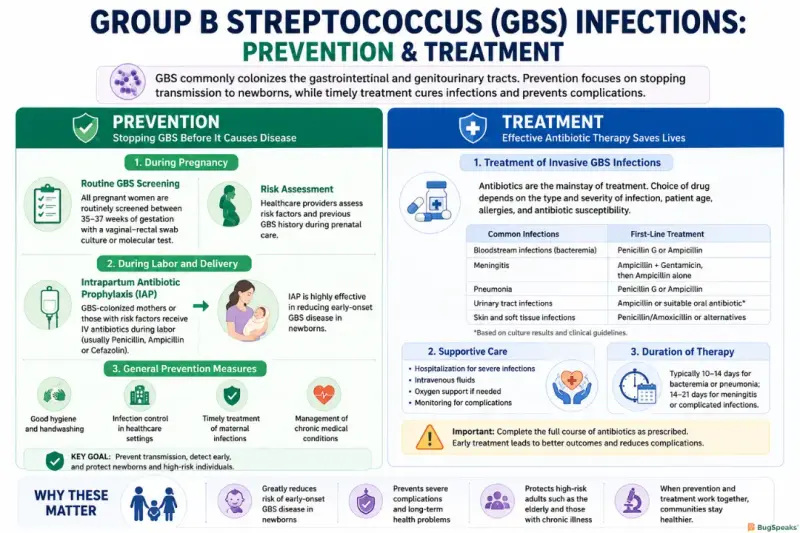
Antibiotics are the primary treatment for invasive Group B Streptococcus infections.
Most clinical isolates remain susceptible to beta-lactam antibiotics, making these medications the preferred treatment option.
### **Commonly Used Antibiotics**
- Penicillin
- Ampicillin
- Ceftriaxone (selected cases)
### **Factors Influencing Treatment Decisions**
- Age of the patient
- Infection severity
- Site of infection
- Pregnancy status
- Antibiotic susceptibility profile
Severe infections often require hospitalization and intravenous antibiotic therapy.
### **Treatment Goals**
Eliminate infection
Prevent complications
Reduce mortality risk
Limit disease progression
**Intravenous Therapy-** Administration of medications or fluids directly into a vein
## **How Can Group B Streptococcus Infections Be Prevented?**
Prevention focuses on identifying maternal colonization and reducing transmission to newborns during childbirth.
Prevention programs have substantially reduced the incidence of early-onset neonatal GBS disease in many regions.
### **Prevention Strategies**
#### **During Pregnancy**
- Routine screening between 35 and 37 weeks of gestation
- Risk assessment during prenatal care
#### **During Labor**
- Administration of recommended antibiotics to colonized mothers
#### **General Prevention Measures**
- Management of chronic illnesses
- Timely treatment of infections
- Appropriate healthcare infection-control practices
### **Vaccine Development**
Researchers continue to develop vaccines targeting major GBS serotypes. Several vaccine candidates have demonstrated promising results in clinical studies, although no licensed vaccine is currently available.
**Intrapartum Antibiotic Prophylaxis:** Preventive antibiotic treatment administered during labor to reduce the risk of transmitting Group B Streptococcus to the newborn.
## **What Are the Most Important Facts About Group B Streptococcus?**
### **Key Takeaways**
Group B Streptococcus is commonly carried by healthy individuals.
It is a leading cause of neonatal bacterial infections worldwide.
Disease occurs when the bacterium invades normally sterile tissues.
Mother-to-infant transmission during childbirth is the primary route of neonatal infection.
Screening and preventive antibiotic use have significantly reduced early-onset disease.
Antibiotics remain the cornerstone of treatment.
Vaccines are currently under development.
### Reference
Raabe VN, Shane AL. _Group B Streptococcus (Streptococcus agalactiae)._ Microbiology Spectrum. 2019.
Armistead B, Oler E, Adams Waldorf KM, Rajagopal L. _The Double Life of Group B Streptococcus: Asymptomatic Colonizer and Potent Pathogen._ Journal of Molecular Biology. 2019.
Vornhagen J, Adams Waldorf KM, Rajagopal L. _Perinatal Group B Streptococcal Infections._ Microbiology and Molecular Biology Reviews. 2017.
Patras KA, Nizet V. _Group B Streptococcal Maternal Colonization and Neonatal Disease._ Molecular Human Reproduction. 2018.
Shabayek S, Spellerberg B. _Group B Streptococcal Colonization, Molecular Characteristics and Epidemiology._ Frontiers in Microbiology. 2018.
Johri AK, Paoletti LC, Glaser P, et al. _Group B Streptococcus: Global Incidence and Vaccine Development._ Nature Reviews Microbiology. 2006.
Le Doare K, Heath PT. _An Overview of Global GBS Epidemiology._ Vaccine. 2013.
## FAQs
Q: What is Group B Streptococcus?
A: Group B Streptococcus is a Gram-positive bacterium that commonly colonizes the digestive and reproductive tracts and can cause serious infections in vulnerable populations.
Q: Is Group B Streptococcus contagious?
A: GBS is not generally considered highly contagious, although transmission from mother to infant during childbirth is well documented.
Q: Why are pregnant women screened for Group B Streptococcus?
A: Screening helps identify colonization and allows preventive treatment during labor to reduce neonatal infection risk.
Q: Can healthy adults carry Group B Streptococcus?
A: Yes. Many healthy adults carry the bacterium without experiencing symptoms or disease.
Q: Is a vaccine available for Group B Streptococcus?
A: No licensed vaccine is currently available, although several candidates are being evaluated in clinical development programs.
---
This blog is powered by Superblog. Visit https://superblog.ai to know more.
---