The Pathobyte Series: Shigella dysenteriae: From Gut Invasion to Systemic Crisis
Shigella dysenteriae is a versatile Gram-negative bacterium capable of causing a wide array of human illnesses. Driven by an advanced arsenal of virulence factors and toxins like the Shiga toxin, it effortlessly evades host immunity, spreading rapidly through the fecal-oral route and contaminated water. Infections range from severe intestinal distress like bloody dysentery to life-threatening systemic conditions, including hemolytic uremic syndrome and kidney failure. Accurate diagnosis leverages classic laboratory cultures and modern tools like PCR testing. While treatment typically requires targeted antibiotic therapy or supportive care, robust prevention relies heavily on rigorous hygiene and proper sanitation protocols.
Why Has Shigella dysenteriae Been Feared for Generations?
Shigella dysenteriae has been feared for centuries because it can transform a regular tummy ache into a dangerous, life-threatening crisis. Long before scientists could look through a microscope, military commanders and doctors noticed a scary pattern. Entire armies and crowded towns would suddenly get hit with dysentery, which meant they had painful, bloody diarrhea, terrible stomach cramps, and lost water way too fast. This illness could sweep through a military camp faster than any enemy army.
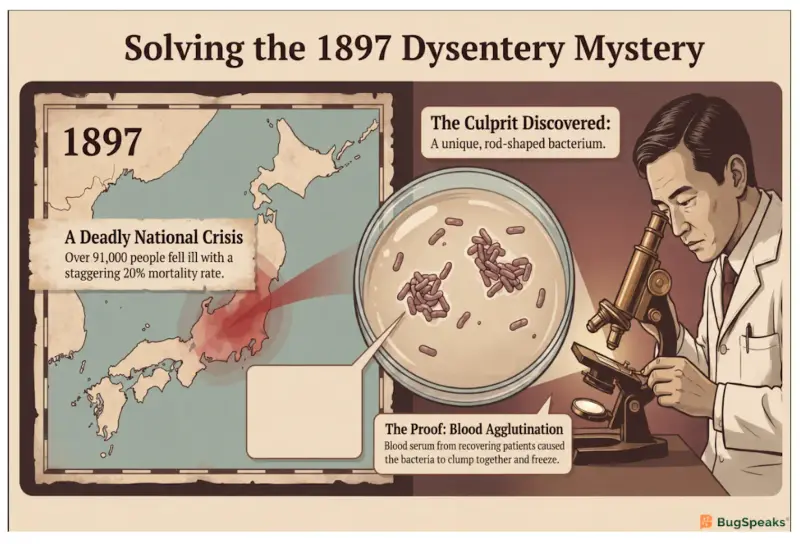
The mystery behind this deadly disease began to clear up in 1897 during a massive outbreak in Japan. More than 91,000 people got sick, and 1 out of every 5 victims died. Desperate for answers, a young Japanese scientist named Kiyoshi Shiga set out to find the killer germ. Shiga studied dozens of patients and successfully found a unique, rod-shaped bacterium. He proved it was the true bad guy by showing that the blood of recovering patients caused agglutination, making the bacteria clump together and freeze.
The name of the germ directly honors his big discovery. The first name, Shigella, was given by scientists to thank Dr. Shiga, while dysenteriae points directly to the painful intestine disease it causes. Today, even though we know a lot more about this germ, it is still a major global health threat in places that do not have clean water or proper toilets.
How Does Shigella dysenteriae Survive and Spread So Efficiently?
This germ survives and multiplies by being an incredibly focused specialist. Unlike other germs that can live happily in dirt or water for a long time, Shigella has a very strict home: it lives naturally only in humans and higher primates like apes and gorillas. Because it has no other animal hideouts, it relies entirely on jumping from one human to another.
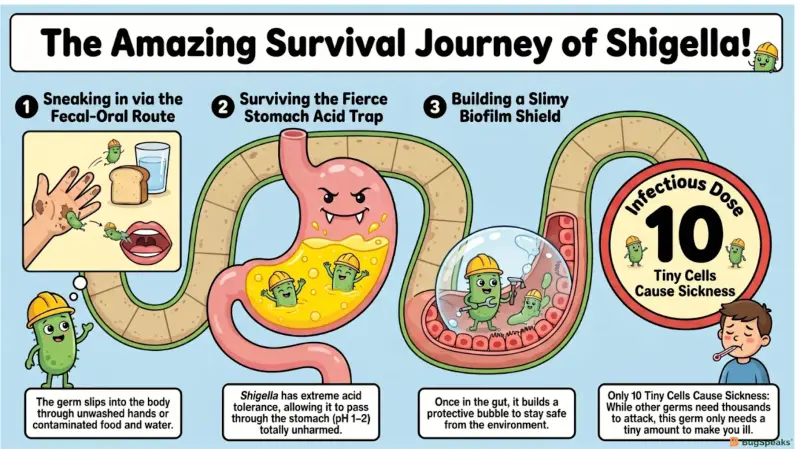
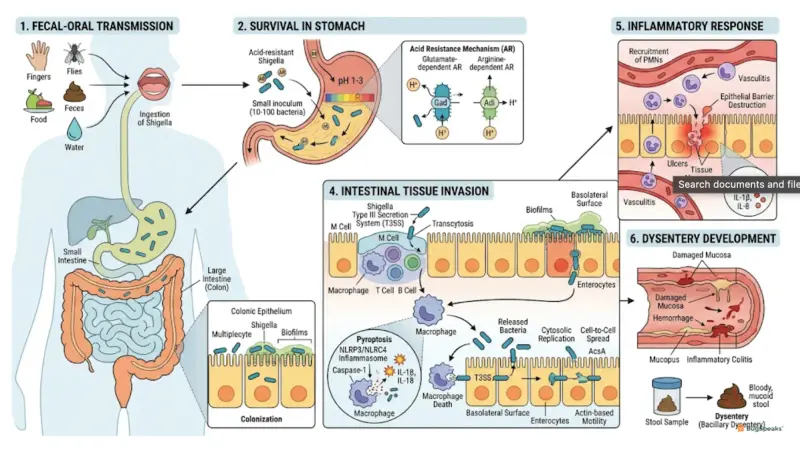
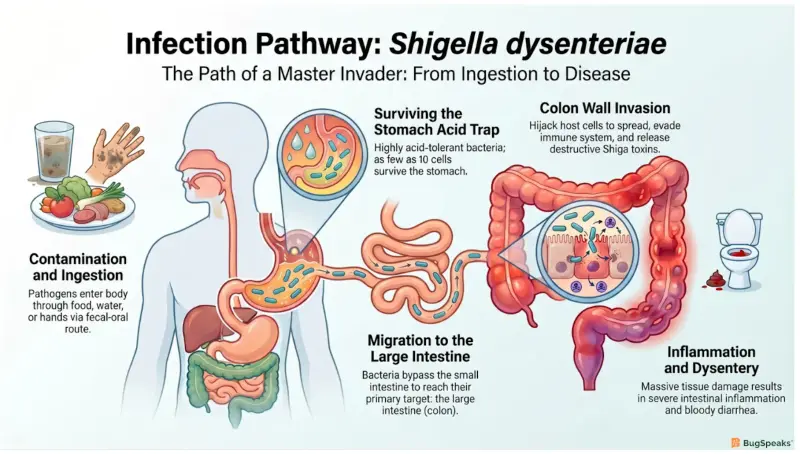
The spread of this germ relies strictly on the fecal-oral route. This is a polite way of saying it spreads when water, food, or hands get contaminated with microscopic amounts of poop. Dirty water is the biggest culprit, which happens when plumbing breaks or sewage mixes with drinking water.
What makes this germ uniquely terrifying is its extreme acid tolerance. Normally, when we eat or drink, our stomach acid acts like a fierce security guard, destroying incoming germs. But Shigella can easily survive this super-strong stomach acid. Because it passes through this trap totally unharmed, a shockingly small number of germs sometimes as few as 10 individual bacteria cells is enough to make a person terribly sick. Once it finds a safe spot, it builds a biofilm, which acts like a slimy shield to protect the germ from dangers.
How Can a Tiny Tummy Germ Hijack Our Cells and Kidneys?
Once Shigella sneaks past the stomach, it settles in the large intestine and launches a two-part attack: physical cell invasion and toxic warfare.
First, the bacterium performs an incredible trick known as actin rocketry. Once it gets inside an intestinal cell, it steals the cell’s internal building blocks (called actin). It forces these blocks to build a tail behind it, literally launching the germ forward like a rocket! This lets the germ punch straight into neighboring healthy cells without ever stepping outside into the open, where our immune system guards could easily see it and destroy it.
Second, the bacterium spits out a terrible poison called the Shiga toxin. This toxin has two parts: a matching key and a deadly payload. The key binds perfectly to the outside of our human cells to let the poison inside. Once it gets in, the payload attacks our cells protein factories (ribosomes) and completely shuts them down. Without proteins, the cells die.
This cellular shutdown causes massive damage. In the gut, it causes bleeding sores. If the poison spills into the bloodstream, it travels straight to the kidneys and rips up the delicate blood vessels. This can trigger a scary medical emergency called Hemolytic Uremic Syndrome (HUS), which causes the kidneys to shut down, destroys red blood cells, and creates dangerous blood clots.
Cellular Hijack: How Shigella Takes Control
[ Shigella enters cell ] ---> [ Triggers "Actin Rocketry" ] ---> [ Spreads directly cell-to-cell ]
[ Kidney Failure / HUS ] <--- [ Shreds Blood Vessels ] <--- [ Releases Shiga Toxin ]
Has Shigella dysenteriae Ever Benefited Humanity?
While a real infection of Shigella is purely destructive, smart scientists have figured out ways to take away the germ's weapons and turn its technology into medical breakthroughs.
One amazing use is in targeted therapy for cancer. Because a piece of the Shiga toxin is incredibly good at tracking down a specific molecule found on cancer cells, researchers use it like a GPS delivery truck. By taking the poison out and attaching powerful cancer-fighting medicines to it instead, they created smart treatments that travel straight to tumors, slip inside, and destroy the cancer from the inside out while leaving healthy parts of the body totally safe.
Furthermore, scientists have changed the DNA of Shigella to create live-attenuated vaccines. By deleting the genes that make the dangerous toxin and removing the keys it uses to spread violently, they made a weakened, safe version of the germ. When swallowed, these tamed germs safely train the body's immune system to fight back, creating protective shields (antibodies) without causing any real sickness.
Why Does Shigella dysenteriae Still Matter in the Modern World?
Shigella is still a major focus for doctors and experts because it is a modern crisis that is actively getting harder to treat. Around the world, Shigella germs cause up to 165 million cases of illness and hundreds of thousands of deaths every year, mostly affecting toddlers and babies under five years old who live in poor areas without clean water.
The biggest threat today is multidrug resistance (MDR). For decades, doctors used standard antibiotic medicines to kill the germ and save lives. However, the bacteria have evolved super fast, trading survival secrets with other germs in the gut. Today, Shigella strains in parts of Asia and Africa have learned how to defeat our strongest medicines, making standard treatments fail up to 96% of the time in some studies.
Modern genomics (reading the germ's entire DNA instruction book) has shown us that Shigella isn't a completely separate family. It is actually a special branch of the common E. coli bacteria that shed old genes and picked up a massive package of "invasion DNA" over time.
This evolutionary history reminds us that germs are constantly changing targets. They adapt to our medicines, our soaps, and our bodies. This tiny bacterium is a powerful reminder that the fight against disease requires constant work, cleaner water, and brand-new scientific discoveries.
Taxonomic Classification
Microbe Profile
Shape: Rod-shaped (like a tiny hot dog).
Gram Nature: Gram-negative (means it has a tough outer skin).
Spore Formation: Non-spore-forming (does not make hard seeds; must move quickly from person to person).
Oxygen Requirement: Can grow with or without oxygen.
Optimal Temperature: 37 degree Celsius (exactly the temperature of a warm human body).
Optimal pH: Neutral, but uniquely built to survive stomach acid down to pH 1–2.
Nutrient Usage: Does not break down lactose or mannitol sugars; uniquely catalase-negative (a chemical trait that sets it apart from all other Shigella types).
Fun Facts
The Virus Connection: In 1915, a scientist named Félix d'Herelle was studying French soldiers with bad dysentery. He discovered something invisible was hunting and eating the Shigella bacteria! This discovery led to the word "bacteriophage" (viruses that destroy bacteria), which started the science of phage therapy.
Number One in Line: The very first live bacterial sample ever saved in the UK’s National Collection of Type Cultures in 1915, labeled NCTC1, was a sample of Shigella taken from a soldier fighting in World War I.
Biological Threat: Because it can cause severe sickness with an incredibly tiny dose and spreads easily through food or water, S. dysenteriae is officially listed as a potential biological weapon threat that scientists monitor very closely.
-Varsha V
Reference
Lampel, K. A., Formal, S. B., & Maurelli, A. T. (2018). A Brief History of Shigella. EcoSal Plus, 8(1), 10.1128/ecosalplus.ESP-0006-2017. https://doi.org/10.1128/ecosalplus.ESP-0006-2017
Kaur, G., Sathyabama, S., Arora, A., Verma, S., Mubin, N., Agrewala, J. N., & Mayilraj, S. (2014). Genome sequencing, annotation and comparative genomic analysis of Shigella dysenteriae strain SD1D. Gut pathogens, 6, 28. https://doi.org/10.1186/1757-4749-6-28
Dublanchet, A., & Bourne, S. (2007). The epic of phage therapy. The Canadian journal of infectious diseases & medical microbiology = Journal canadien des maladies infectieuses et de la microbiologie medicale, 18(1), 15–18. https://doi.org/10.1155/2007/365761
Magana-Arachchi, D. N., & Wanigatunge, R. P. (2020). Ubiquitous waterborne pathogens. Waterborne Pathogens, 15–42. https://doi.org/10.1016/B978-0-12-818783-8.00002-5
Payne S. M. (2019). Laboratory Cultivation and Storage of Shigella. Current protocols in microbiology, 55(1), e93. https://doi.org/10.1002/cpmc.93
Batista, A., Dodou, H., Rodrigues, M., Pereira, P., Sales, G., Medeiros, S., & Nogueira, N. (2018). Modulatory Effect of Lippia alba Essential Oil on the Activity of Clinically Used Antimicrobial Agents on Salmonella typhi and Shigella dysenteriae Biofilm. Scientia Pharmaceutica, 86(4), 52. https://doi.org/10.3390/scipharm86040052
Danielewicz, N., Rosato, F., Tomisch, J., Gräber, J., Wiltschi, B., Striedner, G., Römer, W., & Mairhofer, J. (2023). Clickable Shiga Toxin B Subunit for Drug Delivery in Cancer Therapy. ACS omega, 8(17), 15406–15421. https://doi.org/10.1021/acsomega.3c00667
Ruamsap N, Imerbsin R, Khanijou P, Gonwong S, Oransathit W, Barnoy S, Venkatesan MM, Chaudhury S and Islam D (2024) A rhesus macaque intragastric challenge model for evaluating the safety, immunogenicity, and efficacy of live-attenuated Shigella dysenteriae 1 vaccine candidates. Front. Microbiol. 15:1454338. doi: 10.3389/fmicb.2024.1454338
Ashkenazi, S., & Cohen, D. (2013). An update on vaccines against Shigella. Therapeutic advances in vaccines, 1(3), 113–123. https://doi.org/10.1177/2051013613500428
Melton-Celsa A. R. (2014). Shiga Toxin (Stx) Classification, Structure, and Function. Microbiology spectrum, 2(4), 10.1128/microbiolspec.EHEC-0024-2013. https://doi.org/10.1128/microbiolspec.EHEC-0024-2013
Liu, Z., Li, X., Lu, Z., Qin, X., Hong, H., Zhou, Z., Pieters, R. J., Shi, J., & Wu, Z. (2022). Repurposing the Pentameric B-Subunit of Shiga Toxin for Gb3-Targeted Immunotherapy of Colorectal Cancer by Rhamnose Conjugation. Journal of pharmaceutical sciences, 111(10), 2719–2729. https://doi.org/10.1016/j.xphs.2022.07.017
Liu, Z., Li, X., Lu, Z., Qin, X., Hong, H., Zhou, Z., Pieters, R. J., Shi, J., & Wu, Z. (2022). Repurposing the Pentameric B-Subunit of Shiga Toxin for Gb3-Targeted Immunotherapy of Colorectal Cancer by Rhamnose Conjugation. Journal of pharmaceutical sciences, 111(10), 2719–2729. https://doi.org/10.1016/j.xphs.2022.07.017
Kaper, J. B., & O'Brien, A. D. (2014). Overview and Historical Perspectives. Microbiology spectrum, 2(6), 10.1128/microbiolspec.EHEC-0028-2014. https://doi.org/10.1128/microbiolspec.EHEC-0028-2014
Qureshi, H., Basheer, A., Faheem, M., Arshad, M. W., Rai, S. K., & Jamal, S. B. (2024). Designing a multi-epitope vaccine against Shigella dysenteriae using immuno-informatics approach. Frontiers in genetics, 15, 1361610. https://doi.org/10.3389/fgene.2024.1361610