The Pathobyte Series- Plesiomonas shigelloides: An Emerging Pathogen
What is Plesiomonas shigelloides?
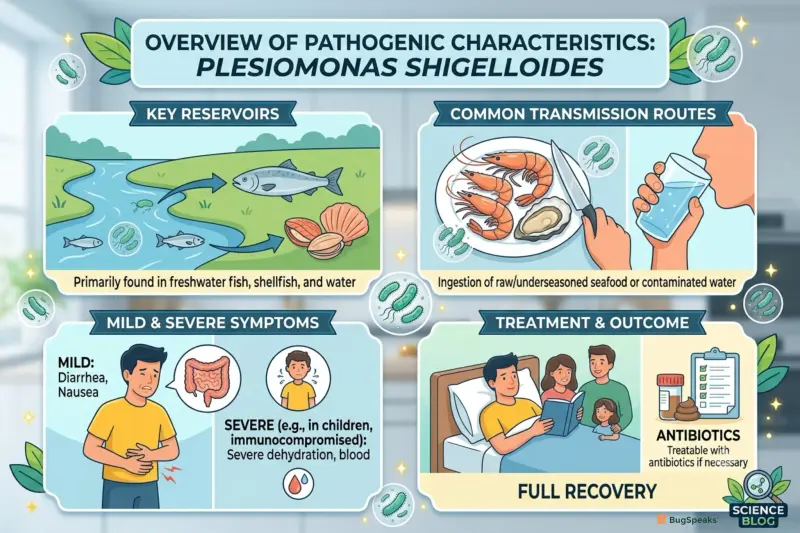
Plesiomonas shigelloides is a naturally occurring bacterium found in freshwater environments and aquatic animals. It belongs to the family Enterobacteriaceae and is unique because it is the only species currently recognized within the genus Plesiomonas. Although it is not among the most common causes of foodborne illness, it has been increasingly recognized as an important cause of diarrheal disease worldwide, particularly in tropical and subtropical regions.
Human infections are usually associated with exposure to contaminated freshwater, untreated drinking water, raw or undercooked seafood, or foods that come into contact with contaminated water. Most illnesses affect the digestive tract, but the bacterium can occasionally invade other parts of the body in people with weakened immune systems.
What is the history behind the name Plesiomonas shigelloides?
Plesiomonas shigelloides was first identified in the early twentieth century, but its classification has changed significantly as microbiology has advanced.
The organism was initially mistaken for members of the genus Shigella because of similarities in certain laboratory reactions. This resemblance led to the species name shigelloides, meaning "similar to Shigella." Later studies demonstrated that the bacterium is genetically and biologically distinct, resulting in its placement within the separate genus Plesiomonas.
The genus name comes from Greek words meaning "near" or "close to" and "unit," reflecting its early perceived relationship with other Gram-negative bacteria. Modern molecular techniques, including DNA sequencing, have clarified its evolutionary position within the order Enterobacterales.
Advances in molecular diagnostics have also improved recognition of P. shigelloides as an emerging waterborne and foodborne pathogen. In recent decades, the increased use of multiplex PCR panels has revealed that infections may be more common than previously recognized because traditional stool cultures often failed to detect the organism.
What disease does Plesiomonas shigelloides cause?
Plesiomonas shigelloides primarily causes acute gastroenteritis, although it can occasionally produce infections outside the gastrointestinal tract.
After entering the digestive system, the bacterium attaches to intestinal cells and produces toxins and other virulence factors that disrupt normal intestinal function. This leads to inflammation and increased fluid secretion into the intestine, resulting in diarrhea.
Most infections resolve within several days without complications. However, symptoms can occasionally persist for weeks, particularly if medical care is delayed or if the individual has underlying health conditions.
Less commonly, the bacterium can cause bloodstream infections, meningitis, cellulitis, septic arthritis, biliary tract infections, and other extraintestinal diseases, especially in individuals with weakened immunity, liver disease, cancer, or blood disorders.
Common symptoms
Symptoms generally appear within one to several days after exposure.
They may include:
Watery diarrhea
Bloody diarrhea in some patients
Abdominal cramps
Nausea
Vomiting
Fever
Headache
Chills
General fatigue
Loss of appetite
Although most cases are mild, severe dehydration can develop in infants, young children, older adults, and people with chronic illnesses.
Who is at higher risk?
Certain groups are more likely to develop severe disease:
Young children
Older adults
People with weakened immune systems
Individuals with liver disease
People with blood disorders
Cancer patients
Organ transplant recipients
Travelers visiting regions with inadequate water sanitation
How does Plesiomonas shigelloides spread?
The bacterium spreads primarily through the fecal–oral route, meaning people become infected after ingesting food or water contaminated with fecal material containing the organism.
Unlike respiratory pathogens, P. shigelloides is not spread through coughing or casual contact.
Common sources of infection include:
The bacterium naturally inhabits freshwater ecosystems and has been isolated from numerous aquatic animals, including fish, amphibians, reptiles, and shellfish. Because it survives well in aquatic environments, contamination of food during harvesting, transportation, or preparation can introduce the organism into the human food chain.
Human-to-human transmission appears to occur much less frequently than environmental transmission and has not been considered the primary route of spread.
How is Plesiomonas shigelloides diagnosed?
Diagnosis is confirmed through laboratory testing because symptoms are similar to those caused by many other gastrointestinal pathogens.
Healthcare providers usually begin by evaluating a person's symptoms, recent travel history, food consumption, and exposure to untreated water.
Laboratory tests may include:
Modern molecular methods have substantially improved detection rates because the bacterium can sometimes be overlooked using conventional stool culture techniques alone.
Additional blood tests may be recommended in severe infections to evaluate dehydration, electrolyte imbalance, or systemic infection.
Key facts at a glance
How is Plesiomonas shigelloides treated?
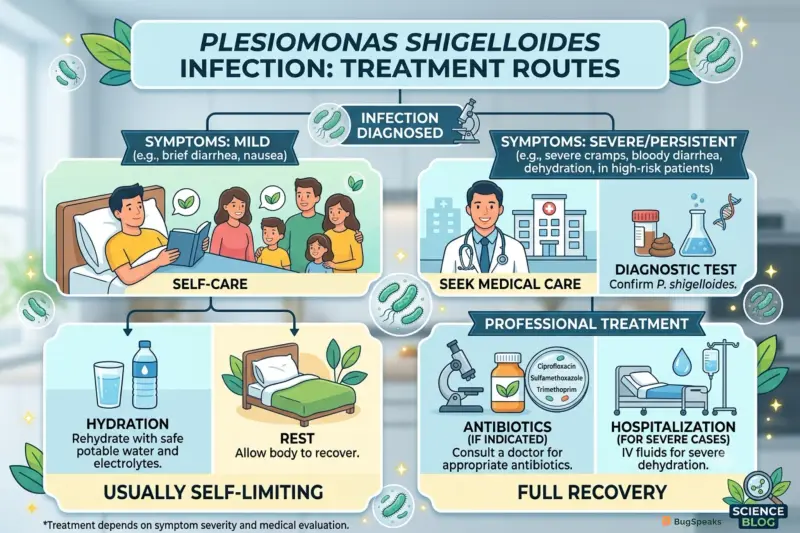
Most Plesiomonas shigelloides infections are treated with supportive care because the illness is typically mild and resolves on its own within a few days. The primary focus of treatment is preventing dehydration by replacing fluids and electrolytes lost through diarrhea and vomiting.
For people with mild symptoms, drinking plenty of fluids and using oral rehydration solutions are usually sufficient. Individuals with severe dehydration, persistent vomiting, or signs of invasive infection may require hospitalization for intravenous (IV) fluids and closer monitoring.
Antibiotics are not routinely needed for uncomplicated gastroenteritis. However, healthcare providers may prescribe them for severe, prolonged, or extraintestinal infections, or for patients at high risk of complications, such as those with weakened immune systems. Because antibiotic susceptibility can vary, treatment is ideally guided by laboratory susceptibility testing.
Treatment at a Glance
Key Takeaway: Never take antibiotics without medical advice. Unnecessary antibiotic use can contribute to antimicrobial resistance and may not improve recovery in uncomplicated infections.
How can you prevent Plesiomonas shigelloides infection?
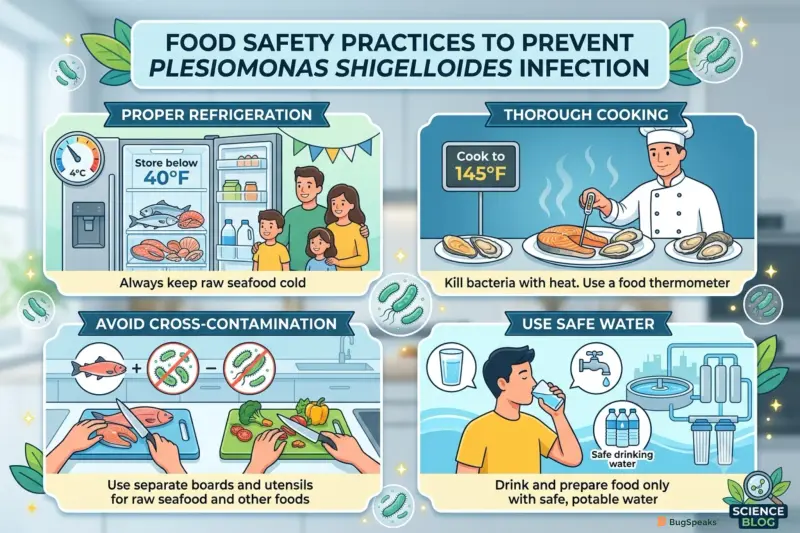
Preventing Plesiomonas shigelloides infection primarily involves consuming safe food and water and maintaining good hygiene practices. Since the bacterium naturally inhabits freshwater environments and aquatic animals, reducing exposure to contaminated water and properly handling seafood are the most effective preventive measures.
Practical Prevention Tips
Drink treated, filtered, or boiled water, especially when traveling to areas with uncertain water quality.
Avoid swallowing water while swimming in lakes, rivers, or other freshwater bodies.
Cook seafood, shellfish, and freshwater fish thoroughly before eating.
Wash fruits and vegetables with safe, clean water.
Prevent cross-contamination by using separate cutting boards and utensils for raw seafood.
Wash hands thoroughly with soap and water before preparing food and before eating.
Refrigerate seafood promptly to reduce bacterial growth.
Who Should Be Extra Careful?
People who are more vulnerable to severe infection should take additional precautions, including avoiding raw or undercooked seafood and untreated water.
These groups include:
Infants and young children
Older adults
Pregnant individuals
People with chronic liver disease
Individuals receiving chemotherapy
Organ transplant recipients
People with weakened immune systems
Prevention Checklist
Microbe Profile
Taxonomic Classification
Domain: Bacteria
Kingdom: Pseudomonadati
Phylum: Pseudomonadota
Class: Gammaproteobacteria
Order: Enterobacterales
Family: Enterobacteriaceae
Genus: Plesiomonas
Species: Plesiomonas shigelloides
Reference
Janda JM, Abbott SL, McIver CJ. Plesiomonas shigelloides revisited. Clinical Microbiology Reviews. 2016;29(2):349-374. doi:10.1128/CMR.00103-15
Janda JM, Abbott SL. The genus Plesiomonas. In: Dworkin M, Falkow S, Rosenberg E, Schleifer KH, Stackebrandt E, eds. The Prokaryotes. 3rd ed. Springer; 2006.
Janda JM, Abbott SL. Evolving concepts regarding the genus Plesiomonas: an expanding perspective on a human pathogen. Clinical Infectious Diseases. 1998;26(2):266-272.
World Health Organization (WHO). Diarrhoeal Disease Fact Sheet. Updated 2024.https://www.who.int/news-room/fact-sheets/detail/diarrhoeal-disease
Centers for Disease Control and Prevention (CDC). Food Safety.https://www.cdc.gov/food-safety/
Centers for Disease Control and Prevention (CDC). Travelers' Health.https://wwwnc.cdc.gov/travel
Merck Manual Professional Edition. Plesiomonas and Other Gram-Negative Infections.https://www.merckmanuals.com/professional
Ryan KJ, Ray CG, eds. Sherris Medical Microbiology. 8th ed. McGraw-Hill Education; 2022.
Murray PR, Rosenthal KS, Pfaller MA. Medical Microbiology. 10th ed. Elsevier; 2023.