# The Pathobyte Series: Mycobacterium avium: Birds and Beyond
Author: BugSpeaks
Author URL: https://www.bugspeaks.com/blog/author/bugspeaks
Published: 2026-05-20
Category: MicroByte Series
Category URL: https://www.bugspeaks.com/blog/category/microbyte-series
Meta Title: Mycobacterium avium: Symptoms, Transmission & Treatment| BugSpeaks
Meta Description: Learn about Mycobacterium avium, a non-tuberculous mycobacterium linked to lung disease and immune-related infections. Explore symptoms, transmission, diagnosis, treatment, prevention, and microbial characteristics.
Tags: Mycobacterium avium, Pathogen
Tag URLs: Mycobacterium avium (https://www.bugspeaks.com/blog/tag/mycobacterium-avium), Pathogen (https://www.bugspeaks.com/blog/tag/pathogen)
URL: https://www.bugspeaks.com/blog/pathobyte-series-mycobacterium-avium
Mycobacterium avium is a slow-growing, weakly Gram-positive bacillus capable of causing a wide array of human illnesses. Driven by an advanced arsenal of intracellular survival mechanisms, it effortlessly evades host immunity, spreading silently through environmental exposure to contaminated water and soil. Infections range from localized cervical lymphadenitis to life-threatening systemic conditions, including chronic pulmonary disease and disseminated bacteremia. Accurate diagnosis leverages classic acid-fast staining and modern tools like molecular testing. While treatment typically requires prolonged multidrug antibiotic therapy with targeted macrolides, robust prevention relies heavily on maintaining clean household water systems and preserving immune health.
## **What is _Mycobacterium avium_?**
_Mycobacterium avium_ is a slow-growing environmental bacterium that belongs to the non-tuberculous mycobacteria (NTM) group. It is commonly found in soil, water systems, dust, and natural environments. In humans, it can cause lung disease, lymph node infections, and disseminated infections, particularly in people with weakened immune systems or chronic lung conditions.
Unlike _Mycobacterium tuberculosis_, _M. avium_ is generally not considered highly contagious between people. Most infections are associated with environmental exposure rather than person-to-person spread. Diagnosis usually requires imaging studies and [laboratory culture](https://www.bugspeaks.com/blog/leptospirainterrogans-pathogen-guthealth/), while treatment often involves long-term combination antibiotic therapy.
**Non-Tuberculous Mycobacteria (NTM) -** Non-tuberculous mycobacteria are a large group of mycobacterial species found naturally in the environment. They are distinct from the bacteria that cause tuberculosis and leprosy.
## **How was _Mycobacterium avium_ named? What is its History?**
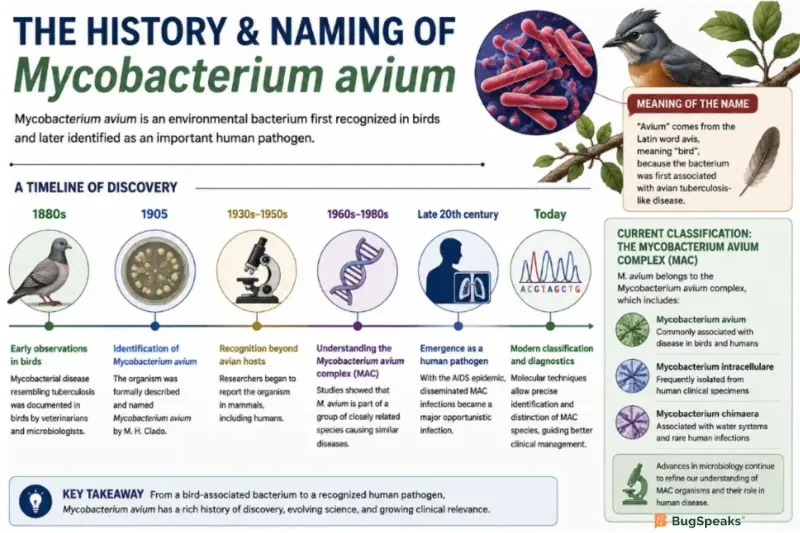
_Mycobacterium avium_ was originally identified in birds and later recognized as a human pathogen. The term “avium” comes from the Latin word _avis_, meaning bird, because the bacterium was first associated with avian tuberculosis-like disease.
Over time, microbiologists discovered that _M. avium_ belongs to a broader group called the _Mycobacterium avium complex_ (MAC), which includes closely related species such as _Mycobacterium intracellulare_. Advances in molecular diagnostics during the late 20th century improved the classification and differentiation of MAC organisms.
Interest in MAC infections increased significantly during the HIV/AIDS epidemic, when disseminated _M. avium_ infections became a major opportunistic infection in severely immunocompromised individuals. Today, [MAC-related pulmonary](https://www.bugspeaks.com/blog/pathogen-salmonella-gutmicrobiome/) disease is increasingly recognized in older adults and people with structural lung disease.
## **What Diseases Does _Mycobacterium avium_ Cause?**
_Mycobacterium avium_ primarily causes pulmonary disease, disseminated infection, and lymphadenitis. Disease severity varies depending on immune status and underlying health conditions.
### **C** ommon Conditions Associated with M. avium
**Disease Type**
**Commonly Affected Group**
**Key Features**
Pulmonary MAC disease
Older adults and chronic lung disease patients
Chronic cough, fatigue, weight loss
Disseminated MAC infection
Advanced HIV/AIDS, immunocompromised individuals
Fever, anemia, night sweats
Cervical lymphadenitis
Children
Swollen neck lymph nodes
Skin and soft tissue infection
Rare
Localized inflammation
## **How Does Mycobacterium avium Cause Disease? (Pathogenesis)**
Mycobacterium avium causes disease by surviving inside immune cells, resisting intracellular destruction, and establishing persistent infection in susceptible hosts. Disease progression depends on both bacterial survival mechanisms and the immune status of the infected individual.
Unlike many extracellular bacteria, M. avium is an intracellular pathogen. After entering the body most commonly through inhalation of aerosolized particles, it is engulfed by macrophages, which are immune cells responsible for destroying microbes. However, M. avium possesses several cellular features that allow it to survive within these cells rather than being eliminated.
Macrophage- A macrophage is a specialized immune cell that engulfs and destroys microorganisms, cellular debris, and foreign particles.
## **What Are the Symptoms of _Mycobacterium avium_ Infection?**
Symptoms depend on the site of infection and the immune status of the individual.
### **Pulmonary Disease Symptoms**
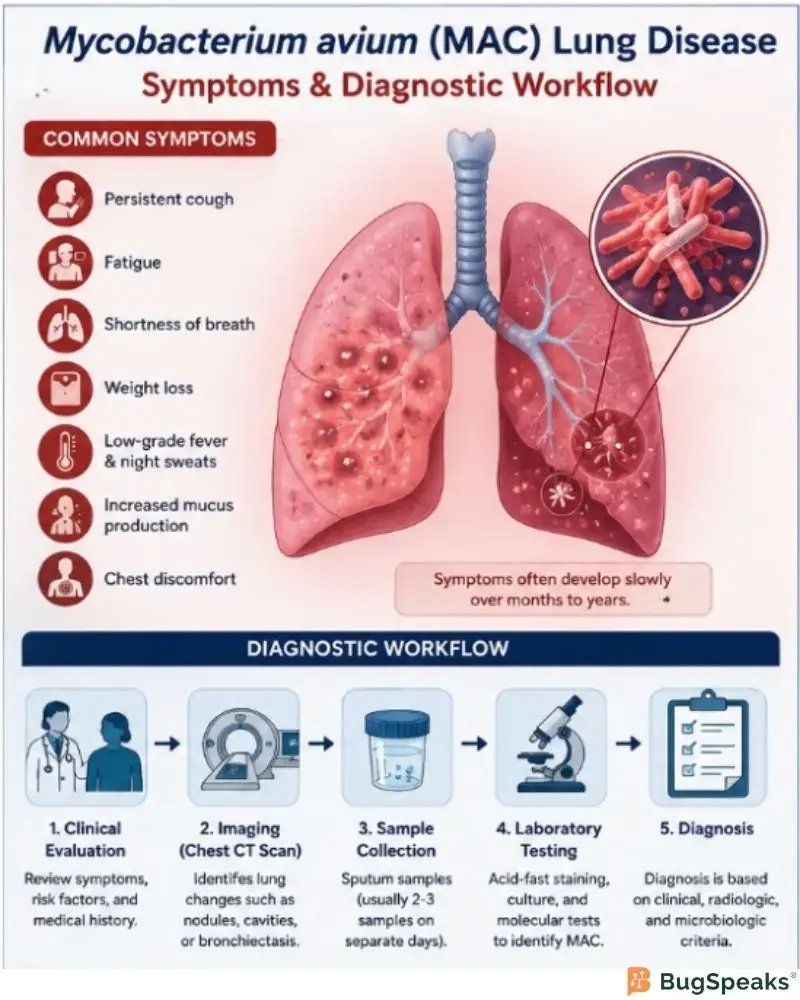
Pulmonary MAC disease often develops slowly over months or years.
Common symptoms include:
- Persistent cough
- Fatigue
- Shortness of breath
- Weight loss
- Low-grade fever
- Night sweats
- Chest discomfort
- Increased mucus production
### **Disseminated Infection Symptoms**
In disseminated disease, the bacterium spreads through the bloodstream.
Symptoms may include:
- Persistent fever
- Severe fatigue
- Weight loss
- Diarrhea
- Abdominal pain
- Enlarged liver or spleen
- Anemia
### **Lymph Node Infection Symptoms**
Children with cervical lymphadenitis may develop:
- Swollen lymph nodes in the neck
- Mild tenderness
- Skin discoloration over lymph nodes
**Disseminated Infection**\- A disseminated infection occurs when a microorganism spreads from one site to multiple organs or tissues through the bloodstream or lymphatic system.
## **How Is _Mycobacterium avium_ Transmitted?**
_Mycobacterium avium_ is mainly acquired through environmental exposure. Current evidence does not support routine person-to-person transmission in most settings.
### **Common Environmental Sources**
The bacterium has been isolated from:
- Household plumbing systems
- Showerheads
- Natural water bodies
- Soil and dust
- Aerosolized water particles
### **Potential Routes of Exposure**
**Exposure Route**
**Example**
Inhalation
Aerosolized water droplets
Ingestion
Contaminated water
Environmental contact
Soil exposure
Researchers believe inhalation of aerosolized bacteria is a major pathway in pulmonary disease. However, exposure alone does not necessarily lead to illness. Host susceptibility plays a major role.
### **Risk Factors**
People at higher risk include:
- Individuals with chronic obstructive pulmonary disease (COPD)
- People with bronchiectasis
- Individuals with cystic fibrosis
- Advanced HIV/AIDS patients
- Organ transplant recipients
- Older adults

## **How is _Mycobacterium avium_ diagnosed?**
Diagnosis requires a combination of clinical evaluation, imaging, and laboratory testing. Because MAC organisms can colonize airways without causing disease, laboratory detection alone is insufficient for diagnosis.
### **Diagnostic Methods**
**Test**
**Purpose**
Chest CT scan
Detect lung abnormalities
Sputum culture
Identify MAC organisms
Acid-fast staining
Detect mycobacteria
Molecular testing
Species identification
Blood cultures
Detect disseminated infection
### **Diagnostic Challenges**
Diagnosis can be delayed because symptoms resemble other respiratory conditions, including tuberculosis and chronic bronchitis. MAC organisms also grow slowly in laboratory cultures, sometimes requiring several weeks for confirmation.
**Acid-Fast Bacteria**\- Acid-fast bacteria retain specific laboratory stains due to the high lipid content of their cell walls. Mycobacteria are classic acid-fast organisms.
## **What Treatments Are Used for _Mycobacterium avium_ Infection?**
Treatment usually involves prolonged multidrug antibiotic therapy. Management depends on disease severity, infection site, and patient health status.
### **Standard Treatment Approach**
Pulmonary MAC disease is commonly treated using combinations of:
- Macrolides (azithromycin or clarithromycin)
- Ethambutol
- Rifampin or rifabutin
Therapy often continues for at least 12 months after cultures become negative.
### **Severe or Disseminated Disease**
In advanced disease, additional antibiotics such as aminoglycosides may be required.
### **Treatment Challenges**
**Challenge**
**Clinical Impact**
Slow bacterial growth
Long treatment duration
Drug resistance
Reduced treatment effectiveness
Medication side effects
Monitoring required
Underlying lung disease
Higher recurrence risk
Close monitoring is important because long-term therapy may affect liver function, vision, or hearing, depending on the medications used.
## **How Can _Mycobacterium avium_ Infection be Prevented?**
Prevention focuses on reducing exposure risk in susceptible individuals and maintaining immune health.
### **Prevention Strategies**
- Maintain clean household water systems
- Reduce exposure to aerosolized water in high-risk settings
- Follow HIV treatment protocols to preserve immune function
- Manage chronic lung diseases appropriately
- Use sterile medical equipment in healthcare environments
### **Healthcare Prevention**
In individuals with advanced HIV infection, preventive antibiotic therapy may be considered under clinical guidance.
Currently, no vaccine specifically targets _Mycobacterium avium_ infection.
## **What Is the Microbe Profile of _Mycobacterium avium_?**
**Characteristic**
**Details**
Gram status
Weakly Gram-positive; acid-fast
Shape
Rod-shaped bacillus
Spore formation
Non-spore-forming
Motile
Non-motile
Oxygen requirements
Aerobic
Optimum temperature
Approximately 37°C
Optimum pH
Near neutral (around pH 6.5–7.5)
## **Taxonomic Classification**
Rank
Name
Domain
Bacteria
Kingsom
Bacillati
Phylum
Actinomycetota
Class
Actinomycetes
Order
Mycobacteriales
Family
Mycobacteriaceae
Genus
Mycobacterium
Species
Mycobacterium avium complex (MAC)
## **Why Is _Mycobacterium avium_ Clinically Important?**
_Mycobacterium avium_ is clinically important because it represents one of the most common non-tuberculous mycobacterial pathogens worldwide. Improved imaging and laboratory techniques have increased recognition of MAC-associated disease in both immunocompromised and immunocompetent populations.
Researchers continue to study why some individuals develop progressive disease while others remain asymptomatic despite environmental exposure.
### Reference
Falkinham JO III. Environmental sources of nontuberculous mycobacteria. _Clin Chest Med._ 2015.
Daley CL, et al. Diagnosis, treatment, and prevention of nontuberculous mycobacterial diseases. _Clin Infect Dis._ 2020.
Griffith DE, et al. An official ATS/IDSA statement: diagnosis, treatment, and prevention of nontuberculous mycobacterial diseases. _Am J Respir Crit Care Med._ 2007.
Johansen MD, et al. Mycobacterium avium complex and the lung: a review. _Clin Microbiol Rev._ 2020.
Winthrop KL, et al. Pulmonary nontuberculous mycobacterial disease prevalence and clinical features. _Am J Respir Crit Care Med._ 2010.
Henkle E, Winthrop KL. Nontuberculous mycobacteria infections in immunosuppressed hosts. _Clin Chest Med._ 2015.
Haworth CS, et al. British Thoracic Society guidelines for management of non-tuberculous mycobacterial pulmonary disease. _Thorax._ 2017.
Ratnatunga CN, et al. The rise of non-tuberculous mycobacterial lung disease. _Front Immunol._ 2020.
Bermudez LE, Sangari FJ, Kolonoski P, Petrofsky M, Goodman J. The Mycobacterium avium complex: pathogenesis and virulence factors. FEMS Microbiol Rev. 2004;28(1):77–90.
## FAQs
Q: Is Mycobacterium avium the same as tuberculosis?
A: No. Mycobacterium avium belongs to the non-tuberculous mycobacteria group and is distinct from Mycobacterium tuberculosis, the bacterium that causes tuberculosis.
Q: Can healthy people get Mycobacterium avium infections?
A: Yes, although severe disease is more common in individuals with weakened immune systems or chronic lung disease.
Q: Is Mycobacterium avium contagious?
A: Current evidence suggests that most infections result from environmental exposure rather than person-to-person transmission.
Q: How long does treatment usually last?
A: Treatment for pulmonary MAC disease often continues for more than a year, depending on clinical response and culture results.
Q: Where is Mycobacterium avium commonly found?
A: It is commonly found in soil, natural water sources, household plumbing systems, and aerosolized water environments.
---
This blog is powered by Superblog. Visit https://superblog.ai to know more.
---