# The Pathobyte Series: Eikenella corrodens: The Slow-Growing Opportunistic Invader
Author: BugSpeaks
Author URL: https://www.bugspeaks.com/blog/author/bugspeaks
Published: 2026-09-02
Category: MicroByte Series
Category URL: https://www.bugspeaks.com/blog/category/microbyte-series
Meta Title: Eikenella corrodens: Opportunistic Pathogen | BugSpeaks
Meta Description: Explore Eikenella corrodens, an opportunistic pathogen linked to bite wounds, oral infections, and endocarditis. Learn its diagnosis, treatment, and prevention.
Tags: Pathogen, Eikenella corrodens
Tag URLs: Pathogen (https://www.bugspeaks.com/blog/tag/pathogen), Eikenella corrodens (https://www.bugspeaks.com/blog/tag/eikenella-corrodens)
URL: https://www.bugspeaks.com/blog/pathobyte-series-eikenella-corrodens
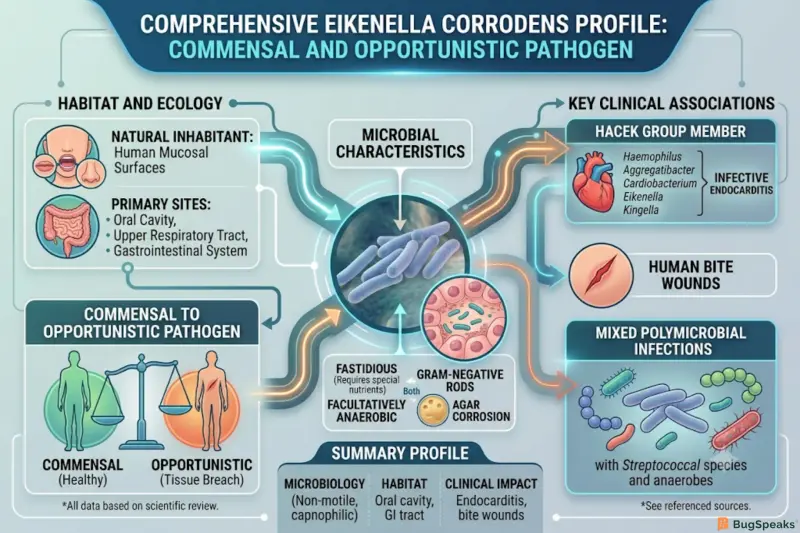
_Eikenella corrodens_ is a fastidious, Gram-negative, facultatively anaerobic, [rod-shaped](https://www.bugspeaks.com/blog/pathobyte-series-proteus-mirabilis) bacterium that naturally inhabits human mucosal surfaces, particularly within the oral cavity, upper respiratory tract, and gastrointestinal system. Although it functions primarily as a commensal organism in healthy individuals, it acts as an opportunistic human pathogen capable of causing severe localized and systemic infections when introduced into normally sterile tissues. _Eikenella corrodens_ is recognized as a core member of the HACEK group, an acronym designating a collection of fastidious Gram-negative bacilli known for causing infective endocarditis. Clinical interest in _E. corrodens_ stems from its distinct microbiological characteristics, including its ability to pit or "corrode" solid agar growth media, its association with human bite wounds, and its presence in mixed polymicrobial infections alongside streptococcal species and anaerobic organisms.
**Commensal-** A symbiotic relationship in which a microorganism resides on or within a host body, obtaining nutrients and habitat without causing harm or benefit to the host tissue under normal baseline conditions.
## **What Is the History and Naming of Eikenella corrodens?**
_Eikenella corrodens_ was first identified in 1958 by Danish microbiologist M. Eiken, who isolated the organism from human clinical specimens and initially designated it as _Bacteroides corrodens_. Eiken observed that colonies of this organism created physical depressions in solid blood agar media, a characteristic phenotypic trait referred to as agar pitting or corrosion. In 1972, microbiologists Jackson and Goodman re-evaluated the biochemical, metabolic, and genetic profiles of the bacterium, determining that it possessed physiological features distinct from the obligately anaerobic genus _Bacteroides_. Consequently, the organism was reclassified into a newly established genus, _Eikenella_, named in honor of M. Eiken, with the specific epithet _corrodens_ preserved to highlight its agar-corroding property.Bacteroides rrodens (1958) ──> Re-evaluated by Jackson & Goodman ──> Eikenella corrodens (1972)
**Phenotypic-** The observable physical, physiological, and biochemical characteristics of an organism, determined by both its genetic code and its environmental interactions.
## **What Diseases and Symptoms Are Caused by Eikenella corrodens?**
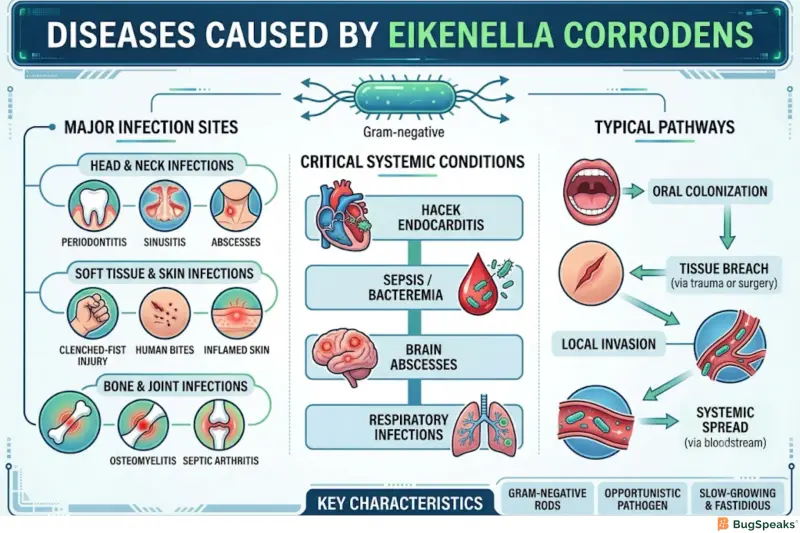
_Eikenella corrodens_ [causes](https://www.bugspeaks.com/blog/pathobyte-series-candida-albicans) diverse clinical infections, most frequently presenting as soft tissue infections, dental diseases, bone involvement, and cardiovascular complications. The symptoms vary directly according to the anatomical site of infection:
- **Head and Neck Infections:** It contributes significantly to chronic periodontitis, periapical abscesses, head and neck space infections, and sinusitis. Symptoms include localized facial pain, tissue edema, erythema, purulent drainage, and progressive bone destruction around dental structures.
- **Bite Wound and Traumatic Soft Tissue Infections:** _E. corrodens_ is isolated from human bite injuries and "clenched-fist" injuries (occurring when an individual's fist strikes human teeth). Symptoms manifest as rapid localized swelling, intense pain, erythema, low-grade fever, and purulent exudate at the injury site.
- **Infective Endocarditis:** As part of the HACEK group, it causes subacute bacterial endocarditis, targeting damaged or prosthetic heart valves. Symptoms include persistent low-grade fever, fatigue, heart murmurs, night sweats, weight loss, and embolic phenomena.
- **Osteomyelitis and Septic Arthritis:** Local invasion or hematogenous spread leads to bone and joint destruction, particularly in the hand, wrist, or knee joints. Clinical signs include severe joint pain, swelling, restricted range of motion, and localized heat.
- **Intra-abdominal and Pelvic Abscesses:** Infections often occur as part of polymicrobial abscess formation following surgical disruption or trauma to the gastrointestinal tract, presenting with localized abdominal pain, fever, and leukocytosis.
**Hematogenous-** Originating within, or spread through, the circulating bloodstream to distant organs or tissues throughout the human body.
## **How Is Eikenella corrodens Transmitted?**
Transmission of _Eikenella corrodens_ occurs almost exclusively through endogenous translocation or direct contact with human oral [secretions](https://www.bugspeaks.com/blog/pathobyte-series-helicobacter-pylori):
1. **Endogenous Translocation:** The primary route of infection occurs when an individual's normal mucosal barrier is compromised by surgery, dental procedures, mechanical trauma, mucosal ulceration, or underlying malignancy, allowing indigenous oral bacteria to invade sterile deep tissues.
2. **Direct Inoculation via Bite Injuries:** Direct transmission happens through human bites or clenched-fist injuries, where the skin barrier is punctured by teeth, inoculating oral fluid directly into subcutaneous tissue, tendon sheaths, or joint capsules.
3. **Fomite and Person-to-Person Contact:** Direct salivary exchange (such as shared utensils or dental instruments) can transfer strains between hosts, though exogenous infection rarely causes disease in the absence of mucosal damage.
**Endogenous-** Developing, originating, or proceeding from within an organism, tissue, or cell rather than from an external environmental source.
## **How Is Eikenella corrodens Diagnosed in a Laboratory?**
Diagnosis of _Eikenella corrodens_ relies on isolation from sterile clinical specimens, microscopic evaluation, and advanced diagnostic testing:
- **Microscopic Morphology:** Gram staining of clinical isolates reveals small, slender, straight Gram-negative rods with rounded ends.
- **Culture and Growth Characteristics:** _E. corrodens_ is fastidious, requiring hemin (X factor) for aerobic growth. On sheep blood agar or chocolate agar incubated in a carbon-dioxide-enriched atmosphere, it forms small, translucent colonies after 24 to 48 hours.
- **Phenotypic Features:** Approximately 50% of strains display characteristic agar corrosion, where colonies depress or sink into the agar surface. Cultures emit a distinctive hypochlorite bleach-like odor.
- **Biochemical Identification:** The organism is oxidase-positive, catalase-negative, urease-negative, indole-negative, and nitrate-reduction positive. It is strictly non-saccharolytic, failing to produce acid from carbohydrate fermentation.
- **Molecular and Diagnostic Methods:** Matrix-Assisted Laser Desorption/Ionization Time-of-Flight Mass Spectrometry (MALDI-TOF MS) and 16S rRNA gene sequencing allow rapid identification when traditional biochemical tests yield ambiguous results.
**Non-saccharolytic-** Incapable of breaking down or metabolizing carbohydrates and sugars to generate energy, utilizing amino acids or organic acids instead.
## **What Is the Recommended Treatment for Eikenella corrodens?**
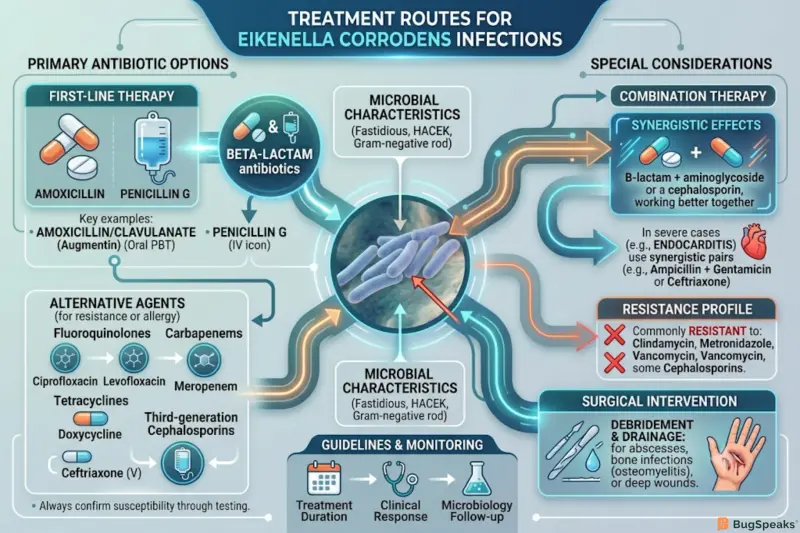
Treatment of _Eikenella corrodens_ infections involves targeted antimicrobial therapy combined with surgical intervention when abscesses or deep wound inoculations are present:
### **Surgical Debridement and Drainage**
Surgical intervention is required for bite injuries, deep space neck infections, and abscesses. Drainage of purulent fluid and thorough debridement of necrotic tissue reduce bacterial burden and restore local perfusion.
### **Antimicrobial Susceptibility Profile**
_E. corrodens_ exhibits a specific pattern of antimicrobial susceptibility and intrinsic resistance that differentiates it from many other Gram-negative bacilli:
- **Susceptible Agents:** Penicillins (such as ampicillin and amoxicillin-clavulanate), extended-spectrum cephalosporins (ceftriaxone, cefotaxime), carbapenems (imipenem, meropenem), fluoroquinolones (ciprofloxacin, levofloxacin), and tetracyclines (doxycycline).
- **Resistant Agents:** _E. corrodens_ is intrinsically resistant to clindamycin, metronidazole, macrolides (erythromycin), vancomycin, and first-generation cephalosporins (cephalexin). It often demonstrates variable or low susceptibility to aminoglycosides.
**Debridement-** The medical or surgical removal of dead, damaged, or infected tissue to improve the healing potential of remaining healthy surrounding tissue.
## **How Can Eikenella corrodens Infections Be Prevented?**
Prevention of _Eikenella corrodens_ infections relies on maintaining mucosal tissue integrity and following immediate hygiene protocols following traumatic exposures:
- **Oral Hygiene Practices:** Regular brushing, flossing, and professional dental cleanings reduce plaque accumulation and minimize the microbial burden of _E. corrodens_ in the oral cavity.
- **Immediate Wound Care for Bites:** Promptly washing human bite injuries or clenched-fist lacerations with sterile saline and soap removes introduced oral fluids and reduces bacterial density.
- **Prophylactic Antimicrobials:** Administering oral amoxicillin-clavulanate following high-risk human bite wounds provides early targeted coverage against _E. corrodens_ and co-inoculated oral flora.
- **Surgical Infection Control:** Adhering to strict aseptic techniques during oral, maxillofacial, and upper gastrointestinal surgical procedures prevents translocation into sterile tissues.
**Aseptic-** Free from pathogenic microorganisms; utilizing procedures designed to prevent contamination by bacteria, viruses, or other microorganisms.
## **Microbe Profile**
The biological characteristics of _Eikenella corrodens_ are summarized in the profile below:
**Gram status:** Gram-negative
**Shape:** Rod-shaped (Bacillus / Coccobacillus)
**Spore formation:** Non-spore-forming
**Motile:** Non-motile (exhibits twitching motility via type IV pili on solid surfaces)
**Oxygen requirements:** Facultative anaerobe
**Optimum temperature:** 35°C to 37°C
**Optimum pH:** 7.2 to 7.6
## Taxonomic classification
Domain: Bacteria
Kingdom: Pseudomonadati
Phylum:Pseudomonadota
Class: Betaproteobacteria
Order: Neisseriales
Family: Neisseriaceae
Genus: Eikenella
Species: E. corrodens
**Capnophilic:** Describing microorganisms that thrive in or require elevated concentrations of carbon dioxide for optimal growth and metabolic activity.
### Reference
Bilos, Z. J., Kucharchuk, A., & Metzger, W. (1978). Eikenella Corrodens in Human Bites. _Clinical Orthopaedics and Related Research_, _&NA;_, 320324. [https://doi.org/10.1097/00003086-197807000-00049](https://doi.org/10.1097/00003086-197807000-00049)
Henriksen, S. D. (1969). Designation of the type strain of Bacteroides corrodens Eiken 1958. _International Journal of Systematic Bacteriology_, _19_(2), 165–166. [https://doi.org/10.1099/00207713-19-2-165](https://doi.org/10.1099/00207713-19-2-165)
Khaledi, M., Sameni, F., Afkhami, H., Hemmati, J., Asareh Zadegan Dezfuli, A., Sanae, M.-J., & Validi, M. (2022). Infective endocarditis by HACEK: a review. _Journal of Cardiothoracic Surgery_, _17_(1). [https://doi.org/10.1186/s13019-022-01932-5](https://doi.org/10.1186/s13019-022-01932-5) Cited by: 126
Luong, N., Tsai, J., & Chen, C. (2001). Susceptibilities of _Eikenella corrodens_, _Prevotella intermedia_, and _Prevotella nigrescens_ Clinical Isolates to Amoxicillin and Tetracycline. _Antimicrobial Agents and Chemotherapy_, _45_(11), 3253–3255. [https://doi.org/10.1128/aac.45.11.3253-3255.2001](https://doi.org/10.1128/aac.45.11.3253-3255.2001)
Patrick, W. D., Brown, W. D., Ian Bowmer, M., & Sinave, C. P. (1990). Infective Endocarditis Due to _Eikenella corrodens_: Case Report and Review of the Literature. _Canadian Journal of Infectious Diseases and Medical Microbiology_, _1_(4), 139–142. [https://doi.org/10.1155/1990/619065](https://doi.org/10.1155/1990/619065)
Schmidt, D. R., & Heckman, J. D. (1983). Eikenella corrodens in Human Bite Infections of the Hand. _The Journal of Trauma: Injury, Infection, and Critical Care_, _23_(6), 478–482. [https://doi.org/10.1097/00005373-198306000-00006](https://doi.org/10.1097/00005373-198306000-00006)
## FAQs
Q: Is Eikenella corrodens a normal part of human flora?
A: Yes, Eikenella corrodens is a normal commensal organism colonizing the human oral cavity, upper respiratory tract, and gastrointestinal mucosa in healthy individuals.
Q: Why is Eikenella corrodens associated with human bite wounds?
A: E. corrodens resides in human saliva and dental plaque, allowing direct inoculation into skin and soft tissue when a bite occurs or when a fist strikes teeth.
Q: Why is clindamycin ineffective against Eikenella corrodens?
A: Eikenella corrodens possesses intrinsic resistance to clindamycin, making this antibiotic clinically ineffective despite its common use for oral and soft-tissue infections.
Q: What does the term "corrodens" refer to in its name?
A: The epithet "corrodens" refers to the bacterium's phenotypic ability to pit or depress the surface of solid agar media as its colonies grow in laboratory cultures.
Q: What role does Eikenella corrodens play in heart infections?
A: E. corrodens is a member of the HACEK group of bacteria, which are known causes of subacute infective endocarditis, particularly in individuals with pre-existing valve abnormalities.
---
This blog is powered by Superblog. Visit https://superblog.ai to know more.
---