# The Pathobyte Series: Candida albicans- How a Common Yeast Causes Disease
Author: BugSpeaks
Author URL: https://www.bugspeaks.com/blog/author/bugspeaks
Published: 2026-08-12
Category: MicroByte Series
Category URL: https://www.bugspeaks.com/blog/category/microbyte-series
Meta Title: Candida albicans: Symptoms, Causes & Treatment | BugSpeaks
Meta Description: Learn how Candida albicans causes candidiasis, from symptoms and transmission to diagnosis, treatment, and prevention. Understand Candida infection risks today.
Tags: Pathogen, Candida albicans
Tag URLs: Pathogen (https://www.bugspeaks.com/blog/tag/pathogen), Candida albicans (https://www.bugspeaks.com/blog/tag/candida-albicans)
URL: https://www.bugspeaks.com/blog/pathobyte-series-candida-albicans
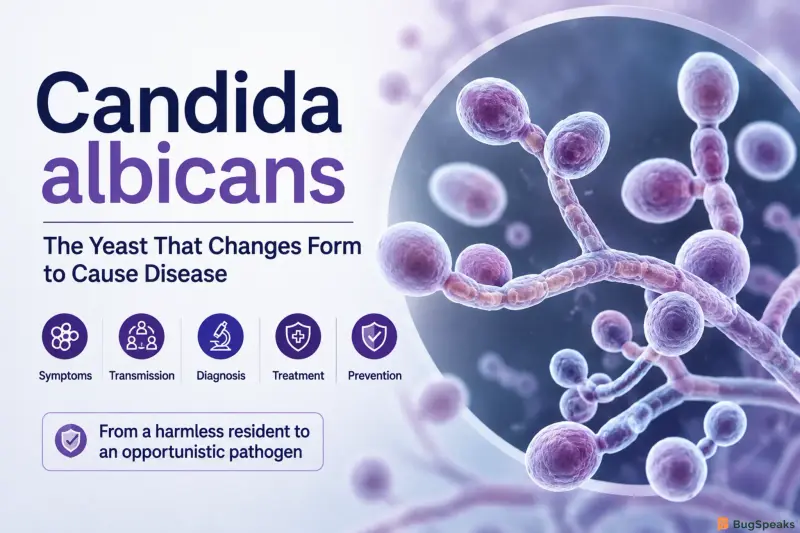
This blog explores _Candida albicans_, a yeast-forming fungus that commonly lives on human skin and mucosal surfaces without causing disease. However, when normal microbial communities, tissue barriers, or immune defenses are disrupted, this usually harmless colonizer can become an [opportunistic pathogen](https://www.bugspeaks.com/blog/pathobyte-series-staphylococcus-aureus) and cause candidiasis. Infections can range from oral thrush, vaginal candidiasis, and skin infections to invasive candidiasis, a serious condition in which the fungus enters the bloodstream and can affect internal organs. _C. albicans_ is particularly notable for its ability to switch between yeast, pseudohyphal, and hyphal forms, a characteristic that contributes to its ability to adapt to different environments and cause disease. This article examines the fungus's history and biology, transmission, clinical manifestations, diagnosis, treatment, prevention strategies, and the characteristics that make _C. albicans_ an important human pathogen.
Candida albicans is a yeast-forming fungus that commonly lives on human skin and mucosal surfaces without causing disease, but it can cause candidiasis when local barriers, microbial communities, or immune defenses are disrupted. It can produce oral thrush, vulvovaginal candidiasis, skin infections, and, in vulnerable patients, invasive bloodstream and organ infections. Most invasive infections arise from Candida already present in the person's own body rather than from acquiring the organism from another person. Diagnosis depends on the site and type of infection, while treatment uses antifungal medicines selected according to the clinical presentation and, for invasive disease, the organism's susceptibility.
Important: Finding _C. albicans_ on a body surface does not necessarily mean that a person has an infection. Colonization and disease are different clinical states.
## **What is the history and naming of _Candida albicans_?**
The organism now known as _Candida albicans_ has been recognized for well over a century, and its name reflects a long history of fungal classification.
The organism was described under earlier names before the genus _Candida_ was established. The species was known as _Oidium albicans_ in the 19th century, while the infection commonly called oral thrush was historically associated with the term moniliasis.
In 1890, Zopf used the name _Monilia albicans_. The modern genus name _Candida_ was introduced by Christine Berkhout in 1923, helping resolve longstanding nomenclature problems. The genus name comes from the Latin _candidus_, meaning white, referring to the pale appearance of colonies. The species name _albicans_ is also derived from Latin and refers to becoming white.
Modern fungal taxonomy has changed considerably because molecular methods have clarified evolutionary relationships among yeasts previously grouped within _Candida_. The name _Candida albicans_, however, remains firmly established in medical and scientific literature.
## Why does the name matter?
Correct naming is more than a historical detail. Different _Candida_ species can have different patterns of antifungal susceptibility and clinical importance. Species-level identification therefore helps clinicians choose appropriate management, particularly in invasive candidiasis.
Taxonomy
The scientific system used to classify organisms according to their characteristics and evolutionary relationships.
## **What diseases does _Candida albicans_ cause, and what are the symptoms?**
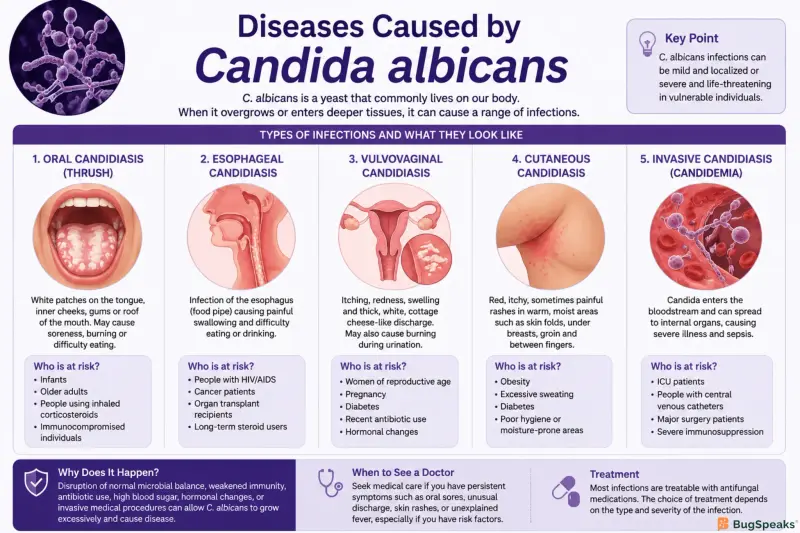
_Candida albicans causes candidiasis, which ranges from localized mucosal infections to potentially life-threatening invasive disease._\*
The clinical picture depends strongly on where the fungus is growing and whether it has invaded tissue or entered the bloodstream.
**Infection**
**Common features**
Oral candidiasis (thrush)
White plaques, soreness, burning, altered taste and discomfort when eating or swallowing
Esophageal candidiasis
Painful swallowing and difficulty swallowing; often associated with deeper immune suppression
Vulvovaginal candidiasis
Vulvar itching, irritation, soreness and abnormal vaginal discharge
Cutaneous candidiasis
Red, inflamed, itchy or painful skin, particularly in moist skin folds
Invasive candidiasis/candidemia
Fever and chills that may persist despite antibacterial treatment; severe disease can progress to sepsis and organ involvement
_C. albicans_ normally exists as a commensal organism on several human mucosal surfaces. Disease becomes more likely when factors such as antibiotic-associated disruption of the microbiota, impaired epithelial barriers, immune suppression, diabetes, or invasive medical procedures alter the balance between host and fungus.
One important biological characteristic is morphological plasticity. _C. albicans_ can grow as budding yeast cells, pseudohyphae, and true hyphae. Environmental conditions, including temperature, pH, nutrients, and host signals, can influence these forms. Hyphal growth is strongly associated with tissue invasion and pathogenicity.
**Commensal**
A microorganism that lives on or in a host without normally causing disease.
## **How is _Candida albicans_ transmitted?**
Most candidiasis results from the person's own colonizing _Candida_, although transmission between people can occur, particularly in healthcare settings.
_C. albicans_ commonly colonizes the gastrointestinal and genitourinary tracts and other mucosal surfaces. For invasive disease, the organism most often originates from these endogenous reservoirs and gains access to deeper tissues or the bloodstream when normal barriers or immune defenses are compromised.
This makes candidiasis different from infections in which exposure to an infected person is usually the primary event.
### Can Candida albicans spread between people?
Yes, but this is not generally the main explanation for candidiasis in otherwise healthy people. Person-to-person transmission has been documented, particularly in hospitals, where healthcare workers, patients, contaminated hands and medical equipment can contribute to spread.
For vulvovaginal candidiasis, sexual transmission is not considered the principal mechanism. The presence of _C. albicans_ is common, and infection generally reflects changes in the local environment and host susceptibility rather than simple exposure to an infected sexual partner.
### **What increases the risk of infection?**
Important risk factors include:
- Recent or prolonged antibiotic exposure
- Immune suppression
- Disruption of mucosal or skin barriers
- Diabetes and poor glycemic control
- Intensive medical care
- Central venous catheters and other invasive devices
- Certain surgical and critical-care conditions
The combination of colonization plus host susceptibility is therefore more important than exposure alone.
**Colonization**
Colonization is the presence and persistence of a microorganism on or in the body without causing tissue damage or clinical disease.
## **How is _Candida albicans_ diagnosed?**
Doctors diagnose _Candida albicans_ infection by examining symptoms and testing a sample from the affected area.
For common infections such as oral thrush or vaginal candidiasis, a healthcare professional may examine the affected area and collect a small sample. The sample can be examined under a microscope or grown in a laboratory culture to check for _Candida_.
Some laboratories use newer tests to identify the exact _Candida_ species more quickly. These may include molecular tests or other laboratory identification methods.
For suspected invasive candidiasis, doctors may test blood or other clinical samples. Blood culture is an important test, although it does not detect every case. Additional laboratory tests may sometimes be used along with the patient's symptoms and medical history.
### **Why is diagnosis important?**
Finding _Candida_ does not always mean that a person has an infection. The fungus can normally live on parts of the body without causing symptoms. Doctors therefore consider the test result together with the person's symptoms, the body site involved, and other clinical findings.
**Culture**
A laboratory test in which a sample is grown under controlled conditions to identify a microorganism.
## **How is _Candida albicans_ treated?**
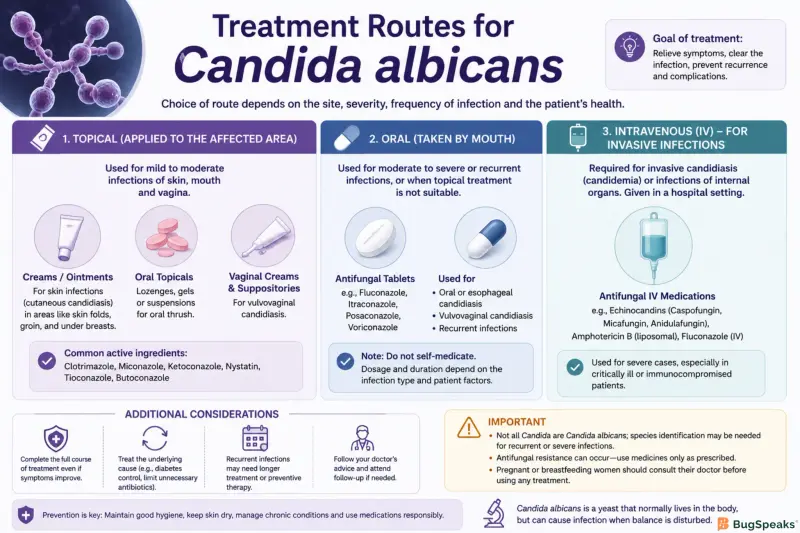
Candidiasis is treated with antifungal medicines, and the choice depends on the infection site, severity, patient factors, and susceptibility of the organism.
For localized mucosal [infections](https://www.bugspeaks.com/blog/pathobyte-series-francisella-tularensis), treatment may involve topical or oral antifungal drugs. Azole antifungals such as fluconazole are widely used in appropriate clinical situations.
In invasive candidiasis, treatment is more intensive. Echinocandins including caspofungin, micafungin and anidulafungin are commonly recommended as initial therapy for many adults with candidemia or invasive candidiasis. Fluconazole can be appropriate for selected patients when susceptibility is expected, and the clinical situation permits. Amphotericin B formulations remain important alternatives in particular circumstances.
Treatment is not simply a matter of choosing the strongest antifungal. Clinicians consider:
Site of infection
Severity of illness
Species identification
Antifungal susceptibility
Drug interactions and toxicity
Immune status and underlying conditions
Presence of medical devices or other potential sources
Antifungal resistance is an increasing clinical concern, although _C. albicans_ remains generally susceptible to many commonly used antifungal drugs. Repeated or prolonged exposure to antifungals can select for less-susceptible strains, making appropriate diagnosis and antifungal stewardship important.
Self-treatment deserves caution. Symptoms attributed to a yeast infection can have other causes, and repeated empiric antifungal use can delay the correct diagnosis.
**Antifungal**
An antifungal is a medicine that inhibits or kills fungi and is used to treat fungal infections such as candidiasis.
## **How can _Candida albicans_ infections be prevented?**
Prevention focuses on reducing avoidable risk factors, maintaining appropriate infection-control practices and managing conditions that increase susceptibility.
There is no practical need or evidence-based rationale to attempt to eliminate _C. albicans_ from every healthy person's body. Because the organism commonly exists as part of the human microbiota, prevention is primarily about reducing the circumstances that allow colonization to become disease.
### **Practical prevention measures**
Use antibiotics only when medically indicated. Broad-spectrum antibiotics can disrupt bacterial communities that contribute to colonization resistance.
Follow infection-control practices in healthcare settings. Hand hygiene and appropriate device care are important for preventing healthcare-associated infections.
Manage underlying conditions. Conditions such as diabetes can increase susceptibility to candidiasis.
Use invasive medical devices appropriately. Catheters and other devices can provide opportunities for invasive infection.
Seek an accurate diagnosis for recurrent symptoms. Repeated treatment without confirming the cause can miss other conditions and contribute to unnecessary antifungal exposure.
For recurrent vulvovaginal candidiasis, seek medical evaluation. Recurrent disease may require confirmation of the species and a longer-term management strategy.
Evidence for probiotics as a way to prevent recurrent vulvovaginal candidiasis remains mixed and insufficient to treat them as a proven standalone preventive measure. For invasive candidiasis, standard infection-control measures remain central to prevention.
**Infection Control**
Infection control comprises practices used to reduce the spread or development of infections, including hand hygiene, appropriate device care, and responsible antimicrobial use.
## **What is the _Candida albicans_ microbe profile?**
_Candida albicans is a Gram-positive-staining, nonmotile, budding yeast that can switch between yeast, pseudohyphal, and true-hyphal forms and can produce chlamydospores under specific conditions._\*
**Field**
**_Candida albicans_**
Gram status
Gram-positive staining
Shape
Oval to spherical budding yeast; can form pseudohyphae and true hyphae
Spore formation
No conventional reproductive spores; can form thick-walled chlamydospores under specific conditions
Motile
No
Oxygen requirements
Facultatively anaerobic
Optimum temperature
Approximately 37°C for growth in the human-host context; morphology is temperature-dependent
Optimum pH
Approximately pH 6–7 for active growth, with substantial tolerance across a broader pH range
The term "Gram-positive" needs some context: Gram staining is primarily a bacterial classification method, but _Candida_ cells generally stain purple because of their cell-wall properties. Microscopy and culture characteristics are not sufficient by themselves for definitive species identification.
Its morphology is particularly distinctive. Under suitable conditions, _C. albicans_ produces germ tubes and true hyphae; under other conditions it grows predominantly as budding yeast. Chlamydospores are thick-walled structures that can be induced under particular laboratory conditions, but they should not be confused with the reproductive spores produced by many molds.
Hypha
An elongated filamentous fungal structure; _C. albicans_ can produce true hyphae during filamentous growth.
Pseudohypha
A chain of elongated yeast cells that remains connected, with constrictions at the junctions between cells.
Chlamydospore
A thick-walled, specialized resting structure produced by some fungi, including _C. albicans_ under particular environmental conditions.
## **What should you remember about _Candida albicans_?**
_Candida albicans_ is both a normal human colonizer and an important opportunistic pathogen. Its ability to change morphology, adhere to tissues, form biofilms, and respond to changes in its environment contributes to its clinical versatility.
The most useful distinction for consumers is colonization versus infection. The presence of _Candida_ is not automatically a sign of illness, and nonspecific symptoms should not be attributed to "Candida overgrowth" without appropriate clinical evaluation. A healthy body can carry _C. albicans_ without symptoms; disease develops when host and microbial factors permit the organism to cause tissue damage or invade normally protected sites.
Opportunistic pathogen
A microorganism that can cause disease when the body's normal defenses or barriers are weakened or disrupted.
### Reference
[Pathogenesis and virulence of Candida albicans review](https://pubmed.ncbi.nlm.nih.gov/34964702/?utm_source=chatgpt.com) ( [PubMed](https://pubmed.ncbi.nlm.nih.gov/34964702/?utm_source=chatgpt.com))
[Candida albicans systematic review for the WHO Fungal Priority Pathogens List](https://pubmed.ncbi.nlm.nih.gov/38935906/?utm_source=chatgpt.com) ( [PubMed](https://pubmed.ncbi.nlm.nih.gov/38935906/?utm_source=chatgpt.com))
[Diagnosing Invasive Candidiasis review](https://pmc.ncbi.nlm.nih.gov/articles/PMC5925725/?utm_source=chatgpt.com) ( [PubMed Central (PMC)](https://pmc.ncbi.nlm.nih.gov/articles/PMC5925725/?utm_source=chatgpt.com))
[Invasive candidiasis Nature Reviews Disease Primers](https://www.nature.com/articles/s41572-024-00503-3?utm_source=chatgpt.com) ( [Nature](https://www.nature.com/articles/s41572-024-00503-3?utm_source=chatgpt.com))
[The Role of Host and Fungal Factors in the Commensal-to-Pathogen Transition of Candida albicans review](https://pmc.ncbi.nlm.nih.gov/articles/PMC10154278/?utm_source=chatgpt.com) ( [PubMed Central (PMC)](https://pmc.ncbi.nlm.nih.gov/articles/PMC10154278/?utm_source=chatgpt.com))
## FAQs
Q: Is Candida albicans a bacterium?
A: No, Candida albicans is a fungus, specifically a yeast-forming fungus. It is therefore biologically distinct from bacteria and is treated with antifungal rather than antibacterial medicines.
Q: Is Candida albicans normally found in the human body?
A: Yes, C. albicans commonly colonizes humans without causing disease. It can be found on mucosal surfaces including the oral, gastrointestinal and genital tracts and can also occur on skin.
Q: Is Candida albicans contagious?
A: Usually, candidiasis results from the person's own colonizing Candida rather than direct transmission from another person. Person-to-person transmission can occur, particularly in healthcare environments, but it is not the usual explanation for candidiasis.
Q: Can Candida albicans cause serious disease?
A: Yes, particularly when host defenses or anatomical barriers are compromised. Invasive candidiasis can enter the bloodstream and affect internal organs, making it a serious medical condition.
Q: Does having Candida albicans mean I have a Candida infection?
A: No, detecting C. albicans does not by itself establish an infection. Colonization is common, so diagnosis depends on the anatomical site, symptoms, clinical findings and appropriate laboratory evidence.
---
This blog is powered by Superblog. Visit https://superblog.ai to know more.
---