Brucella abortus is a stealthy bacterium that caused historical medical mysteries until Alice Evans proved it links sick cows to human Malta fever. As an obligate intracellular pathogen, it cannot survive long outside a host. Instead, it targets pregnant cattle due to a massive craving for the sugar erythritol, causing devastating reproductive failure. When engulfed by immune macrophages, it injects proteins to create a safe vacuole, silently multiplying and evading destruction. Science fights back using rapid Rose Bengal tests and the Strain 19 vaccine, which lacks the ability to eat erythritol. Today, researchers engineer its surface to create better vaccines.
How Did a Tiny, Sneaky Germ Trick the World's Smartest Scientists?
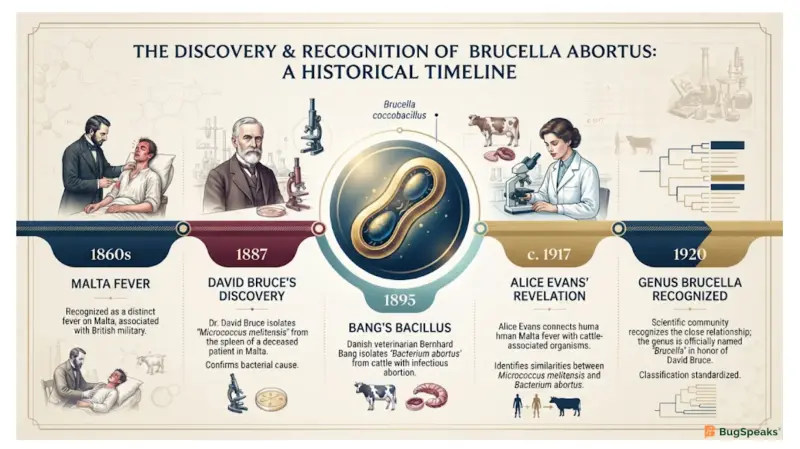
Have you ever heard of a tiny bacterium that managed to fool scientists for over thirty years? Back in the late eighteen hundreds, doctors found a strange germ causing a severe sickness called Malta fever that went up and down. A military doctor named David Bruce discovered this tiny circular invader inside sick soldiers. At the exact same time, a totally different scientist named Bernhard Bang found a germ making farm cows sick over in Denmark. Everyone thought these two germs were completely unrelated. They looked slightly different and caused different problems. It was a massive medical mystery. This sneaky pathogen tricked the best medical minds.
For a very long time, nobody connected the dots between the sick cows and the sick soldiers. That all changed when a brilliant American scientist named Alice Evans started investigating. She worked for the agriculture department and decided to look more closely at both germs. She carefully studied how they grew and what they looked like under a microscope. Despite facing unfair doubts because she was a woman without a traditional medical degree, she proved everyone wrong. She discovered that both germs were practically identical. Her amazing work proved that drinking raw milk from sick cows was actually causing the strange human illness across oceans.
Because of her incredible discovery, scientists finally realized they were dealing with one huge global problem. In nineteen twenty, important experts officially grouped these sneaky germs together into a brand new family. They named this family of germs after Sir David Bruce to honor his early discovery on the island. This is how the name we use today was officially born. The specific germ that causes cattle to lose their babies became known worldwide as our featured villain today. It is truly amazing how one clever researcher connected a mysterious island illness to common farm animals, solving a giant global medical puzzle forever.
Why Does This Invader Need a Mammal to Survive and Grow?
Unlike many normal germs found in dirt or water, this particular invader cannot survive out in the open environment for very long. It is essentially an obligate partner to disaster, meaning it absolutely must live inside a living host to survive. It cannot swim away from danger or build tough armor to protect itself from drying out. Instead, its entire life goal is to enter a mammal, hide deep inside, and steal nutrients. When it enters a cow or a human, it immediately starts searching for the perfect neighborhood to settle down. It specifically targets the reproductive organs because it loves the local food.
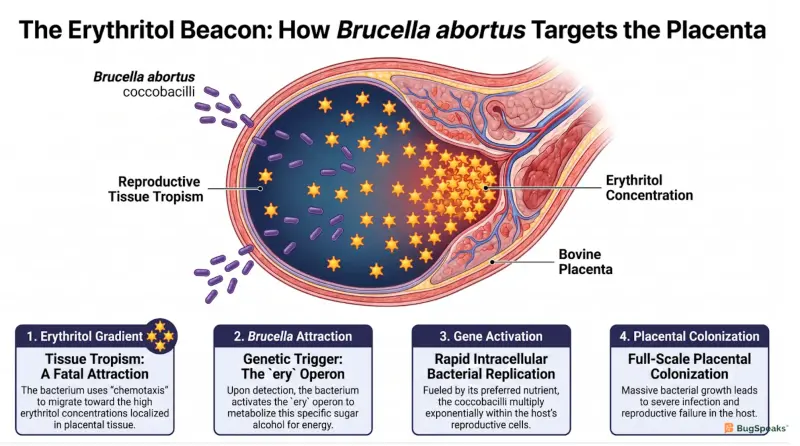
This germ has a massive sweet tooth for a very specific type of sugar. While most normal bacteria prefer common sugars like glucose to get their energy, this germ craves a special four-carbon sugar called a polyol. The exact name of this sweet treat is erythritol. This special nutrient is found in huge amounts inside pregnant cows. Because the germ is so hungry for this specific sugar, it rapidly invades these tissues to feed. This extreme attraction to a specific tissue is called tropism. The bacteria eat the sugar, multiply quickly, and cause terrible infections that make cows lose their unborn calves very suddenly.
Humans can also get very sick if they accidentally invite this hungry germ inside their bodies. The most common way people get infected is by drinking unpasteurized milk from sick animals. Once inside a human, the disease causes severe night sweats, terrible muscle aches, and a high temperature that constantly goes up and down over many weeks. Because the germ hides deep inside the human body parts like the liver and bones, the sickness can last for a very long time. It is a highly dangerous infection that requires intensive medicine and careful treatment from expert doctors to completely clear it away forever.
How Does This Sneaky Germ Hide Inside Our Immune System?
When dangerous germs enter our bodies, our immune system sends out special guard cells to eat the invaders. The most important guard cell is the macrophage, which literally means big eater. Usually, when this giant guard cell eats a germ, it traps the invader in a cellular stomach and destroys it with strong acids. However, this brilliant microbe has a secret weapon. Instead of panicking when it gets eaten, it actually wants to be swallowed by the guard cell! It intentionally gets scooped up so it can build a hidden fortress safely inside the very cell that was supposed to destroy it completely forever.
Once trapped inside the guard cell, the germ rests in a bubble called an endosome. This bubble normally fills with acid to dissolve the germ. But when the acid levels drop, the germ uses the sour acid as a signal to activate its survival tools. It deploys a molecular syringe to inject special proteins into the human cell. These proteins trick the host cell into moving the bubble away from the danger zone. It navigates to a safe spot near the cell factory where there is plenty of food and absolutely zero acid, creating a perfect permanent hideout to start multiplying extremely rapidly.
This safe, newly formed bubble is technically known as a vacuole, and it becomes a cozy indoor swimming pool for the germ. Because the outer skin of the germ is strangely smooth and stealthy, the cell alarms never ring. The germ silently replicates until the guard cell is completely stuffed full of new bacteria. Finally, the cell bursts open, releasing thousands of new invaders to attack neighboring cells. This incredible stealth ability is why this disease is so hard to cure. The immune system simply cannot find the germs while they are happily camping inside the very cells meant to fight them!
[Gets Eaten by Macrophage] ──► [Senses Acid Drop in Endosome] ──► [Injects Secret Proteins] ──► [Hides Safe in Vacuole]
How Did Scientists Create Cures for the Sneaky Farm Invader?
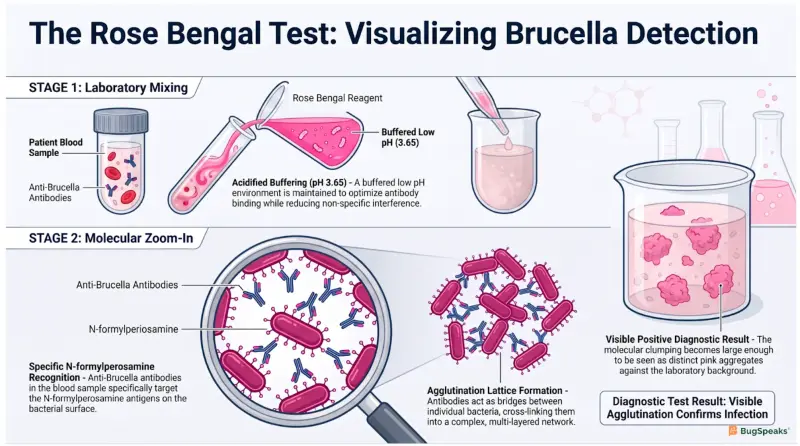
To stop this farm sickness from spreading, scientists had to invent very clever tests. One brilliant test uses a special pink dye called Rose Bengal. Doctors mix this acidic pink dye with blood from a sick animal. If the animal is infected, their immune system will have created an antibody to fight it. These tiny protein defenders grab onto the pink germs and clump them all together into visible pink dots. This quick card test allows farmers and doctors to instantly see if an animal is infected right in the field, helping them isolate sick cows before the disease spreads much further today.
Besides testing, the greatest victory against this germ was the creation of a weakened version used to train immune systems. In nineteen twenty three, a researcher discovered a naturally weak strain called Strain Nineteen. This incredible mutated germ was missing the exact genes needed to eat its favorite sugar. Because it could not digest its preferred meal, it could not cause major illness in cows. It served as the perfect vaccine to safely teach the immune system what the invader looked like. This one amazing discovery helped farmers around the entire globe save millions of cows from this terrible reproductive animal disease forever.
Modern scientists are still improving these medical tools by physically changing the outer skin of the germ. A typical germ is covered in a sugar coating called an antigen, which acts like a nametag. Scientists eventually created mutant versions of the germ that completely lacked this specific sugar nametag. By using a germ without a nametag for medicine, doctors can easily tell the difference between a naturally sick cow and a vaccinated cow when they test the blood. This brilliant trick is helping countries eliminate the tricky sickness from their farming lands for good, protecting both animals and humans very safely today.
How Are Modern Scientists Sorting Out This Microscopic Family Tree?
Today, researchers have incredible tools to study exactly how these tricky germs are built. Instead of just looking through a basic microscope, they read the entire genome, which is the complete instruction manual of the bacteria. They discovered something super weird about this pathogen. Instead of having just one instruction book like most normal bacteria, it actually has two separate circular books of DNA! Scientists believe having two separate books gives the germ a huge advantage. It allows the germ to keep its basic survival instructions safe in one book while placing special invasion tools in the second book for very quick access every day.
By reading these genetic instruction manuals, scientists found that our dangerous germ is secretly related to harmless dirt bugs! These soil bacteria are so genetically similar that a single small mutation could explain their differences. Because their DNA looks almost exactly the same, some scientists recently tried to combine them into one single family name. However, medical experts strongly disagreed. They argued that calling a harmless dirt bug by the same name as a dangerous biological weapon would confuse hospital laboratories. Mixing up the names could cause terrible accidents and slow down the treatment of deeply sick human patients safely everywhere today.
The people whose job is to name and organize living things are known as taxonomists, and they face a tough challenge. A good taxonomist knows that biology is about more than just matching letters of DNA. They have to consider how a germ actually behaves in the real world. A bug that peacefully helps plants grow in the garden is fundamentally different from a stealthy predator that aggressively attacks pregnant cows and humans. By understanding these vital differences, modern science continues to protect our farms and our families from the sneaky, invisible dangers hiding right under our very own high-powered microscopes today!
Taxonomic Classification Table
Microbe Profile
Shape: Coccobacilli (short, rounded rods), typically measuring approximately 0.6 to 1.5 μm in length and 0.5 to 0.7 μm in width.
Gram Stain Nature: Gram-negative with a complex, atypical cell envelope.
Spore-forming: Non-spore-forming.
Biofilm formation: Capable of auto-aggregation and biofilm-like formation under specific stress conditions.
Oxygen requirements: Aerobic and capnophilic during primary isolation (frequently requires 5–10% added CO2).
Optimal Temp: 37°C for optimal growth and whole-cell viability (mesophilic).
Optimal pH: 6.6 to 7.4. Growth is severely inhibited below 4.1 to 4.5.
Nutrient Usage: Chemoorganotrophic, possessing a massive preference for the four-carbon polyol erythritol over standard hexoses like glucose.
Fun Facts
Overcoming Gender Bias in Science: When Alice C. Evans first proposed in 1918 that the bacterium causing contagious abortion in cattle was practically identical to the one causing deadly Malta fever in humans, her groundbreaking findings were largely dismissed due to the intense sexism of the era.
A Lethal "Sweet Tooth": The bacterium's devastating preference for infecting the reproductive organs of cattle is driven by a massive craving for erythritol, a sugar alcohol highly concentrated in the bovine placenta and fetal fluids.
Friendly Fire in the Immune System: Rather than fighting off the immune system's frontline soldiers (neutrophils), Brucella quietly drops fragments of its own lipopolysaccharide to trigger the neutrophils to prematurely self-destruct without causing a massive inflammatory alarm.
Reference
Zavattieri, L., Muñoz González, F., Ferrero, M. C., & Baldi, P. C. (2023). Immune Responses Potentially Involved in the Gestational Complications of Brucella Infection. Pathogens, 12(12), 1450. https://doi.org/10.3390/pathogens12121450
Xiao, Y., Li, M., Guo, X., Zeng, H., Shuai, X., Guo, J., Huang, Q., Chu, Y., Zhou, B., Wen, J., Liu, J., & Jiao, H. (2022). Inflammatory Mechanism of Brucella Infection in Placental Trophoblast Cells. International journal of molecular sciences, 23(21), 13417. https://doi.org/10.3390/ijms232113417
Mancilla M. (2016). Smooth to Rough Dissociation in Brucella: The Missing Link to Virulence. Frontiers in cellular and infection microbiology, 5, 98. https://doi.org/10.3389/fcimb.2015.00098
Lorenzo, J. M., Munekata, P. E., Dominguez, R., Pateiro, M., Saraiva, J. A., & Franco, D. (2018). Main Groups of Microorganisms of Relevance for Food Safety and Stability: General Aspects and Overall Description. Innovative Technologies for Food Preservation, 53–107. https://doi.org/10.1016/B978-0-12-811031-7.00003-0
Golshani, M., & Buozari, S. (2017). A review of Brucellosis in Iran: Epidemiology, Risk Factors, Diagnosis, Control, and Prevention. Iranian biomedical journal, 21(6), 349–359. https://doi.org/10.18869/acadpub.ibj.21.6.349
Al-Tamimi, M., Altarawneh, S., Mustafa, M. A., El-Sallaq, M., & Shihab, P. (2024). Quantitative and equipment-free paper-based agglutination assay of bacterial cells. RSC advances, 14(29), 20516–20528. https://doi.org/10.1039/d4ra03001j
Mugizi, D. R., Muradrasoli, S., Boqvist, S., Erume, J., Nasinyama, G. W., Waiswa, C., Mboowa, G., Klint, M., & Magnusson, U. (2015). Isolation and molecular characterization of Brucella isolates in cattle milk in Uganda. BioMed research international, 2015, 720413. https://doi.org/10.1155/2015/720413
Dabral, N., Burcham, G. N., Jain-Gupta, N., Sriranganathan, N., & Vemulapalli, R. (2019). Overexpression of wbkF gene in Brucella abortus RB51WboA leads to increased O-polysaccharide expression and enhanced vaccine efficacy against B. abortus 2308, B. melitensis 16M, and B. suis 1330 in a murine brucellosis model. PloS one, 14(3), e0213587. https://doi.org/10.1371/journal.pone.0213587
Stranahan, L. W., & Arenas-Gamboa, A. M. (2021). When the Going Gets Rough: The Significance of Brucella Lipopolysaccharide Phenotype in Host-Pathogen Interactions. Frontiers in microbiology, 12, 713157. https://doi.org/10.3389/fmicb.2021.713157
Barquero-Calvo, E., Mora-Cartín, R., Arce-Gorvel, V., de Diego, J. L., Chacón-Díaz, C., Chaves-Olarte, E., Guzmán-Verri, C., Buret, A. G., Gorvel, J. P., & Moreno, E. (2015). Brucella abortus Induces the Premature Death of Human Neutrophils through the Action of Its Lipopolysaccharide. PLoS pathogens, 11(5), e1004853. https://doi.org/10.1371/journal.ppat.1004853