This thrilling blog post explores the terrifying rise of Acinetobacter baumannii, a sneaky superbug that transformed from a harmless soil microbe into a global hospital menace. It survives for weeks on dry medical equipment, patiently waiting to attack weakened patients in intensive care units. To protect itself, the bacteria build incredibly thick, sticky biofilm fortresses and rapidly steal genetic codes from other germs to become resistant to almost every known medicine. While this extreme pan-drug resistance has created a critical global health crisis, modern scientists are finally fighting back, developing groundbreaking new drugs like Zosurabalpin to destroy this unstoppable invader.
How Did a Quiet Soil Microbe Become a Global Hospital Menace?
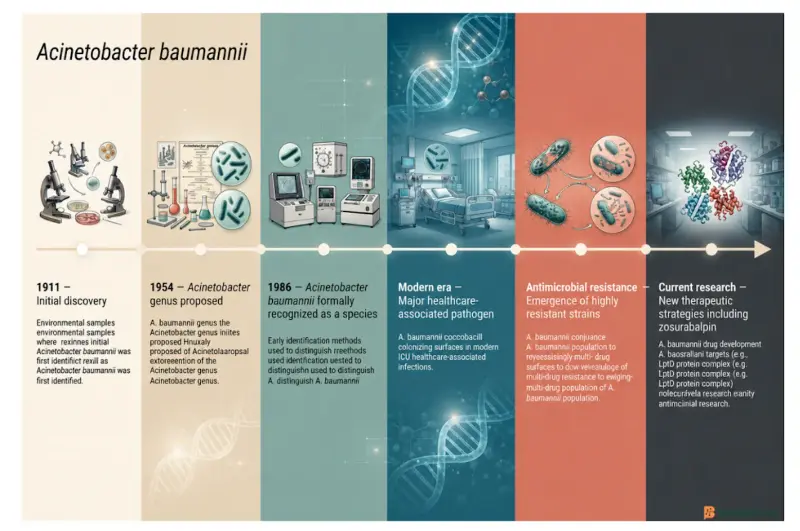
Let us dive into the surprising history of this incredible microscopic organism. The germ we are studying today is a tough, round little rod called a coccobacillus. The famous Dutch scientist Martinus Beijerinck first discovered this tiny microbe hiding in a simple soil sample way back in the year nineteen eleven. At that time, nobody knew how dangerous it would eventually become. It was just a harmless germ quietly living in the dirt, completely ignored by the busy medical doctors of the world. It spent its early days breaking down natural compounds, remaining entirely peaceful and perfectly safe for everyone.
For many decades, scientists were incredibly confused by this sneaky little germ. Because it looked like so many other bacteria, researchers kept giving it totally different names, creating a giant puzzle in the scientific records. This chaotic naming process, which scientists call taxonomy, made it extremely difficult to track the germ properly. Finally, in 1944, two smart French researchers proposed a brand new genus named Acinetobacter. They chose this special word from an ancient Greek term meaning not mobile. They believed this specific group of germs could not move around like other fast bacteria in their natural environment.
It took until the year nineteen eighty-six for this massive mystery to be fully solved. Brilliant French experts used advanced tests to look deep inside the genetic material of the germs. They officially declared Acinetobacter baumannii as a completely unique species within its complex family tree. They named it to honor Paul Baumann, a wonderful scientist who helped organize the messy bacterial records. Today, this specific germ is famous for completely transforming from a quiet soil dweller into a highly dangerous hospital invader, causing tremendous panic. It has truly become one of the most stubborn medical challenges facing humanity worldwide.
How Does This Ultimate Survivor Thrive on Completely Dry Surfaces?
This amazing bacterium is an incredibly tough survivor that thrives in the harshest environments imaginable. While some germs rely completely on a host body to survive, this bug is an opportunistic pathogen. This means it waits patiently for the perfect chance to strike when a person is already sick or severely weak. It rarely infects healthy people living normal daily lives outside. Instead, it has evolved beautifully to dominate modern intensive care units inside hospitals. There, it can easily find weakened patients who have tragically lost their natural immune defenses, making them the perfect targets for this silent, invisible microbial attacker.
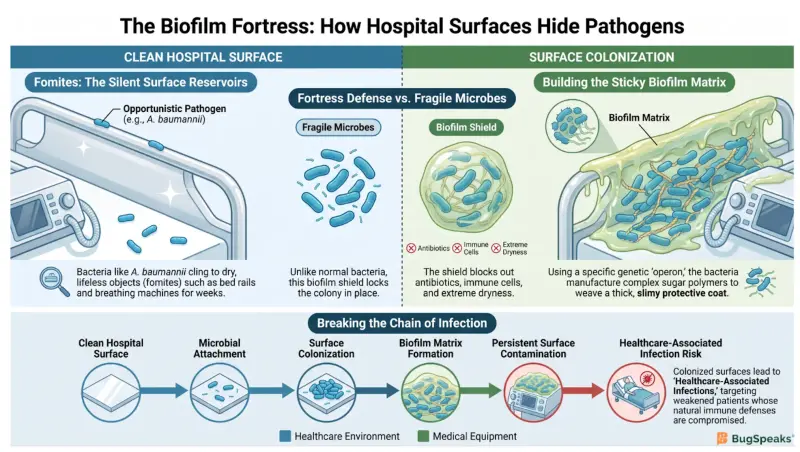
One of its most terrifying superpowers is its extreme resistance to severe dryness, a complex biological process scientists call desiccation. Unlike fragile bugs that dry up and die quickly without any moisture, this germ can survive for many consecutive weeks on completely dry surfaces. Inside a busy hospital, it clings easily to dry, lifeless objects known as fomites. These objects include common things like metal bed rails, plastic charting boards, and expensive mechanical breathing machines. By resting quietly on these everyday items, the bacteria can easily catch a ride from one hospital room to another without ever being noticed.
Because hospitals frequently use powerful medicines to destroy other competing bacteria, this clever bug quickly steps into the empty space to take absolute control. It begins by quietly covering the skin and breathing tubes of sick patients, a fast process known as colonizing. Once it establishes a strong biological foothold inside a patient, it can cause severe bloodstream infections and dangerous breathing problems. It absolutely loves the artificial environments we create inside health centers! It survives there by scavenging tiny leftover amounts of nutrients, proving that it thrives brilliantly by exploiting our very own medical equipment against us every single day.
Why Does This Bug Build a Sticky, Impenetrable Fortress to Protect Itself?
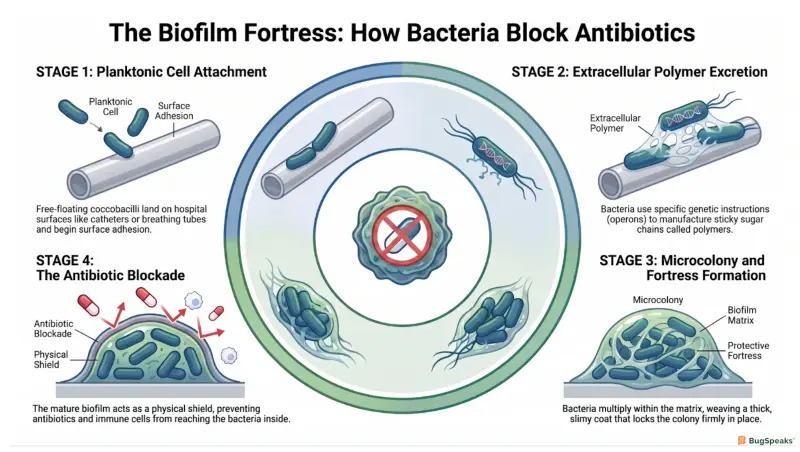
Instead of drilling physically into our bodies, this pathogen builds an incredibly powerful fortress called a biofilm. To create this sticky, protective shield, the germ uses a very special genetic instruction manual called an operon. This unique genetic code directs the bacteria to manufacture complex chains of heavy sugars, which smart scientists call polymers. These sticky sugar chains weave together seamlessly into a thick, slimy coat that completely covers the entire bacterial colony. This impressive microscopic shield locks the germs firmly onto dangerous medical breathing tubes and plastic catheters, ensuring they can never be easily washed or scrubbed away today.
Once the fortress is beautifully built, the germs depend heavily on special outer membrane proteins to strengthen the thick walls and attach strongly to vulnerable human cells. Even stranger, while early scientists incorrectly thought this germ could not move, modern microscopic cameras have revealed a shocking truth. The bug actually exhibits a creepy type of movement known as twitching motility. By extending and rapidly pulling back tiny hair-like arms called pili, the bacteria can smoothly glide across solid plastic surfaces. This brilliant sliding motion allows the deadly colony to spread outward rapidly, capturing significantly more territory inside a busy hospital.
This sneaky germ also has a brilliant trick for surviving deep inside infected human tissues where there is almost no breathable air available. When precious oxygen levels drop dangerously low, creating a harsh condition called anoxia, the bacteria do not panic and die. Instead, they quickly power down their biological engines and enter a long, incredibly deep sleep. By pausing their normal metabolic growth and simply waiting inside the slimy fortress walls, they easily survive until the local conditions finally improve. It is an amazing biological strategy that turns a supposedly simple microbe into an absolutely unstoppable microscopic biological tank!
[Step 1: Attach to Hospital Surface] ──► [Step 2: Produce Sticky Sugar Matrix] ──► [Step 3: Build Protective Biofilm Fortress] ──► [Step 4: Block Antibiotics and Human Immune Cells]
How Did This Stealthy Invader Become Resistant to Almost Every Known Medicine?
The real story of this modern pathogen focuses entirely on the terrifying failure of our current medicine! In the past, early doctors confidently dreamed of finding perfect chemical medicines to cure every single infection easily. For a short time during the nineteen seventies, this hospital germ was easily defeated by standard antibiotics. However, the bug soon developed an incredible ability to steal secret genetic codes from other surrounding bacteria. It grabs these floating defensive blueprints, which are often stored on small DNA rings called plasmids, and shares them rapidly through a direct physical connection process famously named biological conjugation today.
Because it steals these secret defensive codes so incredibly quickly, the bacteria can build powerful molecular weapons. It creates tiny chemical machines called enzymes that physically chew up and destroy our very best medicines before they can even start working! If any potent drugs do manage to slip inside the tough bacterial cell wall, the germ uses a second amazing defense system. It builds powerful molecular vacuum cleaners known universally as efflux pumps. These microscopic pumps actively push out vast amounts of dangerous drugs, including heavy chemical weapons like macrolides, exactly like panicked sailors tossing water from a sinking ship!
Today, this terrifying ability to evolve rapidly has created mutant strains that show a completely pan-drug-resistant nature, meaning almost every single medicine we have is totally useless against them. The World Health Organization has officially named this specific pathogen as a critical global priority. Doctors desperately need completely new strategies because our traditional medical treatments simply do not work anymore. To fight back, international health groups are heavily focused on preventing infections entirely and funding intense global surveillance systems. By actively watching how the germ spreads globally, scientists hope to buy us enough precious time to invent modern cures.
Can a Groundbreaking New Medicine Finally Defeat This Unstoppable Pathogen?
After fifty long years of frustrating scientific failures, modern researchers have finally discovered a brand new weakness inside this superbug! Because traditional medicines kept failing, scientists examined the complex biogenesis of the germ itself. This means they studied exactly how the bacteria build their protective outer shells step by step. They discovered that the bugs must transport giant fats and sugars, called macromolecules, from deep inside their inner jelly-like center, known as the cytoplasm, all the way to the outer skin. If the bacteria cannot move these large building blocks outward successfully, their protective outer walls will become incredibly weak.
To exploit this hidden structural weakness, scientists invented an amazing new experimental drug called Zosurabalpin. This brilliant medicine is a special type of chemical chain known as a peptide. When it enters the microscopic battlefield, it aggressively jams the tiny molecular bridges that transport those building blocks, creating a massive biological traffic jam! The toxic building materials quickly pile up inside the germ, destroying it from the inside out. This makes the revolutionary drug highly bactericidal, meaning it actively kills the bug completely. Furthermore, early tests reveal it has an excellent pharmacokinetic profile, traveling safely through the human body.
Amazingly, while clinical doctors fight this terrible bug, environmental scientists are trying to use its tough cousins for global good! Specific environmental strains show an incredible talent for bioremediation, meaning they can literally eat hazardous pollution like thick crude oil and dangerous agricultural pesticides. By deploying these hungry germs to clean up toxic chemical waste, known as xenobiotics, scientists hope to heal damaged ecosystems entirely. However, deploying large groups of these living germs, called consortia, is very risky because they still carry hidden dangerous traits. Solving this final dilemma is the next great frontier in microscopic biological science happening today!
Taxonomic Classification Table
Microbe Profile
Shape: Coccobacillus (short, almost round rod).
Gram Stain Nature: Gram-negative (features a complex envelope with lipopolysaccharides).
Spore-forming: Non-spore-forming.
Biofilm formation: Highly proficient (forms robust biofilms mediated by the csu operon and OmpA).
Oxygen requirements: Strictly aerobic (can survive hypoxia in dormancy).
Optimal Temp: 37°C (can grow at elevated temperatures up to 44°C).
Optimal pH: Neutral pH of 7.0 (can survive at pH 5 for bioremediation).
Nutrient Usage: Non-fermenting and non-fastidious (uses amino acids, xenobiotics, and complex hydrocarbons).
Fun Facts
The "Iraqibacter" Menace: It earned this scary nickname after causing severe, multidrug-resistant infections among soldiers returning from Iraq and Afghanistan in the early 2000s!
The Motility Paradox: Although its name literally means "not mobile" in Greek, it actually uses a creepy "twitching" and "swarming" technique to glide smoothly across hospital surfaces!
The Master DNA Thief: It is a "natural transformant," meaning it can actively snatch free-floating, naked DNA from dead bacteria and instantly plug those genetic secrets into its own blueprint!
Reference
Lin, M. F., & Lan, C. Y. (2014). Antimicrobial resistance in Acinetobacter baumannii: From bench to bedside. World journal of clinical cases, 2(12), 787–814. https://doi.org/10.12998/wjcc.v2.i12.787
Peleg, A. Y., Seifert, H., & Paterson, D. L. (2008). Acinetobacter baumannii: emergence of a successful pathogen. Clinical microbiology reviews, 21(3), 538–582. https://doi.org/10.1128/CMR.00058-07
Ayoub Moubareck, C., & Hammoudi Halat, D. (2020). Insights into Acinetobacter baumannii: A Review of Microbiological, Virulence, and Resistance Traits in a Threatening Nosocomial Pathogen. Antibiotics (Basel, Switzerland), 9(3), 119. https://doi.org/10.3390/antibiotics9030119
Kubin, C. J., Garzia, C., & Uhlemann, A.-C. (2025). Acinetobacter baumannii treatment strategies: a review of therapeutic challenges and considerations. Antimicrobial agents and chemotherapy, 69(8), e0106324. https://doi.org/10.1128/aac.01063-24
Sati, H., Carrara, E., Savoldi, A., Hansen, P., Garlasco, J., Campagnaro, E., Boccia, S., Castillo-Polo, J. A., Magrini, E., Garcia-Vello, P., Wool, E., Gigante, V., Duffy, E., Cassini, A., Huttner, B., Pardo, P. R., Naghavi, M., Mirzayev, F., Zignol, M., Cameron, A., … WHO Bacterial Priority Pathogens List Advisory Group (2025). The WHO Bacterial Priority Pathogens List 2024: a prioritisation study to guide research, development, and public health strategies against antimicrobial resistance. The Lancet. Infectious diseases, 25(9), 1033–1043. https://doi.org/10.1016/S1473-3099(25)00118-5
Stoian, I. A., Balas Maftei, B., Florea, C. E., Rotaru, A., Costin, C. A., Pasare, M. A., Crisan Dabija, R., & Manciuc, C. (2025). Multidrug-Resistant Acinetobacter baumannii: Resistance Mechanisms, Emerging Therapies, and Prevention-A Narrative Review. Antibiotics (Basel, Switzerland), 15(1), 2. https://doi.org/10.3390/antibiotics15010002
Howard, A., O'Donoghue, M., Feeney, A., & Sleator, R. D. (2012). Acinetobacter baumannii: an emerging opportunistic pathogen. Virulence, 3(3), 243–250. https://doi.org/10.4161/viru.19700
Tayabali, A. F., Dirieh, Y., Groulx, E., Elfarawi, N., Di Fruscio, S., Melanson, K., Moteshareie, H., Al-Gafari, M., Navarro, M., Bernatchez, S., Demissie, Z., & Anoop, V. (2024). Survival and virulence of Acinetobacter baumannii in microbial mixtures. BMC microbiology, 24(1), 324. https://doi.org/10.1186/s12866-024-03471-6Shaker, R. A. E., Nagy, Y. I., Adly, M. E., Khattab, R. A., & Ragab, Y. M. (2022). Acinetobacter baumannii, Klebsiella pneumoniae and Elizabethkingia miricola isolated from wastewater have biodegradable activity against fluoroquinolone. World journal of microbiology & biotechnology, 38(11), 187. https://doi.org/10.1007/s11274-022-03367-5
Wang, R., Wang, J., Wang, L., Cai, Y., Wang, Y., Luo, H., Chen, B., Chen, J., Fang, J., & Song, Z. (2025). A novel eco-friendly Acinetobacter strain A1-4-2 for bioremediation of aquatic pollutants. Scientific reports, 15(1), 23207. https://doi.org/10.1038/s41598-025-05431-0