# Parkinson’s Disease and the Gut: Understanding the Gut-Brain Connection
Author: Neha Rao
Author URL: https://www.bugspeaks.com/blog/author/neha-rao
Published: 2026-08-26
Category: Microbiome and Disease
Category URL: https://www.bugspeaks.com/blog/category/microbiome-and-disease
Meta Title: Parkinson’s Disease and the Gut-Brain Axis | BugSpeaks
Meta Description: Discover the Parkinson’s disease gut microbiome link, alpha-synuclein, and vagus nerve pathways. Explore emerging gut-brain research and key insights today.
Tags: Gut Health, gut-brain axis, Parkinson’s Disease
Tag URLs: Gut Health (https://www.bugspeaks.com/blog/tag/gut-health), gut-brain axis (https://www.bugspeaks.com/blog/tag/gut-brain-axis), Parkinson’s Disease (https://www.bugspeaks.com/blog/tag/parkinsons-disease)
URL: https://www.bugspeaks.com/blog/parkinsons-disease-gut-brain-connection
## Why do scientists think Parkinson's disease starts in the gut?
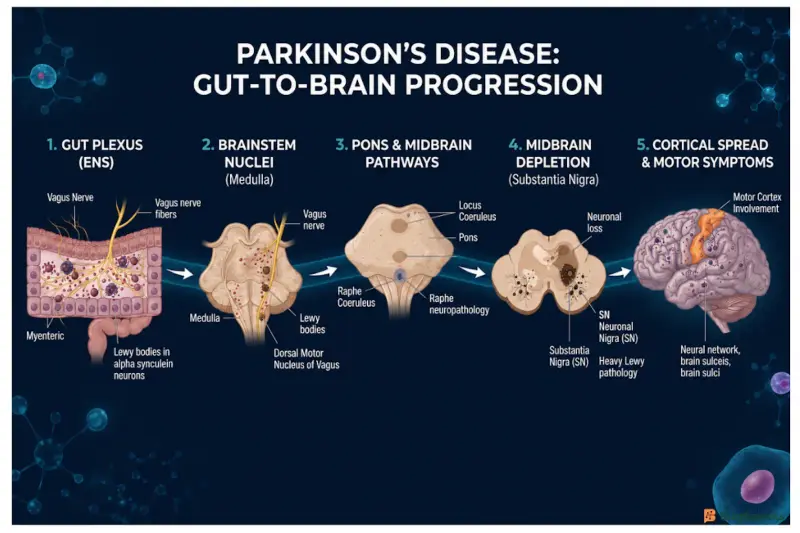
Scientists believe Parkinson's Disease (PD) begins in the [gut](https://www.bugspeaks.com/blog/thyroid-gut-health-hashimoto) because abnormal proteins like alpha-synuclein clump together inside your gut nerves decades before any brain symptoms ever appear. Instead of striking the brain first, this early gut clumping serves as the starting step on a five-part biological ladder that the disease slowly climbs long before any movement problems appear. Your gut wall is packed with millions of tiny nerve cells that help manage digestion without you thinking about it [Manfredsson (2018)](https://doi.org/10.1016/j.nbd.2018.01.008). When bad bacteria in your gut make toxic chemicals, the proteins in these gut nerves fold the wrong way and form sticky piles. These sticky piles are the very first biological changes linked to this disease, starting a slow climb toward the brain.
The millions of nerves lining your digestive system make up the Enteric Nervous System (ENS), which acts as the bottom step of our ladder. Because these nerves are always exposed to digested food and bacteria, they are highly vulnerable to damage from a messy gut environment. Normally, these cells carry messages smoothly, but when a toxic molecule touches them, a common protein called alpha-synuclein changes shape and clumps together [Manfredsson (2018)](https://doi.org/10.1016/j.nbd.2018.01.008). This shape change makes the proteins sticky, so they group into tiny clumps that damage the nerve. Over many years, these aggregates slowly prepare to move out of the gut.
To climb up to the brain, the sticky proteins use a physical pathway called the vagus nerve, which is a long wire connecting your gut directly to your head. This long wire allows the damage on the bottom of the ladder to slowly creep upward toward the next step [Svensson (2015)](https://doi.org/10.1002/ana.24448). Scientists discovered this direct link by studying patients who had their vagus nerve cut for other medical reasons [Svensson (2015)](https://doi.org/10.1002/ana.24448). These patients had a much lower risk of getting Parkinson's, showing that cutting the physical pathway acts like removing the ladder and blocking the abnormal proteins from reaching the brain.
**Parkinson's Disease (PD)**\- A brain illness that causes shaking, stiffness, and trouble walking.
**Enteric Nervous System (ENS)**\- A huge network of millions of nerves inside your belly wall that controls digestion.
**Alpha-synuclein**\- A normal protein in nerve cells that can sometimes twist and stick together into harmful clumps.
**Vagus nerve**\- A long neural wire or highway that connects your gut nerves directly to your brainstem.
**Alpha-synuclein**\- A normal protein found inside nerve cells that can sometimes twist out of its natural shape and stick together to form harmful, sticky clumps.
## What is the biological ladder that the disease climbs?
The disease climbs a biological staging ladder of five distinct steps that connect your gut nerves all the way to your upper brain. This five-tier system maps how the sticky protein travels and causes different problems as it reaches higher levels over time [Palacios (2023)](https://doi.org/10.1002/ana.26719). Step One starts in the stomach or nose pathways, where the first protein clumping is detected. Step Two is the lower brainstem, located at the back of your neck, which controls sleep and heart rate [(Lee, 2025)](https://doi.org/10.1186/s40168-025-02095-w). These bottom steps are climbed slowly, often taking twenty years before any movement problems begin to show up.
As the sticky protein climbs higher, it reaches Step Three, which is the midbrain area. This middle part of the brain is very important because it makes dopamine, a chemical your body uses to control smooth movements. When the sticky protein clumps damage these dopamine-producing cells, your body begins to experience classic movement problems like shaking and stiff muscles. At this point, doctors usually make diagnoses, even though the disease has already been climbing the staging ladder for several decades [Palacios (2023)](https://doi.org/10.1002/ana.26719). After this middle step, the damage spreads even higher to Step Four, which includes the crucial motor regions.
Step Four reaches the motor regions of the upper brain, where your thoughts are turned into actual physical movements. This makes walking, writing, and talking much harder because the sticky protein interferes with normal nerve signals. Finally, the disease reaches Step Five, which involves broader brain regions that control memory, thinking, and emotions [Palacios (2023)](https://doi.org/10.1002/ana.26719). This final step explains why advanced stages of the disease cause mental confusion alongside physical shaking. Knowing this five-tier climb helps scientists understand that the illness is a very slow process starting at the bottom. This deep [understanding](https://www.bugspeaks.com/blog/histamine-intolerance-gut-health) allows doctors to look for early warning signs decades before brain damage occurs.
**Ladder Step**
**Physical Brain Region**
**Core Function Controlled**
**Symptoms When Sticky Clumps Reach Here**
Step 1
Gut Nerves & Olfactory Pathways
Digestion and Sense of Smell
Constipation and early loss of smell
Step 2
Lower Brainstem
Sleeping, Heart Rate, and Automatic Bodily Functions
Dream acting out, sleeping disorders, and tiredness
Step 3
Midbrain
Producing Dopamine for Movement Control
Shaking, stiffness, and slow body movements
Step 4
Motor Regions
Coordinating Physical Movement Commands
Difficulty walking, writing, and speaking clearly
Step 5
Broader Brain
High-level Memory, Emotions, and Thinking
Confusion, memory loss, and emotional changes
**Biological staging**\- A five-step biological system showing how disease damage climbs from the gut up into the brain.
**Lower brainstem**\- The bottom part of the brain that controls automatic functions like sleeping and heart rate.
**Midbrain**\- The middle section of the brain that produces dopamine to keep movements smooth.
**Motor regions**\- The movement control centers of the brain that coordinate walking and writing.
**Broader brain**\- The outer sections of the brain that control thinking, memory, and complex emotions.
**Dopamine**\- A vital chemical messenger made by specialized cells in the middle of your brain that your body uses to coordinate smooth and steady muscle.
**Olfactory Pathways**\- The biological network of connected nerves that controls your sense of smell, acting alongside your gut as one of the very first entry points where early disease changes can be detected.
## How does a damaged gut boundary act as the starting step?
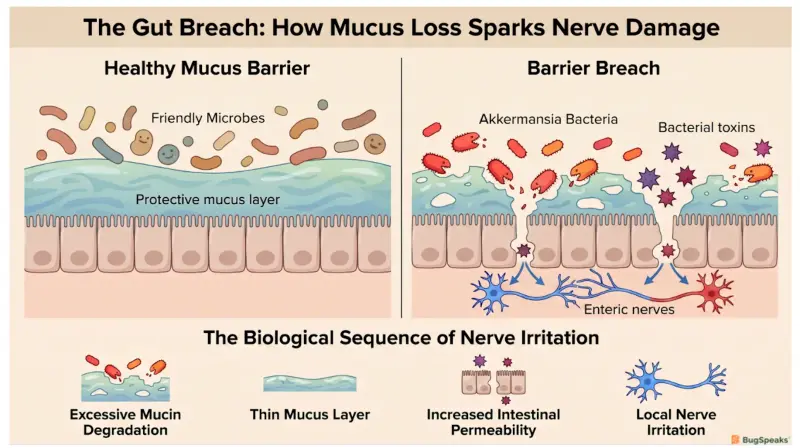
A damaged gut boundary acts as the starting step of the disease ladder because a thinned protective layer lets harmful bacterial signals trigger protein clumping in local nerves. This thinned layer is caused by a major imbalance in your stomach microbes, which scientists call dysbiosis [Wallen (2022)](https://doi.org/10.1038/s41467-022-34667-x). In a healthy gut, trillions of friendly microbes live together in a balanced community that protects your body. However, in patients with this illness, the balance is lost, and bad bacteria begin to take over the space, creating a messy environment that weakens your protective boundaries and starts the climb. This messy situation allows bad germs to multiply rapidly and release harmful triggers.
One major bad guy in this messy environment is a bacterium called Akkermansia muciniphila. While this microbe is normally helpful in small numbers, it can grow too numerous and cause serious trouble in your gut [Lee (2025)](https://doi.org/10.1186/s40168-025-02095-w). This particular bacterium is an expert at mucin degradation, which means it eats away the slimy mucus wall that keeps your gut cells safe [Lee (2025)](https://doi.org/10.1186/s40168-025-02095-w). When these bacteria eat too much of this slimy protective coat, they leave the gut lining bare and exposed, similar to a wooden house losing its outer paint. Without this slimy coat, the delicate gut lining is completely unprotected from environmental hazards.
Without a thick coat of mucus, the delicate cells of the intestinal barrier become thin and leaky. This leakage allows toxic products from bacteria to slip through the gaps and directly touch your gut nerves [Duan (2023)](https://doi.org/10.1007/s12264-023-01123-9). When these toxic elements hit the nerves, they cause swelling and irritate the proteins inside, forcing them to twist into sticky clumps [Wallen (2022)](https://doi.org/10.1038/s41467-022-34667-x). This local damage on the bottom step of the staging ladder acts as the spark that ignites the entire climbing process, sending abnormal signals up the vagus nerve. As a result, the physical journey of the clumped protein begins its long and slow upward march.
**Dysbiosis**\- An unhealthy imbalance where bad stomach microbes take over and push out the friendly ones.
**Akkermansia muciniphila**\- A gut bacterium that is helpful in small amounts but eats too much mucus if it overgrows.
**Mucin degradation**\- The process of digesting and eating away the protective, slimy mucus layer in your gut.
**Intestinal barrier**\- A delicate wall of tightly packed cells that keeps harmful waste and germs inside the gut.
## What molecular triggers accelerate the climb up the ladder?
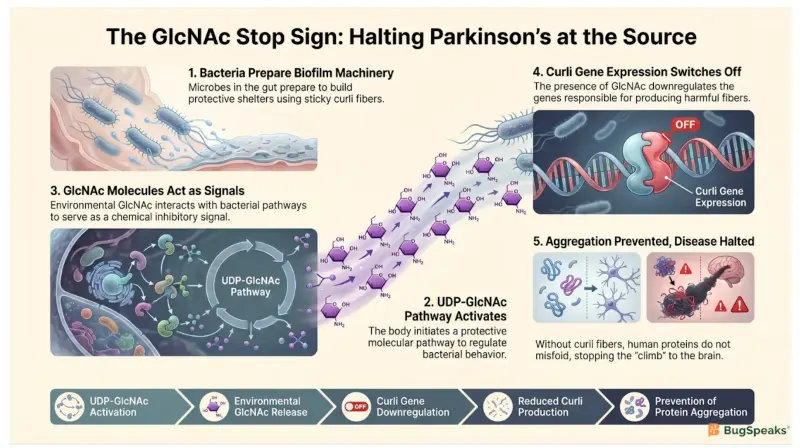
Toxic bacterial proteins and highly inflammatory molecules act as molecular accelerators that speed up the clumping of brain-wiring proteins in the gut. A specific bacterium called Escherichia coli is often found in high numbers inside the unbalanced guts of patients [Lee (2025)](https://doi.org/10.1186/s40168-025-02095-w). This microbe produces tiny, sticky fibers called curli proteins that it uses to build protective shelters [Wallen (2022)](https://doi.org/10.1038/s41467-022-34667-x). These curli fibers look and behave exactly like the sticky brain proteins linked to Parkinson's. When these two sticky proteins meet, they trigger a dangerous reaction that makes both of them clump together much faster. These bacterial shelters act like magnets that attract normal brain proteins, forcing them to aggregate.
This dangerous reaction is called cross-seeding, where the bacterial curli fibers act like a template or cookie cutter that forces our own proteins to misfold. When our normal proteins touch the curli fibers, they copy the bad shape and stick together [Lee (2025)](https://doi.org/10.1186/s40168-025-02095-w). This process speeds up the creation of sticky clumps in the enteric nervous system, acting like a booster engine that pushes the disease up the lower steps of the ladder. Without this bacterial helper, the proteins would clump much more slowly, keeping the disease stuck at the bottom level. Therefore, these bad microbes directly accelerate the physical movement of the damage through your body.
Additionally, these bad bacteria release toxic molecules called lipopolysaccharides (LPS) from their outer walls [Wallen (2022)](https://doi.org/10.1038/s41467-022-34667-x). These toxic elements cause massive swelling and irritation in the gut wall, which further damages the nerves. This swelling makes your body's defense cells highly active, but they end up causing more harm than good by making the environment even more toxic. This double attack of curli and LPS acts like a powerful accelerator, speeding up the slow climb of the sticky proteins up the staging ladder and toward the vulnerable cells of your lower brain. This intense irritation of local tissues makes the nerve wires highly vulnerable to structural damage.
**Escherichia coli**\- A common type of gut bacteria that can multiply during dysbiosis and release harmful triggers.
**Curli**\- Tiny, sticky protein fibers made by bacteria to build shelters, which look like misfolded human proteins.
**Cross-seeding**\- A dangerous copying process where bacterial fibers force normal human proteins to misfold and clump together.
**Lipopolysaccharides (LPS)**\- Toxic molecules from bad bacterial walls that cause swelling and irritate local gut tissues.
## How do protective gut chemicals act as roadblocks to halt the climb?
Healthy gut chemicals and specific sugar building blocks act as biological roadblocks that protect our cell boundaries and stop proteins from clumping. The most important protective chemicals are Short-Chain Fatty Acids (SCFAs), which are made when friendly microbes digest healthy plant fibers [Duan (2023)](https://doi.org/10.1007/s12264-023-01123-9). These fatty acids act like fuel that feeds your gut cells, keeping them strong and tightly packed together. When you eat lots of fiber-rich fruits and vegetables, your friendly bacteria produce a large amount of these chemicals, which repair the protective wall and keep the bottom steps of the ladder safe. These barriers make it extremely difficult for abnormal protein clumps to travel any further.
A vital type of short-chain fatty acid is called butyrate, which has powerful healing powers that quiet down swelling and protect nerves. Butyrate travels to your gut nerves and helps them produce protective elements that prevent proteins from twisting into bad shapes [Duan (2023)](https://doi.org/10.1007/s12264-023-01123-9). In patients with this illness, the bacteria that make butyrate are severely reduced, which removes the roadblocks and leaves the ladder open for the sticky proteins to climb up [Duan (2023)](https://doi.org/10.1007/s12264-023-01123-9). By eating more fiber or using special probiotics like Bifidobacterium breve and Bacillus subtilis, we can increase butyrate levels and stop the disease from moving upward. This simple dietary action provides a powerful shield that supports our local digestive nerves.
Another brilliant roadblock involves the Uridine Diphosphate N-acetylglucosamine (UDP-GlcNAc) pathway, which produces a special signaling sugar. This signaling sugar is called environmental GlcNAc, and it acts like a stop sign that tells bad bacteria to stop making sticky biofilm shelters [Lee (2025)](https://doi.org/10.1186/s40168-025-02095-w). When environmental GlcNAc is plentiful, bad bacteria stay quiet and do not produce the curli fibers that cause cross-seeding. In a healthy gut, this sugar pathway is highly active, keeping the starting step of the ladder locked down. Supporting this pathway offers a wonderful new way to halt the disease climb early. By focusing on this sugar process, we can find brand new ways to prevent nerve problems.
**Chemical Element**
**Biological Role in Gut**
**Impact on the Staging Ladder**
**Primary Bacterial Source**
Curli Fibers
Sticky protein templates
Speeds up clumping by cross-seeding human proteins
Escherichia coli
Lipopolysaccharides
Toxic cell wall components
Causes swelling and thins out cell walls
Bad Gram-negative germs
Short-Chain Fatty Acids
Cell fuel and boundary healer
Closes gaps in the wall and blocks the climb
Friendly fiber-digesting microbes
Environmental GlcNAc
Signaling sugar molecule
Acts as a stop sign to prevent curli production
Helpful Gram-positive bacteria
**Short-Chain Fatty Acids (SCFAs)**\- Healthy, healing chemicals made by friendly bacteria when they digest plant fibers.
**Butyrate**\- A powerful type of short-chain fatty acid that repairs cell walls, reduces swelling, and shields nerves.
**Uridine Diphosphate N-acetylglucosamine (UDP-GlcNAc)**\- A protective cell pathway that builds healthy walls and controls bad germs.
**Environmental GlcNAc**\- A natural signaling sugar that acts as a stop sign to prevent bad bacteria from making curli fibers.
Visualize the process- [https://youtu.be/thL2YVwOt1g](https://youtu.be/thL2YVwOt1g)
### Reference
Manfredsson, F. P., Luk, K. C., Benskey, M. J., Gezer, A., Garcia, J., Kuhn, N. C., Sandoval, I. M., Patterson, J. R., O'Mara, A., Yonkers, R., & Kordower, J. H. (2018). Induction of alpha-synuclein pathology in the enteric nervous system of the rat and non-human primate results in gastrointestinal dysmotility and transient CNS pathology. _Neurobiology of disease_, _112_, 106–118. [https://doi.org/10.1016/j.nbd.2018.01.008](https://doi.org/10.1016/j.nbd.2018.01.008)
Svensson, E., Horváth-Puhó, E., Thomsen, R. W., Djurhuus, J. C., Pedersen, L., Borghammer, P., & Sørensen, H. T. (2015). Vagotomy and subsequent risk of Parkinson's disease. _Annals of neurology_, _78_(4), 522–529. [https://doi.org/10.1002/ana.24448](https://doi.org/10.1002/ana.24448)
Palacios, N., Wilkinson, J., Bjornevik, K., Schwarzschild, M. A., McIver, L., Ascherio, A., & Huttenhower, C. (2023). Metagenomics of the Gut Microbiome in Parkinson's Disease: Prodromal Changes. _Annals of neurology_, _94_(3), 486–501. [https://doi.org/10.1002/ana.26719](https://doi.org/10.1002/ana.26719)
Lee, J. Y., Jo, S., Lee, J., Choi, M., Kim, K., Lee, S., ... & Chung, S. J. (2025). Distinct gut microbiome characteristics and dynamics in patients with Parkinson’s disease based on the presence of premotor rapid-eye movement sleep behavior disorders. _Microbiome_, _13_(1), 108.
Wallen, Z. D., Demirkan, A., Twa, G., Cohen, G., Dean, M. N., Standaert, D. G., Sampson, T. R., & Payami, H. (2022). Metagenomics of Parkinson's disease implicates the gut microbiome in multiple disease mechanisms. _Nature communications_, _13_(1), 6958. [https://doi.org/10.1038/s41467-022-34667-x](https://doi.org/10.1038/s41467-022-34667-x)
Palacios, N., Wilkinson, J., Bjornevik, K., Schwarzschild, M. A., McIver, L., Ascherio, A., & Huttenhower, C. (2023). Metagenomics of the Gut Microbiome in Parkinson's Disease: Prodromal Changes. _Annals of neurology_, _94_(3), 486–501. [https://doi.org/10.1002/ana.26719](https://doi.org/10.1002/ana.26719)
Wei, W., Wang, S., Xu, C., Zhou, X., Lian, X., He, L., & Li, K. (2022). Gut microbiota, pathogenic proteins and neurodegenerative diseases. _Frontiers in microbiology_, _13_, 959856\. [https://doi.org/10.3389/fmicb.2022.959856](https://doi.org/10.3389/fmicb.2022.959856)
Duan, W. X., Wang, F., Liu, J. Y., & Liu, C. F. (2024). Relationship Between Short-chain Fatty Acids and Parkinson's Disease: A Review from Pathology to Clinic. _Neuroscience bulletin_, _40_(4), 500–516. [https://doi.org/10.1007/s12264-023-01123-9](https://doi.org/10.1007/s12264-023-01123-9)
## FAQs
Q: How can a disease that affects the brain start in the stomach?
A: The stomach is lined with millions of delicate nerves that help digest your food. These nerves are connected directly to the brain stem by a long nerve pathway called the vagus nerve. When abnormal proteins fold incorrectly and clump in your stomach, they can travel up this nerve wire like a climber on a ladder, eventually reaching the brainstem and upper brain.
Q: What is the very first step on the staging ladder?
A: Step One of the ladder starts in the nerves of the digestion system and olfactory (sense of smell) pathways. This explain why patients experience non-motor problems like constipation and a loss of smell decades before any shaking or stiffness starts.
Q: Why does eating healthy fiber protect my brain?
A: When you eat fiber, friendly bacteria in your stomach ferment it to produce short-chain fatty acids like butyrate. These healthy chemicals repair your protective mucus layer, keep your gut cells packed tightly, and block bad bacterial triggers from touching your nerves.
Q: Can bad bacteria speed up Parkinson's disease?
A: Yes, bad bacteria like Escherichia coli produce tiny, sticky proteins called curli. These sticky fibers act like templates that force normal human proteins in your gut nerves to copy their twisted shape, accelerating the clumping process.
Q: Does cutting the vagus nerve cure the illness?
A: Cutting the vagus nerve does not cure the illness once it has already spread, but historical studies show that patients who had this nerve cut early in life had a much lower risk of getting the disease. This is because cutting the nerve pathway removes the biological ladder, preventing sticky clumps from climbing to the brainstem.
---
This blog is powered by Superblog. Visit https://superblog.ai to know more.
---