# Discovering the Power of Gut Bacteria for Kidney Stone Prevention
Author: Varsha V
Author URL: https://www.bugspeaks.com/blog/author/varsha-v
Published: 2026-08-19
Category: Microbiome and Disease
Category URL: https://www.bugspeaks.com/blog/category/microbiome-and-disease
Meta Title: Oxalobacter and Kidney Stones: Gut Health | BugSpeaks
Meta Description: Learn how Oxalobacter and gut bacteria help manage oxalate and may support kidney stone prevention. Discover the gut-kidney connection and read the science!
Tags: Gut Health, Kidney Stones, Oxalobacter formigenes
Tag URLs: Gut Health (https://www.bugspeaks.com/blog/tag/gut-health), Kidney Stones (https://www.bugspeaks.com/blog/tag/kidney-stones), Oxalobacter formigenes (https://www.bugspeaks.com/blog/tag/oxalobacter-formigenes)
URL: https://www.bugspeaks.com/blog/oxalobacter-kidney-stone-prevention
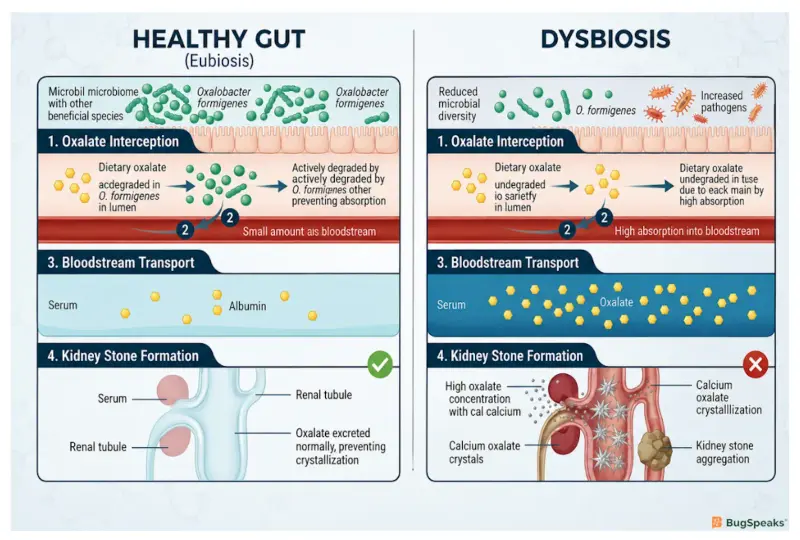
## What is the intestinal interception zone, and how does it prevent kidney stone formation?
The intestinal interception zone prevents kidney stones by using friendly [gut](https://www.bugspeaks.com/blog/vitamin-d-gut-health-probiotics) bacteria such as Oxalobacter formigenes, Lactobacillus, and Bifidobacterium to consume dietary oxalate before it can travel through your bloodstream and overload your kidneys. When you eat plant foods like spinach, beets, or almonds, they introduce an incoming compound called oxalate that your body cannot digest [Hatch (2017)](https://doi.org/10.21037/atm.2016.12.70). This compound normally enters your large intestine, which serves as a vital interception zone designed to filter out waste. Specialized bacteria living inside this colonic zone eat the compound, safely neutralizing it before it ever gets a chance to escape into your downstream transport pathway where it can build up and cause problems.
If these waste molecules manage to escape the colonic interception zone, they enter the bloodstream to begin downstream transport. This transport pathway carries the molecules directly to your kidneys, which act as the final handling organs. Inside your kidneys, the compound can bind with calcium to form sharp, hard crystals that pile up in the renal tubules [Pang et al. (2026)](https://doi.org/10.3389/fcimb.2026.1804800). This crystallization leads to painful kidney stones, which can block your normal urine flow, cause serious tissue injury, and lead to sudden medical emergencies that require expensive hospital treatment to resolve, which can make a person feel very sick and uncomfortable for several weeks.
Your body tries to maintain healthy homeostasis, or a state of complete internal balance. The intestinal epithelium can pull waste molecules back out of your bloodstream and pump them directly into the gut to be excreted. This active secretion relies on a specialized pump protein called solute carrier family 26 member 6, or SLC26A6 [Pang et al. (2026)](https://doi.org/10.3389/fcimb.2026.1804800). Keeping this gut-level barrier filter highly active ensures that your kidneys are offloaded, protecting your entire body from painful crystal formations and keeping your urinary system functioning perfectly every single day so that you can stay happy and fully energized.
**Oxalate**\- A tiny, sour compound found in healthy plants like spinach that our bodies cannot use as food and must get rid of.
**Renal tubules**\- Tiny, delicate cleaning tubes inside your kidneys that filter waste products out of your blood to make urine.
**Homeostasis**\- The beautiful way your body balances all of its systems to keep you healthy, stable, and feeling good.
**Intestinal epithelium**\- The thin, protective wall of cells lining your gut that decides what gets absorbed and what gets kept out.
**Solute carrier family 26 member 6 (SLC26A6)**\- A tiny, microscopic gatekeeper pump on your gut wall that pushes harmful oxalate out of your body.
## Who is Oxalobacter formigenes and why is this bacterium the ultimate interception agent?
Oxalobacter formigenes is a highly specialized [gut bacterium](https://www.bugspeaks.com/blog/thyroid-gut-health-hashimoto/) that acts as the ultimate interception agent because it eats oxalate as its only source of food and energy to survive. Unlike other gut bacteria that can eat many different sugars, this tiny anaerobic specialist has a highly restricted diet consisting strictly and solely of oxalate as its only source of carbon and energy [Hatch (2017)](https://doi.org/10.21037/atm.2016.12.70). Because it cannot live on any other substance, it acts as a permanent biological drain inside your colon. It constantly pulls the incoming compound out of your digested food and destroys it completely before the waste has any opportunity to leak into your downstream transport pathway and cause crystal deposits inside your kidneys.
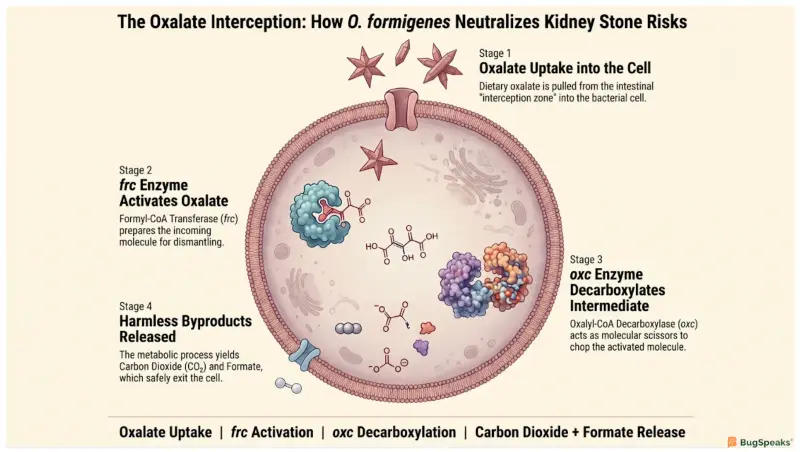
The way this microscopic consumer operates is extremely elegant and depends on two main enzymes. First, the bacterium uses formyl-coenzyme A transferase, or frc, to prepare the incoming oxalate molecules [Pang et al. (2026)](https://doi.org/10.3389/fcimb.2026.1804800). Second, it uses another enzyme called oxalyl-coenzyme A decarboxylase, or oxc, to break them down into simple carbon dioxide and formic acid [Pang et al. (2026)](https://doi.org/10.3389/fcimb.2026.1804800). Through this metabolic process, the bacterium gets its life energy while destroying the harmful acid, keeping your downstream transport systems clean and preventing crystals from forming in your final handling organs, which helps protect your overall metabolic health for a very long time.
In addition to eating this compound, this specialized bacterium actively talks to your intestinal cells to speed up waste disposal. Its presence in your gut sends chemical signals that tell the lining to pull circulating oxalate back out of your blood and dump it into the colon [Hatch (2017)](https://doi.org/10.21037/atm.2016.12.70). Carrying this bacterium reduces your risk of forming painful stones by up to seventy percent [Kaufman et al. (2008)](https://doi.org/10.1681/ASN.2007101058). This makes it our most important biological shield, and protecting it from common clinical antibiotics is crucial for keeping our internal filtration working correctly so that your body never has to experience painful crystal blockages.
**System Component**
**Biological Term**
**System Action & Mechanism**
**Impact on Kidney Stone Prevention**
Incoming Compound
Oxalate
Natural waste found in foods that humans cannot digest
Represents the potential load that must be cleaned up to avoid saturation
Interception Zone
Intestine
The primary area where food is processed and microbes reside
The final physical checkpoint to neutralize compounds before they enter the blood
Interception Agent
Oxalobacter formigenes
A friendly bacterium that destroys the incoming compound
Prevents excess compounds from leaving the gut and entering your bloodstream
Downstream Transport
Bloodstream
The liquid road that carries absorbed elements around
Carries any unintercepted waste straight to your final handling organs
Final Handling Organ
Kidneys
The filtration system that processes blood and makes urine
Filters the blood, making it vulnerable to painful crystal formations
**Anaerobic**\- A term for friendly microbes that live and grow deep inside your tummy where there is absolutely no air or oxygen.
**Formyl-coenzyme A transferase (frc)**\- A special tool used by _Oxalobacter_ to latch onto oxalate molecules and prepare them to be dismantled.
**Oxalyl-coenzyme A decarboxylase (oxc)**\- The molecular scissors that _Oxalobacter_ uses to chop up prepared oxalate into harmless gas and acid.
**Oxalobacter formigenes-** A highly specialized, friendly gut bacterium that acts as our body's primary shield against kidney stones by eating oxalate as its only source of food and energy.
## **W** hat happens when the interception system breaks down and how does this lead to kidney stones?
When the [gut's interception system](https://www.bugspeaks.com/blog/chronic-fatigue-syndrome-gut-health/) loses its protective microbes, a state of gut dysbiosis occurs, which allows excess oxalate to flood the bloodstream and form painful kidney stones. This breakdown is often caused by clinical antibiotic use, which accidentally destroys friendly bacterial populations [Pang et al. (2026)](https://doi.org/10.3389/fcimb.2026.1804800). Without these active consumers to degrade the incoming compound, a large amount of the waste remains in your gut. It is easily absorbed into your downstream transport path, traveling directly to your kidneys for filtration, which quickly overloads your final handling organs with too much chemical waste that your body simply cannot handle on its own.
Once inside the kidneys, this high concentration of waste causes hyperoxaluria, which simply means too much oxalate in the urine [Cui et al. (2026)](https://doi.org/10.1186/s12934-026-02977-0). The filtered compound quickly binds to calcium, creating sharp, hard mineral crystals that injure the renal cells. These crystals can take the form of whewellite, which is a very dense monohydrate, or weddellite, which is a dihydrate crystal [Pang et al. (2026)](https://doi.org/10.3389/fcimb.2026.1804800). This crystallization process is accelerated by pro-inflammatory bacteria like Escherichia-Shigella, which make the kidney environment much more welcoming to stones, leading to rapid blockages, pain, and severe tissue damage inside your body.
When these sharp crystals damage your kidney tissues, they can stick to tiny calcium deposits called Randall's plaques [Pang et al. (2026)](https://doi.org/10.3389/fcimb.2026.1804800). These plaques act like anchors, allowing crystals to accumulate and grow into large stones. A colonic barrier breakdown also allows a toxic bacterial component called lipopolysaccharide, or LPS, to leak into your bloodstream [Cui et al. (2026)](https://doi.org/10.1186/s12934-026-02977-0). This LPS triggers low-grade inflammation throughout the body, reducing your kidneys' natural ability to stop painful crystal growth and leading to a long-term breakdown of your entire metabolic system, which can make your body feel weak and tired.
**Whewellite**\- A very tough, tightly packed crystal made of calcium and oxalate that acts as the hard center of most kidney stones.
**Weddellite**\- A slightly different type of calcium-oxalate crystal that looks like tiny pyramids under a microscope and is stabilized by urine.
**Randall's plaques**\- Tiny, rough calcium patches on the inside of the kidney that behave like sticky Velcro where crystals can attach and grow.
**Lipopolysaccharide (LPS)**\- A toxic shield found on bad bacteria that can leak into your blood and make your body's immune system angry and inflamed.
**Hyperoxaluria-** An unhealthy condition where too much oxalate builds up in your urine, making it very easy for painful crystals and kidney stones to form.
## How does a cooperative network of gut microbes help keep our kidneys safe?
A cooperative network of diverse gut microbes works together like a team to maintain a strong interception zone that degrades oxalate and protects your kidneys from damage. While Oxalobacter is the most efficient consumer, it cannot protect your body alone [Ticinesi et al. (2019)](https://doi.org/10.1016/j.kint.2019.03.020). Other generalist bacteria, such as certain species of Bifidobacterium and Lactobacillus, also help to consume and break down this incoming compound [Hatch (2017)](https://doi.org/10.21037/atm.2016.12.70). This multi-species network provides essential backup support, making sure that your gut's filtration capacity remains highly resilient even if one species gets temporarily weakened by medication, stress, or a poor diet with too much processed sugar.
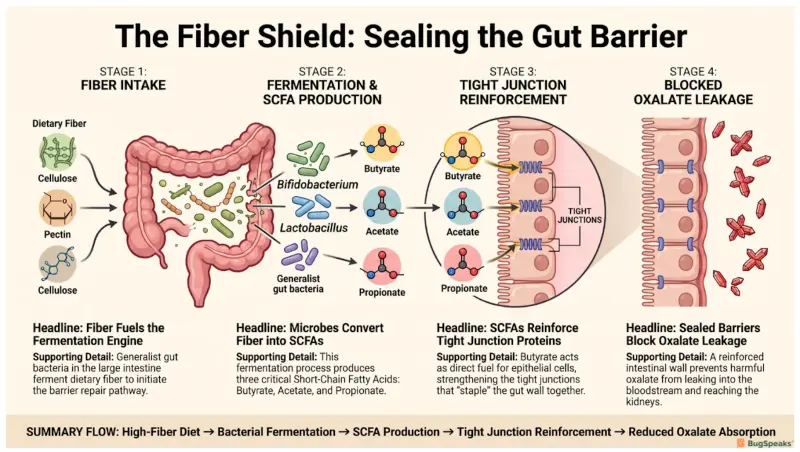
Metagenomic research shows that healthy people have a stable community of bacteria that help Oxalobacter grow and survive in the gut [Miller et al. (2019)](https://doi.org/10.1016/j.kint.2019.02.012). This friendly microbial network includes fiber-fermenting bacteria that make short-chain fatty acids, or SCFAs [Pang et al. (2026)](https://doi.org/10.3389/fcimb.2026.1804800). These SCFAs, including acetate, propionate, and butyrate, feed your intestinal cells and keep your gut wall tightly sealed [Pang et al. (2026)](https://doi.org/10.3389/fcimb.2026.1804800). This tight seal stops the incoming compound from leaking passively into your downstream transport pathway, where it could travel straight to your sensitive filtration organs and cause painful blockages and permanent cell damage.
Furthermore, when these fiber-fermenting microbes are active, they lower the pH inside your colon to an acidic range of about 5.5 to 6.5 (where neutral is 7.0) inside your colon. A lower pH causes the incoming oxalate to bind with calcium right in your food, forming insoluble salts that pass safely out of your body [Pang et al. (2026)](https://doi.org/10.3389/fcimb.2026.1804800). Without this cooperative network, single probiotics often fail to colonize because they lack a supportive microbial team [Ticinesi et al. (2019)](https://doi.org/10.1016/j.kint.2019.03.020). Protecting this diverse bacterial community is therefore essential for long-term health, ensuring that your intervention remains fully active every single day so that crystals never find a way to grow and cause you painful blockages.
**Microbe Name**
**Interception Class**
**Main Task in the Gut**
**Resilience Level**
_Oxalobacter formigenes_
Primary Specialist
Eats only oxalate to destroy it [Hatch (2017)](https://doi.org/10.21037/atm.2016.12.70)
Low; easily wiped out by common clinical antibiotics
_Lactiplantibacillus plantarum_
Generalist Backup
Consumes sugars and degrades some oxalate [Xu et al. (2024a)](https://doi.org/10.3389/fcimb.2026.1804800)
High; highly resistant and survives easily
_Bifidobacterium animalis_
Generalist Backup
Lowers gut pH to lock oxalate away in stool [Hatch (2017)](https://doi.org/10.21037/atm.2016.12.70)
Medium; needs healthy fiber to remain stable
**Short-chain fatty acids (SCFAs)**\- Super-healthy, nutritious juices produced by friendly microbes when they digest plant fibers from your food.
**Acetate**\- A common SCFA made by your gut microbes that helps maintain healthy metabolic balance and protects against crystal deposits.
**Propionate**\- A supportive SCFA that regulates energy, reduces inflammation, and keeps your body's systems running smoothly.
**Butyrate**\- The most important SCFA of all, acting as a direct fuel to patch up any leaks or holes in your intestinal wall.
**Metagenomic**\- An advanced scientific method of reading and mapping the DNA of an entire community of gut microbes to see how they work together as a team.
## What new science-backed strategies are being developed to restore our body's interception system?
Scientists are developing advanced therapies like engineered bacteria, targeted synbiotics, and special diets to restore active oxalate interception in the human gut and prevent kidney stones. A groundbreaking 2025 study successfully engineered a common human gut bacterium, Phocaeicola vulgatus, to break down oxalate [Whitaker et al. (2025)](https://doi.org/10.1126/science.adu8000). To keep this therapy completely safe, researchers designed the bacteria to only survive in the gut when fed a specific seaweed sugar called porphyran. This allows doctors to turn the colonic colonization on or off as needed, providing precise control over the treatment without disrupting your other friendly microbes, which makes it a highly promising medical tool.
In early human trials, this engineered bacterium successfully colonized the colons of participants and safely lowered the levels of oxalate in their urine [Whitaker et al. (2025)](https://doi.org/10.1126/science.adu8000). Other scientists are using live biotherapeutic products, or LBPs, which are natural probiotic strains isolated from traditional fermented foods [Pang et al. (2026)](https://doi.org/10.3389/fcimb.2026.1804800). For instance, a specific strain of Lactiplantibacillus plantarum utilizes its native oxalate decarboxylase, or oxdc, to protect the kidneys from oxidative stress and crystal deposition, which helps restore your body's biological filtration system and prevents painful stone recurrence from ever starting again so you can feel healthy and active.
Beyond adding individual microbes, we can also restore the interception system through synbiotics and dietary modifications. A synbiotic combines a beneficial probiotic microbe with a prebiotic substrate, which is the specific food that microbe needs to grow and thrive in your gut [Bhardwaj et al. (2025)](https://doi.org/10.7759/cureus.98728). Additionally, drinking caffeine has been shown to activate protective pathways in kidney cells by triggering the antioxidant Nrf2 signaling system and blocking the sticky Snail1 protein to prevent crystals from adhering to injured renal tissues [Cui et al. (2026)](https://doi.org/10.1186/s12934-026-02977-0) preventing crystals from sticking to tissues [Cui et al. (2026)](https://doi.org/10.1186/s12934-026-02977-0). This [creates a powerful](https://www.bugspeaks.com/blog/rychbiome-probiokids-child-gut-health), science-backed shield that makes it very simple to prevent painful stones from forming and keeps your entire body feeling healthy, safe, and incredibly strong as you grow older.
**Live biotherapeutic products (LBPs)**\- Living, beneficial bacteria that are scientifically selected or engineered to cure or prevent specific diseases.
**Oxalate decarboxylase (oxdc)**\- A powerful, natural enzyme used by bacteria to dismantle oxalate and neutralize it before it leaves the gut.
**Synbiotics**\- Super-powered health capsules that contain both friendly living bacteria and the exact plant fibers they need to eat to survive.
**Prebiotics**\- Special, non-digestible plant fibers that serve as a direct energy source to feed and grow your gut's microbial shield.
**Phocaeicola vulgatus**\- A common, friendly gut bacterium that scientists successfully engineered to act as a designer shield by breaking down oxalate in the intestine.
**Porphyran**\- A unique sugar found in seaweed that serves as the exclusive "food key" to grow and control the engineered _Phocaeicola vulgatus_ bacteria in your gut.
**Oxidative stress**\- Internal wear-and-tear or cellular damage caused by harmful molecules, which can injure delicate kidney tissues and make it easier for sharp crystals to stick.
**Nrf2 signaling**\- A natural protective pathway inside your kidney cells that works like an automatic shield to defend tissues against inflammation and cellular damage.
**Snail1 protein**\- A sticky cellular protein that acts like glue inside the kidneys, which harmful crystals try to use to stick to tissue walls and grow into larger stones.
Visualize the process- [https://youtu.be/DoDuVrOuLjc](https://youtu.be/DoDuVrOuLjc)
### Reference
Kaufman, D. W., Kelly, J. P., Curhan, G. C., Anderson, T. E., Dretler, S. P., Preminger, G. M., & Cave, D. R. (2008). Oxalobacter formigenes may reduce the risk of calcium oxalate kidney stones. _Journal of the American Society of Nephrology : JASN_, _19_(6), 1197–1203. [https://doi.org/10.1681/ASN.2007101058](https://doi.org/10.1681/ASN.2007101058)
Ticinesi, A., Nouvenne, A., & Meschi, T. (2019). Gut microbiome and kidney stone disease: not just an Oxalobacter story. _Kidney international_, _96_(1), 25–27. [https://doi.org/10.1016/j.kint.2019.03.020](https://doi.org/10.1016/j.kint.2019.03.020)
Afkari, R., Feizabadi, M. M., Ansari-Moghadam, A., Safari, T., & Bokaeian, M. (2019). Simultaneous use of oxalate-degrading bacteria and herbal extract to reduce the urinary oxalate in a rat model: A new strategy. _International braz j urol : official journal of the Brazilian Society of Urology_, _45_(6), 1249–1259. [https://doi.org/10.1590/S1677-5538.IBJU.2019.0167](https://doi.org/10.1590/S1677-5538.IBJU.2019.0167)
Izatulina, A. R., Nikolaev, A. M., Kuz’mina, M. A., Frank-Kamenetskaya, O. V., & Malyshev, V. V. (2019). Bacterial effect on the crystallization of mineral phases in a solution simulating human urine. _Crystals_, _9_(5), 259.
Cui, T., Yang, Y., Lange, D., Wang, X., Ruan, J., Ji, J., Dang, K., Zhou, Y., & Xiao, J. (2026). Gut microbiome and metabolome signatures in calcium oxalate stone recurrence: a multi-omics study. _Microbial cell factories_, _25_(1), 100. [https://doi.org/10.1186/s12934-026-02977-0](https://doi.org/10.1186/s12934-026-02977-0)
Bhardwaj, M., Singhal, A., Bhardwaj, G., & Dukic, I. (2025). Probiotic and Synbiotic Interventions Targeting Oxalate-Degrading Gut Bacteria for the Prevention of Kidney Stones: A Systematic Review. _Cureus_, _17_(12), e98728. [https://doi.org/10.7759/cureus.98728](https://doi.org/10.7759/cureus.98728)
Hatch M. (2017). Gut microbiota and oxalate homeostasis. _Annals of translational medicine_, _5_(2), 36. [https://doi.org/10.21037/atm.2016.12.70](https://doi.org/10.21037/atm.2016.12.70)
Pang S, Zhang Z, Ma Q, Liu Y, Wang S, Wang J and Bi Y (2026) The gut–kidney microbiome–oxalate axis in calcium oxalate nephrolithiasis: mechanisms and microbiome-based interventions. Front. Cell. Infect. Microbiol. 16:1804800. doi: 10.3389/fcimb.2026.1804800
## FAQs
Q: Why are kidney stones so painful when they form?
A: Kidney stones are made of thousands of tiny, sharp calcium oxalate crystals that look like spiked balls or blocks under a microscope Pang et al. (2026). When these hard crystals travel through your narrow, delicate urinary tubes, they scratch the walls, causing inflammation, blockages, and intense pain Bhardwaj et al. (2025).
Q: Can I get Oxalobacter formigenes back if antibiotics wiped it out?
A: Once it is completely lost, O. formigenes struggles to return naturally because the gut is highly competitive Pang et al. (2026). Scientists are developing specialized therapies (called Live Biotherapeutic Products) to safely reintroduce these primary specialists into your interception system Whitaker et al. (2025).
Q: How does eating enough dietary calcium help my interception system?
A: Calcium acts like a natural magnet in your stomach and intestines. When you eat calcium with your meals, it binds directly to oxalate, forming heavy insoluble clumps that cannot pass into your bloodstream Pang et al. (2026). This means the oxalate passes safely out of your body in your stool.
Q: What is the difference between whewellite and weddellite crystals?
A: Whewellite is the highly dense, stable form of calcium oxalate monohydrate, while weddellite is the dihydrate form, which contains more water molecules Pang et al. (2026). Certain bacteria and urinary proteins can influence which type of crystal forms, with bacteria frequently helping to stabilize and speed up the growth of weddellite Izatulina et al. (2019).
Q: How does dietary fiber protect my kidneys from stone formation?
A: Fiber feeds the generalist microbes in your colonic interception zone, allowing them to ferment fiber and produce helpful short-chain fatty acids like butyrate Pang et al. (2026). These SCFAs keep the intestinal wall tightly sealed, which blocks raw oxalate from passively leaking into your bloodstream Cui et al. (2026).
---
This blog is powered by Superblog. Visit https://superblog.ai to know more.
---