What is the intestinal interception zone, and how does it prevent kidney stone formation?
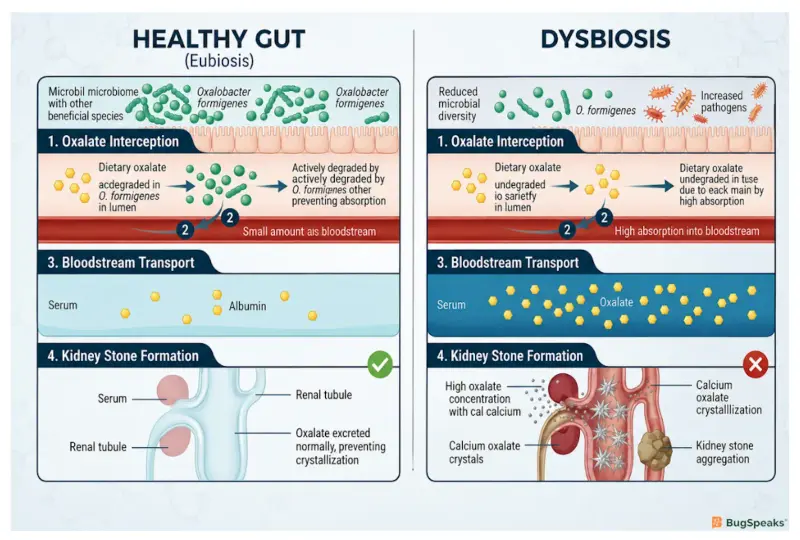
The intestinal interception zone prevents kidney stones by using friendly gut bacteria such as Oxalobacter formigenes, Lactobacillus, and Bifidobacterium to consume dietary oxalate before it can travel through your bloodstream and overload your kidneys. When you eat plant foods like spinach, beets, or almonds, they introduce an incoming compound called oxalate that your body cannot digestHatch (2017). This compound normally enters your large intestine, which serves as a vital interception zone designed to filter out waste. Specialized bacteria living inside this colonic zone eat the compound, safely neutralizing it before it ever gets a chance to escape into your downstream transport pathway where it can build up and cause problems.
If these waste molecules manage to escape the colonic interception zone, they enter the bloodstream to begin downstream transport. This transport pathway carries the molecules directly to your kidneys, which act as the final handling organs. Inside your kidneys, the compound can bind with calcium to form sharp, hard crystals that pile up in the renal tubulesPang et al. (2026). This crystallization leads to painful kidney stones, which can block your normal urine flow, cause serious tissue injury, and lead to sudden medical emergencies that require expensive hospital treatment to resolve, which can make a person feel very sick and uncomfortable for several weeks.
Your body tries to maintain healthy homeostasis, or a state of complete internal balance. The intestinal epithelium can pull waste molecules back out of your bloodstream and pump them directly into the gut to be excreted. This active secretion relies on a specialized pump protein called solute carrier family 26 member 6, or SLC26A6 Pang et al. (2026). Keeping this gut-level barrier filter highly active ensures that your kidneys are offloaded, protecting your entire body from painful crystal formations and keeping your urinary system functioning perfectly every single day so that you can stay happy and fully energized.
Who is Oxalobacter formigenes and why is this bacterium the ultimate interception agent?
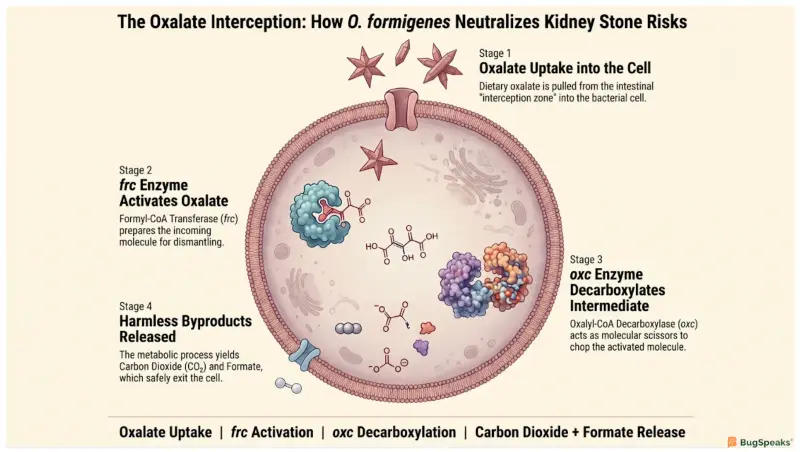
Oxalobacter formigenes is a highly specialized gut bacterium that acts as the ultimate interception agent because it eats oxalate as its only source of food and energy to survive. Unlike other gut bacteria that can eat many different sugars, this tiny anaerobic specialist has a highly restricted diet consisting strictly and solely of oxalate as its only source of carbon and energy Hatch (2017). Because it cannot live on any other substance, it acts as a permanent biological drain inside your colon. It constantly pulls the incoming compound out of your digested food and destroys it completely before the waste has any opportunity to leak into your downstream transport pathway and cause crystal deposits inside your kidneys.
The way this microscopic consumer operates is extremely elegant and depends on two main enzymes. First, the bacterium uses formyl-coenzyme A transferase, or frc, to prepare the incoming oxalate moleculesPang et al. (2026). Second, it uses another enzyme called oxalyl-coenzyme A decarboxylase, or oxc, to break them down into simple carbon dioxide and formic acidPang et al. (2026). Through this metabolic process, the bacterium gets its life energy while destroying the harmful acid, keeping your downstream transport systems clean and preventing crystals from forming in your final handling organs, which helps protect your overall metabolic health for a very long time.
In addition to eating this compound, this specialized bacterium actively talks to your intestinal cells to speed up waste disposal. Its presence in your gut sends chemical signals that tell the lining to pull circulating oxalate back out of your blood and dump it into the colonHatch (2017). Carrying this bacterium reduces your risk of forming painful stones by up to seventy percentKaufman et al. (2008). This makes it our most important biological shield, and protecting it from common clinical antibiotics is crucial for keeping our internal filtration working correctly so that your body never has to experience painful crystal blockages.
What happens when the interception system breaks down and how does this lead to kidney stones?
When the gut's interception system loses its protective microbes, a state of gut dysbiosis occurs, which allows excess oxalate to flood the bloodstream and form painful kidney stones. This breakdown is often caused by clinical antibiotic use, which accidentally destroys friendly bacterial populationsPang et al. (2026). Without these active consumers to degrade the incoming compound, a large amount of the waste remains in your gut. It is easily absorbed into your downstream transport path, traveling directly to your kidneys for filtration, which quickly overloads your final handling organs with too much chemical waste that your body simply cannot handle on its own.
Once inside the kidneys, this high concentration of waste causes hyperoxaluria, which simply means too much oxalate in the urineCui et al. (2026). The filtered compound quickly binds to calcium, creating sharp, hard mineral crystals that injure the renal cells. These crystals can take the form of whewellite, which is a very dense monohydrate, or weddellite, which is a dihydrate crystalPang et al. (2026). This crystallization process is accelerated by pro-inflammatory bacteria like Escherichia-Shigella, which make the kidney environment much more welcoming to stones, leading to rapid blockages, pain, and severe tissue damage inside your body.
When these sharp crystals damage your kidney tissues, they can stick to tiny calcium deposits called Randall's plaquesPang et al. (2026). These plaques act like anchors, allowing crystals to accumulate and grow into large stones. A colonic barrier breakdown also allows a toxic bacterial component called lipopolysaccharide, or LPS, to leak into your bloodstreamCui et al. (2026). This LPS triggers low-grade inflammation throughout the body, reducing your kidneys' natural ability to stop painful crystal growth and leading to a long-term breakdown of your entire metabolic system, which can make your body feel weak and tired.
How does a cooperative network of gut microbes help keep our kidneys safe?
A cooperative network of diverse gut microbes works together like a team to maintain a strong interception zone that degrades oxalate and protects your kidneys from damage. While Oxalobacter is the most efficient consumer, it cannot protect your body aloneTicinesi et al. (2019). Other generalist bacteria, such as certain species of Bifidobacterium and Lactobacillus, also help to consume and break down this incoming compoundHatch (2017). This multi-species network provides essential backup support, making sure that your gut's filtration capacity remains highly resilient even if one species gets temporarily weakened by medication, stress, or a poor diet with too much processed sugar.
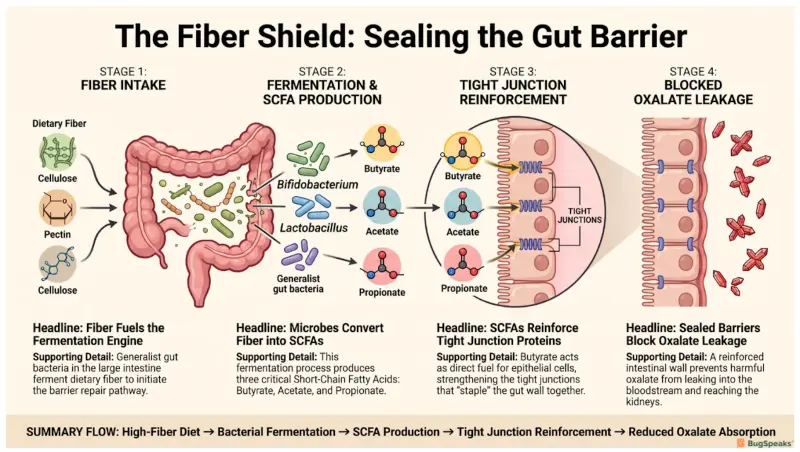
Metagenomic research shows that healthy people have a stable community of bacteria that help Oxalobacter grow and survive in the gutMiller et al. (2019). This friendly microbial network includes fiber-fermenting bacteria that make short-chain fatty acids, or SCFAsPang et al. (2026). These SCFAs, including acetate, propionate, and butyrate, feed your intestinal cells and keep your gut wall tightly sealedPang et al. (2026). This tight seal stops the incoming compound from leaking passively into your downstream transport pathway, where it could travel straight to your sensitive filtration organs and cause painful blockages and permanent cell damage.
Furthermore, when these fiber-fermenting microbes are active, they lower the pH inside your colon to an acidic range of about 5.5 to 6.5 (where neutral is 7.0) inside your colon. A lower pH causes the incoming oxalate to bind with calcium right in your food, forming insoluble salts that pass safely out of your bodyPang et al. (2026). Without this cooperative network, single probiotics often fail to colonize because they lack a supportive microbial teamTicinesi et al. (2019). Protecting this diverse bacterial community is therefore essential for long-term health, ensuring that your intervention remains fully active every single day so that crystals never find a way to grow and cause you painful blockages.
What new science-backed strategies are being developed to restore our body's interception system?
Scientists are developing advanced therapies like engineered bacteria, targeted synbiotics, and special diets to restore active oxalate interception in the human gut and prevent kidney stones. A groundbreaking 2025 study successfully engineered a common human gut bacterium, Phocaeicola vulgatus, to break down oxalateWhitaker et al. (2025). To keep this therapy completely safe, researchers designed the bacteria to only survive in the gut when fed a specific seaweed sugar called porphyran. This allows doctors to turn the colonic colonization on or off as needed, providing precise control over the treatment without disrupting your other friendly microbes, which makes it a highly promising medical tool.
In early human trials, this engineered bacterium successfully colonized the colons of participants and safely lowered the levels of oxalate in their urineWhitaker et al. (2025). Other scientists are using live biotherapeutic products, or LBPs, which are natural probiotic strains isolated from traditional fermented foodsPang et al. (2026). For instance, a specific strain of Lactiplantibacillus plantarum utilizes its native oxalate decarboxylase, or oxdc, to protect the kidneys from oxidative stress and crystal deposition, which helps restore your body's biological filtration system and prevents painful stone recurrence from ever starting again so you can feel healthy and active.
Beyond adding individual microbes, we can also restore the interception system through synbiotics and dietary modifications. A synbiotic combines a beneficial probiotic microbe with a prebiotic substrate, which is the specific food that microbe needs to grow and thrive in your gutBhardwaj et al. (2025). Additionally, drinking caffeine has been shown to activate protective pathways in kidney cells by triggering the antioxidant Nrf2 signaling system and blocking the sticky Snail1 protein to prevent crystals from adhering to injured renal tissuesCui et al. (2026) preventing crystals from sticking to tissuesCui et al. (2026). This creates a powerful, science-backed shield that makes it very simple to prevent painful stones from forming and keeps your entire body feeling healthy, safe, and incredibly strong as you grow older.
Visualize the process- https://youtu.be/DoDuVrOuLjc
Reference
Kaufman, D. W., Kelly, J. P., Curhan, G. C., Anderson, T. E., Dretler, S. P., Preminger, G. M., & Cave, D. R. (2008). Oxalobacter formigenes may reduce the risk of calcium oxalate kidney stones. Journal of the American Society of Nephrology : JASN, 19(6), 1197–1203. https://doi.org/10.1681/ASN.2007101058
Ticinesi, A., Nouvenne, A., & Meschi, T. (2019). Gut microbiome and kidney stone disease: not just an Oxalobacter story. Kidney international, 96(1), 25–27. https://doi.org/10.1016/j.kint.2019.03.020
Afkari, R., Feizabadi, M. M., Ansari-Moghadam, A., Safari, T., & Bokaeian, M. (2019). Simultaneous use of oxalate-degrading bacteria and herbal extract to reduce the urinary oxalate in a rat model: A new strategy. International braz j urol : official journal of the Brazilian Society of Urology, 45(6), 1249–1259. https://doi.org/10.1590/S1677-5538.IBJU.2019.0167
Izatulina, A. R., Nikolaev, A. M., Kuz’mina, M. A., Frank-Kamenetskaya, O. V., & Malyshev, V. V. (2019). Bacterial effect on the crystallization of mineral phases in a solution simulating human urine. Crystals, 9(5), 259.
Cui, T., Yang, Y., Lange, D., Wang, X., Ruan, J., Ji, J., Dang, K., Zhou, Y., & Xiao, J. (2026). Gut microbiome and metabolome signatures in calcium oxalate stone recurrence: a multi-omics study. Microbial cell factories, 25(1), 100. https://doi.org/10.1186/s12934-026-02977-0
Bhardwaj, M., Singhal, A., Bhardwaj, G., & Dukic, I. (2025). Probiotic and Synbiotic Interventions Targeting Oxalate-Degrading Gut Bacteria for the Prevention of Kidney Stones: A Systematic Review. Cureus, 17(12), e98728. https://doi.org/10.7759/cureus.98728
Hatch M. (2017). Gut microbiota and oxalate homeostasis. Annals of translational medicine, 5(2), 36. https://doi.org/10.21037/atm.2016.12.70
Pang S, Zhang Z, Ma Q, Liu Y, Wang S, Wang J and Bi Y (2026) The gut–kidney microbiome–oxalate axis in calcium oxalate nephrolithiasis: mechanisms and microbiome-based interventions. Front. Cell. Infect. Microbiol. 16:1804800. doi: 10.3389/fcimb.2026.1804800