Is the mouth an isolated biological unit?
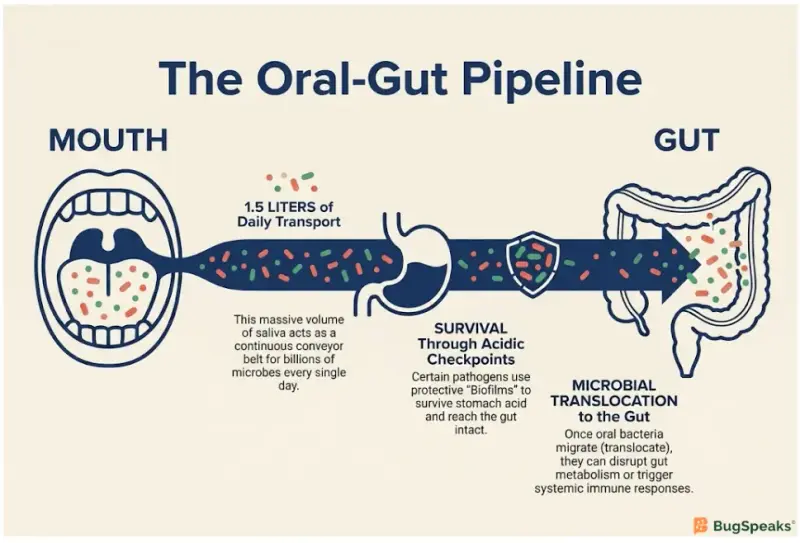
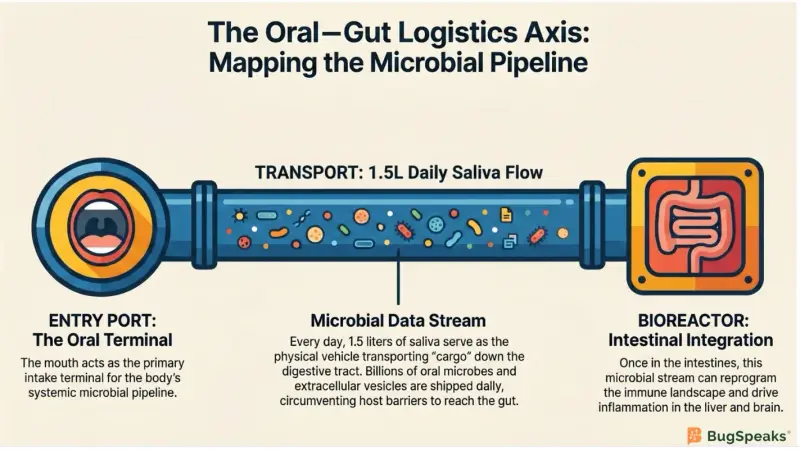
No, the mouth is the primary intake terminal for a massive, high-speed industrial pipeline known as the Oral-Gut Axis that continuously delivers microbial data into your system. From a biological systems engineering perspective, we can no longer view the oral cavity as a separate, independent room; it is a highly integrated route where oral microbes modulate your body’s internal securityLi et al. (2026). Every single day, your mouth produces about 1.5 liters of saliva, which acts as a constant transport fluid, carrying billions of oral microbes directly into your downstream digestive tractLi et al. (2026).
Under certain health conditions, this continuous feed of raw microbial material penetrates your downstream security barriers, allowing oral bacteria to interact directly with your Intestinal Epithelial Cells. This interaction initiates a series of signal cascades that can reshape your body's immune balanceLi et al. (2026). Once Translocation occurs and these microbes reach the gut, they actively disrupt local microbial metabolism and trigger immune sensors. Consequently, the mouth acts as the upstream command center, dictating the efficiency of your internal "bioreactors" and triggering immune activation across the entire body.
How does the 'refinery' in the mouth regulate internal pressure?
The mouth functions as a sophisticated chemical refinery that performs the first critical step in Enterosalivary Circulation to manage your systemic blood pressure. Specialized oral bacteria residing on the back of the tongue act as "sensors" that reduce dietary nitrates into NitriteLi et al. (2026). Once this Nitrite-rich saliva is swallowed, it is converted into Nitric Oxide (NO), which acts as the body’s primary "Pressure Relief Valve."
This molecule travels through your pipeline to relax blood vessels and regulate the "Pipe Pressure" of your cardiovascular system. However, when you disrupt this refinery by using harsh antiseptic mouthwashes, these sensors are eliminated, leading to a "Software Crash" in your blood pressure regulation. This proves that your oral microbial hardware is a primary regulator of heart health and systemic pressure.
How does 'contaminated cargo' move along the pipeline?
Pathogenic oral bacteria act as "rogue agents" that bypass the stomach’s acid barriers to settle in the intestines, causing industrial-scale disruption. The physical and chemical checkpoints of the gastrointestinal pipeline, specifically upper digestive acids and bile salts are engineered to prevent the colonization of the gut by oral bacteria. However, certain "Adaptive Pathogens," such as Porphyromonas gingivalis and Fusobacterium nucleatum, exhibit exceptional acid tolerance, allowing them to survive these checkpoints and move downstreamFrontiers (2024).
Furthermore, these bacteria utilize sophisticated logistical strategies, such as forming a Biofilm, to create a protective shield that allows them to pass through the stomach intact. This "Contaminated Cargo" disrupts your internal balance by impairing intestinal barrier function and releasing Endotoxins into your bloodstreamXu et al. (2025). This disruption generates a systemic pro-inflammatory state that is directly linked to the pathogenesis of serious issues like hypertension, diabetes, and heart diseaseXu et al. (2025).
Table 1: Pathogen Transit Log
How do 'security drills' in the pipeline protect the host?
Before the cargo reaches the deep gut bioreactors, it passes through "Security Drill Centers" called Peyer’s Patches to train your body’s defensive protocols. Here, specialized immune cells sample the incoming oral microbial data to "teach" your security teams how to react. When the intake terminal delivers high-quality data from friendly, Commensal bacteria, the security teams remain calm and the system runs smoothly.
However, if the terminal seeds the pipeline with high-alert pathogens, it causes a "Mis-training" called Th17-priming. This causes your immune drones to accidentally attack your own internal infrastructure, fueling the systemic "Internal Fires" often associated with autoimmune conditions and chronic inflammatory crashes. Maintaining the quality of the data at the intake port is the only way to ensure the security drills don't lead to a self-inflicted system failure.
What are the 'high-speed data packets' in the logistics chain?
Bacterial Extracellular Vesicles (BEVs) act as nanosized, high-speed couriers that deliver inflammatory instructions directly from your mouth to your gut. In this biological logistics network, the transportation of active pathogens is only one way the system is disrupted; it also uses these specialized carriers to transmit pathogenic data across long distancesFu et al. (2025). These vesicles are incredibly stable and have an exceptional capacity to penetrate your body's physiological barriersFu et al. (2025).
These data packets are heavily loaded with Virulence Factors toxic molecules that directly damage your tissues. Once inside the gut, these vesicles disrupt intestinal epithelial barrier integrity by degrading critical Tight Junctions like ZO-1 and occludinFu et al. (2025). Simultaneously, they act as master "hijackers" of your immune system, triggering a massive release of pro-inflammatory signals like Cytokines that put your entire body on high alertFu et al. (2025).
Can a 'port security breach' cause internal fires?
Oral microbes trigger systemic inflammation by "short-circuiting" the immune sensors in your intestinal lining, executing a catastrophic port security breach. These microbes produce proteolytic enzymes that rapidly degrade your Tight Junctions, destroying the structural integrity of your intestinal wallLi et al. (2026). Once the physical barrier is compromised, MAMPs and endotoxins leak freely into your circulation, initiating widespread, systemic "fires" known as chronic inflammation.
This localized breakdown acts as a signal amplifier, funneling inflammatory products directly to the liver and causing conditions like MASLDXu et al. (2025). Furthermore, these unchecked signals can even bypass the blood-brain barrier, reaching your central nervous system to induce Neuro-inflammation, which is linked to memory loss and cognitive declineXu et al. (2025).
Does a faulty intake terminal lead to 'structural decay'?
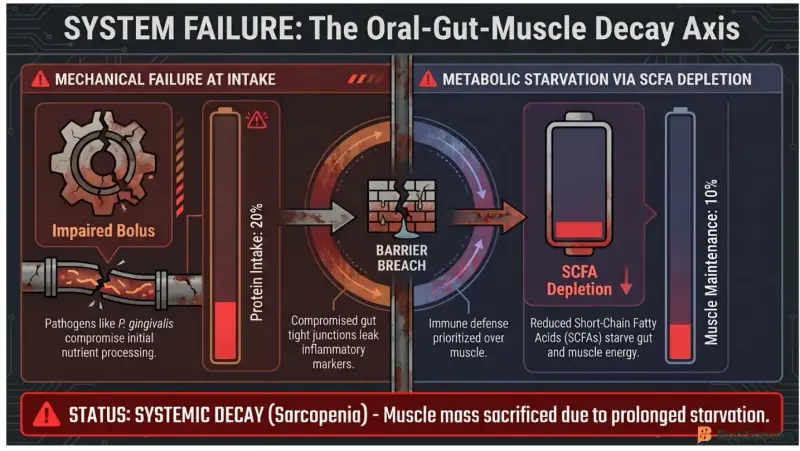
Chronic oral dysbiosis is a primary driver of frailty and muscle loss, technically known as Sarcopenia, by disrupting your gut's ability to process nutrients. When your intake terminal (the mouth) malfunctions, it initiates a cascade of "structural decay" throughout your physical infrastructureAzzolino et al. (2025). This compromised terminal impairs you in two ways: mechanical failure and metabolic starvation.
Mechanically, poor oral health prevents you from chewing properly, which reduces the Bioavailability of essential proteins needed for muscle strengthAzzolino et al. (2025). Metabolically, translocating oral pathogens disrupt the production of critical microbial fuels like Short-Chain Fatty Acids (SCFAs). For example, the SCFA known as Acetate is heavily used by muscle cells for energy; its loss due to an unhealthy mouth directly promotes muscle wastingAzzolino et al. (2025).
Table 2: Structural Decay Markers
How do we achieve 'total pipeline integrity'?
Achieving total pipeline integrity requires a systems-engineering approach that fortifies the intake terminal and recalibrates the downstream gut through Crosstalk signaling. Interventions targeting the communication between the mouth and gut can intercept inflammatory signals before they cause catastrophic system crashesFu et al. (2025). One promising solution uses "maintenance drones" next-generation probiotics like Akkermansia muciniphila to act as a protective barrier. These beneficial bacteria suppress the toxins of oral pathogens and stop Inflamm-aging, preserving the functional lifespan of your entire bodyFu et al. (2025).
-Varsha V
Visualize the process- https://youtu.be/l6gZAkFRaDE
Reference
Li, C., Fan, Y., & Chen, X. (2026). Oral microbiota-driven immune modulation along the oral-gut axis: from local signals to systemic inflammation. NPJ biofilms and microbiomes, 12(1), 46. https://doi.org/10.1038/s41522-026-00912-0
Azzolino, D., Carnevale-Schianca, M., Bottalico, L., Colella, M., Felicetti, A., Perna, S., Terranova, L., Garcia-Godoy, F., Rondanelli, M., Passarelli, P. C., & Lucchi, T. (2025). The Oral-Gut Microbiota Axis as a Mediator of Frailty and Sarcopenia. Nutrients, 17(15), 2408. https://doi.org/10.3390/nu17152408
Xu, Q., Wang, W., Li, Y., Cui, J., Zhu, M., Liu, Y., & Liu, Y. (2025). The oral-gut microbiota axis: a link in cardiometabolic diseases. NPJ biofilms and microbiomes, 11(1), 11. https://doi.org/10.1038/s41522-025-00646-5
Fu, W., Yang, N., Yan, J., Han, B., Niu, Q., Li, Z., Bai, R., & Yu, T. (2025). Oral-Gut Microbial Crosstalk and Therapeutic Applications of Bacterial Extracellular Vesicles. Biomolecules, 16(1), 26. https://doi.org/10.3390/biom16010026
https://www.frontiersin.org/journals/microbiology/articles/10.3389/fmicb.2024.1475159/full