What is the hidden fungal kingdom inside your gut?
Your gut is home to a tiny but very powerful community of fungi known as the mycobiomeButtar et al. (2024). While bacteria are much more numerous, these fungal organisms make up about zero point one percent of the total microbial biomass in your digestive systemMedoro et al. (2026). They do not just sit there quietly; instead, they act like quiet neighbors who share the same apartment building with bacteria and your body's own cells. Together, they constantly talk to each other to help maintain a healthy, balanced environment that keeps your body working properly and feeling great every single day.
Most of the fungi in your digestive system are commensal organisms, meaning they live in harmony with your bodySantus et al. (2021). These friendly fungi, such as helpful yeast strains, rely on the food you eat to survive and growButtar et al. (2024). In return, they help break down nutrients and train your immune system so it can recognize friendly microbes versus dangerous invadersZhang et al. (2025). When the environment is stable, this partnership is peaceful, keeping your intestinal barrier strong and preventing unnecessary, painful, or harmful immune reactions.
If this delicate balance is disrupted by poor diet, stress, or antibiotics, it can trigger a state called dysbiosisButtar et al. (2024). Santus et al. (2021). When these threads spread, they can irritate your gut lining, leading to increased inflammation and making you more susceptible to conditions like inflammatory bowel disease (IBD)Buttar et al. (2024). Eating the right foods is the most effective way to prevent this imbalance, soothe your gut lining, and keep your microenvironment working in a safe, cooperative manner.
How do culinary mushrooms send helpful signals to your gut?
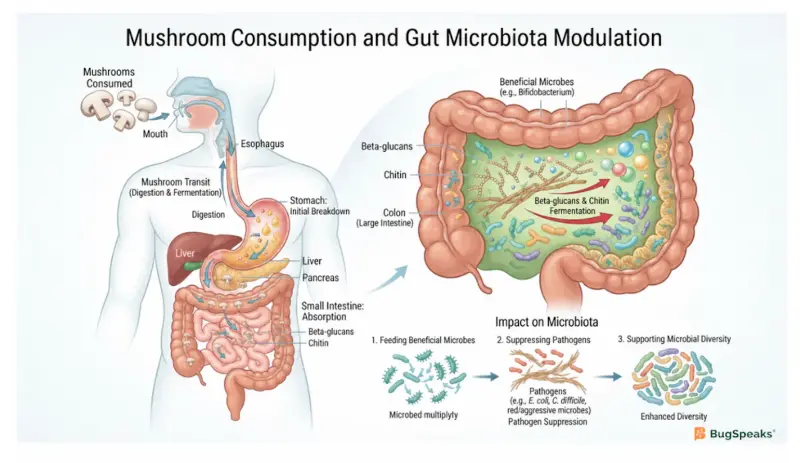
Eating mushrooms like Oyster, Shiitake, and Lion's Mane alters your gut environment by acting as targeted nutritional modifiers through their prebiotic fibers, like beta-glucans and chitinJin et al. (2025). These mushrooms contain a wealth of complex prebiotic fibers that your human digestive juices cannot break down on their ownKeigler et al. (2026). Because these fibers survive the journey through your stomach, they arrive intact in your colon, where they serve as specialized nourishment for beneficial microbes. This process changes the physical chemistry of your gut, encouraging friendly bacteria like Bifidobacterium, Lactobacillus, Bacteroides, and Akkermansia to multiply while making it very difficult for harmful, disease-causing pathogens like E. coli and Salmonella to colonize your intestinal tract and cause problems.
The most important prebiotic fibers found in these culinary mushrooms are called beta-glucansMirończuk-Chodakowska et al. (2021). Unlike the linear fibers found in oats or barley, mushroom-derived glucans have unique, complex branching structures with specific linkagesDicks and Ellinger (2020). These complex branches make the fibers highly fermentable, allowing them to act as a slow-release fuel source for your resident microbesKeigler et al. (2026). As your gut bacteria ferment these branching sugars, they produce beneficial gases like hydrogen and acidify the local environment, which naturally keeps dangerous, disease-causing bacteria from taking over your gut or disrupting your health.
Another critical structural component of the mushroom cell wall is a tough, insoluble fiber known as chitinKeigler et al. (2026). Chitin works like a protective shield, giving the mushroom its firm texture and wrapping around other soluble sugarsDicks and Ellinger (2020). Although it is very tough, specialized bacteria like Bacteroides in your gut can slowly digest this fiber, releasing smaller sugar molecules that feed other beneficial microbesKeigler et al. (2026). This slow, steady breakdown ensures that your gut has a continuous supply of energy, which supports a highly diverse microbial population and strengthens the protective mucus lining of your intestines.
Why do bacteria and fungi share food in the gut?
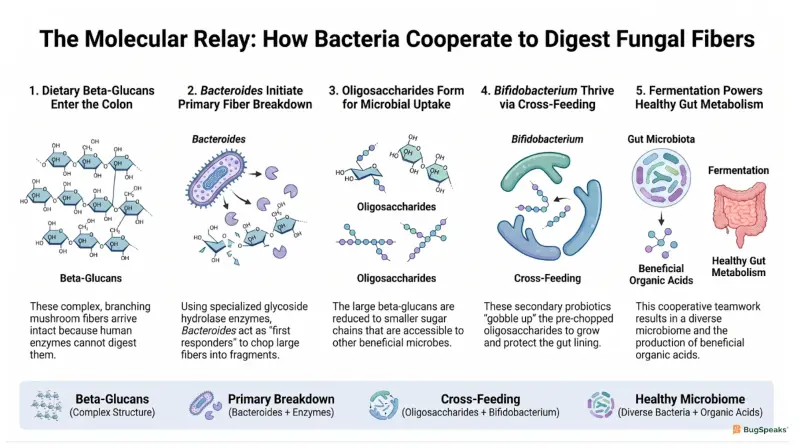
Your gut microbes work together through a cooperative sharing process known as inter-kingdom cross-feedingFernandez-Julia et al. (2023). Fungal cell walls are too large and complex for many probiotic microbes like Bifidobacterium to break down large fibers into bite-sized piecesFernandez-Julia et al. (2023). Once these large fibers are broken down, the resulting smaller sugars are released into the local environment, providing a vital food source for secondary beneficial microbes. This cooperative teamwork ensures that no nutritional resources are wasted, allowing a diverse range of microbes to thrive together in harmony.
A group of highly specialized bacteria belonging to the genus Bacteroides acts as the primary degraders of these mushroom fibersFernandez-Julia et al. (2023). These microbes contain specialized genetic clusters that act like toolbox systems, allowing them to detect, bind, and chop complex fungal sugarsFernandez-Julia et al. (2023). They secrete custom enzymes (called glycoside hydrolases) that clip the tough branches of the fibers, breaking them down into smaller piecesFernandez-Julia et al. (2023). By digesting these complex mushroom carbohydrates, they keep the energy flowing through the gut ecosystem and prevent the buildup of undigested waste that could otherwise promote the growth of harmful, toxic pathogens.
Probiotic partners like Bifidobacterium and Lactobacillus act as secondary consumers, gobbling up the pre-chopped fibersFernandez-Julia et al. (2023). While these friendly bacteria lack the heavy machinery to tackle large mushroom fibers on their own, they are incredibly efficient at absorbing the smaller oligosaccharides left behindFernandez-Julia et al. (2023). When you eat culinary mushrooms, you are essentially feeding this entire molecular relay teamKeigler et al. (2026). This cooperative feeding loop dramatically increases the populations of these protective, health-promoting microbes, which shield your gut lining, keep your entire digestive tract running smoothly, and help you digest food.
How do mushrooms help train your body's immune defenses?
Your body recognizes fungal cell walls using specialized immune alert sensors called Dectin-1Zhang et al. (2025). These sensors are located on the surface of your intestinal immune cells and act like scanners that specifically read the shape of mushroom beta-glucansButtar et al. (2024). When a fiber binds to this sensor, it triggers a gentle, non-inflammatory signal that keeps your immune cells alert and activeMedoro et al. (2026). This process works like a practice drill for your body's defenses, ensuring they are prepared to fight off real infections without overreacting and causing inflammation in your intestines.
This gentle sensory contact directly encourages the development of peaceful immune cells called regulatory T cellsJin et al. (2025). These specialized cells act like peacekeepers, releasing calming signals that prevent your immune system from attacking friendly microbes or your own tissuesZhang et al. (2025). By promoting the growth of these calming cells, mushroom fibers help resolve chronic, low-grade inflammation in your gut liningButtar et al. (2024). This balancing act is crucial for preventing painful, hyper-reactive inflammatory responses, helping your body maintain a state of long-term immune harmony to keep you healthy.
Furthermore, the fermentation of these fibers by friendly bacteria produces crucial molecules called short-chain fatty acidsJin et al. (2025). These organic acids, such as butyrate, act like a structural sealant, providing the primary energy source for your colonic cellsButtar et al. (2024). They help lock the tight junctions between your gut cells, preventing toxic molecules from leaking into your bloodstreamJin et al. (2025). This epigenetic signaling represses inflammatory pathways, showing that the cooperative partnership between mushroom fibers and gut bacteria is essential for protecting your systemic health, shielding your internal organs, and keeping your daily energy high.
How does this gut conversation influence the rest of your body?
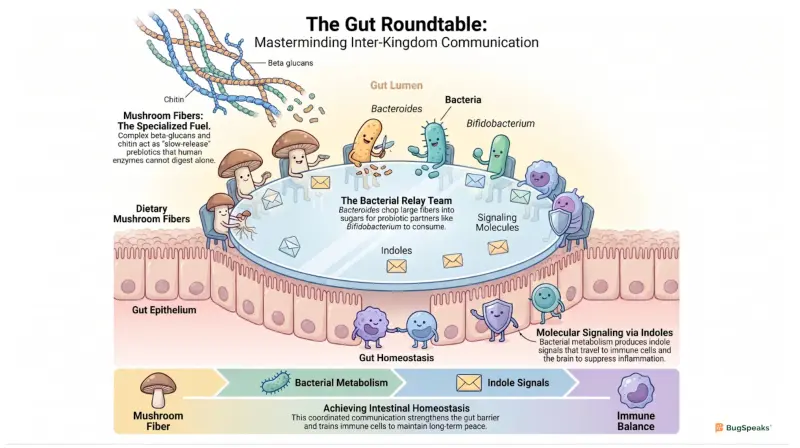
Your gut and brain are connected by a highly active communication highway called the gut-brain axisMedoro et al. (2026). This system allows your gut microbes to send direct signals to your central nervous system through nerve pathways and hormonesMedoro et al. (2026). When your gut is balanced, it produces a steady flow of beneficial metabolites that support healthy brain functionMedoro et al. (2026). Conversely, an imbalanced, inflamed gut can send distress signals to the brain, contributing to fatigue, anxiety, and mood changes, which highlights why keeping your gut kingdoms is essential for your mental well-being.
A key amino acid involved in this long-distance brain communication is called tryptophanMedoro et al. (2026). When you eat mushrooms, helpful gut bacteria convert this amino acid into protective molecules called indolesMedoro et al. (2026). These indoles travel through your blood and bind to specialized receptors called aryl hydrocarbon receptors (AhR) in your brain, helping to suppress neuroinflammation and protect your nerve cellsMedoro et al. (2026). This tryptophan pathway acts like a calming shield, showing how eating healthy fungal foods can directly soothe your nervous system, support your cognitive health as you grow older, and keep your highly active mind sharp.
In addition, these bacterial metabolites stimulate the release of a metabolic hormone called glucagon-like peptide-1Lai et al. (2024). This hormone, produced by specialized cells in your gut, travels to your brain to signal that you are full and satisfiedLai et al. (2024). By encouraging the release of this satiety hormone, mushroom fibers help regulate your appetite and blood sugar levels naturallyLai et al. (2024). This demonstrates that the quiet daily dialogue between fungi, bacteria, and your body is the ultimate biological control system for your metabolism, insulin production,and your overall daily physical energy.
Visualize the process- https://youtu.be/VXZHMi9nCqY
Reference
Mirończuk-Chodakowska, I., Kujawowicz, K., & Witkowska, A. M. (2021). Beta-Glucans from Fungi: Biological and Health-Promoting Potential in the COVID-19 Pandemic Era. Nutrients, 13(11), 3960.https://doi.org/10.3390/nu13113960
Santus, W., Devlin, J. R., & Behnsen, J. (2021). Crossing Kingdoms: How the Mycobiota and Fungal-Bacterial Interactions Impact Host Health and Disease. Infection and immunity, 89(4), e00648-20.https://doi.org/10.1128/IAI.00648-20
Fernandez-Julia, P., Black, G. W., Cheung, W., Van Sinderen, D., & Munoz-Munoz, J. (2023). Fungal β-glucan-facilitated cross-feeding activities between Bacteroides and Bifidobacterium species. Communications biology, 6(1), 576.https://doi.org/10.1038/s42003-023-04970-4
Dicks, L., & Ellinger, S. (2020). Effect of the Intake of Oyster Mushrooms (Pleurotus ostreatus) on Cardiometabolic Parameters-A Systematic Review of Clinical Trials. Nutrients, 12(4), 1134.https://doi.org/10.3390/nu12041134
Lai, M. D., Ong, K. C., Arumugam, B., & Kuppusamy, U. R. (2024). Nutritional composition, efficacy and mechanisms of oyster mushrooms (Pleurotus spp.) in preventing metabolic syndrome: Insights into perspectives and challenges. Food Bioscience, 61, 104768.
Buttar, J., Kon, E., Lee, A., Kaur, G., & Lunken, G. (2024). Effect of diet on the gut mycobiome and potential implications in inflammatory bowel disease. Gut microbes, 16(1), 2399360.https://doi.org/10.1080/19490976.2024.2399360
Medoro A, Castagnetti A, Intrieri M, Scapagnini G and Davinelli S (2026) Diet, mycobiome and virome: from mucosal immunity to gut–brain axis regulation. Front. Nutr. 13:1873950. doi: 10.3389/fnut.2026.1873950
Zhang, T., Guo, F., Zhang, C., & Xiang, Y. (2025). Decoding the role of gut mycobiota in immune regulation and disease. Virulence, 16(1), 2541704.https://doi.org/10.1080/21505594.2025.2541704
Tafesh, A., Najami, N., Jadoun, J., Halahlih, F., Riepl, H., & Azaizeh, H. (2011). Synergistic antibacterial effects of polyphenolic compounds from olive mill wastewater. Evidence-based complementary and alternative medicine : eCAM, 2011, 431021.https://doi.org/10.1155/2011/431021
Jin, Y., He, J., Fan, D., Wang, L., Cui, N., Liu, Y., & Liu, D. (2025). Application of edible fungi in gut microbiota regulation. NPJ science of food, 10(1), 24.https://doi.org/10.1038/s41538-025-00671-w
Keigler, J. I., Leite Nobrega de Moura Bell, J. M., & Marco, M. L. (2026). Myco-foods and the gut microbiome: impacts of mycelial extracts, biomass, and mold-fermented foods. Gut microbes, 18(1), 2677948.https://doi.org/10.1080/19490976.2026.2677948