Why Do Sore Spots Appear in Your Mouth When You Lack Vitamin B12?
Sore spots appear in your mouth because a lack of Vitamin B12 stops your body from making new cells to keep your mouth lining healthy and strongLešić et al. (2024). Your mouth lining is like a fast-moving conveyor belt that needs to be replaced every 3 to 7 days. When you lack this key vitamin, the conveyor belt slows down, and tiny holes start to break open. These painful holes are what we call Recurrent Aphthous Stomatitis (RAS), or simple mouth ulcersLešić et al., 2024). These sores are the first red flag that your body is running low on fuel.
These mouth sores to other strange things happening in your body, like feeling very tired or having a tingly tongueBoukssim and Chbicheb (2024). These clues are not random, but are actually linked to the same underlying problem of low B12. When you do not have enough B12, your body cannot make healthy red blood cells, which causes a condition called Pernicious AnemiaBoukssim and Chbicheb (2024). This means less oxygen reaches your tissues, leading to constant fatigue, body numbness, and a sore, swollen tongue, which scientists call glossitisLešić et al. (2024).
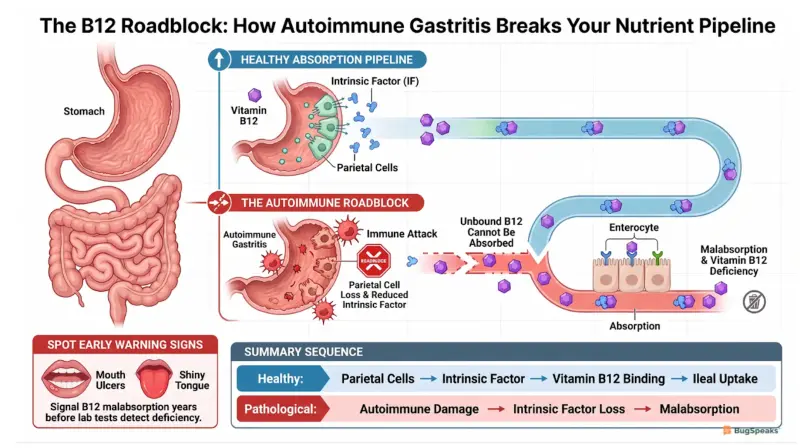
These early signs are very important because they usually show up in your mouth long before a laboratory blood test can detect the deficiencyBoukssim and Chbicheb (2024). Your tongue can become smooth and shiny because the tiny bumps on it, called filiform papillae, start to shrink and fade awayLešić et al. (2024). This shiny look is a clear clue that the mouth lining is struggling to maintain its protective barrier. By looking closely at these mouth clues, we can spot a nutritional gap and start fixing the problem before it causes serious damage to your nervous system.
How Does a Problem in Your Stomach Cause Sickness in Your Mouth?
A problem in your stomach causes mouth sickness because your stomach lining is the primary gatekeeper needed to absorb Vitamin B12 from your foodBoukssim and Chbicheb (2024). Your stomach has special working parts called parietal cells that make a protein helper called Intrinsic Factor (IF)Boukssim and Chbicheb (2024). This helper acts like an escort that grabs B12 in your stomach and carries it safely to your intestines for absorption. If your body mistakenly attacks its own stomach lining, these special cells get worn down and stop making this helper, which is a condition called atrophic gastritisLešić et al. (2024).
This autoimmune attack acts like a roadblock on our symptom timeline, stopping the vital escort protein from doing its jobBoukssim and Chbicheb (2024). Without this escort helper, the Vitamin B12 from your daily meals cannot get into your bloodstream, no matter how much healthy food you eat. The vitamin is simply carried away as waste, leaving your body tissues starving for the fuel they need to grow and repair. This stomach roadblock is the real root cause behind the painful mouth ulcers and red, burning patches that appear on your palate, warning us that your absorption pipeline is completely broken.
This stomach roadblock is often called Pernicious Anemia, a slowly growing disease that can hide for ten or twelve years before it is diagnosedBoukssim and Chbicheb (2024). During this quiet time, you might feel some fatigue, but your mouth is already posting warning notes Boukssim and Chbicheb (2024). Evaluating B12 levels in patients with oral sores is extremely important because dentists can often spot this silent stomach issue first. Doctors can use B12 shots or high-dose pills to bypass the stomach roadblock and heal your bodyBoukssim and Chbicheb (2024).
How Do Oral Pathogens Travel Down to Your Gut to Cause Damage?
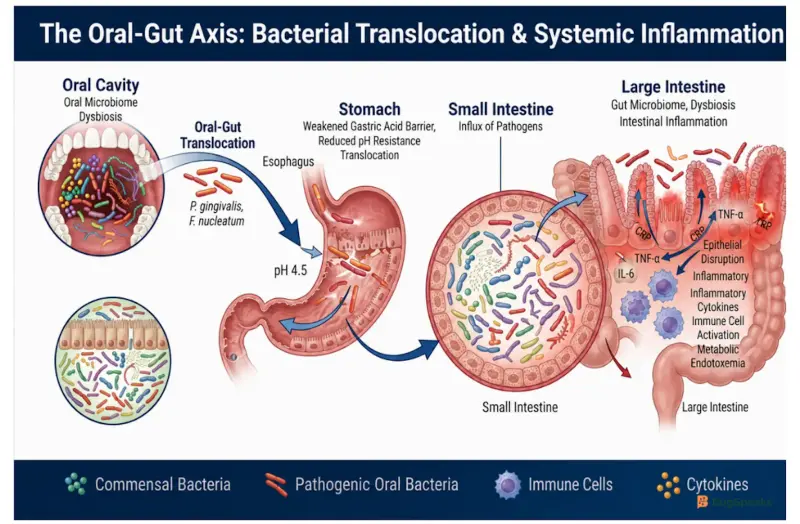
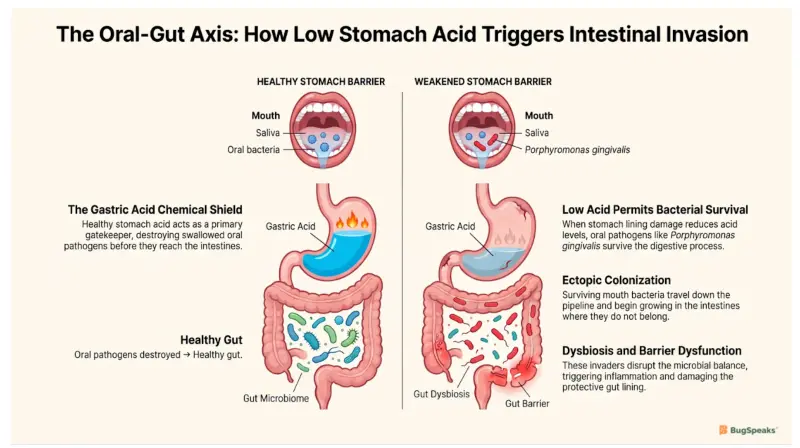
Oral pathogens travel down to your gut because swallowing carries millions of mouth bacteria directly into your stomach every single dayXu et al. (2025). Usually, your stomach has a strong chemical shield made of gastric acid that kills these invaders before they go any further down your digestive tract. But when B12 is low due to stomach lining damage, your stomach acid levels can drop significantly, weakening this protective barrier. This allows bad mouth bacteria, such as Porphyromonas gingivalis, to slip through the stomach and easily enter your intestines, a process called salivary microbial translocationXu et al. (2025).
This leakage of mouth bacteria down the digestive pipeline is known as ectopic colonization, which simply means bacteria growing in places they do not normally belongXu et al. (2025). When these mouth invaders settle in your gut, they disrupt your normal bacterial balance, causing a state called dysbiosisWang et al. (2024). These bad bacteria release harmful toxins like lipopolysaccharide (LPS) and zonula occludens toxin (Zot), which trigger gut inflammationand cause irritation, which can trigger inflammatory bowel disease (IBD) in sensitive peopleWang et al. (2024). On our symptom clue board, we can clearly see how a weak stomach barrier connects mouth health directly to gut troubles, pain, and systemic inflammation.
This mouth-to-gut connection is a two-way street where a problem in one area can quickly cause problems in the otherWang et al. (2024). For example, when mouth bacteria like Porphyromonas gingivalis disrupt your gut, they damage your intestinal lining and cause gut leakage. This gut leakage allows toxins to travel through your blood, leading to system-wide inflammation that can make your mouth sores even worse than before. By keeping your mouth clean, brushing your teeth regularly, and using safe mouth rinses, you can reduce the bad bacteria in your saliva, protecting your stomach and gut from these invading forces.
How Does Vitamin B12 Rebuild Your Injured Gut Lining?
Vitamin B12 rebuilds your injured gut lining by activating a special protective pathway called the hypoxia-inducible factor-1 (HIF-1) signaling pathwayFeng et al. (2024). This healing pathway acts like a team of expert construction workers that turns on when your body tissues are damaged or low on oxygen. When Vitamin B12 enters your gut, it stimulates this pathway to start rebuilding the broken areas of your intestines. This pathway helps repair the outer layer of your gut, ensuring that food can be digested properly while keeping harmful germs from leaking out into your bloodstream or causing any further damage.
This rebuilding process helps fix the microscopic gates in your gut wall, which scientists call tight junction proteins, like OccludinFeng et al. (2024). These proteins act like tiny, secure locks that hold your gut cells tightly together, making the wall strong and leak-proof in your daily life. To measure how tight and secure these gates are in your body, scientists use a test called Transepithelial Electrical Resistance (TEER)Feng et al. (2024). When Vitamin B12 activates the HIF-1 pathway, it increases this resistance score significantly, showing that the gut wall is once again fully sealed and protected against harmful bacterial invaders.
A sealed gut wall means that bad bacteria and toxins can no longer slip into your blood to cause body-wide irritationFeng et al. (2024). This healing process is the ultimate restoration event on our symptom timeline. By repairing the gut barrier, Vitamin B12 helps calm the immune system and reduces the inflammation that triggers recurring mouth ulcers in daily life. This shows that fixing the gut lining is a key step to stopping mouth sores for good, highlighting how closely your stomach, gut, and mouth are linked in daily health, growth, and wellness.
What Happens If You Take Too Much Vitamin B12?
If you take too much Vitamin B12, the excess vitamins can saturate your gut and disrupt the delicate balance of your gut bacteriaForgie et al. (2023). While your body absorbs what it needs, any unabsorbed B12 travels down to your large intestine as waste. This sudden flood of vitamins can change how your gut bacteria compete and share nutrients in your intestines. Instead of helping, this excess B12 can actually reduce the overall diversity of your gut microbiome by depleting helpful groups like Lachnospiraceae and the Clostridia vadinBB60 group, while selectively expanding Proteobacteria like Parasutterella, making it harder for your body to maintain a healthy, balanced, and stable internal ecosystem.
This nutritional flood can deplete a very important family of friendly gut bacteria called LachnospiraceaeForgie et al. (2023). These friendly bacteria act like a protective shield that keeps bad germs from settling in your gut and causing painful infections. When this protective shield is weakened by too much B12 in your gut, it opens up a wide gap for opportunistic pathogens to easily invade your body and trigger disease. For example, in animal studies, this B12 excess allowed a harmful germ called Citrobacter rodentium to colonize your body and cause severe gut damage, diarrhea, and swellingForgie et al. (2023).
This show of pathogen expansion is a final warning. It teaches us a very important rule in biology: more is not always better for your body. Taking moderate amounts of B12 helps heal your gut, but excessive over-supplementation can disrupt your inner microbial communityForgie et al. (2023). By testing your Vitamin B12 levels first with a simple and quick check, you can easily find the perfect balance to keep your mouth, stomach, and gut bacteria working together in harmony, keeping your mouth completely free of painful ulcers and sores for many years to come.
Visualize the process- https://youtu.be/v0IvjBD5Yt8
Reference
Boukssim, S., & Chbicheb, S. (2024). Oral manifestations of vitamin B12 deficiency associated with pernicious anemia: A case report. International journal of surgery case reports, 121, 109931.https://doi.org/10.1016/j.ijscr.2024.109931
Rajasekaran, J. J., Krishnamurthy, H. K., Bosco, J., Jayaraman, V., Krishna, K., Wang, T., & Bei, K. (2024). Oral Microbiome: A Review of Its Impact on Oral and Systemic Health. Microorganisms, 12(9), 1797.https://doi.org/10.3390/microorganisms12091797
Feng, C., Yan, J., Luo, T., Zhang, H., Zhang, H., Yuan, Y., Chen, Y., & Chen, H. (2024). Vitamin B12 ameliorates gut epithelial injury via modulating the HIF-1 pathway and gut microbiota. Cellular and molecular life sciences : CMLS, 81(1), 397.https://doi.org/10.1007/s00018-024-05435-5
Lešić, S., Ivanišević, Z., Špiljak, B., Tomas, M., Šoštarić, M., & Včev, A. (2024). The Impact of Vitamin Deficiencies on Oral Manifestations in Children. Dentistry journal, 12(4), 109.https://doi.org/10.3390/dj12040109
Wang, A., Zhai, Z., Ding, Y., Wei, J., Wei, Z., & Cao, H. (2024). The oral-gut microbiome axis in inflammatory bowel disease: from inside to insight. Frontiers in immunology, 15, 1430001.https://doi.org/10.3389/fimmu.2024.1430001
Xu, Q., Wang, W., Li, Y., Cui, J., Zhu, M., Liu, Y., & Liu, Y. (2025). The oral-gut microbiota axis: a link in cardiometabolic diseases. NPJ biofilms and microbiomes, 11(1), 11.https://doi.org/10.1038/s41522-025-00646-5
Forgie, A. J., Pepin, D. M., Ju, T., Tollenaar, S., Sergi, C. M., Gruenheid, S., & Willing, B. P. (2023). Over supplementation with vitamin B12 alters microbe-host interactions in the gut leading to accelerated Citrobacter rodentium colonization and pathogenesis in mice. Microbiome, 11(1), 21.https://doi.org/10.1186/s40168-023-01461-w