Why has the ancient Indian drumstick tree suddenly re-emerged as a modern superfood?
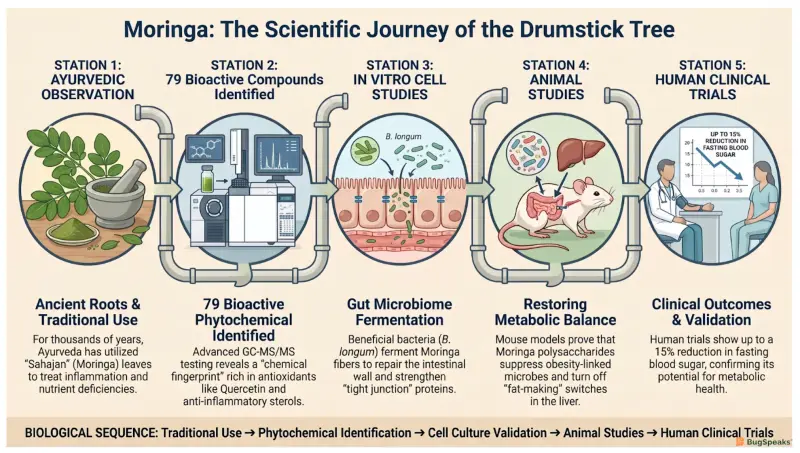
Moringa oleifera, traditionally known as sahajan(in Unani medicine) or shigru (in Malayalam), has re-emerged as a modern superfood because it has a huge amount of vitamins, minerals, and proteins that are much higher than standard healthy foodsKashyap (2022). For thousands of years, families in India recorded how these trees helped heal bodies. Ancient Indian medical books, known as Ayurveda, listed the use of the leaves, pods, and seeds to help with stomach aches, joint pain, and low red blood cellsTaher (2025). This historical record serves as an inspiration map, helping scientists today explore what makes this tree so special for our daily health.
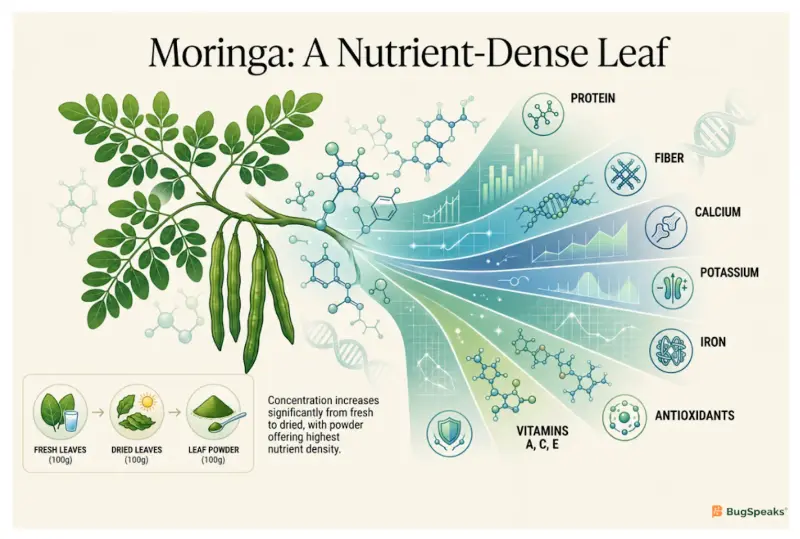
When scientists tested these dried leaves in modern laboratories, they were amazed by the rich nutritional payload. The dry leaf powder contains high-quality proteins, which provide all the essential building blocks our bodies cannot make on their own, like lysine and valineKashyap (2022). It also contains macronutrients like healthy fiber that sweeps out our digestive tubes. Fresh leaves contain more vitamin C than oranges and more calcium than milkPaikra (2017). These natural values make the green leaves an incredibly strong, healthy food that helps malnourished children recover their normal weight rapidlyKashyap (2022).In clinical settings, when malnourished children were administered 10 grams of dried Moringa leaf powder daily, they demonstrated a significant increase in weight gain and experienced a rapid recovery compared to the control group over a 6-month trial period. This rapid recovery is driven by the leaves' high content of digestible proteins, essential amino acids (such as lysine and valine), vitamins (including vitamins A, B, C, and E), and vital minerals like calcium, iron, and potassium
The plant's great power comes from a mixture of special protective compounds called phytochemicals, which are healthy molecules plants make to shield themselves from drought and bugsTaher (2025). Among these compounds, the leaves are packed with natural antioxidant elements like vitamin E, vitamin C, and beta-caroteneKashyap (2022). These antioxidants act like little shields that neutralize harmful oxygen free radicals, which damage our body cellsVargas-Sánchez (2019). Rather than treating this drumstick plant as a magical cure, scientists treat these ancient observations as high-priority clues. They must study each molecule step-by-step to see how they can support our biological health.
What active biochemical molecules does the lab extract from these common green leaves?
Modern laboratory analysis shows that Moringa oleifera leaves contain many active chemical helpers, including isothiocyanates, flavonoids, phenolic acids, sterols, and special non-digestible polysaccharides, which work together to regulate our body systemsTaher (2025),Li (2022). Here, scientists use a highly advanced sorting machine called GC-MS/MS, which stands for Gas Chromatography-Mass Spectrometry/Mass Spectrometry, to separate and identify all the individual volatile compounds found in the leafTaher (2025). By using this advanced tool, researchers can draw an exact chemical fingerprint of the leaf's secret molecular power.
In these chemical screenings, researchers identified exactly seventy-nine distinct bioactive compounds inside the leaf extractTaher (2025). The most abundant molecule is called 4,5-dimethoxy-2-biphenylcarboxylic acid, which makes up over one-third of the entire leaf mixture and has strong antibacterial qualitiesTaher (2025). They also found healthy plant sterols like gamma-sitosterol and stigmasterol, which help lower unhealthy blood cholesterol levels, stop inflammation, and keep cells growing normallyTaher (2025). Another important antioxidant they isolated is called quercetin, a special flavonoid compound that blocks swelling in the body, regulates sugar, and protects our vital body cells from daily damage in human tissuesKashyap (2022).
When a leaf is chewed or crushed, a special natural enzyme called myrosinase is immediately activated to protect the plantLouisa (2022). This enzyme acts like a molecular key that unlocks a special sulfur compound called glucomoringin, breaking it down to create active isothiocyanatesLouisa (2022). These molecules give the tree its spicy, mustard-like taste and fight harmful germs. The laboratory also found complex polysaccharides, which are long fiber chains built from simple sugars called monosaccharides that feed our helpful gut bacteriaLi (2022). This proves the common drumstick leaf is really a miniature, highly sophisticated chemical factory that keeps our bodies running smoothly.
How do gut microbes ferment moringa compounds to repair the intestinal barrier?
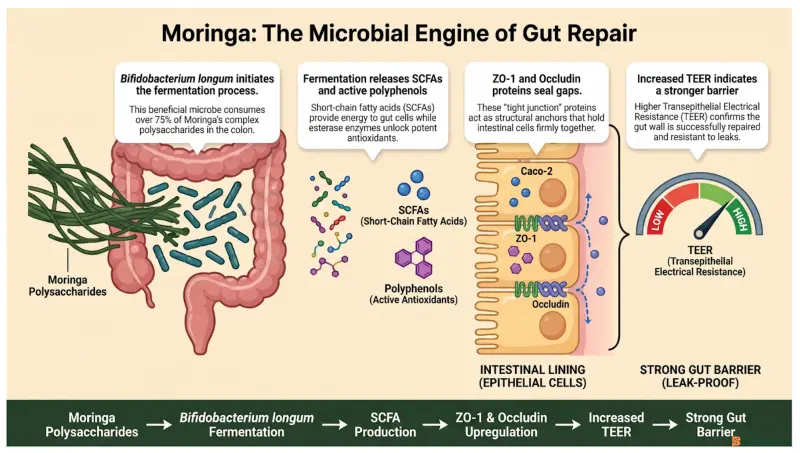
In vitro cell studies show that friendly gut microbes ferment the complex fibers and sugars in Moringa oleifera leaves to produce energy molecules that repair and seal the gut wallKable (2025). When we swallow the leaf's indigestible fiber chains, they slide past our stomach acids and land directly in our colon. There, the resident bacteria use anaerobic fermentation to digest these raw plant sugars, converting them into short-chain fatty acids that feed our gut cells and keep our metabolic systems healthy.
To understand this gut digestion, scientists tested three specific resident microbes: Bifidobacterium longum, Bacteroides thetaiotaomicron, and Escherichia coliKable (2025). They discovered that Bifidobacterium longum grew the most, consuming over seventy-five percent of the plant sugars while releasing free, active antioxidant compounds into the gut Kable (2025). This helpful microbe uses a special enzyme to untie and activate locked-up antioxidants like chlorogenic acid to neutralize dangerous free radicals. This represents a beautiful symbiotic loop where the good bacteria eat the leaf's tough fibers and release health-promoting molecules into our bodies, making us feel strong.
Next, scientists poured these fermented juices onto human Caco-2 cells, which represent a model of our intestinal wallKable (2025). They measured the wall's tightness using TEER, or Transepithelial Electrical Resistance, and found that the fermented juices significantly increased the electrical resistanceKable (2025). This confirms that microbes help seal the wall, repairing gaps by rebuilding crucial tight junction proteins called zonula occludens-1 and occludinHusien (2024 - Animals). This repair process also prevents cell apoptosis, which is a form of cell suicide triggered by bacterial toxins, keeping the gut lining strong.
Does science confirm that moringa can reshape the entire gut microbiome to prevent chronic metabolic conditions?
Extensive animal trials show that Moringa oleifera leaves prevent chronic conditions like obesity and gut inflammation by restructuring the gut microbiome and reducing harmful pathogensLi (2022). They cannot show how a complete living body handles these molecules. Therefore, scientists feed standardized Moringa leaves to mice to see how their living organs and blood vessels react. These animal experiments allow us to study the complex connection between the leaf fibers, the gut bacteria, and the whole body's metabolic health, ensuring safe and reliable pathways for eventual human use.
In a twelve-week mouse study, animals eating a high-fat diet were supplemented with Moringa leavesLi (2022). This treatment successfully prevented weight gain, lowered fat storage, and improved insulin levelsLi (2022). Researchers found that the leaves turn down a fat-making switch in the liver called SREBP-1c while turning up energy-burning switchesLouisa (2022). This healthy shift occurred because the leaf polysaccharides completely reshaped the gut bacteria population. They boosted helpful, fiber-eating microbes while systematically suppressing obesity-linked strains, repairing the gut barrier, lowering body fat, and significantly lowering inflammatory markers like IL-6 in the blood streamElabd (2018).
In mice suffering from a severe form of gut inflammation called colitis, Moringa leaf polysaccharides significantly increased bacterial diversity and restored healthy balancesHusien (2024 - Frontiers in Nutrition). At the cell level, this microbial rescue quieted hyperactive inflammatory sensors like TLR4 and MyD88, which are proteins that sound the alarm when toxins enterHusien (2024 - Animals). By quietening these sensors, the treatment stopped the master switch NF-κB from producing tissue-damaging proteins like TNF-α and IL-1βHusien (2024 - Animals). This animal model evidence proves that the leaf's active components work systemically to reverse severe microbial dysbiosis and calm chronic body inflammation.
How does this laboratory success translate to human clinical trials?
Human clinical trials show that Moringa oleifera leaves provide mild and variable glycemic and cardiovascular benefits, meaning that raw traditional hype has outpaced solid clinical proofVargas-Sánchez (2019),Louisa (2022). It is a strict law of science that success in a rodent cage does not automatically translate to the human body. Our human systems are much more complex, shaped by different genetics, diets, and lifestyles. Thus, while animal tests show uniform glycemic benefits, human preclinical translation is still in its infancy, requiring many more structured clinical trials to confirm these initial claims.
A systematic review of current human trials reveals a significant gap between animal results and human reality. For example, in a three-month test of postmenopausal women, eating seven grams of dried Moringa leaf powder daily successfully reduced fasting blood sugar by fifteen percentVargas-Sánchez (2019). However, in another study of type 2 diabetes patients taking four grams of Moringa capsules daily for a month, researchers found no significant differences in fasting glucose or HbA1c levels compared to the placebo groupVargas-Sánchez (2019). These conflicting results prove that the superfood effect is highly variable, depending on the dosage, duration, and patient state.
Despite these mixed trial results, science confirms that the drumstick tree is a safe, highly nutritious, and exceptional food choiceLouisa (2022). Its outstanding payload of proteins, antioxidants, and unique fibers offers daily support for our bodies and gut microbiomeKashyap (2022). While we still need larger human RCTs to fully understand its clinical power, adding this traditional green leaf to our diet is a proven, excellent way to boost overall wellnessTaher (2025). Ultimately, this ancient plant beautifully bridges traditional Indian wisdom and modern laboratory research, showing that sahajan is truly a highly valuable gift for our health.
Visualize the process- https://youtu.be/hspBgHlKsp0
Reference
Taher, M. A., Islam, M. A., Tasmi, S. F., Hasan, M. M., Hasnat, H., Shompa, S. A., Hossain, M. R., Afroze, M., Nazowa, M. S., & Khan, M. (2025). Phytochemical profiling and bioactivity validation of Moringa oleifera leaves: Antimicrobial, antidiarrheal, analgesic, and in silico insights. PloS one, 20(9), e0332048. https://doi.org/10.1371/journal.pone.0332048
Husien HM, Rehman SU, Duan Z and Wang M (2024) Effect of Moringa oleifera leaf polysaccharide on the composition of intestinal microbiota in mice with dextran sulfate sodium-induced ulcerative colitis. Front. Nutr. 11:1409026. doi: 10.3389/fnut.2024.1409026
Paikra, B. K., Dhongade, H. K. J., & Gidwani, B. (2017). Phytochemistry and Pharmacology of Moringa oleifera Lam. Journal of pharmacopuncture, 20(3), 194–200. https://doi.org/10.3831/KPI.2017.20.022
Chiș, A., Noubissi, P. A., Pop, O. L., Mureșan, C. I., Fokam Tagne, M. A., Kamgang, R., Fodor, A., Sitar-Tăut, A. V., Cozma, A., Orășan, O. H., Hegheș, S. C., Vulturar, R., & Suharoschi, R. (2023). Bioactive Compounds in Moringa oleifera: Mechanisms of Action, Focus on Their Anti-Inflammatory Properties. Plants (Basel, Switzerland), 13(1), 20. https://doi.org/10.3390/plants13010020
Kable, M. E., Storms, D. H., Alkan, Z., Muriki, M., DeVries, D., Waterman, C., & Lemay, D. G. (2025). Gut Microbe Fermentation of Moringa oleifera Leaf Extract Increases Measurable Polyphenols and Improves Barrier Function in a Cell Culture Model. MicrobiologyOpen, 14(6), e70068. https://doi.org/10.1002/mbo3.70068
Husien, H. M., Peng, W., Essa, M. O. A., Adam, S. Y., Ur Rehman, S., Ali, R., Saleh, A. A., Wang, M., & Li, J. (2024). The Anti-Inflammatory Properties of Polysaccharides Extracted from Moringa oleifera Leaves on IEC6 Cells Stimulated with Lipopolysaccharide In Vitro. Animals, 14(23), 3508. https://doi.org/10.3390/ani14233508
Kashyap, P., Kumar, S., Riar, C. S., Jindal, N., Baniwal, P., Guiné, R. P. F., Correia, P. M. R., Mehra, R., & Kumar, H. (2022). Recent Advances in Drumstick (Moringa oleifera) Leaves Bioactive Compounds: Composition, Health Benefits, Bioaccessibility, and Dietary Applications. Antioxidants, 11(2), 402. https://doi.org/10.3390/antiox11020402
Elabd, E. M. Y., Morsy, S. M., & Elmalt, H. A. (2018). Investigating of Moringa Oleifera Role on Gut Microbiota Composition and Inflammation Associated with Obesity Following High Fat Diet Feeding. Open access Macedonian journal of medical sciences, 6(8), 1359–1364. https://doi.org/10.3889/oamjms.2018.313
Li L, Ma L, Wen Y, Xie J, Yan L, Ji A, Zeng Y, Tian Y and Sheng J (2022) Crude Polysaccharide Extracted From Moringa oleifera Leaves Prevents Obesity in Association With Modulating Gut Microbiota in High-Fat Diet-Fed Mice. Front. Nutr. 9:861588. doi: 10.3389/fnut.2022.861588
Louisa, M., Patintingan, C. G. H., & Wardhani, B. W. K. (2022). Moringa Oleifera Lam. in Cardiometabolic Disorders: A Systematic Review of Recent Studies and Possible Mechanism of Actions. Frontiers in pharmacology, 13, 792794. https://doi.org/10.3389/fphar.2022.792794
Vargas-Sánchez, K., Garay-Jaramillo, E., & González-Reyes, R. E. (2019). Effects of Moringa oleifera on Glycaemia and Insulin Levels: A Review of Animal and Human Studies. Nutrients, 11(12), 2907. https://doi.org/10.3390/nu11122907