The Hidden Threat of Microplastics to Our Gut Microbiome
What Defines Our Baseline Balance and the Invasion of Plastic Grit?
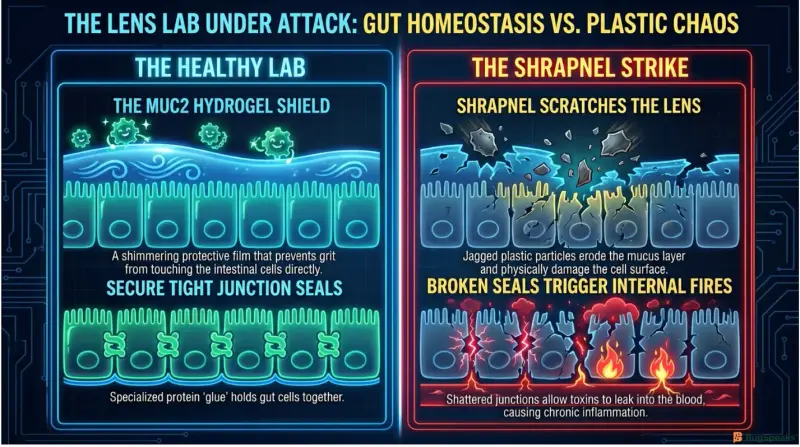
Intestinal homeostasis is a state of perfect balance where your gut functions like a High-Precision Optical Lens Grinding Lab, maintaining a flawless surface to ensure your body can absorb nutrients while keeping out dangerous intruders. In this internal lab, your intestinal lining acts as an elite telescope lens that must be kept perfectly clear and strong to work correctly. This environment is managed by a dynamic fluid filled with nutrients and signals that allow your body to communicate with its internal residents. Within this fluid, trillions of helpful microbes, known as your fining agents, work day and night to produce the fuels and polishes needed to keep your intestinal lenses in top condition. This baseline state is one of incredible harmony, where every chemical reaction is designed to protect the single layer of cells forming the wall of your internal city.
The modern world has disrupted this delicate lab by introducing industrial shrapnel in the form of Micro- and Nanoplastics (MNPs), which are tiny bits of plastic that act like rogue grit in our polishing mixture. Micro- and Nanoplastics (MNPs) are defined as synthetic particles measuring less than 5 millimeters and 1 micrometer, respectively, and they are now found in everything from the water we drink to the seafood we eatSnehamayee et al. (2026). These particles are made of durable materials like Polyethylene (PE) and Polypropylene (PP), which your body’s natural enzymes cannot break down. Instead of passing through safely, this industrial shrapnel stays in the lab, scratching the lenses and jamming the microbial tools used by your workers, turning a healthy lab into an unstable environment where the lenses of your health are constantly under threat.
Human exposure to this plastic grit is now unavoidable, as these particles have become a permanent part of our food chain through degraded packaging and environmental pollution. Estimates show that people may ingest hundreds of thousands of these particles every year, which enter the Gastrointestinal (GI) tract as synthetic intruders. Because the gut is the first place these plastics land, it takes the hardest hit from this continuous toxic assault, altering the baseline microbiome structure. Unlike real food that your microbes can use for energy, these plastic bits exhibit high chemical reactivity due to their large surface area, meaning they actively change the chemistry of your gut. The plastic is predominantly made of synthetic polymers like Polystyrene (PS) and Polyvinyl Chloride (PVC), which are designed to last for hundreds of years, causing the fine-tuning of your gut to break down.
How Does Rogue Grit Scratch the Lenses and Breach the Barrier?
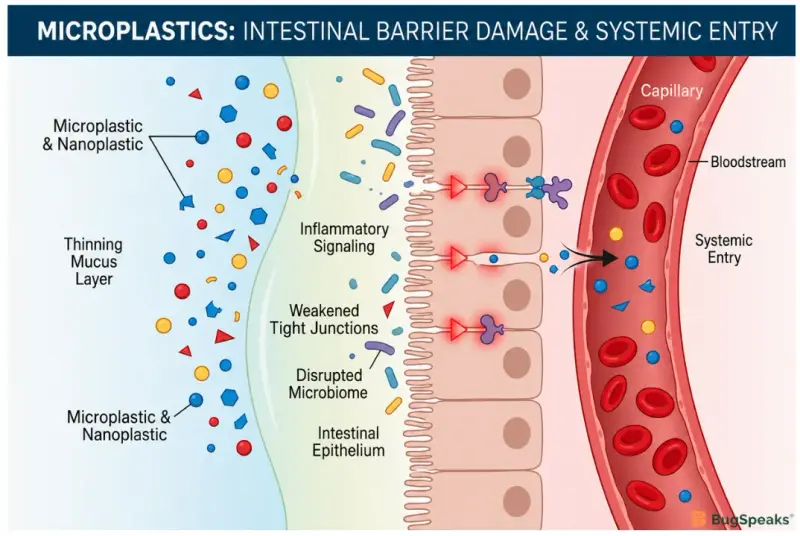
The rogue grit scratches your intestinal lenses by wearing down the mucin layer, which is the protective hydrogel coating that acts as a physical shield for your gut cells. In our lens lab, this mucus is like a thick protective film that prevents dust and grit from touching the glass directly. However, recent research has shown that plastic particles can stick directly to these mucosal proteins, causing the protective coating to thin out and lose its thicknessLazaridis et al. (2025). Once this shield is weakened, the plastic particles can directly attack the tight junctions, which are the specialized protein seals that hold your intestinal cells together to prevent leaks.
When these seals are damaged, the gut enters a state of high permeability, or leaky gut, where dangerous materials from the slurry can slip into your bloodstream. This breach is often the starting point for inflammatory bowel disease (IBD), a condition where the gut is in a constant state of red alert and irritationSaadeh et al. (2026). Very small nanoplastics are particularly sneaky because they can use a process called transcytosis to hitch a ride directly through a cell, bypassing the seals entirely. This is like a tiny thief climbing through a window instead of trying to pick the lock on the door, triggering internal fires of inflammation that the body finds very difficult to put out.
As the grit breaches the lens, it specifically targets the Gut-Associated Lymphoid Tissue (GALT), which is the security department of the lab. Specialized cells accidentally pick up the plastic and carry it directly to the immune system police, where the plastic gets stuck inside, causing them to become confused and aggressive. This confusion means the security guards stop looking for real germs and start attacking everything, including the helpful microbial workers. This friendly-fire situation is a major reason why people with high plastic exposure can feel tired and inflamed, as their body's defense system is distracted by the non-degradable shrapnel that has bypassed the broken cell barriers.
Table 1: Particle Size and Barrier Breach Mechanics
Why Does Shrapnel Jam the Staff and Cause Population Shifts?
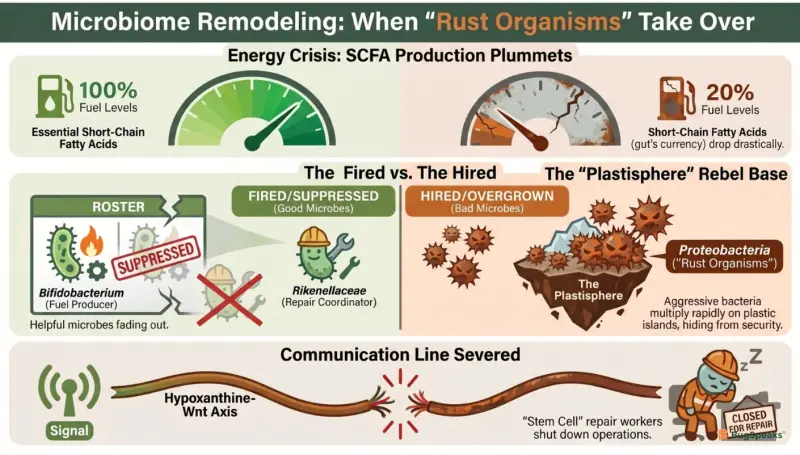
The industrial shrapnel jams your fining agents by chemically altering the lab's environment, which forces a state of dysbiosis where helpful bacteria are replaced by aggressive rust organisms. In a healthy lab, your microbes produce healthy short-chain fatty acids like butyrate, which act as the primary energy source to keep the lens-grinding workstations running smoothly. However, when plastic grit floods the slurry, it changes the balance of your internal staff, drastically reducing the number of expert polishersYang et al. (2026). This shift makes the environment in your gut more toxic, which further damages the delicate lenses you are trying to protect and maintain.
One of the most dangerous effects of this shrapnel is the disruption of the hypoxanthine-wnt axis, a specialized communication system that your gut uses to talk to its stem cells. These stem cells are the master repair workers responsible for creating brand-new cells to replace old or damaged parts of the intestinal lens. Research has shown that when microplastics are present, they strategically deplete microbial families that maintain this pathwayJiang et al. (2024). Without this signal, the repair workers quit, and the gut can no longer fix the scratches caused by the plastic grit, leading to a permanent state of structural decay and a failure of the hematopoietic stem cells to renew.
Furthermore, the plastic particles provide a new, artificial home for bad bacteria known as the "plastisphere," which acts like a floating rebel base where dangerous germs can hide from security guards. This unique ecosystem allows the bad bugs to multiply rapidly while the helpful workers are suppressed by the chemical stress of the plastic. This loss of diversity makes your internal lab less resilient to stress, ensuring that even a small problem can turn into a major health crisis. This creates a vicious cycle: the plastic damages the staff, the staff stops repairing the lab, and the lab becomes more damaged by the plastic, accelerating the decay of hematopoietic stem cells.
Table 2: Gut Microbiome Remodeling and Staff Changes
What Toxic Payloads Are Hidden Within the Shrapnel?
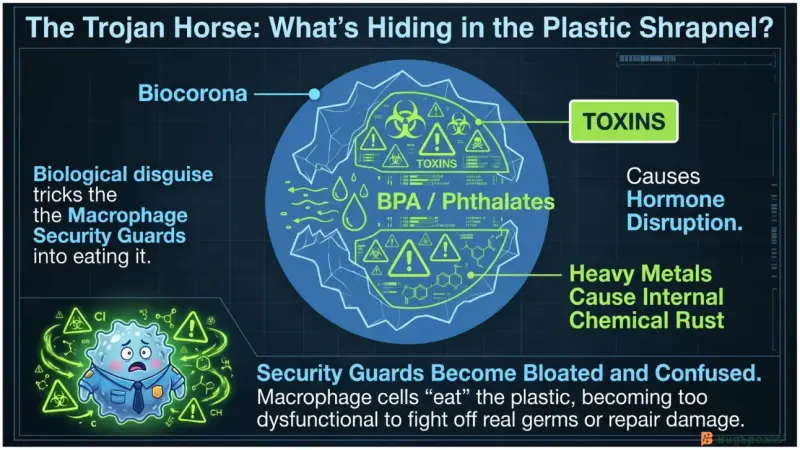
The industrial shrapnel is not just inert grit; it acts as a delivery system for a devastating chemical payload through what scientists call the Trojan Horse effect. When plastic particles enter the gut, they quickly acquire a biocorona, which is a disguise made of proteins and fats that coats the plastic. This mask hides the synthetic nature of the grit, allowing it to sneak past the lab’s security guards, known as macrophages, or trick them into a dangerous overreactionSnehamayee et al. (2026). Once the guards swallow the plastic gift, it releases its hidden poisons, causing the security cells to become bloated and unable to protect the lab.
Beyond the biological disguise, plastics are filled with manufacturing chemicals called plasticizers that can leach out and toxify the entire polishing slurry. Chemicals like Bisphenol A (BPA) are used to make plastics flexible, but they are not permanently bound to the particles, allowing them to seep directly into your system. As the shrapnel travels through the gut, these endocrine disruptors seep into your system, where they interfere with your body’s natural hormones and drive intense localized inflammationSaadeh et al. (2026). This chemical attack makes the seals between your lens cells loose and weak, allowing even more toxins to flood into your internal city.
The rogue grit also acts as a magnet for external poisons like heavy metals and pollutants from the environment. Because plastic has a large and sticky surface area, it carries high doses of these toxins directly to the most vulnerable parts of your intestinal lining, meaning you swallow a concentrated dose of environmental poison. This combination of physical scratching and chemical poisoning creates an immunologically hostile environment where the helpful finding agents cannot survive. Your high-precision lab essentially becomes a toxic waste site where the workstations are under constant chemical attack, driven by leaking plasticizers and sneaky endocrine disruptors that bypass the macrophages.
Table 3: Common Plastic Polymers and Their Toxic Payloads
How Can the Lab Technicians Protect the Workstations?
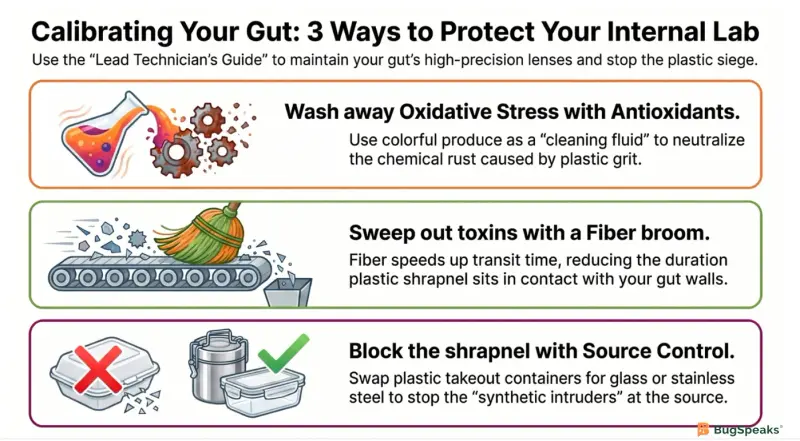
Protecting your high-precision lab from the constant influx of plastic shrapnel requires both reducing your exposure and supporting your body’s natural defense against oxidative stress. Oxidative stress is the chemical rust that forms on your biological workstations when they are exposed to the chemical fires caused by plastics. While we cannot remove every bit of plastic from our world, we can support our lab technicians by eating plenty of antioxidants that neutralize this rust. Compounds found in colorful fruits and vegetables act like specialized cleaning fluids that wash away the corrosive byproducts of the grit, reducing overall intestinal permeabilitySnehamayee et al. (2026).
Another essential strategy is ensuring that your fining agents have plenty of fiber or prebiotics to keep the broom of the digestive tract moving quickly. Fiber increases the bulk of your stool and speeds up the transit time, which reduces the amount of time the rogue grit spends in contact with your intestinal lenses. This limits the chance for the plastic to release its toxic payload or perform the bioaccumulation that leads to long-term poisoning in other organs. By keeping the slurry moving quickly, you ensure that the lab stays as clean as possible, even when environmental contaminants are present, giving your workers the strength they need to clear out the debris.
Finally, we must move toward advanced clinical monitoring to see exactly how these particles are affecting our individual health and barrier stability. Because every person's lab is staffing a different crew of microbes, some people may be more vulnerable to plastic damage than others, making personalized care essentialLazaridis et al. (2025). By treating our gut as a high-precision lab and focusing on barrier health, we can choose glass or stainless steel containers to reduce the amount of grit entering the slurry. Small changes in your daily habits can dramatically decrease permeability and halt bioaccumulation, keeping your telescope lenses flawless so that you can live a life of health and vitality.
Table 4: Advanced Logistics and Infrastructure Restoration
Visualize the process- https://youtu.be/oqDOnHB3UyY
Reference
https://www.sciencedirect.com/science/article/pii/S2161831326000384
Lazaridis, K. N., Koutsari, C., & Samsonraj, R. M. (2025). Microplastics and Nanoplastics and the Digestive System. Gastro hep advances, 4(8), 100694. https://doi.org/10.1016/j.gastha.2025.100694
https://www.xiahepublishing.com/2994-8754/JTG-2025-00054
Saadeh M, Dutta P, Hong G, Oldfield E, Johnson DA. Micro- and Nanoplastics: A Paradigm Shift in the Pathogenesis of Inflammatory Bowel Disease. J Transl Gastroenterol. Published online: Mar 13, 2026. doi: 10.14218/JTG.2025.00054.
https://pmc.ncbi.nlm.nih.gov/articles/PMC10978833/
Jiang, L., Ye, Y., Han, Y., Wang, Q., Lu, H., Li, J., Qian, W., Zeng, X., Zhang, Z., Zhao, Y., Shi, J., Luo, Y., Qiu, Y., Sun, J., Sheng, J., Huang, H., & Qian, P. (2024). Microplastics dampen the self-renewal of hematopoietic stem cells by disrupting the gut microbiota-hypoxanthine-Wnt axis. Cell discovery, 10(1), 35. https://doi.org/10.1038/s41421-024-00665-0
https://www.mdpi.com/2673-8929/5/1/8
Snehamayee, N., Somya, S., Kumar, S. C., Niranjan, M., Ranjan, S. B., & Kumar, M. N. (2026). Microplastics and Human Health: A Comprehensive Review on Exposure Pathways, Toxicity, and Emerging Risks. Microplastics, 5(1), 8. https://doi.org/10.3390/microplastics5010008
https://pmc.ncbi.nlm.nih.gov/articles/PMC12818824/
Yang, X. Y., Zhang, Z. W., Chen, G. D., & Yuan, S. (2026). Gut microbiome remodeling induced by microplastic exposure in humans. Gut microbes, 18(1), 2617696. https://doi.org/10.1080/19490976.2026.2617696