The MicroByte Series -Staphylococcus epidermidis: A Double-Edged Sword
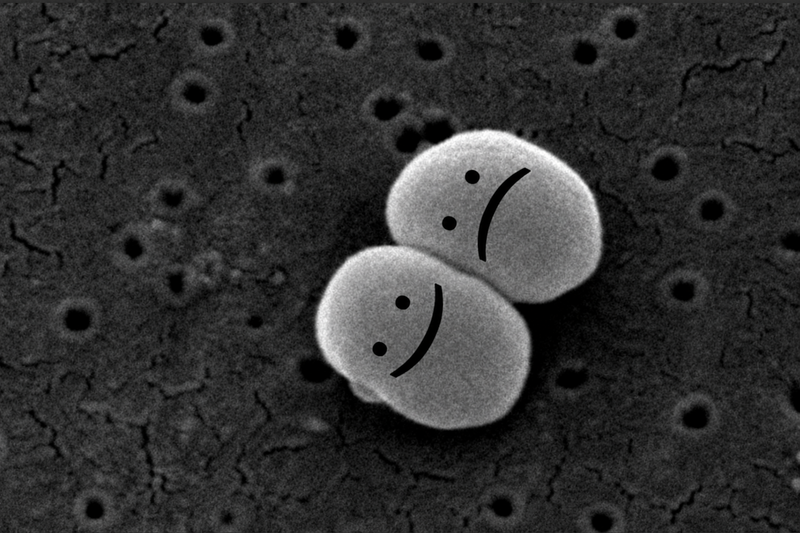
First identified in 1884, Staphylococcus epidermidis is a versatile Gram-positive bacterium capable of acting as a complex double-edged sword in human health. Driven by an advanced arsenal of anchoring proteins and ceramide-boosting enzymes, it effortlessly colonizes epithelial surfaces, spreading rapidly through dry, sebaceous, and moist mucous membranes. Impacts range from beneficial skin barrier hydration and childhood immune system training to hazardous hospital-acquired infections via implanted medical devices and intravenous lines. Accurate identification leverages classic laboratory profiling and modern clinical culture analysis. While optimization typically requires targeted probiotic therapy for skin-protective strains, active infection management relies heavily on precise diagnostic verification and prompt antibiotic treatment.
History and naming
Staphylococcus epidermidis, whose name comes from ‘staphyl ’, meaning its grape-bunch-like appearance under a microscope, ‘coccus ’, which indicates the round shape of the cells, and ‘epidermidis ’, from its strong association with the skin. However, this bacterium went by several names prior. In 1884, Friedrich Rosenbach differentiated it from S. aureus, naming it Staphylococcus albus, due to its white appearance. Later, when bacteria were split according to their colony colours, Winslow and Winslow proposed its renaming to Albococcus epidermidis, acknowledging its role in the skin. It was later grouped back with the Staphylococcus genus, and it remains S. epidermidis to this date.
Habitat
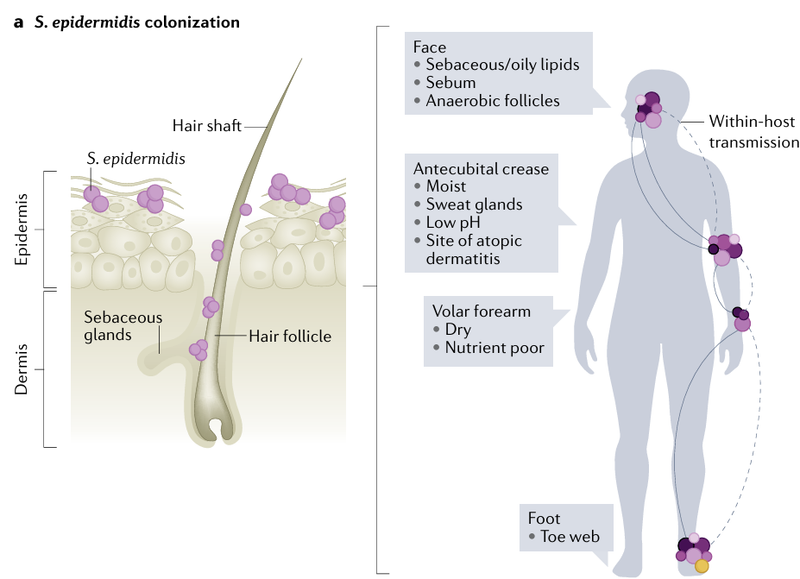
S. epidermidis, as its name suggests, can live in all types of skin sites, be it dry, sebaceous, or oily, but prefers moist sites. In terms of body sites, it is found in the armpit, nostrils, and face, as it is adapted to also thrive in mucous membranes.
Health Benefits
S. epidermidis has several useful properties that allow it to inhabit the skin and be part of the skin microbiome. It has anchoring proteins, which allow it to attach to the skin’s surface, where it plays important roles throughout a person’s lifetime- it is believed we first encounter this microbe in the womb. During childhood, it ‘trains’ the immune system. This ‘training’ allows the immune system to recognise the normal microbiota and only react against harmful microbes that can cause infection and disease. It can also produce enzymes to increase ceramide levels in the skin, which help maintain its hydration. Interestingly, it also competes with Staphylococcus aureus, known to be associated with severe infections and skin conditions, by secreting antimicrobial compounds or by recruiting immune cells. S. epidermidis also plays a similar immune-modulating role in the nasal microbiome and may be involved in fighting off respiratory infections.
Applications of S. epidermidis
The positive roles played by S. epidermidis in skin health are beginning to be harnessed through the development of probiotics. An exploratory study showed that isolated S. epidermidis from a human’s own facial skin, when re-applied, improved skin barrier integrity and hydration. It has also been proposed that the introduction of this commensal into the nostril during respiratory infection could help in faster recovery due to its ability to compete with pathogens and harness the immune system. Certain strains of S. epidermidis have also been shown to reduce S. aureus when applied to patients with atopic dermatitis- a condition typically known to be made worse by this pathogen. Further research is needed to identify strains of S. epidermidis that can exert positive effects while posing minimal risk.
Risks
Despite its several interesting and beneficial properties, and being low-virulent, S. epidermidis is also known to cause infection, being one of the leading causes of hospital-acquired infections. It commonly enters the body through the process of implanting prosthetics and medical devices, or IV lines and injections, due to its presence on the skin. These infections must be identified and treated promptly through appropriate culture analysis and antibiotic treatment.
Microbe Profile
Gram nature: Positive
Shape: Cocci
Spore formation: No
Biofilm formation: Yes
Coagulase enzyme: Negative
Oxygen requirement: Facultative anaerobe- can grow in low or high oxygen
Optimal temperature: 30–37°C
Temperature range: 6.5–46°C
Optimal pH: 5-7
Heat resistance: Some food-isolated strains can even survive at 80°C
Taxonomic classification
Domain: Bacteria
Phylum: Bacillota
Class: Bacilli
Order: Bacillales
Family: Staphylococcaceae
Genus: Staphylococcus
Species: Staphylococcus epidermidis
-Antara Arvind
Reference
Licitra G. (2013). Etymologia: Staphylococcus. Emerging Infectious Diseases, 19(9), 1553. https://doi.org/10.3201/eid1909.ET1909
Otto M. (2009). Staphylococcus epidermidis--the 'accidental' pathogen. Nature reviews. Microbiology, 7(8), 555–567. https://doi.org/10.1038/nrmicro2182
Severn, M. M., & Horswill, A. R. (2023). Staphylococcus epidermidis and its dual lifestyle in skin health and infection. Nature reviews. Microbiology, 21(2), 97–111. https://doi.org/10.1038/s41579-022-00780-3
Kim, H.J., Jo, A., Jeon, Y.J. et al (2019). Nasal commensal Staphylococcus epidermidis enhances interferon-λ-dependent immunity against influenza virus. Microbiome 7, 80. https://doi.org/10.1186/s40168-019-0691-9
Nodake, Y., Matsumoto, S., Miura, R., Honda, H., Ishibashi, G., Matsumoto, S., Dekio, I., & Sakakibara, R. (2015). Pilot study on novel skin care method by augmentation with Staphylococcus epidermidis, an autologous skin microbe--A blinded randomized clinical trial. Journal of dermatological science, 79(2), 119–126. https://doi.org/10.1016/j.jdermsci.2015.05.001
Ortega-Peña, S., Rodríguez-Martínez, S., Cancino-Diaz, M. E., & Cancino-Diaz, J. C. (2022). Staphylococcus epidermidis Controls Opportunistic Pathogens in the Nose, Could It Help to Regulate SARS-CoV-2 (COVID-19) Infection? Life, 12(3), 341. https://doi.org/10.3390/life12030341
Teruaki Nakatsuji et al. (2017), Antimicrobials from human skin commensal bacteria protect against Staphylococcus aureus and are deficient in atopic dermatitis.Sci. Transl. Med.9, eaah4680.DOI:10.1126/scitranslmed.aah4680
Lee E, Anjum F. Staphylococcus epidermidis Infection. [Updated 2023 Apr 27]. In: StatPearls [Internet]. Treasure Island (FL): StatPearls Publishing; 2025 Jan-. Available from: https://www.ncbi.nlm.nih.gov/books/NBK563240/
Chiara Montanari, Diana I. Serrazanetti, et al (2015), New insights in thermal resistance of staphylococcal strains belonging to the species Staphylococcus epidermidis, Staphylococcus lugdunensis and Staphylococcus aureus, Food Control, Volume 50, Pages 605-612, ISSN 0956-7135, https://doi.org/10.1016/j.foodcont.2014.09.039.
Pedroza-Dávila, U., Uribe-Alvarez, C., Morales-García, L., Espinoza-Simón, E., Méndez-Romero, O., Muhlia-Almazán, A., Chiquete-Félix, N., & Uribe-Carvajal, S. (2020). Metabolism, ATP production and biofilm generation by Staphylococcus epidermidis in either respiratory or fermentative conditions. AMB Express, 10(1), 31. https://doi.org/10.1186/s13568-020-00966-z.
Skovdal, S. M., Jørgensen, N. P., & Meyer, R. L. (2022). JMM Profile: Staphylococcus epidermidis. Journal of Medical Microbiology, 71(10). https://doi.org/10.1099/jmm.0.001597.