The MicroByte Series-Levilactobacillus brevis: A Cheesy Story
First identified in 1919, Levilactobacillus brevis is a versatile Gram-positive bacterium capable of supporting digestive health and driving diverse food fermentations. Driven by an advanced ability to tolerate harsh acid and bile environments, it effortlessly thrives within the human gastrointestinal tract, colonizing various natural and dairy niches. Applications range from crafting artisanal cheeses like pungent Blue Stilton to mitigating severe systemic conditions, including inflammatory colitis and metabolic tissue damage. Accurate identification leverages classic laboratory cultures and modern tools like molecular genus reclassification. While optimization typically requires targeted dietary supplementation for gut microbiome balance, robust commercial prevention relies heavily on controlling hop-resistant beverage spoilage strains.
History and naming
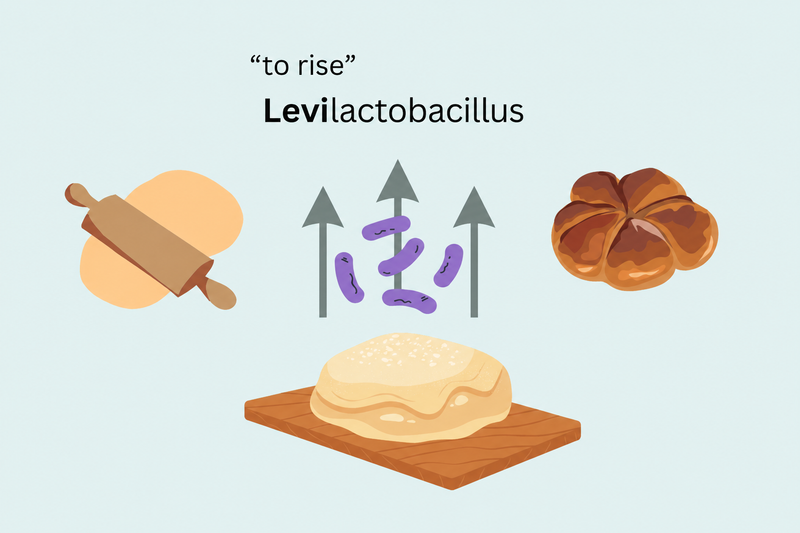
Levilactobacillus brevis was initially classified as being Betabacterium breve by S. Orla-Jensen in 1919, based on its functional properties. It was later reclassified to the Lactobacillus designation, and after further reclassification of the Lactobacillus genus in 2020, became part of the Levilactobacillus genus, and remains part of it to this date. Levilactobacillus comes from the ability of member species to act as “leaveners” or create “rise”, referring to their widespread use as starter cultures for bread and other fermented foods. “Brevis” is the Latin word for short.
Habitat
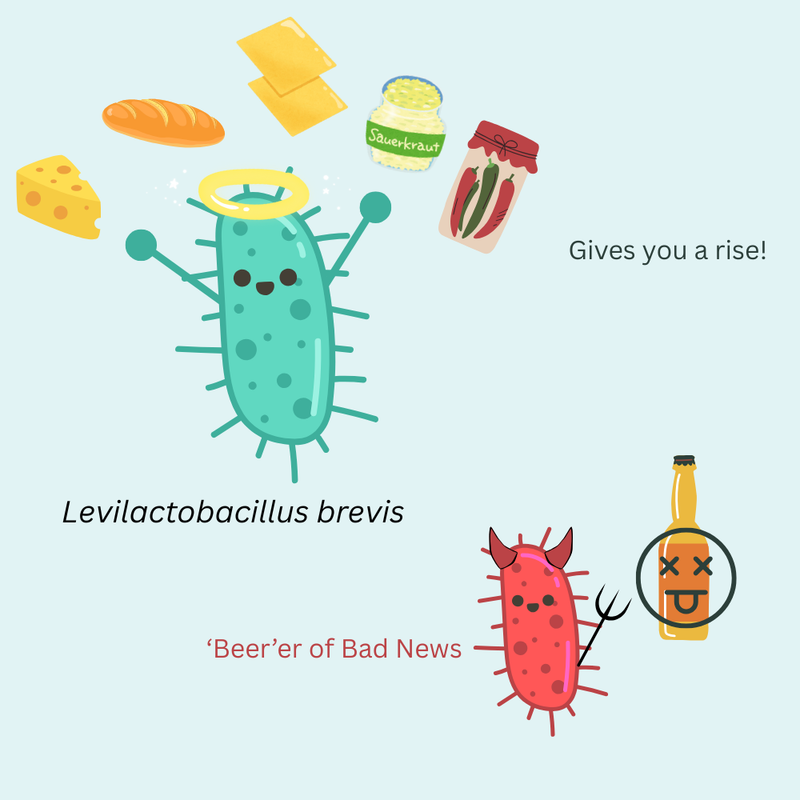
L. brevis is considered to be a “free-living” species, having been isolated from a wide variety of anthropological and natural niches. It is found in dairy products like milk and cheese, and also in other fermented beverages and foods like sauerkraut, and in baked goods like sourdough bread. It is also found in agricultural habitats like silage and manure. It is also part of the normal human gut microbiome.
Health Benefits: Role in the gut
Levilactobacillus brevis, like several of its Lactobacillus genus companions, is a regular occupant of the intestinal microbiome and has several traits that contribute to its use as a probiotic. It is able to survive in and tolerate acid and bile-rich environments, which points to its ability to survive in the GI tract and the gut environment. It also demonstrates anti-oxidant properties, with an ability to scavenge oxygen radicals in a laboratory set-up. In animal IBD models, it was shown to improve the associated colitis, potentially through maintenance of proper intestinal structure and function, and regulation of inflammatory signals. Similarly, when strains isolated from “Sinki”, a traditional Darjeeling-Himalayan fermented food made from radish root, were given to mice models, beneficial effects were seen. Metabolic parameters in animals fed a high-fat diet improved, along with inflammation, antioxidant activity, and gut structure. This points towards L. brevis as a promising probiotic, not only as a beneficial starter for fermented foods, but also as a probiotic in its own right.
Applications
L. brevis is widely used in the production of a variety of cheeses all over the world. It has been found in local Bazoft cheese from Iran, where researchers also found it had inhibitory properties against Salmonella and Enterococcus strains, which are known food pathogens. It has also been isolated from Blue Stilton cheese, where it produces high levels of putrescine- an amine compound that contributes to the characteristic smell that gives Stilton the classification of being a ‘stinky’ cheese. It has also been isolated from fresh smoked cheeses like Croatian traditional preparations, and fresh and pickled soft cheeses from Serbia. Interestingly, isolates from the latter showed high cholesterol usage, which may improve the nutritional properties of this cheese.
Strains of this microbe have also been isolated from spontaneously fermented sauerkraut, where they also showed good cell adhesion properties in lab conditions, adding to the mounting evidence for their application as gut-colonising probiotics. Besides these, L. brevis is also found in a variety of foods and beverages like kefir, where it is part of the starter culture, and in a variety of cheeses as part of their flora, like majorero, cheddar, Italian Caciocavallo cheese, and sheep’s milk cheese. Besides milk and dairy products, it has also been isolated from German wheat sourdough bread, wheat bread starter, rye bread, as well as panettone bread. L. brevis is also found in and used to ferment vegetables like eggplant, cabbage (sauerkraut), and black olives.
Fun Fact
L. brevis, despite its useful applications in the food industry for the preparation of fermented foods and beverages, is one of the most notorious organisms for beer spoilage, causing a change in texture and smell, becoming more “silky” and “buttery”, respectively. This is due to its ability to survive low pH, and specifically for L. brevis, the resistance of some strains to hops and its compounds. Hops are an integral part of most beer brewing processes for their ability to provide bitterness and foam stability to beer, and importantly, they have an antimicrobial effect. The exact mechanisms through which these resistant strains act are unknown, and the establishment of the same could be a key area of interest for the beverage industry.
Risks
Besides beer spoilage, L. brevis is also associated with the spoilage of wine. The presence of this microbe in excess can also cause spoilage in juices, salad dressings, or even cheeses, leading to unfavourable textures, appearance, and smell.
Taxonomic Classification
Domain: Bacteria
Phylum: Bacillota
Class: Bacilli
Order: Lactobacillales
Family: Lactobacillaceae
Genus: Levilactobacillus
Species: Levilactobacillus brevis
Microbe Profile
Gram nature: +ve
Shape: Bacilli, single or chains
Spore formation: No
Biofilm formation: Yes
Oxygen requirement: Aerotolerant
Optimal Temperature: 30°C
Optimal pH: 4 to 6
Food Source: Obligate Heterofermentative- Galactose, Lactose, Maltose, Sucrose, Esculin
-Antara Arvind
Reference
Zheng, J., Wittouck, S., Salvetti, E., Franz, C. M., Harris, H. M., Mattarelli, P., O’Toole, P. W., Pot, B., Vandamme, P., Walter, J., Watanabe, K., Wuyts, S., Felis, G. E., Gänzle, M. G., & Lebeer, S. (2020). A taxonomic note on the genus Lactobacillus: Description of 23 novel genera, emended description of the genus Lactobacillus Beijerinck 1901, and union of Lactobacillaceae and Leuconostocaceae. INTERNATIONAL JOURNAL OF SYSTEMATIC AND EVOLUTIONARY MICROBIOLOGY, 70(4), 2782–2858. https://doi.org/10.1099/ijsem.0.004107
Heineman, P. (1920). Orla-Jensen’s classification of lactic acid bacteria. Journal of Dairy Science, 3(2), 143–155. https://doi.org/10.3168/jds.s0022-0302(20)94257-1
Rezaei, Z., Nickfar, F., Salari, A., Yousefi, M., Khodaparast, M. H. H., & Shamloo, E. (2023). Feasibility of biofilm production capacity by Levilactobacillus brevis isolated from motal cheese and evaluation of biofilm resistance produced in vitro and in yogurt. Arabian Journal of Chemistry, 16(5), 104702. https://doi.org/10.1016/j.arabjc.2023.104702
Ibrahim, S. A. (2015). Lactic Acid Bacteria: Lactobacillus spp.: Other Species. In Elsevier eBooks. https://doi.org/10.1016/b978-0-08-100596-5.00857-x
Feyereisen, M., Mahony, J., Kelleher, P., Roberts, R. J., O’Sullivan, T., Geertman, J. A., & Van Sinderen, D. (2019). Comparative genome analysis of the Lactobacillus brevis species. BMC Genomics, 20(1). https://doi.org/10.1186/s12864-019-5783-1
Shin, M. Y., Yong, C. C., & Oh, S. (2020). Regulatory Effect of Lactobacillus brevis Bmb6 on Gut Barrier Functions in Experimental Colitis. Foods (Basel, Switzerland), 9(7), 864. https://doi.org/10.3390/foods9070864
Ghosh, A. J., Ghosh, S., Islam, R., Sarkar, S., & Saha, T. (2024). Dietary supplementation of Lactobacillus brevis SAD ameliorates high-fat diet-induced hyperglycemia and associated metabolic issues in Swiss albino mice. Egyptian Journal of Basic and Applied Sciences, 11(1), 148–161. https://doi.org/10.1080/2314808x.2024.2324409
Champiri, I. D., Bamzadeh, Z., Rahimi, E., & Rouhi, L. (2022). Isolation and Identification of Lactobacillus brevis from Cottage Cheese of Bazoft City, Iran and Evaluation of Its Antimicrobial Activity Against Some Pathogenic Microorganisms. Iranian Journal of Medical Microbiology, 16(1), 17–34. https://doi.org/10.30699/ijmm.16.1.17
Ami, Y., Kodama, N., Umeda, M., Nakamura, H., Shirasawa, H., Koyanagi, T., & Kurihara, S. (2023). Levilactobacillus brevis with High Production of Putrescine Isolated from Blue Cheese and Its Application. International Journal of Molecular Sciences, 24(11), 9668. https://doi.org/10.3390/ijms24119668
Kant, R., Uroić, K., Hynönen, U., Kos, B., Šušković, J., & Palva, A. (2016). Genome Sequence of Lactobacillus brevis Strain D6, Isolated from Smoked Fresh Cheese. Genome Announcements, 4(2). https://doi.org/10.1128/genomea.00264-16
Uroić, K., Nikolić, M., Kos, B., Andreja, L. P., Beganović, J., Lukić, J., Jovčić, B., Filipić, B., Miljković, M., Golić, N., Topisirović, L., Čadež, N., Raspor, P., & Šušković, J. (2014, June 15). Probiotic Properties of Lactic Acid Bacteria Isolated from Croatian Fresh Soft Cheese and Serbian White Pickled Cheese. https://hrcak.srce.hr/122348
Beganović, J., Kos, B., Pavunc, A. L., Uroić, K., Jokić, M., & Šušković, J. (2013). Traditionally produced sauerkraut as source of autochthonous functional starter cultures. Microbiological Research, 169(7–8), 623–632. https://doi.org/10.1016/j.micres.2013.09.015
Cocolin, L., & Ercolini, D. (2007). Molecular techniques in the microbial ecology of fermented foods. In Springer eBooks. https://doi.org/10.1007/978-0-387-74520-6
Teixeira, P. (2014). LACTOBACILLUS | Lactobacillus brevis. In Elsevier eBooks (pp. 418–424). https://doi.org/10.1016/b978-0-12-384730-0.00178-6
Preissler, P., Behr, J., & Vogel, R. F. (2010). Detection of Beer-spoilageLactobacillus brevisstrains by Reduction of Resazurin. Journal of the Institute of Brewing, 116(4), 399–404. https://doi.org/10.1002/j.2050-0416.2010.tb00790.x
Sakamoto, K., Margolles, A., van Veen, H. W., & Konings, W. N. (2001). Hop resistance in the beer spoilage bacterium Lactobacillus brevis is mediated by the ATP-binding cassette multidrug transporter HorA. Journal of bacteriology, 183(18), 5371–5375. https://doi.org/10.1128/JB.183.18.5371-5375.2001.