# The MicroByte Series: Lactococcus lactis: From Dairy Starter to Probiotic Powerhouse
Author: BugSpeaks
Author URL: https://www.bugspeaks.com/blog/author/bugspeaks
Published: 2025-11-19
Category: MicroByte Series
Category URL: https://www.bugspeaks.com/blog/category/microbyte-series
Meta Title: Lactococcus lactis Benefits & Uses Explained | BugSpeaks
Meta Description: Discover Lactococcus lactis benefits for gut health, immunity, fermentation, and food safety. Learn how this probiotic supports wellness today.
Tags: Gut Microbiome, Probiotics, Lactococcus lactis
Tag URLs: Gut Microbiome (https://www.bugspeaks.com/blog/tag/gut-microbiome), Probiotics (https://www.bugspeaks.com/blog/tag/probiotics), Lactococcus lactis (https://www.bugspeaks.com/blog/tag/lactococcus-lactis)
URL: https://www.bugspeaks.com/blog/microbyte-series-lactococcus-lactis
_Lactococcus lactis_ is a versatile Gram-positive bacterium capable of supporting a wide array of industrial and host health functions. Driven by an advanced arsenal of muco-adhesion proteins and potent bacteriocins like nisin, it effortlessly drives fermentation, spreading rapidly through mesophilic dairy starters and vertebrate gastrointestinal tracts. Benefits range from localized digestive support via short-chain fatty acids to systemic metabolic improvements, including Type 2 Diabetes regulation and immunomodulation. Accurate identification leverages classic laboratory morphology and modern tools like comparative genomics. While optimization typically requires targeted probiotic validation for subspecies like _lactis_ and _cremoris_, robust industrial utilization relies heavily on rapid lactose acidification and food biopreservation protocols.
## History
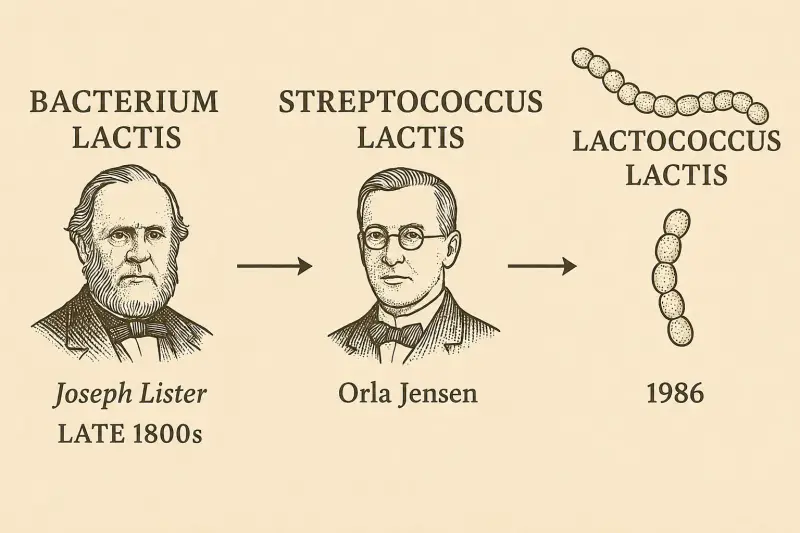
The story of the humble dairy starter, now known as _Lactococcus lactis_, is a thrilling snapshot of microbial science history. Its scientific journey began in the late 1800s when Joseph Lister, the father of antiseptic surgery, first identified the organism involved in fermentation, initially calling it _Bacterium lactis_. For a long time, however, it lived under the name _Streptococcus lactis,_ a classification given by the Danish microbiologist Orla Jensen, who grouped it with other lactic acid-producing cocci based on its simple, bead-like shape. The formal shift to the currently accepted nomenclature occurred in 1986, when Schleifer and colleagues established the distinct genus _Lactococcus_. This molecular reclassification was based on deep phylogenetic analysis, separating these organisms from true _Streptococcus_ species while retaining them within the order Lactobacillales. The progression in nomenclature from _Bacterium_ to _Streptococcus_ to _Lactococcus_ is a direct chronicle of the advancement in microbial science, moving from basic morphological observation to comparative genomics. The current status provides a more accurate reflection of the organism’s distinct genetic and metabolic profile relative to other members of the Streptococcaceae family.
**Antiseptic surgery**- A medical practice where specialized chemicals and clean techniques are used to eliminate germs and prevent infections during surgical procedures.
**Nomenclature**\- The specialized scientific system used for naming things, such as assigning official names to plants, animals, and bacteria.
**Phylogenetic analysis**\- The study of how different organisms are related through evolution, often mapped out like a family tree based on their DNA.
**Comparative genomics**\- A field of biology where scientists compare the complete DNA blueprints (genomes) of different species to spot similarities and differences.
**Metabolic profile**\- A snapshot of all the chemical reactions, nutrients used, and waste products created by an organism to stay alive and generate energy.
## Health Benefits
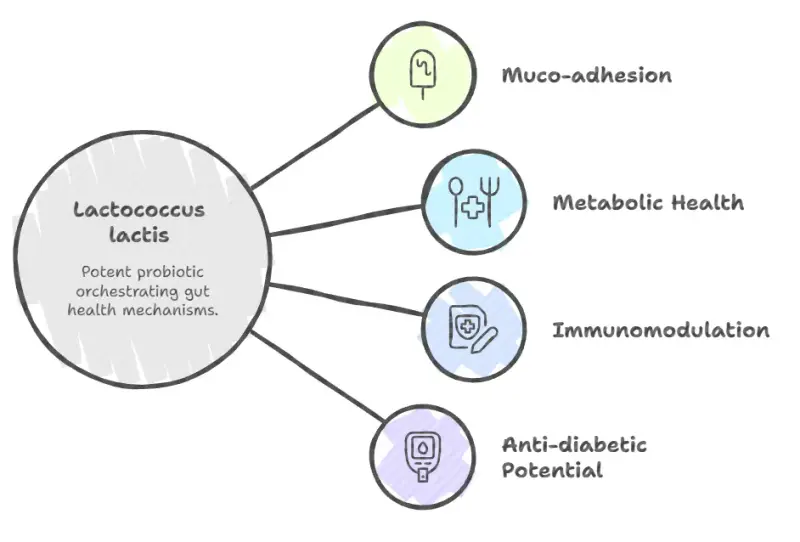
_Lactococcus lactis_ acts as a [potent probiotic](https://www.bugspeaks.com/blog/probiotics-antibiotics-gut-health/) by orchestrating a sequence of highly specific and synergistic mechanisms that bolster gut health, commencing withmuco-adhesion, the critical first step involving the temporary colonization of the intestinal epithelium; this is achieved through cell-wall anchored proteins, such as the aggregation factor, which increases cell surface hydrophobicity to facilitate non-specific interactions with the mucus layer, ensuring the localized delivery of beneficial metabolites. A striking example of the organism's genomic economy is the cell-wall proteinase (PrtP), an enzyme vital for casein degradation in industrial settings, which simultaneously modifies the cell's physicochemical properties, resulting in greater hydrophobicity and demonstrably increasing adherence to biotic surfaces like mucin. Once established, _L. lactis_, like other Lactic Acid Bacteria (LAB), contributes significantly to the gut's metabolic health by promoting the bioproduction of Short-Chain Fatty Acids (SCFAs), key metabolites (e.g., butyrate) that nourish colonocytes, maintain intestinal barrier function, and provide valuable antioxidant activity while lowering the genotoxicity of fecal water. Furthermore, specific strains, such as _L. lactis subsp. lactis_, display sophisticated immunomodulation capabilities, showing promise in stimulating proinflammatory cytokine production and modulating overall immune and inflammatory signaling pathways, suggesting potential as a novel therapeutic agent for immune-related disorders; however, this promise is tempered by the vital caveat of high strain-specificity, requiring rigorous clinical validation for each proposed application, as highlighted by instances where one formulation ( _L. lactis spp. cremoris_) failed to show significant effects on T-regulatory cells in healthy human subjects, underscoring the necessity of strain-level testing. A 6-week study on mice revealed the powerful [anti-diabetic potential](https://www.bugspeaks.com/blog/diabetes-gutdysbiosis-microbialdna/) of a 14-strain probiotic isolated from fermented camel milk. This diverse microbial mix, featuring key gut-health champions like _Lactococcus lactis_, significantly improved both blood glucose and blood lipid parameters. This finding suggests that these traditional camel milk microbes could serve as a promising natural intervention to delay the development and progression of Type 2 Diabetes (T2D).
**Muco-adhesion**\- The unique ability of a substance or microbe to stick tightly to the moist, protective mucus layers inside the body (such as the gut lining).
**Intestinal epithelium**\- The delicate, single layer of tightly packed cells that lines the insides of the intestines, absorbing nutrients while blocking harmful invaders.
**Aggregation factor**\- A specific molecule or protein on the surface of bacteria that allows them to stick together in clumps or attach firmly to tissues.
**Cell-wall proteinase (PrtP)**\- A specialized enzyme located on the outer shell of certain bacteria that cuts up complex proteins (like milk proteins) into smaller, easily digestible pieces.
**Short-Chain Fatty Acids (SCFAs)**\- Healthy compounds produced when good gut bacteria ferment dietary fiber; they serve as a crucial energy source for the cells lining your colon.
**Proinflammatory cytokine production**\- The process where the body manufactures chemical alarm signals that trigger inflammation to help fight off an injury or infection.
**T-regulatory cells**\- Specialized "peacekeeper" white blood cells that prevent the immune system from overreacting, keeping inflammation in check and stopping allergies.
## Industrial Application
_Lactococcus lactis_ is indispensable to the dairy industry, serving as the primary organism in mesophilic starter cultures for fermentation at moderate temperatures. Its fundamental role is the rapid conversion of lactose into lactic acid, a process that is critical for two reasons: preservation, as the resulting low inhibits spoilage and pathogenic organisms; and coagulation, as the acid destabilizes casein micelles to form the curds essential for the structure of cheeses like [Cheddar and Gouda](https://www.bugspeaks.com/blog/the-microbyte-series-5-lactobacillus-helveticus/). Beyond simple acidification, specific biovars are selected for complex flavor development. Notably, _L. lactis_ subsp. _lactis_ biovar _diacetylactis_ acts as a crucial co-starter because it possesses the extra ability to ferment citric acid into characteristic aroma compounds, most importantly diacetyl, which imparts the sought-after creamy or buttery flavor to products like sour cream. This citrate pathway also generates carbon dioxide, a gas vital for defining the texture of certain semi-hard cheeses (creating 'eyes') and for giving body to buttermilk.
Beyond its dairy roles, specific strains of _Lactococcus lactis_ produce nisin, a crucial bacteriocin used for food biopreservation. This potent antimicrobial peptide effectively targets Gram-positive pathogens by binding to Lipid II (blocking cell wall formation) and simultaneously disrupting the bacterial cell membrane, leading to rapid cell death. This unique and powerful mechanism makes nisin invaluable for controlling tough foodborne threats, including spore-forming bacteria, securing its role as a cornerstone of food safety.
**Mesophilic starter cultures-** Blends of friendly bacteria that thrive at moderate temperatures (around 20–30°C) and are used to kickstart the fermentation of cheeses, butter, and sour cream.
**Coagulation-** The process of a liquid changing into a thick, semi-solid gel or clot, such as milk curdling to make cheese or blood forming a clot to stop bleeding.
**Bacteriocin-** A natural, defensive protein produced by one bacterium to target and destroy rival bacteria competing for the same food and space.
**Antimicrobial peptide-** A tiny, naturally occurring protein molecule that acts as a built-in weapon to kill harmful microbes like bacteria, viruses, or fungi.
**Nisin-** A widely used, natural food preservative made by certain lactic acid bacteria that prevents spoilage by killing harmful bacteria in foods like cheese and canned goods.
## Taxonomic Classification
**Domain:** Bacteria
**Phylum:** Bacillota
**Class:** Bacilli
**Order:** Lactobacillales
**Family:** Streptococcaceae
**Genus:** Lactococcus
**Species:** Lactococcus lactis
## Microbial Profile:
**Shape:** Spherical Shape
**Gram nature:** Gram-positive
**Spore formation:** No spore formation
**Oxygen requirement:** Anaerobic
**Optimal temperature:** 30 °C
**Optimal pH:** 6.3-6.9
-Varsha V
### Reference
Mahony, J., Bottacini, F., & van Sinderen, D. (2023). Towards the diversification of lactococcal starter and non-starter species in mesophilic dairy culture systems. _Microbial biotechnology_, _16_(9), 1745–1754.
Samaržija, D., Antunac, N., & Havranek, J. L. (2001). Taxonomy, physiology and growth of Lactococcus lactis: a review. _Mljekarstvo_, _51_(1), 35-48.
Mercier-Bonin, M., & Chapot-Chartier, M. P. (2017). Surface proteins of Lactococcus lactis: bacterial resources for muco-adhesion in the gastrointestinal tract. _Frontiers in microbiology_, _8_, 2247.
Markowiak-Kopeć, P., & Śliżewska, K. (2020). The Effect of Probiotics on the Production of Short-Chain Fatty Acids by Human Intestinal Microbiome. _Nutrients_, _12_(4), 1107.
Jeong, H., Kim, S., Hwang, U. S., Choi, H., & Park, Y. S. (2023). Immunostimulatory Activity of _Lactococcus lactis_ subsp. _lactis_ CAB701 Isolated from Jeju Cabbage. _Microorganisms_, _11_(7), 1718
Kondrotiene, K., Zavistanaviciute, P., Aksomaitiene, J., Novoslavskij, A., & Malakauskas, M. (2024). _Lactococcus lactis_ in Dairy Fermentation—Health-Promoting and Probiotic Properties. _Fermentation_, _10_(1), 16.
Hassan, H., St-Gelais, D., Gomaa, A., & Fliss, I. (2021). Impact of Nisin and Nisin-Producing _Lactococcus lactis_ ssp. _lactis_ on _Clostridium tyrobutyricum_ and Bacterial Ecosystem of Cheese Matrices. _Foods (Basel, Switzerland)_, _10_(4), 898
## FAQs
Q: Why was Lactococcus lactis originally classified as a Streptococcus?
A: Early microbiologists grouped it with streptococci because of its simple, bead-like spherical shape. Deep genetic analysis in 1986 finally corrected this historical grouping by moving the organism into the entirely distinct Lactococcus genus.
Q: How does the cell-wall enzyme PrtP help this bacterium pull double duty?
A: In the factory setting, it efficiently breaks down complex milk proteins, while inside the human body, it actively alters the cell's outer surface. This structural change makes the bacterium significantly stickier, boosting its ability to anchor to our protective gut lining.
Q: What gives sour cream and certain cheeses their signature buttery flavor?
A: The specialized variant L. lactis biovar diacetylactis ferments the citric acid naturally found within the dairy mixture. This specific chemical pathway produces a compound called diacetyl, which is the exact aromatic element responsible for that rich, creamy taste.
Q: How does the bacteriocin nisin actively destroy dangerous foodborne pathogens?
A: It binds directly to target molecules in the cell wall to completely freeze further bacterial construction. Simultaneously, it rips open holes through the germ's outer membrane, causing a catastrophic fluid leak that results in immediate cell death.
Q: What did the six-week animal study reveal about the health benefits of L. lactis?
A: Trials demonstrated that a multi-strain probiotic mix featuring this bacterium successfully and significantly lowered blood glucose levels. It also optimized crucial blood lipid parameters, highlighting its exciting therapeutic potential to delay the progression of Type 2 Diabetes.
---
This blog is powered by Superblog. Visit https://superblog.ai to know more.
---