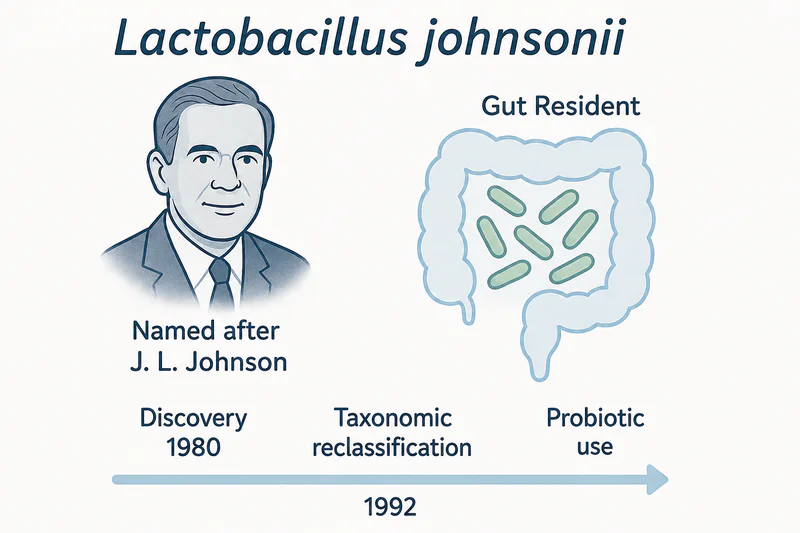
First described in 1992, Lactobacillus johnsonii is a versatile Gram-positive bacterium capable of supporting a wide array of host health functions. Driven by an advanced arsenal of natural antimicrobials and bacteriocins, it effortlessly modulates host immunity, spreading rapidly through host-adapted commensal niches and functional food substrates. Benefits range from localized digestive issues like colitis and H. pylori infections to systemic enhancements, including metabolic regulation and psychobiotic stress relief. Accurate identification leverages classic laboratory cultures and modern tools like comparative genomic mapping. While optimization typically requires targeted probiotic therapy for strains like NCC533 and BS15, robust utilization relies heavily on global safety validations and antibiotic-alternative husbandry protocols.
History and Naming
Lactobacillus johnsonii has an interesting backstory. First described in 1992, it was often mistaken for L. acidophilus until scientists realized it deserved its own name, honoring microbiologist J.L. Johnson. The first strain was surprisingly isolated from human blood in Belgium, showing that while it’s usually a friendly gut resident, it can sometimes appear in unusual places.
In 2020, when the massive Lactobacillus genus was split into 25 new groups, many species were renamed. But L. johnsonii held on to its original name, keeping its identity as part of the “acidophilus group.” Today, it’s known as a gut-adapted species that quietly plays a role in human health, with a history as unique as its name.
Habitat and Ecological Niche
Beyond its quirky taxonomic history, Lactobacillus johnsonii is best known as a friendly commensal that lives alongside its hosts. It has been found in the guts of humans, pigs, dogs, poultry, rodents, and even honeybees, each time adapting to the specific conditions of that host. In people, it’s part of the normal gut community and can also appear in the female urogenital tract.
This wide presence shows that L. johnsonii isn’t a wanderer in the wild but a microbe that prefers the nutrient-rich comfort of host environments. Over time, it has co-evolved with its animal partners, with certain strains uniquely tuned to thrive in particular species. It also finds its way into human life through fermented foods and probiotics, where it’s used to enhance gut health or improve fermentation in animal feed. In short, L. johnsonii has carved out a lifestyle that’s tightly linked to both animals and humans, a versatile microbe with a knack for building long-term relationships.
Health Benefits
What makes Lactobacillus johnsonii truly stand out is the wide range of health benefits. Many of its strains are recognized as probiotics, the “good bacteria” that help restore balance in the gut and beyond.
One of its best-known talents is fighting off harmful microbes. Certain strains release natural antimicrobials and acids that block troublemakers like E. coli, Salmonella, and Clostridium perfringens. L. johnsonii has also shown promise against Helicobacter pylori, a stomach bacterium linked to ulcers in both children and adults, showing reduced colonization when taken in probiotic form.
Its impact goes deeper than just fighting pathogens. L. johnsonii helps calm inflammation by “teaching” the immune system to respond more gently. Instead of triggering constant alarms, it encourages the production of soothing immune signals, which may explain why it shows benefits in conditions like colitis, allergies, and even general gut irritation. It also strengthens the gut lining, reducing “leaky gut” and protecting the body from toxins sneaking into the bloodstream.
Beyond the gut, researchers are finding that L. johnsonii might play roles in metabolism and even mental health. Some strains improve blood sugar control and cholesterol levels, while others seem to support brain health through the gut–brain connection. Early animal studies even suggest it could reduce stress-related behaviors and boost memory, hinting at potential future use as a psychobiotic.
Taken together, L. johnsonii is more than just a harmless gut resident. It’s a versatile ally that protects against infections, nurtures the immune system, and may even support overall health. Importantly, though, not all strains are the same; each has its own strengths, which is why scientists carefully study specific strains like NCC533, N6.2, or BS15 when testing for benefits.
Applications
Lactobacillus johnsonii has a versatile role across the healthcare and food industries. In animal models, strains of L.johnsonii have shown promising therapeutic effects in treating H.pylori infections and in reducing the blood glucose levels.
Its strong safety record, with recognition as GRAS in the US and QPS in the EU, makes it an attractive candidate for therapeutic and dietary applications, including gastritis, diarrhea, allergies, and metabolic disorders.
In the food industry, L. johnsonii enhances fermentation by converting sugars into lactic acid, contributing both flavor and microbial safety. Though not a mainstay in traditional yogurt starter cultures, it adds probiotic value when included and is increasingly studied for producing bacteriocins, natural antimicrobials that could extend shelf life and reduce food spoilage.
Beyond its applications in human health and the food industry, Lactobacillus johnsonii also plays a valuable role in animal health, with direct and indirect benefits for humans. Specific strains, such as BS15, have been shown to improve gut health, enhance immunity, and promote growth in poultry. In pigs, they help reduce weaning-associated diarrhea and support weight gain. Beekeepers have observed that it strengthens colonies against stress and pathogens, while in aquaculture, it has demonstrated protective effects in shrimp against White Spot Syndrome Virus, highlighting its potential for sustainable marine farming. Additionally, it is used in silage fermentation, improving feed quality and suppressing harmful microbes.
The use of probiotics in animal health represents an emerging and promising alternative, especially considering the global threat of antimicrobial resistance. Probiotics can strengthen the immune system, promote the production of antimicrobial peptides, and help prevent severe infections. By doing so, they may significantly reduce the reliance on antibiotics in animal husbandry, thereby lowering the risk of multidrug-resistant microbes transferring to humans.

Taxonomic classification
Domain: Bacteria
Phylum: Bacillota
Class:Bacilli
Order:Lactobacillales
Family:Lactobacillaceae
Genus:Lactobacillus
Species:L. johnsonii
Microbe Profile
Shape: Rod-shaped
Gram nature: Gram-positive
Spore formation: No
Biofilm formation: Yes
Oxygen requirement: Partially Anaerobic
Optimal temperature: 37°C
Optimal pH:5.5 to 5.8
Nutrient usage: Glucose
Reference
Zhang, Z., Zhao, L., Wu, J., Pan, Y., Zhao, G., Li, Z., & Zhang, L. (2023). The Effects of Lactobacillus johnsonii on Diseases and Its Potential Applications. Microorganisms, 11(10), 2580. https://doi.org/10.3390/microorganisms11102580
Arzola-Martínez, L., Ravi, K., Huffnagle, G. B., Lukacs, N. W., & Fonseca, W. (2024). Lactobacillus johnsonii and host communication: insight into modulatory mechanisms during health and disease. Frontiers in Microbiomes, 2, 1345330.
Dekham, K., Jones, S.M., Jitrakorn, S. et al. Functional and genomic characterization of a novel probiotic Lactobacillus johnsonii KD1 against shrimp WSSV infection. Sci Rep 13, 21610 (2023). https://doi.org/10.1038/s41598-023-47897-w