# The Microbyte Series - Lactobacillus acidophilus- It's in the name!
Author: Neha Rao
Author URL: https://www.bugspeaks.com/blog/author/neha-rao
Published: 2025-06-11
Category: MicroByte Series
Category URL: https://www.bugspeaks.com/blog/category/microbyte-series
Meta Title: Lactobacillus acidophilus Benefits & Uses | BugSpeaks
Meta Description: Discover Lactobacillus acidophilus benefits for gut health, immunity, digestion, cholesterol, and skin wellness. Learn how this probiotic supports health.
Tags: Probiotics, Lactobacillus acidophilus
Tag URLs: Probiotics (https://www.bugspeaks.com/blog/tag/probiotics), Lactobacillus acidophilus (https://www.bugspeaks.com/blog/tag/lactobacillus-acidophilus)
URL: https://www.bugspeaks.com/blog/microbyte-series-lactobacillus-acidophilus
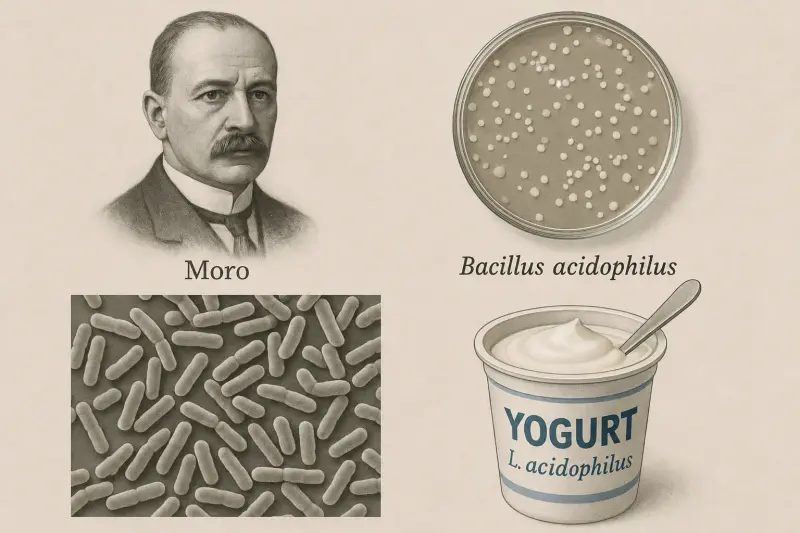
First isolated in 1900, _Lactobacillus acidophilus_ is a versatile Gram-positive bacterium capable of supporting a wide array of human health functions. Driven by an advanced arsenal of organic acids and tight junction proteins, it effortlessly optimizes the gut environment, spreading rapidly through fermented dairy products, yogurts, and plant-based juices. Benefits range from localized digestive relief like lactose-intolerant bloating to broad systemic regulations, including heart health, cholesterol management, and gestational diabetes blood sugar control. Accurate identification leverages classic laboratory cultures and modern tools like comparative genomic taxonomic revisions. While optimization typically requires targeted probiotic therapy for diverse commercial strains, robust utilization relies heavily on organic acid preservation and food fermentation protocols.
## **History and naming**
_L. acidophilus_ was first isolated in 1900 from infant feces by Moro and originally named _Bacillus acidophilus_. The species has undergone multiple taxonomic revisions due to limitations in early methods that relied on morphology and biochemistry. Many human isolates were incorrectly labeled as _L. acidophilus_ from 1920 to the 1970s. Phenotypic similarity among lactic acid bacteria led to frequent misidentifications and misclassifications, including strains now reclassified (e.g., _L. johnsonii_). Several strains with the same genetic identity have been labeled differently across culture collections and commercial uses. Despite taxonomic confusion, _L. acidophilus_ became a widely used probiotic, particularly in dairy products like yogurt.
**Feces-** Poop or solid waste material excreted from the body after food has been digested and nutrients have been absorbed.
**Taxonomic-** Relating to taxonomy, the scientific system used to name, describe, and classify living organisms into organized groups based on shared characteristics.
**Morphology-** The study of the physical shape, size, structure, and external appearance of an organism or its parts (such as how a bacterium looks under a microscope).
**Phenotypic similarity-** When two different organisms look, function, or behave alike due to shared physical traits, even if their underlying genetics are different.
**Genetic identity-** The exact DNA sequence or genetic blueprint that uniquely defines a specific organism or strain.
**Culture-** In biology, a laboratory method of growing microbes (like bacteria or yeast) in a controlled environment, such as a Petri dish, so they can be studied.
## Health benefits
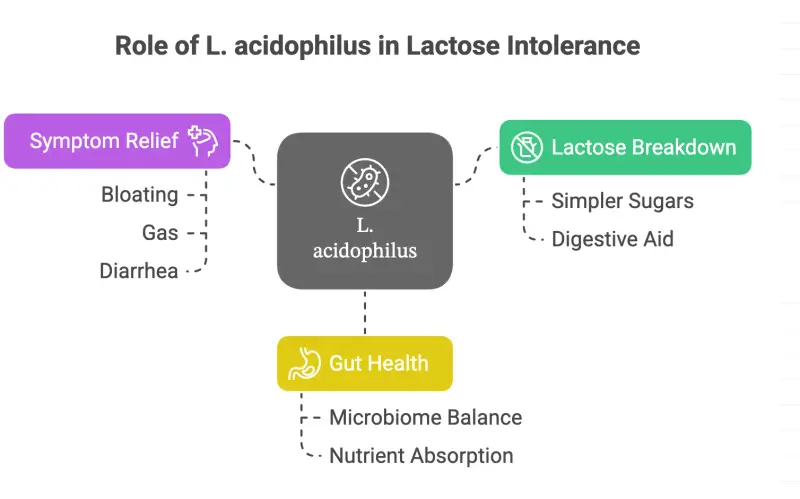
Lactobacillus acidophilus exhibits several key characteristics that play an important role in maintaining overall health. _Lactobacillus acidophilus_ guards the gut by producing acids, making the gut environment unfavourable for the growth of harmful bacteria and supporting the beneficial ones. It also plays a crucial role in strengthening the [gut barrier integrity](https://www.bugspeaks.com/blog/leaky-gut-syndrome-causes-symptoms-and-treatment-options/) by increasing the expression of tight junction proteins and the production of protective substances like mucin. _Lactobacillus acidophilus_ produces lactase (β-galactosidase), which helps break down lactose into simpler sugars, easing symptoms like bloating and cramps in lactose-intolerant people. It also supports heart health by reducing cholesterol absorption in the gut and helping remove cholesterol from arteries, lowering the risk of plaque build-up. For immunity, it boosts protective antibodies (like IgG and IgA), increases helpful immune cells (CD4⁺), and reduces inflammation by lowering inflammatory markers like IL-6 and TNF-α. In [oral health](https://www.bugspeaks.com/blog/oralmicrobiome-gutmicrobiome-gutoralaxis/), it competes with harmful bacteria, reducing plaque and the risk of cavities. In pregnant women with gestational diabetes, taking _L. acidophilus_ through probiotic yogurt lowered blood sugar and HbA1c levels, likely by producing beneficial acids that improve insulin sensitivity and reduce inflammation. It also helps in managing skin issues like eczema in children with allergies by lowering inflammation and reducing allergy-related markers when taken daily.
**Gut barrier integrity-** The strength and health of the intestinal lining, which acts as a protective shield to let nutrients into the body while keeping harmful bacteria and toxins from leaking out.
**Tight junction proteins-** Specialized molecular "stitches" that lock the cells of our gut lining tightly together, preventing unwanted substances from slipping between them into the bloodstream.
**Mucin-** A thick, slippery protein that forms the core of mucus, coating and protecting delicate internal tissues like the stomach and intestines from irritation and germs.
**Lactose-intolerant-** The inability to fully break down and digest lactose, the natural sugar found in dairy products, often leading to gas, bloating, or stomach cramps.
**Antibodies-** Custom-made protective proteins created by the immune system to recognize, latch onto, and neutralize specific invading germs.
**Inflammatory markers-** Measurable chemicals or proteins in the body that spike when the immune system is actively fighting off an infection, injury, or irritation.
**Plaque-** A sticky, stubborn buildup; this most commonly refers to the film of bacteria that forms on teeth or the fatty deposits that accumulate inside arteries.
**HbA1c levels-** A standard blood test measurement that reveals a person's average blood sugar levels over the past two to three months, crucial for tracking diabetes risk.
## Applications of Lactobacillus acidophilus
_Lactobacillus acidophilus_ is broadly utilised in the **f** ermentation of dairy, meat, and plant-based products, where it enhances their nutritional value, sensory attributes, and shelf life. Fermentation by _Lactobacillus acidophilus_ boosts nutritional and antioxidant properties in fruit and vegetable juices. _Lactobacillus acidophilus_ produces organic acids, which results in increasing acidity and prevents spoilage by hindering the growth of bad microbes, thus extending the shelf life of the product. Acidophilus milk, a [fermented drink](https://www.bugspeaks.com/blog/fermented-foods-and-microbiome/) enriched with _Lactobacillus acidophilus,_ aids in better digestion and controls cholesterol levels.
**Fermentation-** A natural process where microbes (like bacteria or yeast) break down sugars and carbs without oxygen, turning them into beneficial acids, gases, or alcohol (as seen in yogurt, kimchi, and sourdough).
**Sensory attributes-** The physical characteristics of a food or product that you experience directly through your senses, including its taste, smell, texture, and color.
**Antioxidant-** A helpful compound that shields human cells from damage caused by harmful, unstable molecules called free radicals, effectively lowering cellular stress.
## Microbe profile
**Shape:** Rod-shaped
**Gram nature:** Gram-positive
**Spore formation:** No
**Oxygen requirement:** Microaerobic- requires oxygen for survival but cannot tolerate normal atmospheric oxygen concentrations.
**Optimal temperature:** 35–38°C
**Optimal pH:** 5.5–6.0
**Food source:** Glucose, fructose, lactose, and sucrose
## Taxonomic Classification
**Domain:** Bacteria
**Phylum:** Bacillota
**Class:** _Bacilli_
**Order:** _Lactobacillales_
**Family:** _Lactobacillaceae_
**Genus:** _Lactobacillus_
**Species:** _Lactobacillus acidophilus_
### Reference
Bull, M., Plummer, S., Marchesi, J., & Mahenthiralingam, E. (2013). The life history of Lactobacillus acidophilus as a probiotic: a tale of revisionary taxonomy, misidentification and commercial success. _FEMS microbiology letters_, _349_(2), 77–87. [https://doi.org/10.1111/1574-6968.12293](https://doi.org/10.1111/1574-6968.12293)
Gao, H., Li, X., Chen, X., Hai, D., Wei, C., Zhang, L., & Li, P. (2022). The Functional Roles of _Lactobacillus acidophilus_ in Different Physiological and Pathological Processes. _Journal of microbiology and biotechnology_, _32_(10), 1226–1233. [https://doi.org/10.4014/jmb.2205.05041](https://doi.org/10.4014/jmb.2205.05041)
Liu, Y., Nawazish, H., Farid, M. S., Abdul Qadoos, K., Habiba, U. E., Muzamil, M., Tanveer, M., Sienkiewicz, M., Lichota, A., & Łopusiewicz, Ł. (2024). Health-Promoting Effects of _Lactobacillus acidophilus_ and Its Technological Applications in Fermented Food Products and Beverages. _Fermentation_, _10_(8), 380. [https://doi.org/10.3390/fermentation10080380](https://doi.org/10.3390/fermentation10080380)
Liu, Y., Nawazish, H., Farid, M. S., Abdul Qadoos, K., Habiba, U. E., Muzamil, M., Tanveer, M., Sienkiewicz, M., Lichota, A., & Łopusiewicz, Ł. (2024). Health-Promoting Effects of _Lactobacillus acidophilus_ and Its Technological Applications in Fermented Food Products and Beverages. _Fermentation_, _10_(8), 380. [https://doi.org/10.3390/fermentation10080380](https://doi.org/10.3390/fermentation10080380)
Huang, Y., Wang, J., Quan, G., Wang, X., Yang, L., & Zhong, L. (2014). Lactobacillus acidophilus ATCC 4356 prevents atherosclerosis via inhibition of intestinal cholesterol absorption in apolipoprotein E-knockout mice. _Applied and environmental microbiology_, _80_(24), 7496–7504. [https://doi.org/10.1128/AEM.02926-1](https://doi.org/10.1128/AEM.02926-14)
Gao, H., Li, X., Chen, X., Hai, D., Wei, C., Zhang, L., & Li, P. (2022). The Functional Roles of _Lactobacillus acidophilus_ in Different Physiological and Pathological Processes. _Journal of microbiology and biotechnology_, _32_(10), 1226–1233. [https://doi.org/10.4014/jmb.2205.05041](https://doi.org/10.4014/jmb.2205.05041)
Tahmourespour, A., & Kermanshahi, R. K. (2011). The effect of a probiotic strain (Lactobacillus acidophilus) on the plaque formation of oral Streptococci. _Bosnian journal of basic medical sciences_, _11_(1), 37–40. [https://doi.org/10.17305/bjbms.2011.2621](https://doi.org/10.17305/bjbms.2011.2621)
Sahhaf Ebrahimi, F., Homayouni Rad, A., Mosen, M., Abbasalizadeh, F., Tabrizi, A., & Khalili, L. (2019). Effect of _L. acidophilus_ and _B._ _lactis_ on blood glucose in women with gestational diabetes mellitus: a randomized placebo-controlled trial. _Diabetology & metabolic syndrome_, _11_, 75\. [https://doi.org/10.1186/s13098-019-0471-5](https://doi.org/10.1186/s13098-019-0471-5)
Nakata, J., Hirota, T., Umemura, H., Nakagawa, T., Kando, N., Futamura, M., Nakamura, Y., & Ito, K. (2019). Additive effect of _Lactobacillus acidophilus_ L-92 on children with atopic dermatitis concomitant with food allergy. _Asia Pacific allergy_, _9_(2), e18. [https://doi.org/10.5415/apallergy.2019.9.e18](https://doi.org/10.5415/apallergy.2019.9.e18)
## FAQs
Q: From what source was Lactobacillus acidophilus first isolated in 1900?
A: It was originally isolated from infant feces by a researcher named Moro.
Q: How does L. acidophilus help people who are lactose-intolerant?
A: It produces lactase, an enzyme that breaks down milk sugar to ease symptoms like bloating and cramps.
Q: How does this bacterium help protect against arterial plaque build-up?
A: It reduces cholesterol absorption in the gut and assists in clearing cholesterol directly from the arteries.
Q: What clinical benefit does L. acidophilus offer to pregnant women with gestational diabetes?
A: Consuming it via probiotic yogurt helps successfully lower blood sugar and long-term HbA1c levels.
Q: What does a "microaerobic" oxygen requirement mean for this microbe?
A: It means the bacterium needs oxygen to survive but cannot tolerate normal, full atmospheric concentrations.
---
This blog is powered by Superblog. Visit https://superblog.ai to know more.
---