The MicroByte Series- Lactiplantibacillus plantarum: The Versatile Probiotic with Ancient Roots
First identified in 1919, Lactiplantibacillus plantarum is a versatile Gram-positive bacterium capable of supporting a wide array of human health functions. Driven by an advanced metabolic flexibility and a nomadic lifestyle, it effortlessly modulates host immunity, thriving dynamically across diverse environmental niches and gastrointestinal tracts. Benefits range from relieving localized irritable bowel syndrome to improving systemic metabolic, immune, and mental well-being markers. Accurate identification leverages classic core-genome phylogeny and modern tools like 16S rRNA sequencing. While optimization typically requires targeted probiotic supplementation for specialized strains, robust safety relies heavily on cautious antibiotic spacing and strict vulnerability screening.
History and naming
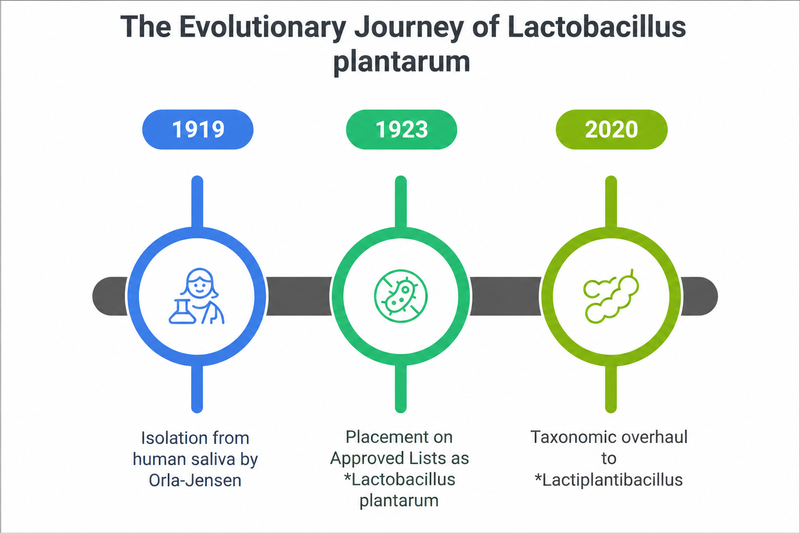
After its first isolation from human saliva in 1919 by Orla-Jensen, who originally named it Streptobacterium plantarum, the organism was placed on the approved lists as Lactobacillus plantarum by Bergey et al. in 1923. The genus Lactobacillus itself was proposed by Beijerinck in 1901 and systematically classified by Orla-Jensen in that same year; mid-20th-century revisions then subdivided species into homo- versus heterofermentative groups. With the advent of molecular tools, 16S rRNA sequencing and core-genome phylogeny, a major taxonomic overhaul in 2020 moved L. plantarum into the newly defined genus Lactiplantibacillus to better reflect its evolutionary relationships. Comparative genomic analyses further reveal that L. plantarum exhibits a “nomadic” lifestyle, lacking strong ecological clustering and thriving across diverse niches from plants and insects to vertebrate gastrointestinal tracts, underscoring its remarkable adaptability.
Ecological Niches and Sources
Lactiplantibacillus plantarum is a highly adaptable and resilient bacterium that thrives in a wide variety of environments, thanks to its impressive metabolic flexibility. It naturally lives in the human body too, showing up in the mouth, gut, and even the vaginal microbiome. This wide range of habitats shows just how versatile L. plantarum really is, each strain adapting uniquely to its environment, making it one of the most diverse and useful bacteria out there.

Health benefits
Lactiplantibacillus plantarum is gaining recognition as a powerful, strain-specific probiotic with wide-ranging health applications. A systematic scoping review of 69 human and animal studies highlights how different strains target specific conditions: L. plantarum 299 relieves IBS symptoms, improves oral health, and lowers inflammation; Lactiplantibacillus plantarum IS-10506 modulates immune responses in atopic dermatitis; L. plantarum LB931 supports vaginal health by limiting pathogenic bacteria; and L. plantarum CCFM8724 helps prevent early childhood cavities. These targeted effects stem from L. plantarum’s ability to interact with host immune and metabolic pathways, influence microbiota composition, and enhance anti-inflammatory cytokines.
Beyond specific strains, L. plantarum as a species supports gut barrier integrity, boosts immunity, and shows promise in lowering cholesterol, managing blood sugar, improving skin conditions like acne and eczema, and even enhancing mental well-being by reducing stress and anxiety. Its antioxidant activity and ability to improve iron absorption add to its clinical appeal. As research deepens, experts emphasize the need for precise strain selection and standardized clinical trials to optimize therapeutic use. With growing evidence, L. plantarum stands out as a multi-functional probiotic with benefits that reach well beyond the gut.
Applications
Lactiplantibacillus plantarum is a versatile and resilient bacterium widely used in the food industry and known for its powerful probiotic properties. Its key role in fermentation comes from its ability to convert sugars into lactic acid through glycolysis, a process that not only provides energy to the microbe but also helps preserve food and enhance its flavor. From simple sugars and lactose to complex plant carbohydrates, L. plantarum can ferment a wide variety of substrates, making it essential in both traditional and industrial fermentation.
This microbe is a common starter culture in the production of yogurt, cheese, sourdough bread, kimchi, pickles, sauerkraut, olives, and even sour beers. It improves the flavor, texture, and shelf life of these foods while also producing natural antimicrobial compounds that act as preservatives. Some strains even go a step further, detoxifying food by neutralizing aflatoxins and reducing allergens, and contributing to the creation of functional foods and specialized enzymes.
Recognized by the European Food Safety Authority, L. plantarum is also a well-studied probiotic with benefits that go beyond digestion. It helps restore microbial balance in the gut, boosts the production of short-chain fatty acids, and supports oral, skin, and vaginal health by outcompeting harmful bacteria. Emerging research also links L. plantarum to the gut-brain axis, showing promise in reducing stress, anxiety, and symptoms associated with depression, autism, and neurodegenerative disorders.
Safety
Lactiplantibacillus plantarum is widely regarded as safe, with GRAS and QPS status. Most people tolerate it well, though mild bloating or gas may occur initially. Rarely, serious infections have been reported in those with weak immunity or heart valve issues. Its benefits depend on the strain and condition, and it may not work for everyone. It should be taken a few hours apart from antibiotics, and is not recommended for those with severe immune or gut issues. Safety checks are needed to avoid risks like antibiotic resistance.
Taxonomic Classification
Domain: Bacteria
Phylum: Firmicutes
Class:Bacilli
Order:Lactobacillales
Family: Lactobacillaceae
Genus:Lactobacillus
Species: Lactiplantibacillus plantarum
Microbe Profile
Gram nature: Gram +ve
Shape: Short-rod
Spore formation: No
Biofilm formation: Yes
Oxygen requirement: Microaerophilic
Optimal Temperature: 37°C
Optimal pH: 5.6
Food source: Galactose, lactose, maltose, mannitol, raffinose, sucrose
Reference
Duar, R. M., Lin, X. B., Zheng, J., Martino, M. E., Grenier, T., Pérez-Muñoz, M. E., Leulier, F., Gänzle, M., & Walter, J. (2017). Lifestyles in transition: evolution and natural history of the genus Lactobacillus. FEMS microbiology reviews, 41(Supp_1), S27–S48. https://doi.org/10.1093/femsre/fux030
Popova-Krumova, P., Danova, S., Atanasova, N., & Yankov, D. (2024). Lactic Acid Production by Lactiplantibacillus plantarum AC 11S-Kinetics and Modeling. Microorganisms, 12(4), 739. https://doi.org/10.3390/microorganisms12040739
Behera, S. S., Ray, R. C., & Zdolec, N. (2018). Lactobacillus plantarum with Functional Properties: An Approach to Increase Safety and Shelf-Life of Fermented Foods. BioMed research international, 2018, 9361614. https://doi.org/10.1155/2018/9361614
Garcia-Gonzalez, N., Battista, N., Prete, R., & Corsetti, A. (2021). Health-Promoting Role of Lactiplantibacillus plantarum Isolated from Fermented Foods. Microorganisms, 9(2), 349. https://doi.org/10.3390/microorganisms9020349
Yilmaz, B., Bangar, S. P., Echegaray, N., Suri, S., Tomasevic, I., Manuel Lorenzo, J., Melekoglu, E., Rocha, J. M., & Ozogul, F. (2022). The Impacts of Lactiplantibacillus plantarum on the Functional Properties of Fermented Foods: A Review of Current Knowledge. Microorganisms, 10(4), 826. https://doi.org/10.3390/microorganisms10040826
Hao, Y., Li, J., Wang, J., & Chen, Y. (2024). Mechanisms of Health Improvement by Lactiplantibacillus plantarum Based on Animal and Human Trials: A Review. Fermentation, 10(2), 73. https://doi.org/10.3390/fermentation10020073