The Ultimate Guide to Megadosing Probiotics: Understanding CFUs and Their Impact
Why does taking more probiotics not guarantee better gut health?
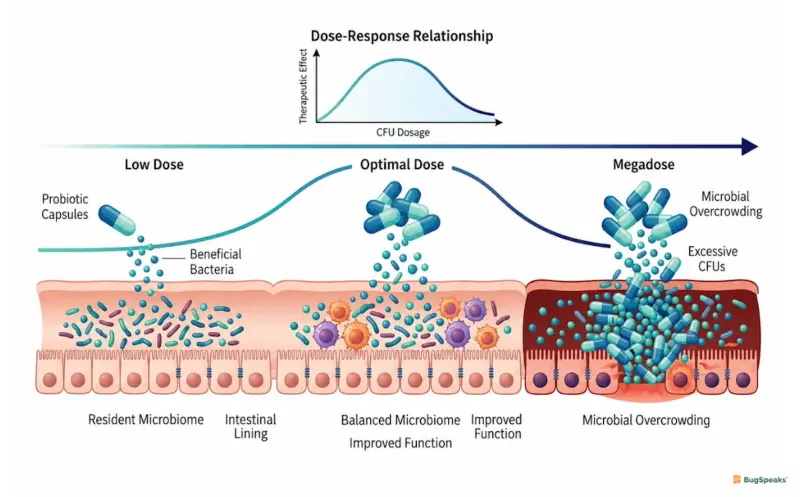
Taking more probiotics does not guarantee better gut health because our body does not treat bacteria like a competition where the biggest number wins. Many people believe that buying supplements with the highest number of Colony-Forming Units, which is the starting dosing parameter that tells us how many live bacteria are inside, is always best. However, scientific tests show that the Dose-Response Relationship how our gut reacts to different amounts of bacteria does not always increase with higher numbers. Just like adding too many seeds can crowd a small garden, taking massive doses does not automatically make your gut healthier or happierOuwehand (2017).
To understand this, we can look at the Precision Dosing Framework, which helps us map how our body reacts. In this system, your gut is the starting point, and each probiotic strain is a highly targeted tool. The amount of bacteria is the dosing parameter, and your unique gut is the response environment that decides the individualized result. If you choose the wrong tool or use a parameter that is too high, you can easily overwhelm your gut’s natural balance. Taking probiotics is not about getting the highest score, but about finding the perfect fit for your private ecosystemOuwehand (2017).
Most helpful bacteria we swallow are actually Transient Microbes, meaning they are temporary visitors that pass through our gut without living there forever. These temporary visitors do their jobs by sending signals to our local immune cells and helping our resident bacteria grow stronger before they leave. Because they are just visiting, dumping billions of extra bacteria into your gut does not help them stay longer. Instead, it can create a crowded traffic jam where your body's response environment gets overwhelmed, showing that the right match matters much more than a massive, unguided quantity of random microbesVitetta et al. (2017).
How can excessive probiotic doses trigger intense gas and bloating?
Excessive probiotic doses trigger intense gas and bloating by crowding your small intestine with too many bacteria that eat your food before you can digest it. This crowding leads to a clinical condition called Small Intestinal Bacterial Overgrowth, where bacteria settle in the upper gut instead of the lower gut. When you eat, these misplaced bacteria quickly consume sugars and fibers, causing rapid Carbohydrate Fermentation that generates massive bubbles of hydrogen and methane gas. This rapid gas production inflates your small intestine like a balloon, causing sudden and severe abdominal distension, heavy gas, and sharp stomach painRao et al. (2018).
Your small intestine has a limited Carrying Capacity, which means it can only handle a small number of bacteria at any time. When you swallow billions of probiotics, you overdrive this carrying capacity and create a traffic jam in your digestive pipe. The bacteria start multiplying in the wrong area, turning your quiet upper gut into a hyperactive fermentation zone. This zone produces gas so quickly that your body cannot absorb or release it naturally, leaving you feeling painfully full, stretched, and visibly bloated within a few minutes after eating any normal meal or drinking a simple cup of waterRao et al. (2018).
This uncomfortable situation is very common in people who take high doses of probiotics for several months. In a special study, doctors found that almost all patients who suffered from unexplained bloating and gas were taking daily probiotic supplements. When these patients stopped taking their supplements, their small intestinal bacterial overgrowth cleared up, and their severe gut symptoms improved dramatically. This clinical study proves that pushing past your gut's natural carrying capacity with megadoses can turn a helpful supplement into the main cause of your daily digestive distress, intense gas pressure, and persistent stomach pain everydayRao et al. (2018).
What is the biological link between megadosing probiotics and brain fog?
The biological link between megadosing probiotics and brain fog is a temporary buildup of acid in your blood that makes your brain feel confused. When you have too many bacteria in your small intestine, they produce a special chemical called D-Lactic Acidosis, which is an acidic metabolite made during fermentation. This acid enters your bloodstream and travels directly to your brain, where it can cause mental confusion and poor memory. This condition explains why some people feel dazed, weak, dizzy, and completely unable to concentrate after taking high-dose probiotics everyday Rao et al. (2018).
Our human body is excellent at clearing normal L-Lactate, which is the standard lactic acid our muscles make during exercise. However, our liver has a slow Metabolic Clearance Bottleneck when trying to break down the bacterial D-lactate version. Because this bacterial acid is cleared so slowly, it accumulates in our system and temporarily changes our blood's chemistry. This accumulation blocks normal brain cell communication, causing the classic symptoms of brain fogginess that make you feel like you are walking through a thick cloud after eating a carbohydrate-rich meal, such as a large bowl of hot pasta or white riceRao et al. (2018).
Doctors verified this link by testing patients who experienced severe brain fogginess alongside painful stomach gas. During these clinical assessments, the patients drank a simple glucose drink that immediately triggered their brain fog symptoms and raised their bacterial acid levels significantly. To resolve this problem, the patients stopped taking high-dose probiotics and allowed their digestive tract to reset its natural balance. With this simple change, eighty-five percent of the patients experienced a complete recovery of their mental clarity. This clear outcome demonstrates that balancing your daily microbiome dose is the best way to maintain a bright mind, sharp memory, and peaceful gutRao et al. (2018)
Why are specific probiotic strains treated as distinct precision tools rather than general wellness products?
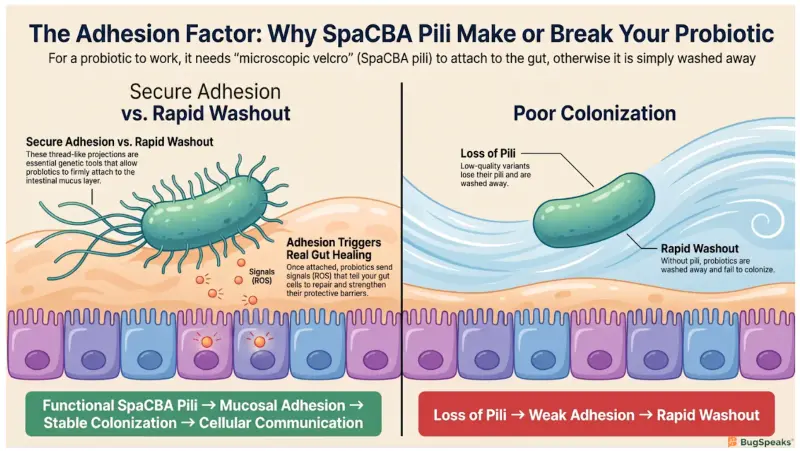
Specific probiotic strains are treated as distinct precision tools because different strains have completely unique genetic instructions that decide how they interact with our body. This biological rule is called Strain Specificity, which explains why two bacteria from the same family can have entirely different clinical effects. For example, some strains have special microscopic velcro threads called SpaCBA Pili that allow them to stick tightly to our gut's mucus lining. Without these tiny velcro threads, the bacteria cannot latch on and will simply wash away without providing any real, long-term health benefits to our physical body and digestive systemVitetta et al. (2017).
Keeping these genetic instructions stable is a major challenge for companies that manufacture probiotics. If the bacteria are not grown under strict conditions, they can lose their pili genes during production, meaning they can no longer adhere to our intestinal walls. In fact, tests show that poorly made variants have less than two percent of the binding ability of the original scientific strain. This is why we must treat strains as precise implements, since even a tiny genetic change can turn a powerful gut protector into an ineffective transient visitor with absolutely no sticking power inside your gutVitetta et al. (2017).
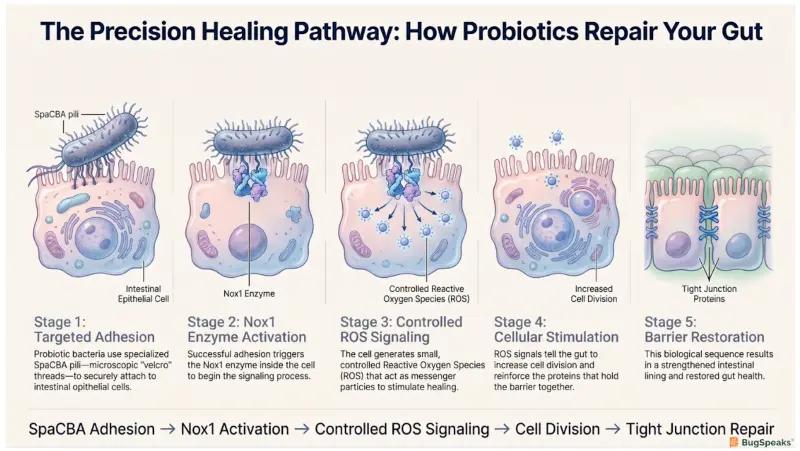
When a high-quality strain successfully sticks to your gut wall, it triggers the release of Reactive Oxygen Species, which are small signaling molecules. These signaling molecules act like microscopic messengers that tell your gut cells to divide, repair, and strengthen their tight junctions. This mild, controlled stimulation helps keep your gut barrier strong and healthy, preventing harmful food particles from leaking out. This scientific proof demonstrates that each right strain acts as a precise signaling key, while generic or mutated bacteria fail to unlock these important healing responses, digestive safeguards, protective barrier networks, and essential cellular pathwaysVitetta et al. (2017).
How do we apply a clinical dosing framework to individual microbiomes?
We apply a clinical dosing framework by treating your gut as a highly personalized Response Environment that requires customized parameters rather than a simple, one-size-fits-all approach. To find your ideal probiotic parameter, a clinician must evaluate your starting point, which includes your symptoms, diet, and medication history. Instead of taking the highest dose available, you should start with a small, precise quantity of a specific strain. This careful strategy allows your gut to adapt smoothly, ensuring you receive the maximum health benefits without causing bacterial traffic jams or dangerous metabolic overload inside your blood or digestive systemVitetta et al. (2017).
Your gut's natural defenses, such as Secretory Immunoglobulin A, which is a protective antibody coating on your intestinal lining, work hard to manage incoming bacteria. If you suddenly flood your system with massive doses, you can exhaust these local defenses and cause inflammation. Furthermore, people who take Proton Pump Inhibitors, which are medications that reduce stomach acid, have a much higher risk of probiotic complications. Without strong stomach acid to filter out incoming microbes, the small intestine is easily overrun, quickly turning a helpful supplement into an unwanted overgrowth of hyperactive bacteria in your delicate digestive systemRao et al. (2018).
To use probiotics safely, you should pay close attention to how your body reacts each day. This means tracking how your bloating, gas, and energy levels change, and adjusting your CFU parameter as needed. If you ever experience brain fogginess or severe stomach fullness, you should stop taking probiotics immediately to let your tummy rest. By treating probiotics as precision tools, you can successfully balance your microbiome, protect your delicate digestive system, and enjoy long-term health, absolute mental clarity, peaceful daily energy, and comfortable digestion for years to come in your daily lifeRao et al. (2018).
Visualize the process- https://youtu.be/r4D9-RE9Gw8
Reference
Rao SSC, Rehman A, Yu S, Andino NM. Brain fogginess, gas and bloating: a link between SIBO, probiotics and metabolic acidosis. Clin Transl Gastroenterol. 2018 Jun 19;9(6):162. doi: 10.1038/s41424-018-0030-7. PMID: 29915215; PMCID: PMC6006167.
Vitetta L, Coulson S, Thomsen M, Nguyen T, Hall S. Probiotics, D-Lactic acidosis, oxidative stress and strain specificity. Gut Microbes. 2017 Jul 4;8(4):311-322. doi: 10.1080/19490976.2017.1279379. Epub 2017 Jan 12. PMID: 28080206; PMCID: PMC5570418.
Ouwehand AC. A review of dose-responses of probiotics in human studies. Benef Microbes. 2017 Apr 26;8(2):143-151. doi: 10.3920/BM2016.0140. Epub 2016 Dec 23. PMID: 28008787.